Best Time to Visit Turkey: Month-by-Month Guide for Private Tours
Quick Answer: The best time to visit Turkey is the spring and autumn shoulder seasons — May and October are the two strongest months for a private tour. Daytime holds a comfortable 18–25 °C across Istanbul, Cappadocia, and the coast. Cappadocia hot air balloon flights launch on 85–92% of mornings in May and 90–95% in October, at sunrise temperatures a family can actually stand. Crowd levels run 20–30% below the July–August peak, and the itinerary is quoted on shoulder-season rather than peak-summer rates. April and September deliver nearly identical conditions and are also strong options, and winter city breaks still work well in Istanbul. Turkey Family Tours, TURSAB licence 13538, runs private departures year-round: the 5-Day Istanbul & Cappadocia Private Tour starts from USD 1,690 pp and the 10-Day Private Turkey Tour from USD 3,490 pp. Get a Private Quote →
This guide on the best time to visit Turkey covers month-by-month weather, school-holiday windows, Cappadocia hot air balloon fly rates and the booking lead times that protect your itinerary. Pair it with our broader Turkey travel guide for visa, packing and itinerary planning.
By Fatih — Founder & Tour Director, Turkey Family Tours · TURSAB licence 13538 · Last updated: August 2026
Best Time to Visit Turkey — Table of Contents show / hide
Turkey’s two shoulder seasons, spring (April–May) and autumn (September–October), deliver the conditions most travelling families are after: warm days, cool nights, low rainfall, and hot air balloon-friendly mornings in Cappadocia. Both windows fall outside Turkey’s domestic peak (mid-July to late August). Hagia Sophia and Ephesus run far quieter than the August peak — and on a private tour your guide times the entries, so your family skips the general queue.
The summer months (June–August) are Turkey’s busiest, according to TurkStat tourism arrival data. For groups with school-age children, they are also the most physically demanding. Underground city visits in Cappadocia, the 2-km marble-paved climb through Ephesus, the white travertine terraces of Pamukkale — all require 30–60 minutes of direct sun exposure. At 35–38°C, that is a different kind of trip.
May and October — the unconditional best months: 18–25°C daytime, 85–95% hot air balloon fly rate, shoulder pricing, lower crowds
April and September — nearly as good; April adds Istanbul’s tulip season, September is Turkey’s cleanest autumn opener
June (first half) — solid inland window; second half warms quickly, coastal Turkey takes over
July–August — coastal-only itineraries work; inland Cappadocia and Pamukkale are demanding in the heat
November–March — off-peak; quieter sites and wider availability; hot air balloon fly-rate drops to ~50% in deep winter; Istanbul stays rewarding year-round
Why Book a Private Guided Turkey Tour
In May and October the daytime range holds at 18–25°C, Cappadocia hot air balloons fly on about 90% of mornings, and the queues at the headline sites run well below the July–August peak. A private guide is what turns those numbers into a workable day: which stop comes first, what hour it is entered, and how long the afternoon break runs are all yours to set. Four advantages compound in the shoulder months.
Why Shoulder Seasons Beat Summer for Private Guided Tours
Heat tolerance: Children under 10 manage 20–25°C far better than 35°C+. Cappadocia drops to 8–12°C overnight in April and October — comfortable cave-hotel sleep without aggressive air conditioning.
Hot air balloon flights: Cappadocia’s Civil Aviation Authority grounds hot air balloons when surface winds exceed 20 km/h. Calm-morning fly rates hold at ~90–95% from May through October — midsummer shifts the launch earlier (05:15–05:30) rather than lowering it — and drop to ~50–55% in winter.
Crowds: Topkapi Palace queues in August run far longer than in late April — a real difference when you’re keeping children engaged at a museum with marble floors that reflect summer heat.
Availability: Shoulder months hold wider hotel and guide-date choice than peak. Rooms and early site slots that are hardest to secure in July and August stay open in May, September and October, so the itinerary is built around the quiet hours rather than around what is left.
Why a Private Guide Changes the Shoulder-Season Equation
A licensed local guide sequences Ephesus and the Cappadocia valley walks for the quiet hours before coach groups arrive. You are not locked to a group departure time. On a hot air balloon morning, the guide builds a flexible 2–3 night Cappadocia stay so a single weather cancellation does not end the experience. The fly-rate figures below are consistent with calm pre-dawn surface winds at the Turkish State Meteorological Service (MGM) Nevşehir station. For the official destination overview, see Go Türkiye.
Pace set to your schedule, not a coach timetable — start the hot air balloon morning at your boarding slot, then rest; no 7am group roll-call
Early-entry sequencing — your guide routes Ephesus and Pamukkale entrances around the coach arrivals (every site named in your itinerary is paid for, not a separate ticket scramble)
One itinerary, three landscapes — Cappadocia valleys + Mediterranean coast + classical ruins in 8–14 days, linked by private transfers and domestic flights
Shoulder-season pricing — May and October run below July–August peak pricing while delivering the year’s best hot air balloon-and-weather combination
Lock availability early — cave hotels in Göreme and Uçhisar fill 12–16 weeks ahead; booking early means you choose the room rather than take what is left
Turkey Weather by Season
Climate data below is averaged from Turkish State Meteorological Service (MGM) records for 2015–2024.
Season
Istanbul
Cappadocia
Antalya
Pamukkale
Hot Air Balloon Fly Rate
Spring (Mar–May)
10–20°C
5–18°C
14–24°C
10–22°C
~80%
Summer (Jun–Aug)
22–30°C
15–32°C
25–35°C
22–35°C
~94%
Autumn (Sep–Nov)
12–25°C
7–24°C
16–28°C
12–26°C
~85%
Winter (Dec–Feb)
3–10°C
−5 to 8°C
8–16°C
3–12°C
~55%
Hot air balloon fly percentages are seasonal launch averages for the Cappadocia operators we work with. The regulating authority is SHGM — Turkish Directorate General of Civil Aviation, which sets the surface-wind ceiling for sunrise launches.
Spring (March–May)
Tulip season in Istanbul (mid-April), flowering meadows in Cappadocia, fresh snowmelt in the Mediterranean rivers. Late April through mid-May is the strongest window of the year. Schools are still in session in many origin countries, but families who can travel get the best Turkey of the year. Bring layers: cave-hotel rooms in Göreme can dip to 9°C overnight even when daytime hits 22°C. See how May splits week by week before fixing spring dates.
Summer (June–August)
Coastal Turkey (Antalya, Bodrum, Fethiye) is built for summer — long beach days, calm Mediterranean, 14-and-a-half-hour daylight. Inland Anatolia is more mixed: Pamukkale averages 34.8°C by day in July, Cappadocia stays below 29°C all summer, and Istanbul’s stone-paved historic peninsula reflects heat upward. June is the most tolerable summer month; August is the hottest and most crowded. A coast-weighted route still works in August — the sea breeze keeps late afternoons manageable. See our June heat by region, July sea-temperature comparison and August coastal routing notes for month-specific heat management.
Autumn (September–November)
The second-strongest window. September feels like a continuation of summer minus the extreme heat (Cappadocia drops to 24°C max) and hot air balloon mornings launch at roughly 92%. The first week still reads as summer, then temperatures fall about 5°C — the September week-by-week drop sets out the dates. October is the photographer’s month — golden vineyards in Cappadocia, clear Bosphorus light in Istanbul, warm sea on the south coast. Mid-November onwards rain begins in Istanbul; pack a light waterproof. The south coast holds longer, with Antalya at 21.4°C by day and sea temperatures of 21–23°C. Our guide to the November 15 turning point covers which itineraries still work after that date. See October week by week for full autumn detail.
Winter (December–February)
Niche but rewarding. Cappadocia under snow is a striking visual — but hot air balloon flights drop to roughly half their schedule on icy mornings. Istanbul stays open and atmospheric (Grand Bazaar in cold-weather coats, empty Sultanahmet interiors). Recommended for families with cold-weather travel experience who want a focused Istanbul trip.
Turkey Family Tours runs private family itineraries under TURSAB licence 13538, and the seasonal patterns below come from operating them year-round — Cappadocia hot air balloon mornings, Pamukkale travertine afternoons, Bosphorus boat days and Antalya beach days. The Destination × Month Matrix at the end maps all four regions side by side.
Best Time to Visit Cappadocia
The single most weather-sensitive part of any Turkey itinerary is the Cappadocia hot air balloon flight. Hot air balloons fly at sunrise on roughly 90–95% of mornings from May through October — the summer months are among the most reliable of the year. Rates fall to ~50–55% in December–February. (Final go/no-go authority sits with SHGM and the operator’s own pilot on the morning.) If your family’s Turkey trip centres on the hot air balloon photo, book a 2-night minimum in Cappadocia so a single weather cancellation does not end the experience. See our guide to what happens on a grounded Cappadocia morning for booking windows and operator selection.
Beyond the hot air balloon, the rest of Cappadocia (underground cities, valley hikes, pottery in Avanos) is best from mid-April to mid-June and again from mid-September to early November. Read our guide to how long each Cappadocia stop takes and what it costs.
Cappadocia day rhythm. A workable Cappadocia family day starts at 04:00 with the hot air balloon pickup (back at the hotel by 08:30 for breakfast), a mid-morning slow-walk in Paşabağ or the Open Air Museum, lunch in Göreme, a long afternoon rest, then a late-afternoon sunset viewpoint. Two anchor activities plus rest and one sunset moment is the rhythm that keeps the rest of the week workable.
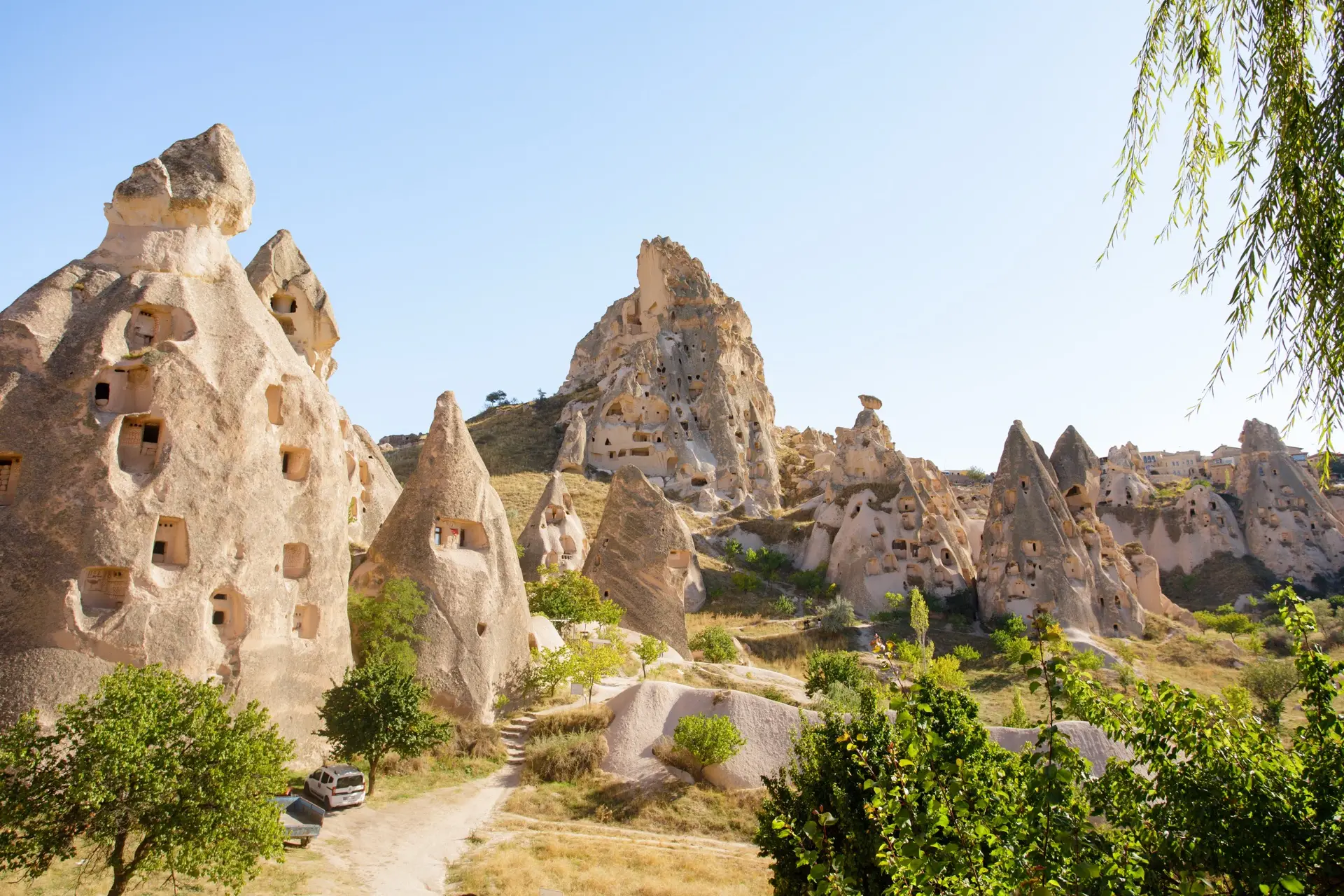
Uchisar rock village in shoulder-season light. Mid-April to mid-June and mid-September to early November are the windows where valley walks and outdoor Cappadocia days work without either heat or ice.
Best Time to Visit Istanbul
Istanbul is comfortable nine months of the year. Sweet spot: April through early June and mid-September through October. Avoid mid-July to mid-August (humidity above 70%, Old City queues painful) and December–January only if your family enjoys cold-weather sightseeing. Bosphorus boat tours run year-round but are most pleasant in shoulder months. See our Istanbul attractions guide for neighbourhood-by-neighbourhood recommendations.
What families come back talking about. The Istanbul moments that land with children are the Bosphorus boat ride at sunset, the Spice Bazaar with a school-age child who has just learned to bargain, and a guided Topkapı morning where the kid-track explanation lands. These work in any shoulder month. The single Istanbul activity that breaks under midsummer humidity is the long Sultanahmet walking morning. Stone-radiated heat at 70%+ humidity is the ingredient most likely to end a family day early.
Best Time to Visit Pamukkale & Ephesus
Both UNESCO sites (Hierapolis-Pamukkale and Ephesus) sit in inland western Anatolia and roast in summer. The white travertine of Pamukkale reflects sun like a snowfield — barefoot walking at noon in July is painful underfoot. Best months: April, May, late September, October. We typically combine these two in a single 2-day Aegean leg. Full details in our Pamukkale travel guide and Ephesus travel guide.
The Aegean 2-day rhythm. The 2-day version opens with an early Ephesus morning (gates at 08:00, marble Curetes Street still cool), a long Aegean lunch in Selçuk or Şirince village, and an overnight in Pamukkale. Day 2 is the early travertine pool walk (07:30 start, before tour buses arrive), Hierapolis tombs, then either Aphrodisias for older children or a Karahayit thermal pool morning for under-10s. Compressing both sites into one day is the single most common Aegean planning mistake. The 8-Day Private Turkey Tour is built around this 2-day rhythm.
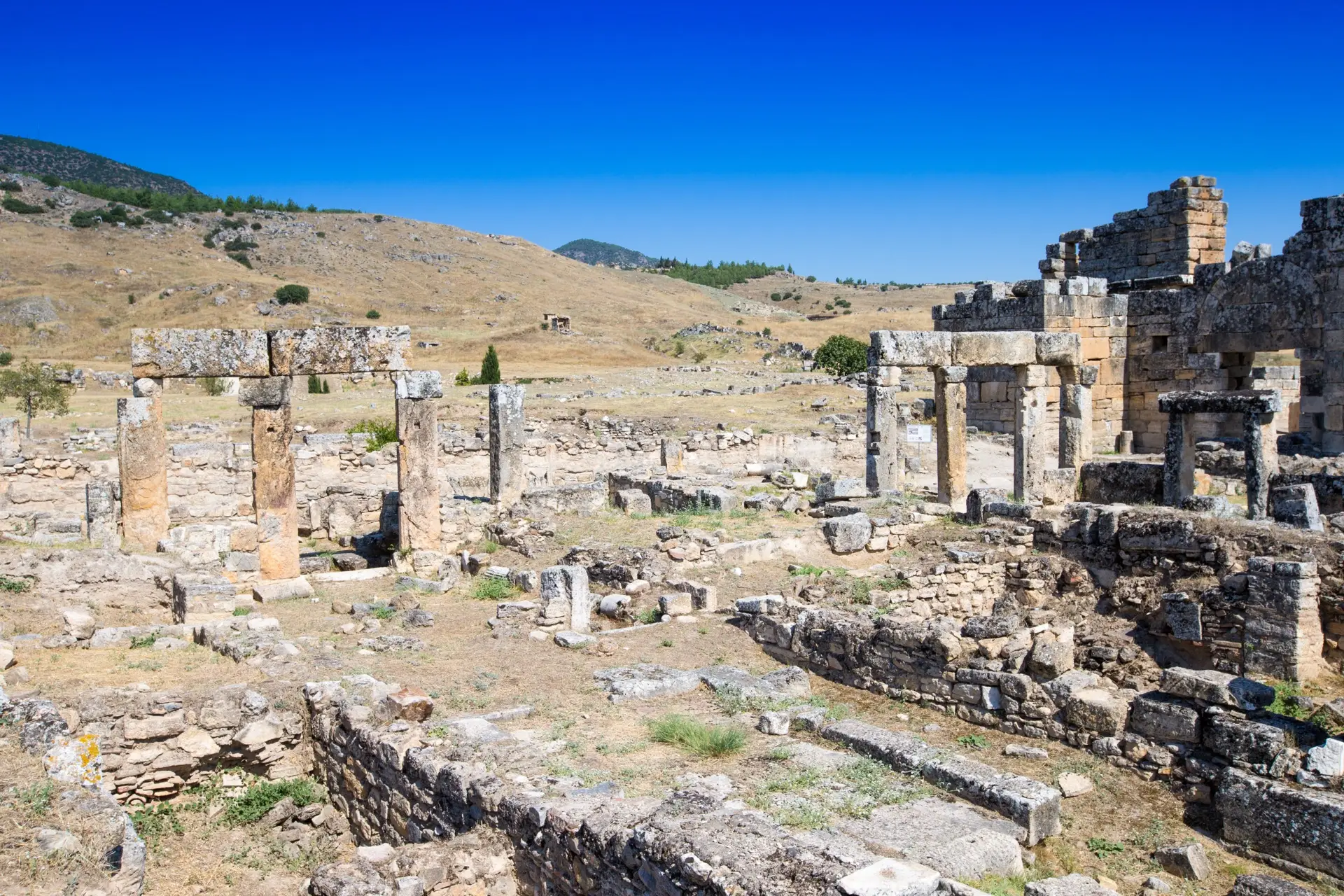
Hierapolis sits on an open plateau with almost no shade. In July and August the stone and the travertine hold heat all day — which is why the Aegean leg belongs in April to early June, or September to October.
Best Time to Visit Antalya & the Turkish Riviera
Antalya is the exception — its Mediterranean climate makes it the one Turkish region where summer works (warm sea, long daylight, family-resort infrastructure). May, June and September are ideal. July–August work for beach-resort families willing to limit midday outdoor time. Our Antalya travel guide covers family resorts, Kaleiçi Old Town, and day-trip options to Aspendos and Perge.
Antalya as the recovery leg. Across our 10-day and 14-day itineraries, Antalya is scheduled after Cappadocia rather than before. Cappadocia hot air balloon mornings start at 04:00 and the underground city plus valley walk days are physically demanding for under-12s. Two beach-resort days in Belek, Kemer or Lara are the rest the week needs. Two low-effort beach days at the end are what keep the last stretch of a 10-day route workable.
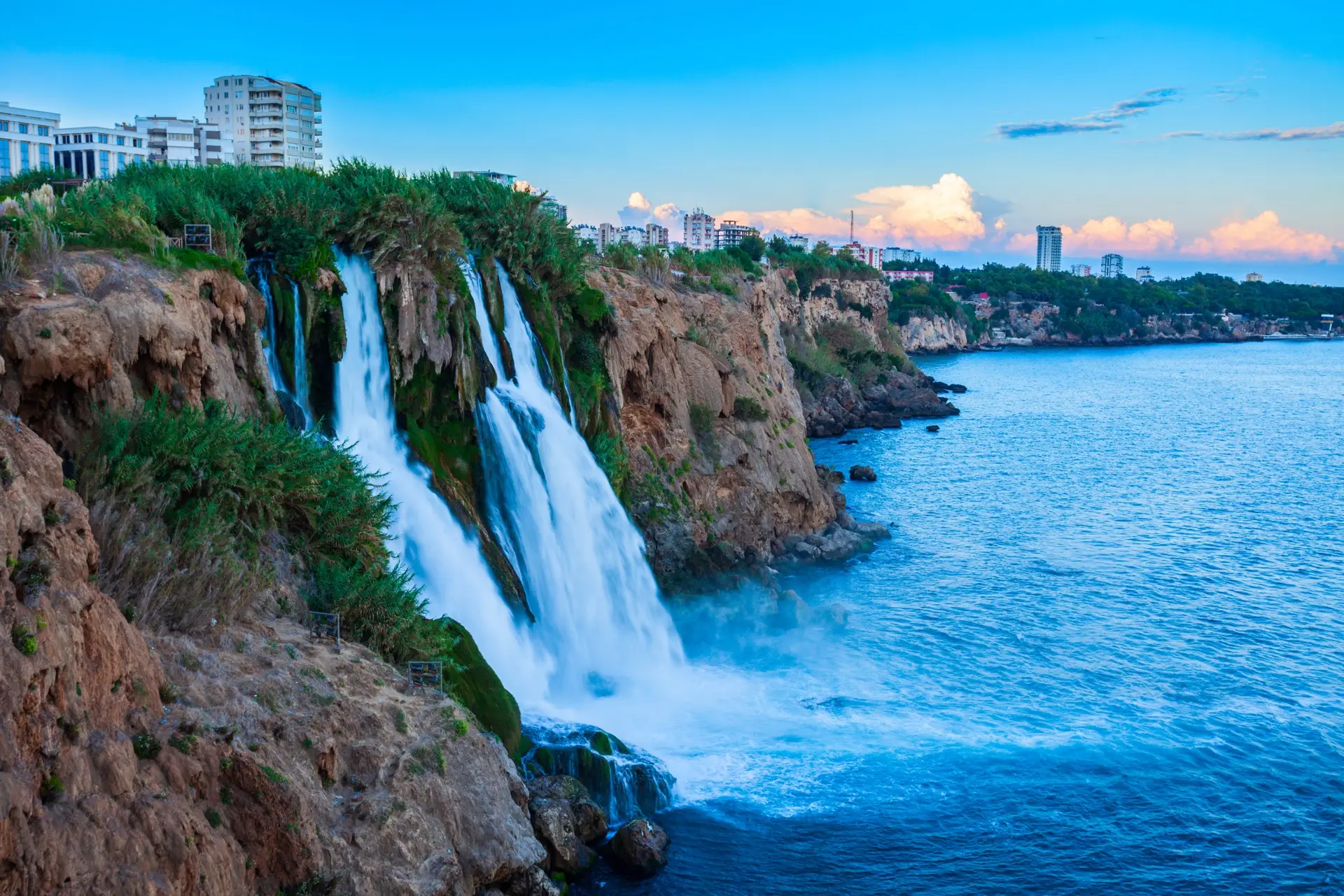
The Duden falls on the Antalya coast. Antalya is the one region where summer holds up, and it is scheduled after Cappadocia so the low-effort beach days land at the end of the trip.
Destination × Month Comfort Matrix
The matrix pairs all four destinations with all twelve months. Sweet spot = best conditions, Workable = viable with route adjustments, Avoid = not recommended for that destination. Ratings combine daytime temperature, hot air balloon-fly probability (Cappadocia row), crowd density, and how much walking each destination asks of a child on a full touring day.
Month
Istanbul
Cappadocia
Pamukkale / Ephesus
Antalya / Riviera
January
Workable (cold, atmospheric)
Avoid (snow, hot air balloon ~50%)
Avoid (cold + grey)
Workable (mild, resorts closed)
February
Workable
Avoid
Avoid
Workable
March
Sweet spot (Istanbul-led trips)
Workable (improving)
Workable
Workable (warming)
April
Sweet spot (tulips)
Sweet spot
Sweet spot
Sweet spot
May
Sweet spot
Sweet spot (peak)
Sweet spot
Sweet spot
June
Workable (warm)
Sweet spot first half, workable late
Workable
Sweet spot
July
Workable (hot + humid)
Avoid (35°C+ inland)
Avoid (travertine roasting)
Workable (sea breeze)
August
Avoid
Avoid (peak crowds + heat)
Avoid
Workable (beach-only)
September
Sweet spot (late month)
Sweet spot
Sweet spot (late month)
Sweet spot
October
Sweet spot
Sweet spot (peak)
Sweet spot
Sweet spot (first half)
November
Workable (cooling)
Workable (first half)
Workable
Workable (cool, resorts winding down)
December
Workable (festive)
Avoid (winter conditions)
Avoid (cold)
Avoid (resorts closed)
Ratings reflect family-with-children comfort across all four destinations simultaneously. Single-destination trips can extend the workable window — a December Istanbul-only trip works well; a December Cappadocia hot air balloon-priority trip is not.
How to read the matrix: If your itinerary includes all four destinations, only months with sweet spot across the row deliver a balanced trip — April, May, September, October. If your itinerary is Cappadocia-priority, late April through May and late September through October are the unconditional best. Coastal-priority can extend into June and early September. Istanbul-only works year-round with cold-weather expectations in December–February.
Month-by-Month Breakdown
January — The coldest month. Istanbul runs 9.6°C by day and 4.2°C at night, with 16 wet days. Antalya holds 15°C. Hot air balloons fly on 50–60% of Cappadocia mornings. Eight of nine Turkey Family Tours private routes run. The 11-day circuit by road is not advised. See our Turkey in January guide.
February — Istanbul’s snowiest month, at 3.5 snow days. The city runs 10.2°C by day and 4.2°C at night, with about 14 wet days, and gains 67 minutes of daylight over the month. Antalya holds 15.6°C with 148 mm of rain. Hot air balloons fly on 45–55% of Cappadocia mornings. See our Turkey in February guide.
March — Transition month. Istanbul tulip preparations underway, late month sees mild sunshine. Cappadocia mornings still cold. Good for Istanbul-priority itineraries matching early school breaks. Istanbul averages 12.4 °C and Antalya 18 °C with 6.7 hours of sun; our guide to March in Turkey builds a route around both.
April — Spring in full force. Tulip Festival in Istanbul (early–mid April), warming temperatures, flowering Cappadocia valleys. Hot air balloon fly-rate rises to ~80%. Our highest-recommended spring month. See how April splits at the 15th before fixing tulip-festival or Cappadocia dates, and what the month costs per adult.
May — Peak spring. Long daylight (sunrise 05:45, sunset 20:00), all sites comfortable, hot air balloons flying on 85–92% of mornings. Best month overall — week-by-week detail in our Turkey in May private tour guide.
June — The Ephesus area averages 33.5 °C by day while Cappadocia stays at 24.9 °C, so the route order matters. Three rules for ordering a June route put the hot valleys early and the Aegean beach late.
July — Hot inland (35°C+ Cappadocia/Pamukkale). Coastal and cruise itineraries recommended. Crowds heavy. For region-by-region heat management, see our Turkey in July private tour guide.
August — Hottest, most crowded, most expensive. Avoid for inland trips. For families locked into August dates we default to a coastal-heavy configuration: the 8-day Istanbul, Cappadocia, Pamukkale and Ephesus route works in August because the sea breeze keeps coastal afternoons tolerable. See our Turkey in August guide for timing details.
September — Sweet spot returns. First week still summery, second half drops 5°C. Hot air balloon fly-rate rises to ~92%. Strong window for school-break departures across multiple countries. For full September detail see our Turkey in September private tour guide.
October — Best autumn month. Golden colours, warm days, cool nights. Photography paradise. Sea still swimmable on the south coast in the first half. For full October detail see our Turkey in October private tour guide.
November — First two weeks pleasant; second half rain begins in Istanbul. Cappadocia clear and cool. Rates come back to shoulder level; hot air balloon fly-rate drops to ~75%. Istanbul runs 16.1°C by day and the month splits at the 15th. For full November detail see our Turkey in November private tour guide.
December — Cold but festive. Istanbul illuminated for New Year. Cappadocia snow possible. Quiet outside Western New Year week. Hot air balloon fly-rate ~50%. Istanbul averages 11.8°C by day. For full December detail see our December winter itinerary guide.
June is the month most families end up weighing against May. The first three weeks hold inland heat at a workable level, Cappadocia hot air balloons fly on 90–95% of mornings, and the Aegean opens properly for swimming at 21–23°C. The second half runs closer to July, when the Ephesus area reaches 36.4 °C by day. Our guide on whether June is a good time to visit Turkey answers it region by region.
July is the opposite trade. Inland Cappadocia and Pamukkale run 35°C and above, so the touring day is split around the middle hours, while the Mediterranean reaches its warmest of the year at 27–28°C and hot air balloons fly on about 95% of mornings. If school dates lock you into it, our July private tour breakdown covers heat management region by region and the booking window peak-season dates need.
Sea Temperature and the Turkish Swimming Season
The Mediterranean climbs from 17–22 °C in May to 28 °C in August, and air temperature and sea temperature do not turn on the same date. Istanbul can be pleasant in April while the Mediterranean is still too cold for a child to stay in, and the coast is often still swimmable in the middle of October after the inland nights have turned cold. If swimming is part of what your family wants from the trip, the water is the number to plan around. Current readings by coast are published by the Turkish State Meteorological Service.
Month
Mediterranean (Antalya, Belek, Side)
Aegean (Bodrum, Çeşme, Fethiye)
What that means
May
17–22 °C
17–20 °C
Opens mid-month. Wading and short swims; cold for under-6s
June
23–25 °C
21–23 °C
First genuinely warm month for all ages
July
27–28 °C
25–27 °C
Warm enough for all ages, hottest air of the year with it
August
28 °C
25–26 °C
Peak water, peak crowds, peak rates
September
26–27 °C
24–25 °C
The best combination of the year: warm sea, easier air
October
23–24 °C to about the 20th, then 21–22
22–23 °C early, 20–21 by mid-month
Mediterranean holds; Aegean cools faster
November
21–23 °C
–
Water still mild, but the season is over for other reasons
December–April
Mid to high teens
Mid to high teens
Not a swimming season on either coast
Coastal sea-surface bands by month. The Mediterranean coast runs one to three degrees warmer than the Aegean through the whole season and holds its warmth two to three weeks longer in autumn.
When the Water Is Warm Enough for Young Children
Adults will swim happily from about 21 °C. Children under six usually will not stay in below 24 °C, which moves the practical family swimming window to mid-June through mid-October on the Mediterranean and roughly two weeks shorter at each end on the Aegean. Between mid-May and mid-June the water suits paddling and short swims rather than an afternoon in the sea, so those trips are planned with a hotel pool as the main water and the sea as the extra.
The Two Ends of the Season
The opening end is set by the water. May starts cold and finishes usable, and the second half of the month is worth one to two degrees over the first. The closing end is not set by the water at all: November still reads 21–23 °C on the Mediterranean, but the afternoon is short, the wind picks up, and many resort hotels close for the season. That is why a swimming-led trip is planned to finish by late October, while a culture-led trip runs well past it.
Daylight Hours and How Much a Touring Day Holds
Istanbul runs about 15 hours of daylight at midsummer and just over 9 hours at the winter solstice — a six-hour swing that decides how much a touring day holds. Antalya moves less, from roughly 14 and a half hours down to 9 and a half. It is the real reason a summer itinerary and a winter itinerary of the same length are not the same trip.
The 15-Hour Summer Day
From June to August the light is not the constraint, the heat is. The usable day is split: sites from first light to about 11:00, a long shaded break, then everything reopens from around 16:30. The reward is the evening. Dinner in Istanbul at 19:30 still runs in full daylight, an Aspendos or Ephesus late entry catches low golden light, and children who slept through the hot afternoon are awake for it. A guide who sets the day around that split gets two proper touring blocks out of it rather than one exhausted one.
The 9-Hour Winter Day
From December to February the light itself is the constraint. Museums and archaeological sites run a shorter winter timetable and last entry moves earlier in the afternoon — current hours for state museums are published on the Ministry of Culture and Tourism’s official museum portal. In practice a winter day holds two major sites, not four, and long transfers eat the light rather than the heat. It is a real argument for a shorter, city-led winter route: five days in Istanbul and Cappadocia works, while the same five days spread across four regions does not.
Cappadocia Hot Air Balloons — Best Months
Cappadocia’s hot air balloon flights launch on roughly 90% of mornings in May and October, peak at 93–95% from June through August, and fall to 50–55% in deep winter. Raw fly rate is highest in midsummer — but May and October pair almost the same launch certainty with mild sunrise temperatures and a fraction of the crowds. The most useful planning metric is the cumulative two-morning probability: book at least two consecutive Cappadocia mornings and the chance you get at least one successful flight rises sharply. The table below tracks both. The decision to fly is the operator’s on the morning, under the Turkish Directorate General of Civil Aviation (SHGM).
Month
Single-morning fly rate
Two-morning cumulative
Notes
January
~50%
~75%
Snow + icy winds. Plan two or three mornings.
February
~55%
~80%
Cold + wind. Plan two or three mornings.
March
~65%
~88%
Improving rapidly mid-month onward.
April
~80%
~96%
Late April excellent. Among the highest of any spring month.
May
85–92%
~99%
The year’s best balance. High launches, mild mornings.
June
90–95%
>99%
Peak reliability; earliest launches of the year (~05:15).
Autumn twin of May. Golden light, 90–95% launches.
November
~75%
~94%
First half holds well; late November rain and wind increase.
December
~50%
~75%
Icy mornings. Plan two or three mornings.
Single-morning rates are seasonal averages across the Cappadocia operators we book with. Two-morning cumulative is the probability of at least one successful flight when two consecutive sunrise slots are booked. Regulating authority: SHGM.
When Hot Air Balloons Fly Most Reliably
The unconditional best windows for hot air balloon flights are late April through late May and mid-September through late October. Both sit on the stable side of seasonal transitions. Surface winds settle below the 20 km/h SHGM ceiling. Sunrise temperatures hover at 4–10°C (cold but tolerable in layers). Both windows sit in the 85–95% single-morning launch band in the table above. For full operator selection, weather protocols, and what to expect from the 04:00 pickup, read our complete Cappadocia hot air balloon guide.
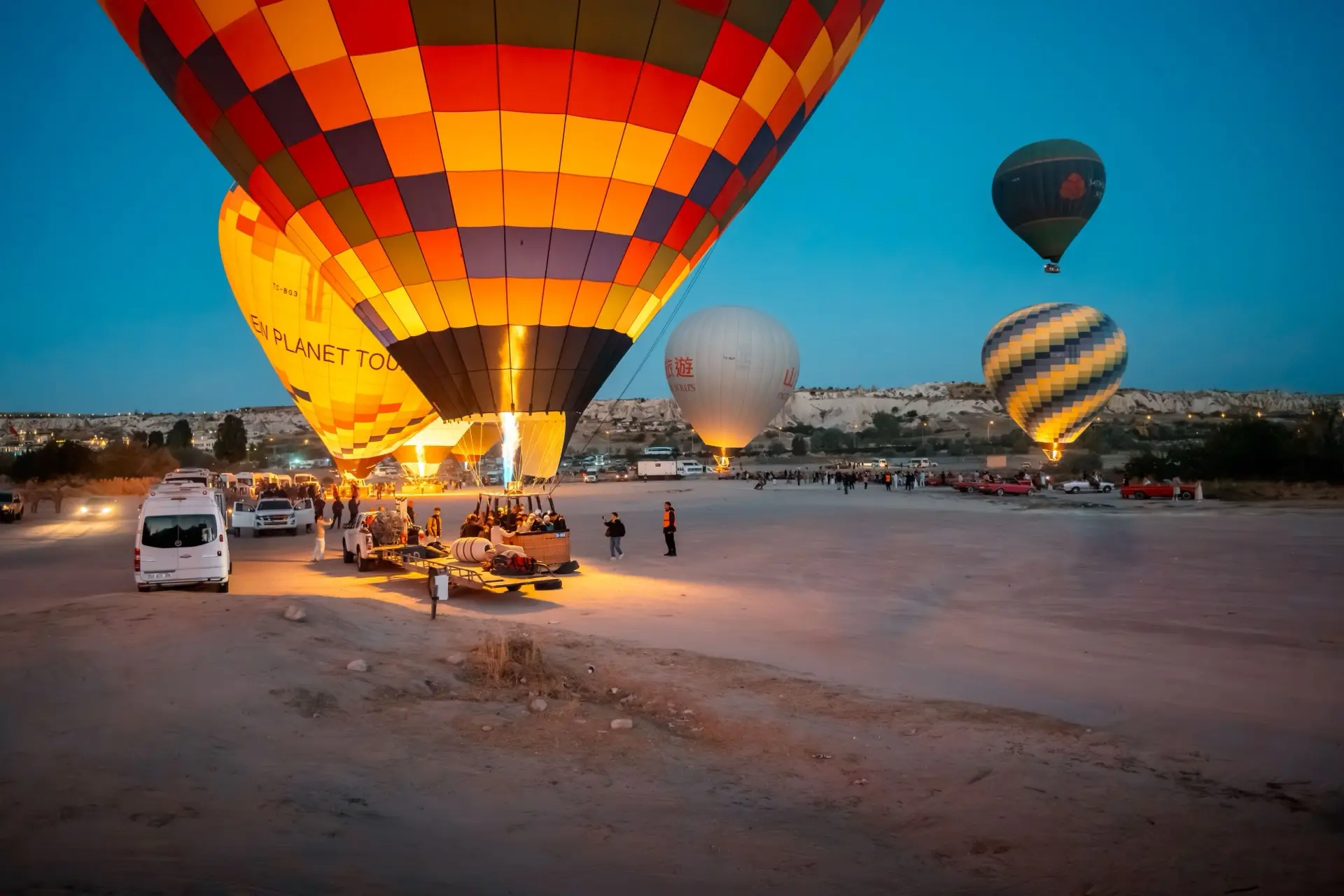
The launch field before sunrise. Pickup is around 04:00 and families are usually back at the hotel by 08:30, which is why the hot air balloon morning is paired with a slow afternoon rather than a second site.
When to Avoid (or Build Buffer Around)
Midwinter (mid-December through February) and peak summer (mid-July through August) carry the highest cancellation risk: winter from wind and ice, summer from thermal turbulence above the convective layer. Plan two or three Cappadocia mornings in winter rather than one: a second morning lifts the cumulative chance of flying from ~50% to ~75%. In peak summer the risk is thermal turbulence rather than wind, and two mornings is usually enough. If the hot air balloon flight is a centrepiece, treat single-morning winter bookings as a bonus rather than a plan.
Booking Lead Time for Hot Air Balloon Mornings
Cappadocia hot air balloon operators with the strongest safety record sell their May, October, and September slots 4–6 months ahead. Peak summer (June–August) sells almost as early — European families dominate that demand. Off-peak months (November, February, March) accept 6–8 week lead times. Lock hot air balloon slots when you confirm your flights, not when you arrive in Istanbul. See how to choose a Cappadocia hot air balloon operator for the backup-morning protocol.
When NOT to Visit Turkey
Two windows cause most of the planning trouble: late July to mid-August for inland itineraries, and January–February for Cappadocia hot air balloon-priority trips. Both windows can still produce strong trips when scoped correctly.
Late July to Mid-August (Inland Itineraries)
If your itinerary includes Cappadocia, Pamukkale, or extended Istanbul Old City walking days, late July to mid-August is the hardest window for families with school-aged children. Heat, crowds, and pricing all peak simultaneously. Coastal-only trips (Antalya, Bodrum) remain viable: see the coast-weighted 8-day itinerary, or the July heat-management breakdown for region-by-region detail. Mid-August is the busiest stretch of the summer, and peak-August crowd planning covers the coastal-only alternative in more depth.
January–February (Cappadocia Hot Air Balloon Priority)
If the hot air balloon flight is the centrepiece of your trip, midwinter is the highest-cancellation window. Plan for 3 nights minimum or shift dates. Shifting the dates barely moves the odds: December launches at roughly 50%, January the same, February about 55%. The lever is nights, not dates — a third Cappadocia morning lifts the cumulative chance of flying to about 88%. See December hot air balloon odds for how a two-morning Cappadocia stay performs that month. For an Istanbul-only winter alternative — atmospheric Old City, festive Galata, Bosphorus cold-weather tea-house culture — our private Istanbul Old City day anchors a strong winter trip without the Cappadocia hot air balloon risk.
What If You Can Only Travel in These Windows?
School calendars and work commitments do not always cooperate. The patterns that produce a satisfying trip in constrained windows:
July–August inland fallback — go coastal-heavy. Replace the Cappadocia leg with an extended Aegean coast loop (Bodrum, Çeşme, or Datça). Sea breeze brings real evenings down to 22–24°C. Schedule sightseeing for 07:00–11:00 and 17:00–19:00, beach in between.
July–August Istanbul fallback — go early. Sultanahmet at 08:00 is workable. Reserved-time entries at Hagia Sophia and Topkapı (purchased ahead) save 40–60 minutes of queue exposure.
Jan–Feb Cappadocia fallback — extend or substitute. Either book 3 full mornings (lifts cumulative fly probability to ~88%) or substitute the Cappadocia leg with extended Istanbul plus a short Bursa or Edirne day-trip.
Jan–Feb Istanbul-only alternative — embrace the cold. Hammam afternoons, Bosphorus tea-house mornings, fewer queues, dramatic empty mosque interiors. See our Istanbul travel guide winter section for cold-weather walking routes.
For any adapted scenario, share your fixed dates and we will build the itinerary version that built around what your family most wants from the trip.
When to Book Your Turkey Tour
Book private Turkey tours 3–4 months ahead for shoulder-season trips (April–May, September–October). For July, August and the last week of December, allow 4–6 months. Cappadocia cave hotels and hot air balloon operators sell out first. Last-minute bookings (under 30 days) are sometimes possible in shoulder season. They do lose access to the best cave-hotel rooms and preferred hot air balloon operators.
Booking Lead Times by Season
Autumn shoulder (Sep–Oct): Book 3–4 months ahead — cave hotels and hot air balloon slots fill first.
Spring shoulder (Apr–May): Book 3–4 months ahead for the best cave hotels.
Peak summer (Jul–Aug): 4–6 months ahead, especially for the coast.
Year-end (Nov–Dec): 4–5 months for festive Istanbul hotels.
Off-peak (Jan–Feb, mid-Nov): 4–6 weeks is usually enough.
Pricing Patterns
Private guided tour pricing follows the same demand curve, because hotel and domestic-flight costs sit inside the quote. The 10-day Istanbul–Cappadocia–Antalya itinerary starts from USD 3,490 pp, and in May or October that figure buys a higher hotel tier than it does in mid-June through August, when coastal room rates peak. Booking early in shoulder season delivers the best combination of conditions and availability. See our full Turkey private tour packages for current pricing. With the season and booking window settled, our planning guide shows how to plan the rest of the trip step by step — route, flights, budget and paperwork in sequence.
Compare Our Private Turkey Tour Packages
Our private itineraries run 1 to 14 days, from USD 190 to USD 4,450 per person — here is how each package matches a school-holiday window. Every one is private: a dedicated licensed local guide, a private vehicle with driver, and your family’s own pace. All are operated under TURSAB licence 13538. The matrix below pairs each package with its best months, age sweet spot, and USD starting band. The numbers behind those bands sit in our guide to Turkey trip prices by tour length, which runs from USD 190 for a single guided day to USD 4,450 per person for a 14-day private circuit.
All packages are private — your family only, a dedicated licensed local guide and a private vehicle with driver — operated under TURSAB licence 13538. Prices are per person on a two-person basis, and the per-person figure falls as the group grows. Final pricing depends on season, accommodation tier (Comfort / Premium), and any optional add-ons.
Short Premium Loops (5 Days)
Two five-day packages suit families with a tight school-holiday window, or first-time visitors who want a focused, low-fatigue trip. The 5-Day Private Istanbul Tour Package (from USD 1,435 pp) stays in the city. The 5-Day Istanbul & Cappadocia Tour (from USD 1,690 pp) trades two Istanbul days for the Cappadocia hot air balloon morning. Choose the Istanbul-only version only if Cappadocia is not on your list.
Classic Core (7–10 Days)
Three itineraries cover the classic circuit. The 7-day private Turkey tour (from USD 2,450 pp) pairs Istanbul and Cappadocia with Ephesus, and is the shortest route that still reaches the Aegean. The 8-day private Turkey tour (from USD 2,790 pp) adds the Pamukkale travertines. The 10-day private Turkey tour (from USD 3,490 pp) picks up Antalya for a Mediterranean coastal leg — best paired with school-break windows that allow a small leave extension. All three suit children aged 8 and up.
Grand Circuit (14 Days)
The 14-Day Private Turkey Tour (from USD 4,450 pp) is our longest itinerary, built for families with a full summer break or a long year-end window. It links Istanbul, Gallipoli and Troy, Ephesus and Pamukkale, the Mediterranean coast and Cappadocia in one loop, so no region is reduced to a stopover. Best for children 8+ (sustained pace), and best in the April–May or September–October shoulder windows where weather supports every leg. To request a quote on any package, share your dates and we will draft an itinerary within 24 hours.
FAQ — Best Time to Visit Turkey
May and October are the best months to visit Turkey. Both sit in the shoulder season, with 18–25°C days and ruins you can walk at midday. Cappadocia hot air balloon mornings fly around 90% of the time in those two months, and April and September run a close second. Summer is hot inland, but it is the most reliable flying season and the best stretch for the coast. Winter is the quietest, with the shortest days and the fewest flying mornings. For a first private trip covering Istanbul, Cappadocia and the Aegean, we plan around one of the two shoulder windows. The month-by-month table above breaks down all twelve.
The cheapest time to visit Turkey is winter, November to March. It is the off-peak stretch for hotels and internal flights, and a private itinerary is quoted on off-peak rather than peak-summer rates. Cappadocia cave hotels still have family rooms a few weeks out rather than three months, so you choose the room instead of taking what is left. Istanbul carries the season on its own, because museums, bazaars and the Bosphorus do not depend on weather. Daytime highs sit at 3–10°C, and a guided Old City day starts at USD 190. What you give up is the coast: no swimming, rain on the Aegean, and some smaller sites on reduced hours. Our Turkey tour cost guide sets out what a private winter itinerary costs.
A private Turkey tour runs from USD 190 for a guided Istanbul day. The 14-day circuit is USD 4,450 per person. Most families land in the middle: the seven-day Istanbul, Cappadocia and Ephesus route at USD 2,450, and the eight-day version that adds Pamukkale at USD 2,790. Those figures are per person on a two-person basis, and they come down as the group grows. Children aged 4–6 pay 40% less and under-3s 70% less. From age 7 the adult rate applies. Every price covers private guiding and a private vehicle with driver, and the multi-day routes also cover hotels and the domestic flights the itinerary needs. The compare table above sets the headline lengths side by side.
Cappadocia hot air balloons launch at sunrise every day of the year. Whether they fly depends on ground-level wind and visibility that morning. May and October are the strongest months at around 90%, with the wider spring average closer to 80% and autumn to 85%. From June to August the rate runs 93–95%, the most reliable stretch of the year. December and January are the weakest at roughly 50%. That is why a winter or early-spring Cappadocia leg is planned with two or three possible mornings rather than one. Pickup is near 04:00, and a grounded morning can usually be retried the next day. See what a hot air balloon morning involves for operators, baskets and flying with children.
Not too hot to travel, but hot enough that the plan has to change. Inland Cappadocia and Ephesus reach 30–38°C in the afternoon. Ruins are walked at dawn, and the middle of the day goes to a shaded lunch, a museum or the hotel pool. The coast is the compensation, with a sea breeze in Antalya and the Aegean and water at 25–28°C. These are also the most reliable hot air balloon months, flying 93–95% of mornings. For many families they are the only block long enough for a full circuit. If you are locked into summer dates, read what a July itinerary looks like and how August differs before fixing the route.
Five days covers Istanbul properly, or Istanbul plus a short Cappadocia run, and nothing beyond that. Seven days is the shortest first-trip length that still reaches the Aegean: Istanbul, Cappadocia and Ephesus at USD 2,450 per person. Eight days adds Pamukkale, and the 10-day Gallipoli and Troy route brings in the Dardanelles without shortening anything else. Two weeks is the version with no travel-day compromises, at USD 4,450. Season shifts the answer. In July and August a day loses its middle hours to the heat, so the same route wants an extra night. Every length sits side by side on our tour packages page.
For the spring and autumn shoulder weeks, 3–4 months is the practical lead time. For July, August and the last week of December, allow 4–6 months. The constraint is rarely flights. It is the small cave hotels in Göreme and Uçhisar, which hold only a handful of family rooms each. Cappadocia hot air balloon slots for those weeks are sold four to six months ahead by the operators with the strongest safety records. Winter dates can come together in two or three weeks if the route is flexible. Whatever the season, your quote is fixed within 24 hours, and the 25% deposit is what holds the hotels. Our step-by-step planning guide walks through the order.
A private trip is confirmed with a 25% deposit. The remaining 75% is paid on arrival in Turkey, in cash or by card. The deposit is non-refundable, and outside the final week it is the only amount at risk. A cancellation inside 7 days of the start date is charged in full, because hotels and internal flights are committed by then. Cancellations must reach us in writing. Date or route changes before the final week are handled case by case. Every enquiry is answered within 24 hours with a fixed quote. Turkey Family Tours is a TURSAB-licensed operator, licence 13538. Start a request on our plan my trip page.
Often, but not perfectly. Turkey’s two strongest windows are April to May and September to October. Both overlap with spring half-terms, Easter and autumn term breaks, which is why those weeks fill first. The long summer holiday lands on the hottest inland stretch. Dawn starts make it work, but it is not the best version of the trip. A full circuit needs 8–14 days, so for some families the long break is the only window that fits. If July or August is your only free block, the route is reordered rather than shortened, with Cappadocia early and the coast at the end. Every private Turkey tour we run is built around your dates.
Yes, for a particular kind of trip. Istanbul is at its best without queues at Hagia Sophia, Topkapı and the Grand Bazaar. Cappadocia under snow is the rarest version of that landscape, and hot air balloons still fly on roughly half of mornings. Hotels and guide dates are wide open. The trade-offs are real: daylight of just over 9 hours in late December, rain on the Aegean and Mediterranean, no swimming, and some coastal sites on winter timetables. Winter suits an Istanbul-and-Cappadocia route of about five days. Save Ephesus, Pamukkale and the coast for a shoulder-season visit. Turkey Family Tours plans January trips as Istanbul-led routes rather than full circuits.
Plan Your Private Turkey Trip
Tell us your dates, group size and interests. Turkey Family Tours (TURSAB-licensed, licence 13538) replies within 24 hours with a draft itinerary tailored to your school-holiday window and weather priorities. 25% deposit secures dates; the balance is paid on arrival in Turkey.
Turkey in November splits in two: the south coast still reaches 21.4 °C by day while Cappadocia falls to 2.5 °C at night. Hot air balloons fly on about 75% of mornings, daylight runs under ten hours, and private land arrangements start at USD 1,435 per adult.
Three nights in Istanbul, one in a Göreme cave hotel, two 75-minute flights: the 5 day Turkey itinerary day by day — what it costs, when to go, and where to bend the route.
How to choose a Cappadocia cave hotel: Göreme vs Uçhisar vs Ürgüp compared, room categories from under USD 100 to USD 250+ terrace suites, which terraces face the hot air balloon launch valleys, and when to book for a cliff-face room.
A first family trip to Turkey runs five to fourteen days across five regions: Istanbul, Cappadocia, Ephesus, Pamukkale and the Mediterranean coast. Private tours run from USD 190 for a day in Istanbul to USD 4,450 for fourteen days.
Galata Tower entry is €30 (about USD 33), open daily, ticket desk closes 18:14. Queue timings, the lift that stops at floor seven, and what the balcony shows.
How many days in Cappadocia? Two nights covers the Göreme valleys, an underground city and the sunrise hot air balloon; one day works from Istanbul but skips the balloon.
A 10 day Turkey itinerary day by day: Istanbul, Cappadocia cave-hotel nights, Pamukkale, Ephesus, Troy and Gallipoli — nightly stops, per-person costs and the two-flight route that makes it work.
✦ Tailor-Made
Let's Plan Your Private Turkey Trip
Tell us about your family — we reply within 24 hours.
 English
 Dutch
Dutch Japanese
 Korean
 Chinese