30 Things to Do in Istanbul by Area: Six Walks, 13 Free, and What a Private Day Costs
Quick Answer: The thirty things to do in Istanbul in this guide fall into six walkable clusters rather than one long list. Sultanahmet holds eight of them, with Hagia Sophia, the Blue Mosque, Topkapı Palace, the Basilica Cistern and the Hippodrome all inside a fifteen-minute walk. The bazaar quarter adds four, Galata and Beyoğlu five, the Bosphorus four, the Asian side three, and six sit beyond the centre. Thirteen of the thirty are free to enter. Three days covers eight to ten of them: two old-city mornings, one bazaar morning and one afternoon on the water. Five of the thirty have a weekly closing day. Topkapı Palace closes on Tuesday, and the working mosques shut to visitors around each of the five daily prayers. Turkey Family Tours, TURSAB-licensed (no 13538), runs a private Istanbul tour from USD 190 for a guided day to USD 1,435 for five days and four nights with hotels, entries and transfers included. Get a Private Quote →
This guide lists thirty things to do in Istanbul with how long each one takes, whether it is free or ticketed, and the day it is closed — the three details that decide whether a morning works. The stops are grouped by neighbourhood rather than ranked, because in a city split by water and hills the useful question is not which sight is best but which three fit into the same walk. It reflects what works for the families we guide through the city, and it carries the numbers we plan against: three to five nights for a first visit, and from USD 190 for a guided day.
By Fatih — Founder & Tour Director, Turkey Family Tours · TURSAB licence 13538 · Last updated: July 2026
Things to Do in Istanbul — Table of Contents show / hide
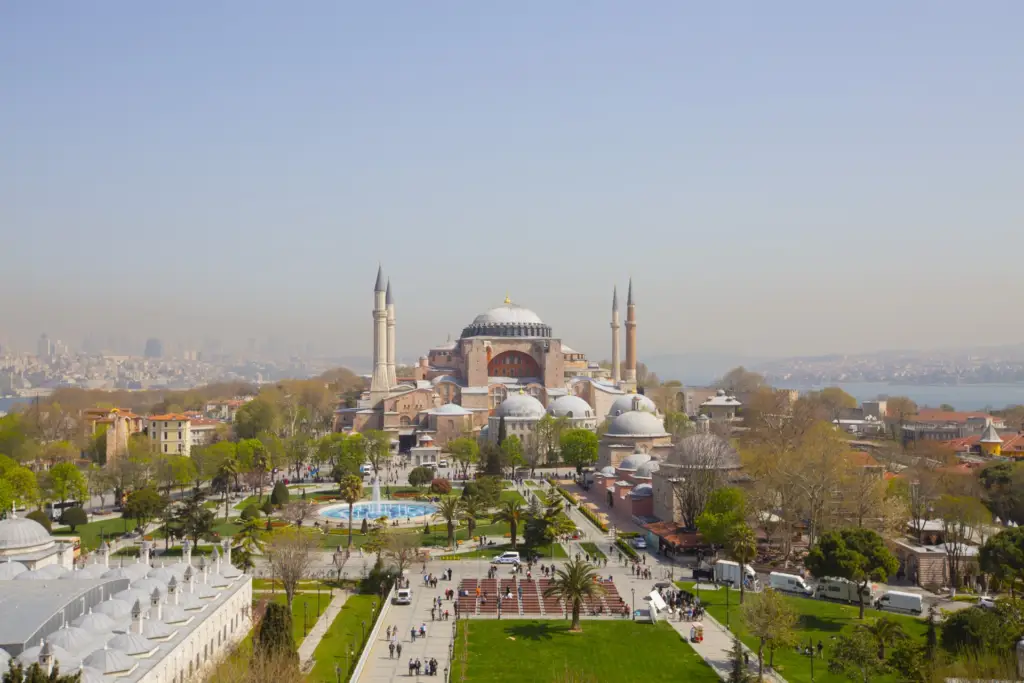
Eight of the thirty stops sit inside this frame — which is why a family walks the old city over two mornings rather than one day.
The table below is the whole guide in one screen: every stop, the cluster it belongs to, how long it honestly takes with a family, and whether it is free or ticketed. Thirteen of the thirty are free, which matters when four or five tickets are bought at every gate rather than one. Six more sit on a single ministry museum card, the one purchase that changes the arithmetic of a week here. The section on the card works out when it pays for a family and when it does not, and names the four big stops it leaves out.
Entry prices in Istanbul are reset by the Ministry of Culture and Tourism and by the independent operators more than once a year, and the euro-denominated tickets move with them. Rather than print figures that go stale before you arrive, the table marks what kind of purchase each stop is. The ticketed ones link through to the official page that holds the live number. A family can then price its own morning against today’s tariff rather than last year’s.
#
Stop
Cluster
How long
Entry
1
Hagia Sophia
Sultanahmet
1 hr
Ticketed — gallery route, not on the pass
2
Blue Mosque
Sultanahmet
30 min
Free
3
Topkapı Palace + Harem
Sultanahmet
2–3 hrs
Ticketed — Harem extra — pass
4
Basilica Cistern
Sultanahmet
45 min
Ticketed — municipal, not on the pass
5
Hippodrome and obelisk
Sultanahmet
20 min
Free
6
Turkish and Islamic Arts Museum
Sultanahmet
1 hr
Ticketed — pass
7
Istanbul Archaeological Museums
Sultanahmet
1.5 hrs
Ticketed — pass
8
Gülhane Park
Sultanahmet
45 min
Free
9
Grand Bazaar
Bazaar quarter
1–2 hrs
Free
10
Spice Bazaar
Bazaar quarter
45 min
Free
11
Süleymaniye Mosque and terrace
Bazaar quarter
45 min
Free
12
Rüstem Paşa Mosque
Bazaar quarter
15 min
Free
13
Galata Tower
Galata & Beyoğlu
60–90 min inc. queue
Ticketed — pass
14
Tünel and İstiklal
Galata & Beyoğlu
1–2 hrs
Free — funicular at card rate
15
Istanbul Modern
Galata & Beyoğlu
1 hr
Ticketed — private museum
16
Çukurcuma antique shops
Galata & Beyoğlu
1 hr
No ticket — you browse the shops
17
Galata Mevlevi House
Galata & Beyoğlu
45 min
Ticketed — pass — ceremony extra
18
Public ferry crossing
Bosphorus
20–25 min
İstanbulkart fare
19
Dolmabahçe Palace
Bosphorus
1.5–2 hrs
Ticketed — National Palaces, own card
20
Ortaköy Mosque and square
Bosphorus
45 min
Free
21
Galata Bridge
Bosphorus
15 min
Free
22
Kadıköy market streets
Asian side
2 hrs
No ticket — you will spend on food
23
Moda waterfront
Asian side
1 hr
Free
24
Maiden’s Tower from Üsküdar
Asian side
30 min shore, 1.5 hrs by boat
Shore view free — boat ticketed
25
Balat and Fener
Beyond the centre
2 hrs
Free
26
Chora (Kariye)
Beyond the centre
45 min
Mosque — mosaic floor ticketed — pass
27
Pierre Loti cable car
Beyond the centre
1 hr with tea
İstanbulkart fare
28
Princes’ Islands
Beyond the centre
Full day
Ferry fare — the day is the cost
29
Theodosian land walls
Beyond the centre
1 hr
Free
30
Miniatürk
Beyond the centre
1.5 hrs
Ticketed — municipal
Two patterns are worth reading out of that table before you start planning. The first is that the free column is not the leftovers. It holds both bazaars, the two best viewpoints, the most photographed mosque in the city and the whole of the Asian side. The second is that the times add up faster than most families expect. The eight Sultanahmet stops alone come to close to eight hours of visiting before a single coffee. That is why this guide splits them across two mornings, and why the families we guide reach the second morning fresh rather than limping through the first. If Istanbul is one leg of a longer trip, our destinations page shows what the rest of the country adds and how far each piece sits from here.
Read as time rather than as a list, the thirty stops come to close to eight hours in Sultanahmet and just over three in the bazaar quarter. Galata and Beyoğlu add five, the Bosphorus three, the Asian side three and a half, and six more sit beyond the centre before the island day is counted. That is close to twenty-nine hours of visiting. For a family that also eats, rests and travels between the stops, it is five full days rather than a long weekend, which is why the sections below group the stops instead of ranking them.
Sultanahmet and the Old City — Eight Stops
Eight of the thirty stops stand on one hill above the Sea of Marmara, inside a fifteen-minute walk of each other, and close enough that you can see the next one from the last. This is everything Byzantium and the Ottomans built to be looked at, in one place. That density is the reason most families sleep here on a first visit. It is also the reason the cluster is easy to overdo. Eight stops is two full mornings, not one day, and the families who compress it remember the queues rather than the mosaics.
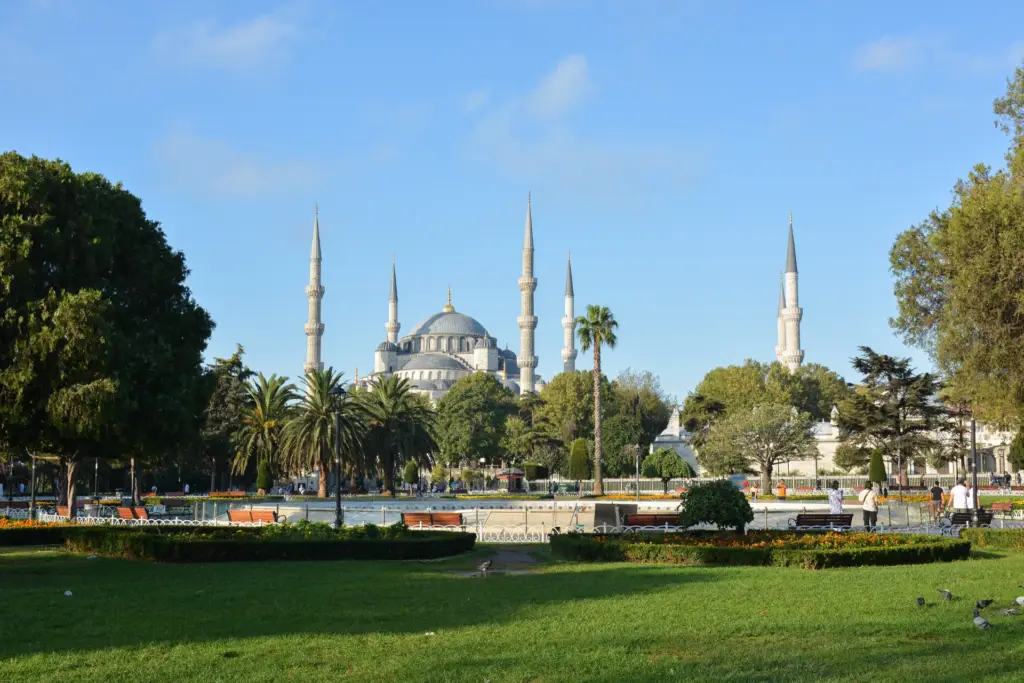
Hagia Sophia and the Blue Mosque face each other across one square — eight of the thirty stops sit within a fifteen-minute walk of it, which is a family’s whole first morning.
1. Stand Under the Hagia Sophia Dome
Nothing else in the city does what the dome does. It is fifty-five metres up and carries a ring of forty windows at its base. On a clear morning the light arrives sideways and the whole roof appears to float, which is exactly what the sixth-century builders were reaching for. Come for the engineering and stay for the layering: Byzantine mosaics above Ottoman calligraphy roundels, a Christian apse behind an Islamic prayer niche, and a marble floor worn into troughs by fourteen centuries of feet. The building works as a mosque again, which changes both the dress code a family arrives in and the route it takes through the building. Allow an hour with a family, because the gallery is reached by a long stone ramp rather than stairs and children slow down on it. We put it first on a guided day, before the ramp fills and the ascent turns into a queue. It opens daily, and the visit is the upper gallery rather than the prayer floor, on a ticket sold on its own. It is not one of the museums on the ministry card. The first hour after opening and the last before closing are the only quiet ones, and a visit can pause briefly around each of the five daily prayers. The Hagia Sophia opening hours run from 08:00 in summer and 09:00 in winter to 19:30, with the gallery closed on Friday from 12:00 to 14:00.
2. Find the İznik Tiles Inside the Blue Mosque
The name is a visitor’s invention, and it comes from what covers the upper walls: more than twenty thousand handmade İznik tiles, most of them blue and turquoise, arranged so the colour deepens as it rises. Stand under the central dome, look up, then look at the lower walls. The difference in tile quality between the two levels is visible, and it tells you where the money ran out. This is a working neighbourhood mosque with six minarets. Shoes come off, shoulders and knees are covered, and heads are covered for women. Scarves are lent free at the door, and families with small children find the carpet the easiest floor of the morning to sit down on. Free, thirty minutes, no ticket and no booking, which makes it the easiest of the eight to fit around a family’s morning. It closes to visitors around each prayer and for about two and a half hours over Friday midday, so aim for mid-morning or late afternoon. The Blue Mosque page sets out the prayer-time closures and what to expect at the security check.
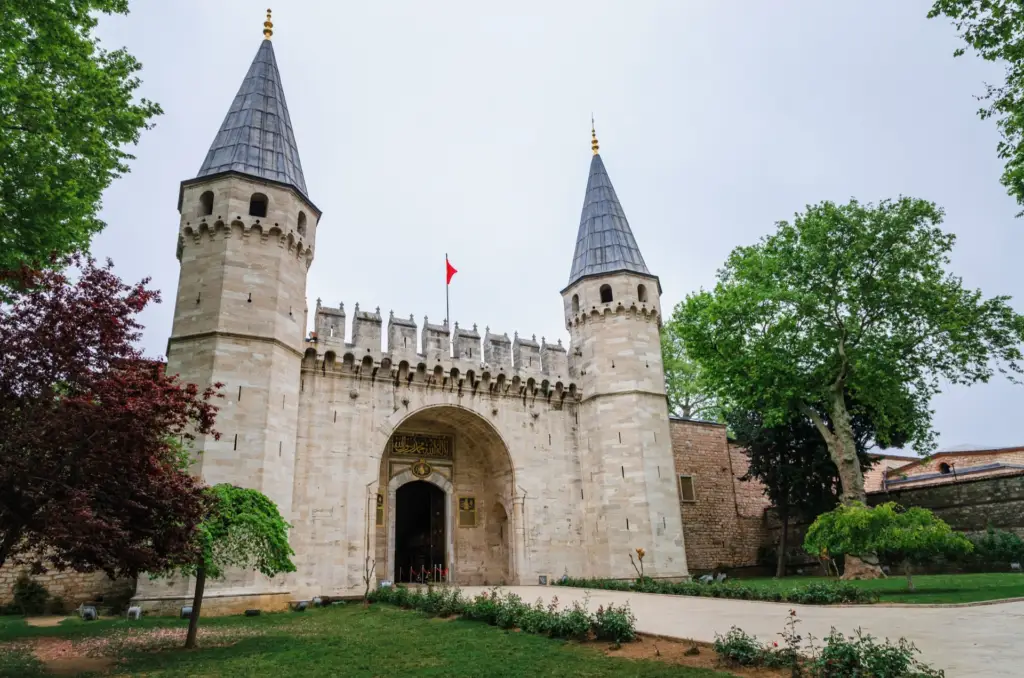
Topkapı is the longest visit in the city, two to three hours with a family, and the one stop that closes on a fixed weekday: Tuesday.
3. Walk the Topkapı Courtyards and Pay Extra for the Harem
Topkapı is not one building but four courtyards that step gradually inward, each less public than the last, and the walk through them is the point. The outer court was open to the city. By the fourth, only the sultan’s household passed. The Treasury holds the emerald-set dagger and the eighty-six-carat Spoonmaker’s Diamond. The terrace at the far end looks down on the Bosphorus, the Golden Horn and the Sea of Marmara at once, the best free-standing view in the old city. The Harem is a separate ticket and a separate entrance inside the palace, so a family buys twice at the same gate. It is also the part most people regret skipping: three hundred rooms of tiled corridors where the dynasty actually lived. The big one: two to three hours, and closed on Tuesday. The Harem is a separate add-on at the gate rather than part of the main entry, and both sit on the ministry museum card. Go at opening — by eleven the ticket line runs down the first courtyard, and a family joining it at that hour loses the best part of a morning. We buy the Harem with the palace ticket rather than at the inner gate, because bought separately it costs a second queue.
4. Descend Into the Basilica Cistern
Three hundred and thirty-six columns hold up a roof under the street, standing in shallow water that was once the old city’s drinking supply. Justinian’s engineers took the columns from older ruins, which is why no two capitals match and why two of them rest on carved Medusa heads — one upside down, one on its side, both unexplained. The walkways are raised, the lighting is deliberately theatrical, and the temperature drops noticeably on the way down the steps, which a family arriving hot feels immediately. That is why we place it in the middle of a July afternoon rather than at the start of a morning. That makes this the best stop in the cluster on a hot afternoon. It is also the one with the most exposed queue, so it rewards arriving at opening or in the last hour. Children tend to rate it above everything else on the hill, and it is the stop families most often ask to repeat. Forty-five minutes, open daily, and ticketed by the municipality under its own system rather than the ministry card. The queue is outdoors and unshaded, and between June and September it regularly passes an hour. The first slot of the day or the last two hours are the fix.
5. Trace the Hippodrome and Its Egyptian Obelisk
The long open space between the Blue Mosque and the tram is not a park. It is the floor of a Roman chariot stadium that held perhaps a hundred thousand people, and three monuments still stand on its central spine. The Egyptian obelisk was carved for Thutmose III around 1450 BC and shipped here in the fourth century. Its granite is so unweathered that the hieroglyphs read as though cut last year. Beside it the Serpent Column, looted from Delphi, once carried three bronze snake heads. Walk the outline rather than the paths and the shape of the track appears underfoot. It costs nothing, takes twenty minutes, and makes everything else on the hill make more sense, which is why we open a family morning with it rather than close one. Free, twenty minutes, open air and open always. It sits between the Blue Mosque and the museum, so it costs nothing to fold into either.
6. See the Carpets at the Turkish and Islamic Arts Museum
Housed in İbrahim Paşa’s palace on the edge of the Hippodrome, this is the quiet one. It holds the finest collection of early Anatolian carpets anywhere, some of them thirteenth-century. They are hung so you can see the wear where they were walked on for six hundred years. The ethnography floor reconstructs a nomadic tent and a village house, which is usually where children slow down. It is rarely busy, fully indoors, and ninety seconds from the Blue Mosque. That makes it the recovery stop for a family when the square is full and the queues are long. An hour, open daily, and on the museum card. Last admission is set well before closing, and the ministry publishes 18:45 for card holders. Treat it as a morning or early-afternoon visit rather than an end-of-day one.
7. Meet the Alexander Sarcophagus at the Archaeology Museums
Three buildings in the gardens below Topkapı, and most visitors never find them. The main hall holds the Alexander Sarcophagus, a fourth-century BC marble tomb carved with a battle so deep it reads as sculpture rather than relief. Traces of the original paint are still on it. The Tiled Pavilion next door is one of the oldest Ottoman buildings in the city. The Museum of the Ancient Orient holds a copy of the Treaty of Kadesh, the earliest surviving peace treaty. Entry usually comes bundled with the Topkapı ticket, so check what you are already holding before you queue again. Ninety minutes if you read the labels, forty minutes if a family goes for the sarcophagus and the mummies alone. Open daily, on the museum card, and with the same 18:45 last admission. It shares a gate approach with Topkapı, which makes it the obvious Tuesday substitute when the palace is shut.
8. Take the Shade Break in Gülhane Park
The old outer garden of the palace runs downhill from Topkapı’s first gate to the Sirkeci waterfront, under plane trees old enough to have shaded Ottoman court processions. In April it is the best tulip display in the city, which is where the flower’s European story began before it reached the Netherlands. Our guide to the Istanbul tulip festival in April gives the peak dates and the other two tulip sites. The rest of the year it is what a family needs between two museums. Shade, benches, a level path, a playground near the lower gate, and tea at the top of the hill with the Bosphorus below. It costs nothing and it is open all day. Use it as the gap between the palace and the museums rather than as a stop in its own right, and let the family eat here rather than in the square. Free, open daily, and worth forty-five minutes. It runs downhill from the Topkapı walls to the Gülhane tram stop, which makes it the right way to end a morning rather than start one.
Four of these eight run as one guided day: Hagia Sophia, the Blue Mosque, Topkapı and the Hippodrome, closing at the Grand Bazaar. The tickets are bought before you land. That is the old-city day we sell, from USD 190 per person with the entries already paid.
Eminönü and the Bazaar Quarter — Four Stops
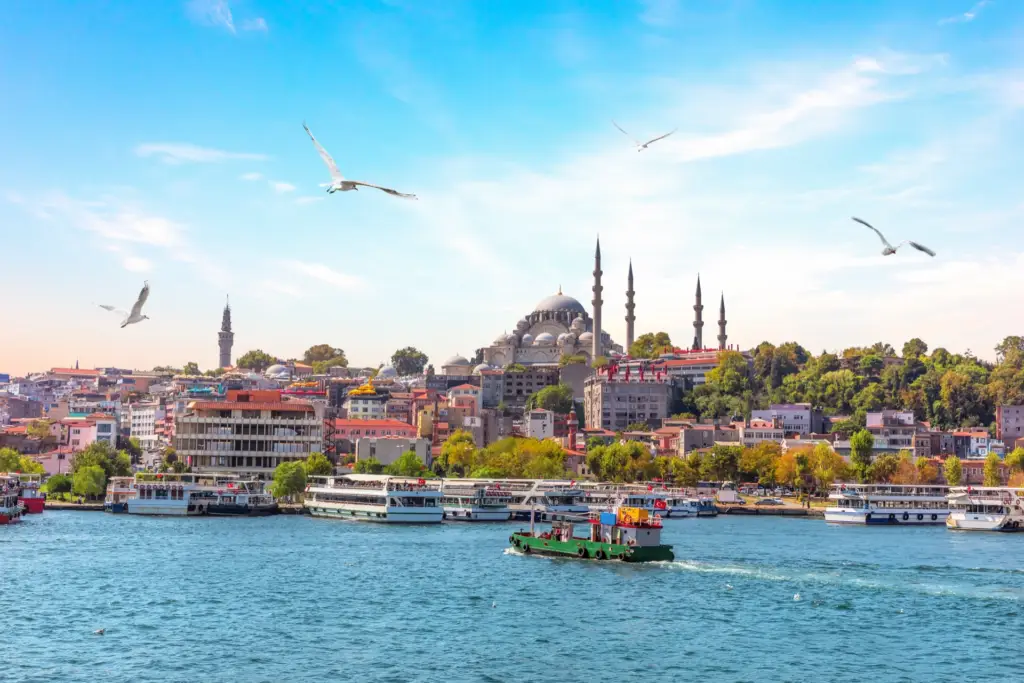
Four of the thirty stops sit in the quarter downhill from Sultanahmet, where the city stops being monumental and starts being commercial. This is where Istanbul has done its trading for five hundred years. The four stops here run from the largest covered market in the world to a mosque most families walk past without seeing. The whole cluster is one family morning, and it ends at the ferry piers — which is why it pairs naturally with a Bosphorus crossing in the afternoon.
Süleymaniye crowns the hill above Eminönü, and the bazaar quarter runs downhill to these piers, where a family morning ends at the ferry.
9. Bargain Your Way Through the Grand Bazaar
Sixty-one covered streets and something over three thousand shops, laid out by trade rather than by chance: gold on one lane, carpets on another, leather on a third. Mehmed II ordered the first stone hall built within a decade of the conquest. The market grew outward around it, which is why the oldest section in the middle feels like a different building. The painted vaults in the oldest lanes are worth as much attention as the shopping. Prices are opening positions, and the first number is usually well above what the seller expects. The polite counter is around half, and the deal lands somewhere in between — hand the job to a nine-year-old and the family will pay less than the adults would. On our days the children do the haggling, and the shopkeepers play along with it. Free to enter, one to two hours to walk, and closed on Sunday and public holidays. Before eleven the lanes are still being opened and the pressure on a family to buy is at its lowest. Our Grand Bazaar page covers which gate to enter and how far the bargaining actually goes.
10. Smell Your Way Down the Spice Bazaar
It was built to be funded by the customs duties of Egypt, which is why Turks still call it the Egyptian Market. It is one L-shaped hall rather than a maze, and you can walk it in twenty minutes or spend an hour. The colour comes from open sacks of sumac, dried chilli and saffron. The smell is mostly cinnamon and roasting nuts, and the tasting counters are why families spend an hour in a hall they meant to cross in twenty minutes. Buy the pistachio-heavy Turkish delight from a shop with a queue of locals, taste before committing, and ignore the saffron sold at implausible prices — it is almost always safflower. Behind the hall the outdoor streets sell cheese, olives and coffee to people who live here, and prices drop by a third the moment you step outside. Free, forty-five minutes, open daily. Late afternoon is when it is fullest, and a family with a pram will not enjoy the hall then. The streets immediately outside it, selling hardware and coffee and cheese, are better than the hall itself and most visitors miss them.
11. Climb to Süleymaniye for the Best Free View in the Old City
Sinan built this for Süleyman the Magnificent and considered it his journeyman work rather than his masterpiece, which tells you something about Sinan. The interior is a single vast space under a dome carried on four piers, plainer than the Blue Mosque and, to many eyes, better for it. The light comes through 138 windows, and the acoustics were tuned with clay jars set into the walls. The terrace on the Golden Horn side is the reason to make the climb: the whole waterway, the bridges and the Galata skyline, with no ticket and no queue. The mosque still serves its neighbourhood, so a family covers shoulders and knees here as elsewhere and plans around the prayer times. Free, forty-five minutes, open daily with the usual prayer-time gaps. The terrace behind it is the reason to climb, and it faces west, so an hour before sunset is the visit — the one free view a family should not trade away.
12. Squeeze Up the Staircase to Rüstem Paşa Mosque
Hidden above the shops of the hardware district, reached by an unmarked staircase that looks like a service entrance, this is the tile mosque. Sinan built it for Süleyman’s grand vizier. Its walls carry İznik tiles from the period when the workshops had just cracked the formula for tomato red, and the result is denser and more varied than anything in the Blue Mosque. It is small, it is rarely crowded, and the contrast between the chaos of the market below and the silence upstairs is the whole experience. Fifteen minutes, no ticket, and one of the few stops where a family will often have the room to itself. Free, fifteen minutes, open daily. The entrance is an unmarked staircase off a street of hardware shops, which is why most people walk past it.
The bazaar sits at the end of Day 2 of the five-day plan rather than the start. That order leaves the haggling until after the standing is done.
Galata, Karaköy and Beyoğlu — Five Stops
Five stops sit across the Golden Horn, where the city changes century. This was Genoese Galata, then the European quarter where the embassies, the banks and the first apartment buildings went up, and it still feels like a different city — steeper, later-rising and more inclined to sit outside. Five stops here make an afternoon and an evening, and it is the cluster families with teenagers reliably prefer.
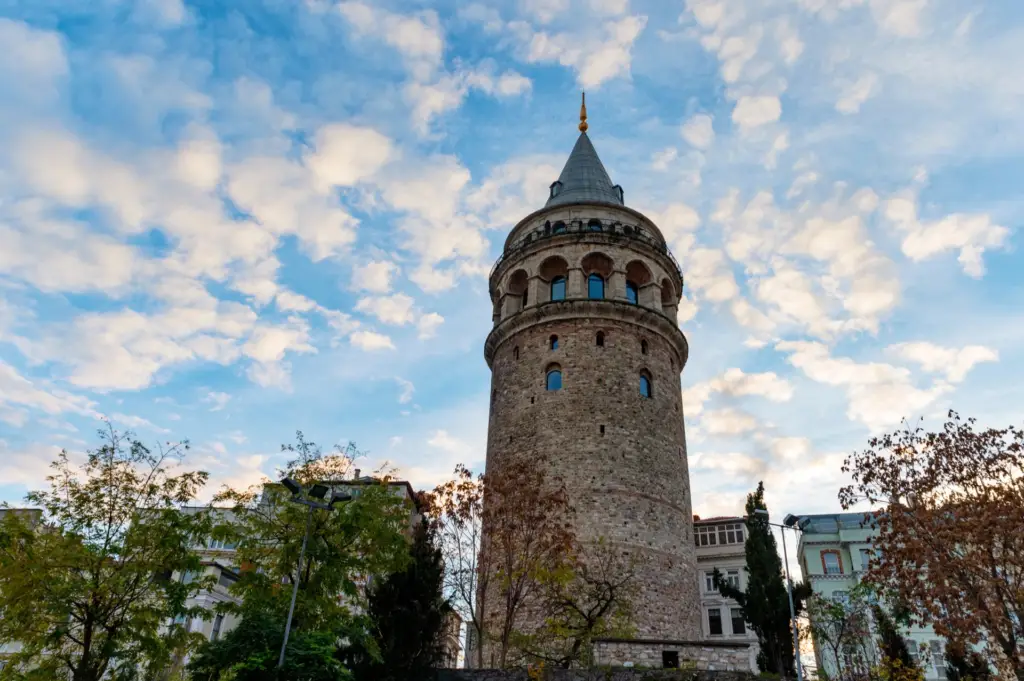
Galata Tower has anchored this hill since the fourteenth century, and the five stops in this cluster sit within twenty minutes of its base, which makes them one family walk rather than three.
13. Queue Early for the Galata Tower Balcony
The Genoese finished this in 1348 as the high point of their walled colony, and it has since been a fire lookout, a prison and a jazz club. What you come for is the balcony: a full circle at 51.65 metres with the old city on one side, the Bosphorus opening on the other, and the Golden Horn directly below. The lift reaches the upper floors but not the last stretch of stairs, which is the detail a family with a pram or a grandparent needs before joining the queue. We schedule the tower in the first hour after opening for that reason, never after lunch. It is one of the two most queue-prone stops in this guide, and the queue is on an unshaded street. Going in the first hour after opening or in the last hour before closing is the difference between ten minutes and ninety, and ninety minutes on an unshaded pavement ends a family’s afternoon. Forty-five minutes including the queue, open daily, and on the museum card — with a published last admission of 18:14 for card holders. The queue is at its worst from four onwards, so this is an opening-time stop or a skip. The pace is set at the ticket desk rather than on the stairs: only about 100 visitors an hour are let onto the balcony, which is the number behind the Galata Tower entry fee and queue timings.
14. Ride the Tünel and Walk İstiklal End to End
The Tünel is the second-oldest underground railway in the world, opened in 1875 to spare merchants the climb from Karaköy. It is a single stop lasting ninety seconds, a novelty for children that also takes the steepest hill in the city out of a family’s afternoon. It surfaces at the bottom of İstiklal, one and a half kilometres of nineteenth-century facades, arcades, bookshops and a red heritage tram that people ride for the photograph. Walk it towards Taksim, but do the walking in the side streets. Çiçek Pasajı’s arcade, the fish market lane behind it, and the Asmalımescit blocks are where the restaurants actually are. It is free, it takes as long as you give it, and it is best after six. Free to walk, one to two hours, and the funicular at the bottom is paid with the travel card. The street is at its best from six in the evening, which is the hour to bring a family up rather than the middle of the day. Before eleven in the morning it is half shuttered.
15. Spend an Hour at Istanbul Modern
The city’s main modern art museum sits on the Karaköy waterfront in a building by Renzo Piano, and the building is half the visit. A reflecting pool on the roof terrace mirrors the Bosphorus, and shutters throw shifting light across the galleries. The permanent collection traces Turkish painting and photography from the late Ottoman period forward. It fills a gap the ancient sites leave open: what the country has been doing for the last hundred years. There is a good café and a genuinely useful bookshop. An hour is enough for a family, two if the temporary show is strong. An hour, closed on Monday, and a private museum with its own ticket rather than a stop on the ministry card. The roof terrace and its reflecting pool are the part that holds children, and the café there is the easiest lunch a family will find in Karaköy.
16. Hunt Through the Çukurcuma Antique Shops
Four or five sloping streets below İstiklal, filled with dealers selling Ottoman brass, film posters, ceramics, and furniture from apartments that were cleared out fifty years ago. Nothing is labelled, prices are negotiable, and the pleasure is the looking rather than the buying. Orhan Pamuk’s Museum of Innocence stands in the middle of it. It is a real museum built to hold the objects from one of his novels, arranged in vitrines chapter by chapter, and one of the strangest small museums in Europe. The neighbourhood has good coffee and no coach groups, and it suits a family with teenagers far better than one with small children. Allow an hour, or half a day if you buy something that needs shipping. No ticket to pay, and an afternoon rather than a morning — the antique shops open late and several close on Sunday.
17. Sit in the Galata Mevlevi House Courtyard
The oldest surviving dervish lodge in the city, set behind a gate near the top of the Tünel, with a walled garden of Ottoman tombstones whose carved headgear tells you the rank of the man beneath. Inside, the octagonal wooden hall where the Mevlevi order held its ceremonies is now a museum of instruments, manuscripts and robes. The ceremony itself is still performed here on certain evenings. It takes forty minutes, it is almost always quiet, and the courtyard is one of the few places in Beyoğlu where a family can sit and the noise stops entirely. Forty-five minutes, closed on Monday, and on the museum card. The whirling ceremony is a separate evening event with its own ticket and its own schedule.
Galata Tower opens Day 4 of that plan, before the queue reaches an hour. İstiklal and Çukurcuma stay free time rather than scheduled stops, because nobody enjoys being marched down a shopping street.
Along the Bosphorus — Four Stops
The strait is the reason the city exists, and it is the one part of Istanbul that cannot be walked. These four stops are strung along the European shore between the palace and the first bridge. Do them by water rather than by road. The coastal traffic is the worst in the city, and the view from a ferry deck is the one families remember a year later.
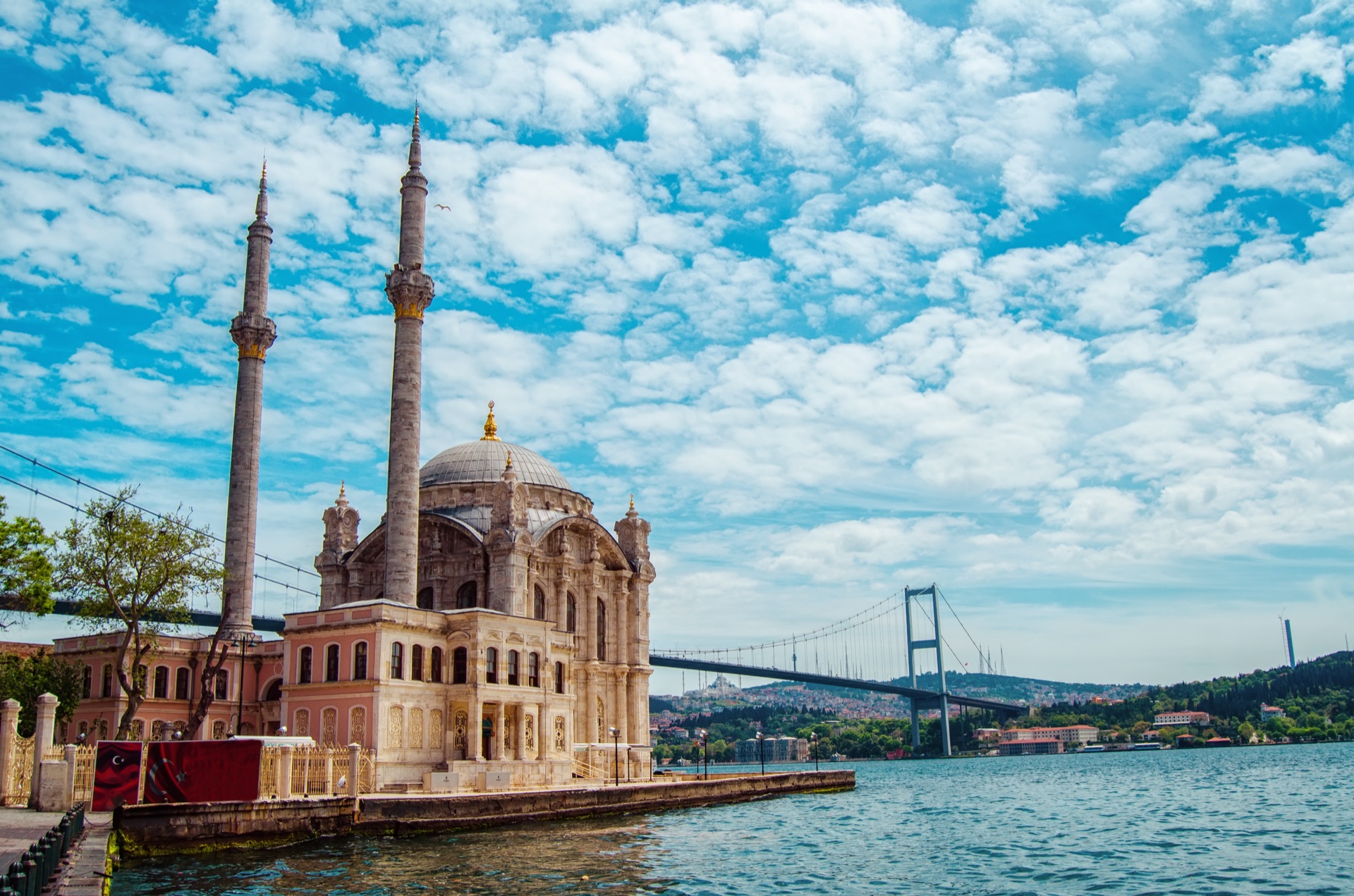
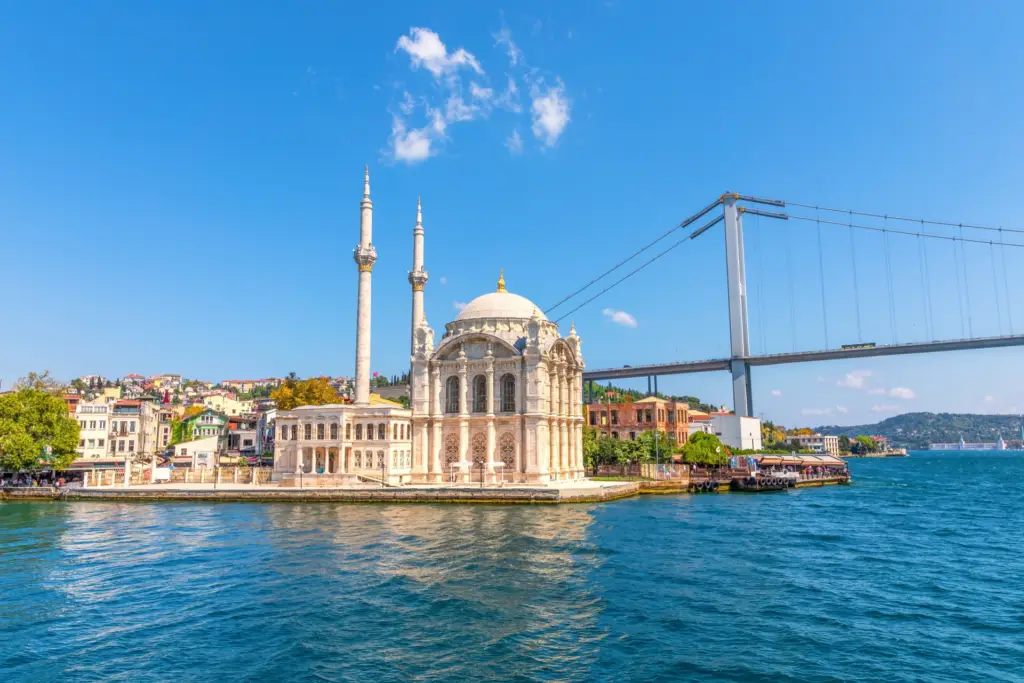
Ortaköy Mosque sits directly under the first Bosphorus bridge — the shortest walk between an Ottoman waterfront and a modern skyline anywhere in the city.
18. Cross the Bosphorus on a Public Ferry
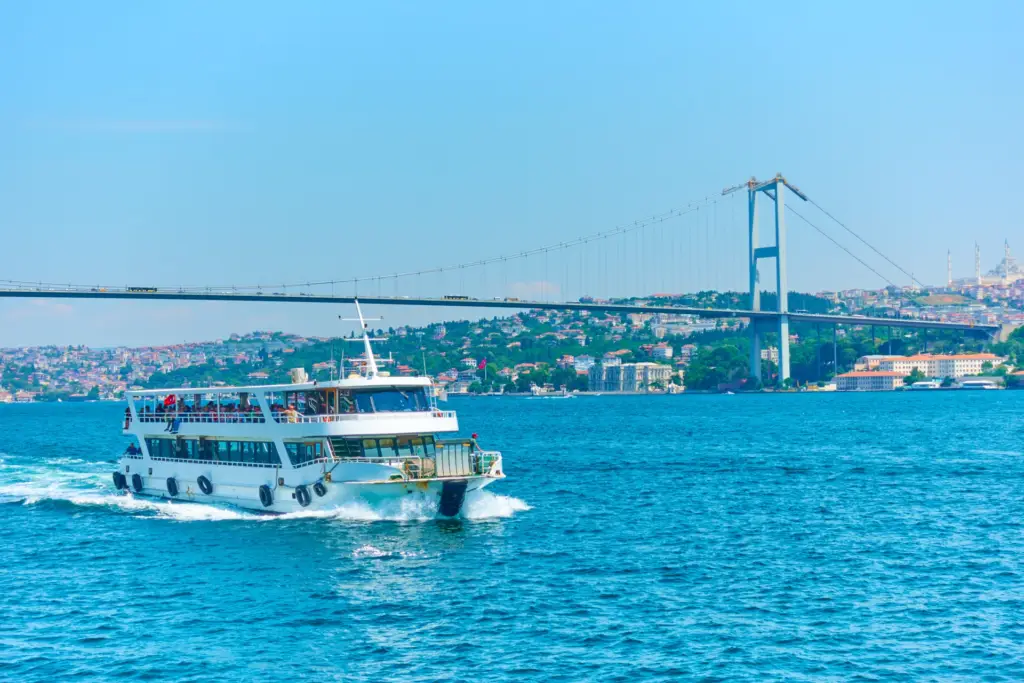
The commuter ferries are the best value in Istanbul and almost nobody on a first visit uses them. They run all day between Eminönü, Karaköy, Beşiktaş, Üsküdar and Kadıköy, and they cost the same as a bus ride on an İstanbulkart. The skyline is the one the tourist cruise sells at ten times the price. Sit on the upper deck at the back, buy tea from the man with the tray, and let the children watch the old city rotate behind the boat as it turns. A family of four crosses for roughly the price of two coffees. The long Bosphorus tour up to the Black Sea mouth is a different product with a fixed timetable and a lunch stop. Twenty to twenty-five minutes each way on the travel card, running all day, and one card taps a whole family aboard. Take the Eminönü–Kadıköy or Karaköy–Üsküdar crossing rather than a tour boat, sit outside, and go across in the hour before sunset if you can choose. Our Bosphorus cruise page compares the six ways of getting on the water.
19. Tour the Chandeliers of Dolmabahçe Palace
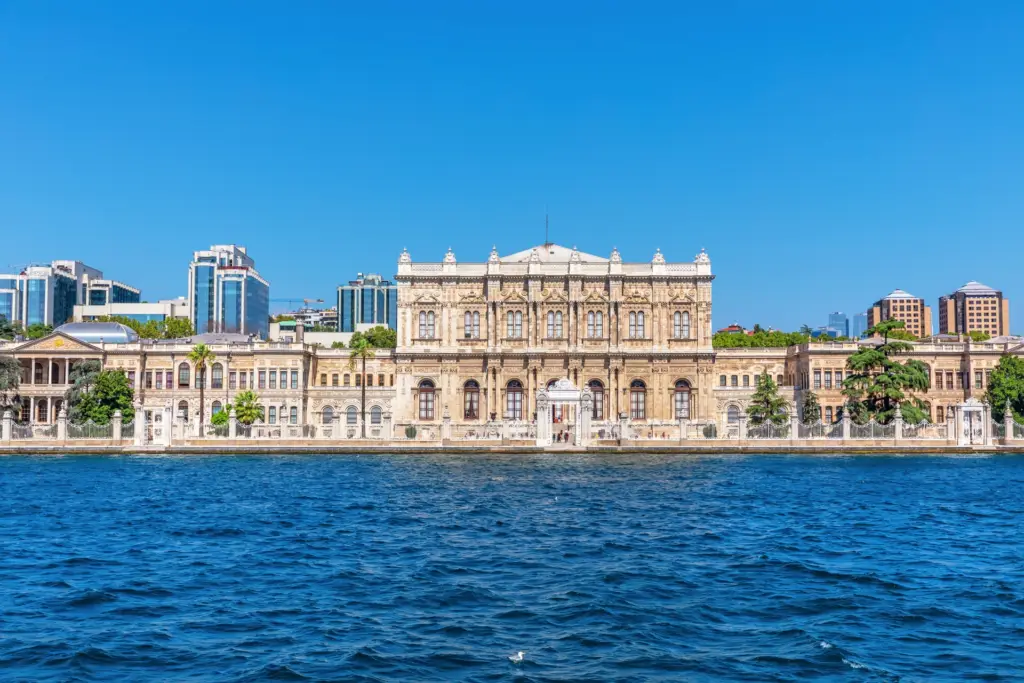
When the sultans left Topkapı in 1856 they built this instead, and the shift in ambition is the point. No courtyards and no austerity. Instead a European palace with a six-hundred-metre waterfront facade, fourteen tonnes of gold leaf on the ceilings, and a four-and-a-half-tonne crystal chandelier over the ceremonial hall. Atatürk died in a modest bedroom at the far end, and every clock in the building is stopped at 09:05. Visits are guided and timed, and photography is restricted inside, which makes it the least forgiving stop on this list for a family with a restless five-year-old. It is the one stop we will talk a family out of when the children are small. The Selamlık and the Harem are ticketed separately, which is the detail that catches families out at the gate. Ninety minutes to two hours and closed on Monday. It belongs to National Palaces rather than the ministry, so the museum card does not open it and it has its own ticket and its own timed entry.
20. Photograph Ortaköy Mosque Under the Bridge
A small baroque mosque on its own stone platform at the water’s edge, with the first Bosphorus bridge sweeping overhead. Nineteenth-century Ottoman and twentieth-century steel sit in the same frame, which is why this is the most photographed spot on the shore. The square behind it fills at weekends with stalls selling kumpir, the baked potato loaded with a dozen fillings, and waffles heavy enough to end an afternoon. Families do best reaching this square hungry rather than fed. Come at sunset, when the light hits the facade and the bridge lights come on. The mosque is small and working. Twenty minutes inside is plenty, and the square is the real stop. Free, forty-five minutes, and best after dark when the bridge above it is lit. The square is a food stop as much as a mosque stop, and the one evening on the shore that works for every age in a family.
21. Watch the Fishermen on the Galata Bridge
Two levels: rods above, restaurants below. The upper deck carries a line of fishermen that never thins, hauling palm-sized hamsi and mackerel into buckets. The whole span smells of bait, diesel and fried fish. Underneath, the arcade of restaurants faces the water, overpriced and aimed squarely at tourists. Eat instead at the balık ekmek boats moored at the Eminönü end, where a grilled mackerel sandwich costs a fraction of the price. Walking the bridge takes fifteen minutes, and doing it at dusk with the mosques lighting up behind you is the free half hour a family talks about longest afterwards. Free, fifteen minutes, any day. Walk it towards the old city at dusk, on the upper deck rather than through the restaurant level below.
The twenty-minute public ferry is stop 18, and one İstanbulkart taps a whole family aboard for the cheapest good hour in the city.
Three of these four are Day 3 on the guided plan — the ferry, Dolmabahçe and Ortaköy, in that order, ending under the bridge at golden hour. The ferry is the middle of the day rather than the transfer to it.
The Asian Side: Kadıköy and Üsküdar — Three Stops
Twenty minutes on a ferry and the tourism stops. There are no queues on this side, few coach groups and almost no monuments. What there is instead is the city that four million people actually live in. After three days of Ottoman interiors that is exactly the change of gear a family trip needs. Half a day is the right size for a first visit with children. A full day works better on a longer stay.
22. Eat Your Way Through Kadıköy Market
The market streets behind the Kadıköy ferry pier are the best eating in the city and are barely on the tourist map. Fishmongers, cheese shops with two hundred varieties, pickle bars selling turşu suyu by the glass, and Çiya Sofrası, whose kitchen reconstructs regional Anatolian dishes that have largely disappeared from restaurants elsewhere. Prices run well below the old city and the crowd is local. Come hungry, let the family eat in three or four places rather than one, and buy the coffee at Fazıl Bey where they have been roasting since 1923. It is where our own guides eat on a day off, which is the only recommendation that matters here. Two hours minimum, and a good deal longer if the weather is kind. No ticket, two hours, open daily and busiest on Tuesday and Friday when the produce stalls are fullest. Bring the family hungry rather than after lunch.
23. Walk the Moda Waterfront at Sunset
South from Kadıköy the shoreline turns into a long, flat promenade with grass, benches and a nostalgic tram. Across the water the whole old-city skyline lines up in silhouette when the sun goes down behind it: Süleymaniye, the Blue Mosque and Hagia Sophia. It is where the neighbourhood walks its dogs and drinks its tea. It is also the only stop in this guide with genuinely easy pram access along its full length, which is why families with a toddler end the Asian half-day here. Children can run. Nothing costs anything. Allow an hour, and time it so the sun sets while you are on it. Free, an hour, flat all the way. This is the sunset stretch on the Asian side and the one place in the old-city radius where a pram is genuinely easier than a carrier.
24. Look Back at the Maiden’s Tower from Üsküdar
The small tower on its islet three hundred metres offshore has been a customs post, a lighthouse and a quarantine station. It also carries a legend about a princess, a prophecy and a snake in a fruit basket, which every guide tells slightly differently. You can take the short boat out to it and climb to the café at the top. Or you can do what most of Üsküdar does and look at it from the shore with tea, which costs a family nothing and frames it better. The waterfront here also holds two Sinan mosques within a few minutes’ walk, both working and both empty of visitors. The shore view from Üsküdar costs nothing and takes half an hour with tea. The boat out to the tower is ticketed separately and turns it into ninety minutes. On a first visit with a family the shore is the better trade.
Six stops sit outside the walkable clusters, between twenty minutes and a full ferry ride from Sultanahmet, which is why they belong on a family’s fifth day rather than its third. They are also the part of the list that separates a family’s second visit from its first. The mosaics, the walls and the islands are where the city stops being a sightseeing route and starts being a place.
Balat’s painted terraces are twenty minutes from Sultanahmet by road, and the stairs between them are the reason this is a fifth-day stop for a family rather than a first-day one.
25. Walk the Painted Streets of Balat and Fener
The old Jewish and Greek quarters on the Golden Horn, where steep lanes of narrow houses have been painted in blocks of ochre, blue and rose. The shopfronts have turned into cafés without the neighbourhood turning into a theme park yet. The Greek Orthodox Patriarchate is here, so is a fifteenth-century synagogue, so is a red-brick Greek school that looks like a castle on the skyline. It is a walking stop rather than a ticketed one: two hours of streets, coffee and stairs, with the best photographs in the city and no queue anywhere. Wear something with grip, because the lanes are cobbled and steep and a family will be on them for two hours. Free, two hours, any day. The streets are steep and cobbled and the painted houses face east, so morning light is when the photographs work and when a family still has the legs for the stairs.
26. See the Mosaics at Chora
Out near the land walls stands a small church whose fourteenth-century mosaics and frescoes are, by common agreement, the finest late Byzantine work anywhere. Gold-ground panels run across the domes of the two entrance halls. The side chapel holds an Anastasis fresco, Christ hauling Adam and Eve bodily out of their tombs — that is worth the journey by itself. The building’s status has changed more than once, and it now functions as a mosque. That affects both the opening arrangements and what is visible, so check before you set out. Allow thirty minutes each way from Sultanahmet and forty-five minutes inside, which is half a family morning for one room of mosaics. It functions as a mosque, with the mosaic and fresco section ticketed and covered by the museum card, and the usual prayer-time gaps apply. It is far enough out that it belongs with the land walls rather than with the old city, and it suits families with older children rather than small ones.
27. Ride the Cable Car to Pierre Loti Hill
A four-minute cable car climbs from the Eyüp waterfront over a hillside cemetery. At the top is a café named after the French novelist who sat here writing about the city in the 1870s. The view runs the full length of the Golden Horn back to the bridges. It is the best of the classic Istanbul panoramas, because you are looking along the water rather than across it. Below the hill, Eyüp Sultan Mosque is one of the holiest sites in Turkey and among the few places in the city where sightseers are outnumbered by pilgrims. The atmosphere is nothing like Sultanahmet, and it is worth the half hour. The cable car is paid with the travel card and runs daily. Allow a family hour including tea at the top. Late afternoon gives the Golden Horn its best light, and the four-minute ride rather than the view is the part of the stop a family’s children remember.
28. Take the Ferry to the Princes’ Islands
Nine islands in the Sea of Marmara, four of them served by ferry, and no private cars on any of them. Büyükada is the largest and the usual choice: wooden Ottoman summer mansions behind overgrown gardens, a monastery on the higher of its two hills, pine woods and a shoreline of small beaches. Getting around is by walking, by bicycle or in an electric shuttle since the horse carriages were retired. The whole thing is a six-to-seven-hour commitment door to door, which is why it belongs on a family’s longer trip rather than a three-night one. On the right day it is the most restful thing the city offers. A full day, not a half. Ferries run daily on the travel card. Summer weekends are packed to the point of queuing for the boat back with tired children, so families go midweek or out of season.
29. Touch the Theodosian Land Walls
Six and a half kilometres of fifth-century fortification ran from the Golden Horn to the Sea of Marmara and held the city against everything for a thousand years, until the cannon of 1453. We walk families along the restored stretch near Edirnekapı rather than the ruined sections, where the footing is poor. Much of it still stands, in stretches ruined enough to climb around and complete enough to show the system. There was an outer wall, a terrace, an inner wall twelve metres high, and ninety-six towers. The best-preserved section is around the Belgrade Gate. The most atmospheric is where a modern road cuts straight through a breach. There is no ticket and very little supervision, so a family needs sensible shoes and an eye on the smaller children. Free, an hour, daylight only. The stonework is uneven and unfenced in stretches, which makes it a good climb for older children and a poor one for toddlers.
30. Shrink Turkey Down at Miniatürk
A park on the upper Golden Horn holding more than a hundred models of Turkish landmarks at 1:25. Hagia Sophia, the terraces of Pamukkale, the Celsus Library at Ephesus and the Cappadocian rock churches are laid out along paths you walk through in about ninety minutes. It rescues more rained-off family afternoons for us than any other stop on this list. It reads as a curiosity to adults and as the highlight of the week to a seven-year-old. It has a practical use beyond that. It is the clearest way for a family to show children where the rest of the country is before the flight to Cappadocia. There is a playground, a maze and a café. Entry is inexpensive and it is never full. Ninety minutes, open daily, municipal ticket. Go in the morning — it is an open-air site with little shade and it is at its worst in the afternoon heat.
None of these six sit on a standard plan. They are what an itinerary written from a blank page is for, and they usually land on a fifth or sixth day rather than a first.
Which Stops Combine Into One Morning
Four of the thirty stops are inside a five-minute walk of this lawn — the clusters below are built on that geography.
Seven half-days cover all thirty stops, and each one is walkable end to end apart from the last. This is the question every list leaves unanswered, and it is the one that decides how much of Istanbul a family actually sees. The city is split by water and stacked on hills, so two stops that look adjacent on a map can be forty minutes apart by road. The six clusters in this guide were built to be walked, and each of the combinations below has been timed on real family days rather than measured on a map.
Half-day
Stops, in order
Walking
Ends at
Old city, morning A
2 Blue Mosque → 5 Hippodrome → 6 Turkish and Islamic Arts → 4 Basilica Cistern
15 min total
Sultanahmet tram
Old city, morning B
1 Hagia Sophia → 3 Topkapı and the Harem → 7 Archaeology Museums → 8 Gülhane Park
20 min total
Gülhane tram, downhill
Bazaar morning
9 Grand Bazaar → 11 Süleymaniye → 12 Rüstem Paşa → 10 Spice Bazaar
35 min, one climb
Eminönü ferry piers
Galata afternoon
15 Istanbul Modern → 13 Galata Tower → 17 Mevlevi House → 14 Tünel and İstiklal
25 Balat and Fener → 26 Chora → 29 Land walls → 27 Pierre Loti
Needs a car between stops
Eyüp, on the Golden Horn
Two of these are deliberately split. The old city is two mornings rather than one day, because the Topkapı-and-Hagia-Sophia pairing alone runs to four or five hours of standing and the families who stack them are the ones who cut the afternoon short. The bazaar morning ends at the ferry piers on purpose, so a family’s lunch and the water crossing follow without a transfer.
Three combinations do not work for a family and are worth naming. Anything on the Asian side plus anything in the old city on the same half-day: the ferry is twenty minutes but the walking either side doubles it. The Princes’ Islands with anything at all — six hours means the day is the island. And Chora with the bazaars, which look close on a map and are separated by the whole width of the old city and its traffic.
Those half-days assemble into a family trip in one order more often than any other:
Day one — old city morning A, then the Hippodrome end of the square in the late afternoon when the coaches have gone.
Day two — old city morning B, the heaviest day of the trip, followed by Gülhane Park rather than another interior, because a family needs the grass by then.
Day three — bazaar morning, ending at the ferry piers so that the water afternoon follows without a transfer.
Day four — the Galata afternoon, with the morning left deliberately empty for whatever the first three days made you want to see twice.
Day five — either the Asian half-day or the fifth-day loop, but not both, because one needs a ferry and the other needs a car.
A three-night trip is the first three of those and nothing else. Adding stops rather than cutting them is how a short family trip turns into a march.
If you want the sequence built around your actual dates, the closures and the ages in the family, that is what a private day is for. Our private old city tour runs morning A and morning B as a single guided day with the entries pre-booked, which removes both ticket queues from the schedule.
The Same Five Days, Guided
Five days, three guided days and ten of the thirty stops — that is the shape of the Istanbul package we run, at USD 1,435 per person for two, USD 1,235 each for four and USD 1,190 each for six. The half-days above are the same city. What changes is that the entries are pre-booked, the order is built around the closing days, and nobody is holding the map.
The Hippodrome (5) and Gülhane Park (8) are both free and both walkable from the hotel
Day 2
Topkapı Palace and the Imperial Treasury, Hagia Sophia, the Blue Mosque, the Hippodrome, the Grand Bazaar — licensed guide, entries included
1, 2, 3, 5, 9
The Basilica Cistern (4) is a separate municipal ticket and is added on request
Day 3
Rüstem Paşa Mosque, the public ferry up the Bosphorus, Dolmabahçe Palace, golden hour at Ortaköy
12, 18, 19, 20
Süleymaniye (11) and the Spice Bazaar (10) sit on the same morning if you want them
Day 4
Galata Tower, the Karaköy waterfront, a Bosphorus crossing, the Çamlıca Hill panorama
13, plus the crossing
Çamlıca is not one of the thirty. Üsküdar and the Maiden’s Tower (24) swap in, as does Kadıköy (22)
Day 5
Free morning, private transfer to the airport
—
—
Four nights sit in a 4-star boutique old-city hotel with breakfast, with a licensed local guide on all three touring days, a private vehicle on Days 3 and 4, both airport transfers and every listed entrance fee inside the price. Lunches and dinners are not, which keeps the eating section above useful rather than decorative.
Twenty of the thirty are not on that plan, and that is the honest reason to ask rather than book blind. The stop list is the part that moves. Swap a palace morning for Balat and Chora, put the Asian side in place of Çamlıca, or drop a museum for the Princes’ Islands. If Cappadocia is also on the list, the same first two days run into a cave hotel and a balloon morning at USD 1,690 per person, flights included. If five days is more than you have, Day 2 also runs on its own, at USD 190 per person for the full day.
Five of the thirty stops here have a weekly closing day. Topkapı Palace closes on Tuesday, Dolmabahçe Palace, Istanbul Modern and the Galata Mevlevi House on Monday, and the Grand Bazaar on Sunday. More family mornings in Istanbul are wasted on a locked gate than on traffic. That list is short enough to plan around once you know it. The complication is the working mosques, which have no closing day at all but shut to visitors five times a day and for longer on Friday.
Stop
Closed
What to do instead that day
Topkapı Palace (3)
Tuesday
Make Tuesday the bazaar morning, or the Archaeology Museums next door
Dolmabahçe Palace (19)
Monday
Ortaköy and the ferry run the same stretch of water
Istanbul Modern (15)
Monday
Çukurcuma and İstiklal fill the same afternoon
Galata Mevlevi House (17)
Monday
Galata Tower queues are shortest on a Monday morning
Grand Bazaar (9)
Sunday and public holidays
The Spice Bazaar and its surrounding streets stay open
Working mosques (2, 11, 12, 20, 26 and Hagia Sophia)
No closing day — shut to visitors around each of the five daily prayers, and roughly 12:00–14:30 on Friday
Move the visit an hour either side; prayer times shift through the year
Everything else on this list
Open daily
—
Two closing patterns are read wrongly often enough to be worth naming. The first is that Monday and Tuesday are not interchangeable. Tuesday takes the single biggest stop in the city out of your week, so if a family trip contains only one full old-city day, do not let it fall on a Tuesday. The second is Friday, which is not a closed day but is the day the mosques give the least time. The midday prayer and the sermon around it take the middle of the day out. Sultanahmet is at its fullest immediately afterwards, which is the worst hour of the week to bring a family into the square.
Last entry is the other trap, and it runs earlier than gate-closing time everywhere. Two of them are published by the ministry itself for museum-card holders: the Galata Tower stops admitting at 18:14, and the Istanbul Archaeological Museums and the Museum of Turkish and Islamic Art stop at 18:45. Treat those as the pattern rather than the exception. Plan to be through any ticketed door by six, and give a family the last hour of light on a terrace or the water instead.
Is the Museum Card Worth Buying
The Ministry of Culture and Tourism sells a single card, MuseumPass İstanbul, that covers thirteen museums in the city. It costs €105 a head and allows one entry per museum, so a family of four is deciding on four cards rather than one. It is valid for five days from the moment you use it at the first museum, not from the day you buy it. It is not valid for after-hours or night-opening events.
Six of the thirty stops in this guide sit on that card:
Topkapı Palace, including the Harem (3) — the largest single entry in the city
Museum of Turkish and Islamic Art (6)
Istanbul Archaeological Museums (7)
Galata Tower (13)
Galata Mevlevi House (17)
Chora, the mosaic section (26)
Four stops that families assume are on it are not, and this is where most of the disappointment comes from. Hagia Sophia is a working mosque with a separate gallery ticket, sold on its own and not covered. The Basilica Cistern is run by the municipality under its own ticketing. Dolmabahçe Palace belongs to National Palaces, a different institution with a different card. And Istanbul Modern is a private museum. Between them those four are some of the most-visited stops in this guide, so the card is a partial solution rather than a total one.
Stripped of the numbers that move, it works like this. The card is priced at roughly what four of the bigger ministry museums cost individually, so it starts paying at the fourth and is comfortably ahead by the sixth. A family working through both Sultanahmet mornings here will hit Topkapı, the Archaeology Museums and the Turkish and Islamic Arts Museum in the same forty-eight hours. Adding the Galata Tower on the third day takes you past the line. A family doing one old-city morning and nothing else should skip it.
Three practical points. Buy it at the first museum you visit rather than in advance, because the five days start on first use and a card bought on arrival day quietly loses one. It does not skip the security queue — it skips the ticket queue, which at Topkapı in July is the longer of the two and the one a family stands in with children. And it does not cover the Harem as a separate purchase at every gate, so check that at the door rather than assuming.
Prices and the museum list are set by the ministry and change. The current card is published on the official MuseumPass page. On a private day none of this applies to you, because entries are booked and paid as part of the arrangement.
Things to Do in Istanbul With Kids, by Age
The table below sorts all thirty stops into three age bands: under 5, 6–11 and 12 and over. No list of things to do in Istanbul survives contact with a tired six-year-old, and the stops that fail a family are rarely the ones parents expect. Mosaics and marble do not hold small children. Water, animals, height, darkness and food do. The table below sorts all thirty stops by the age that actually enjoys them, based on what works and what does not on the family days Turkey Family Tours runs each week.
Stop
Under 5
6–11
12+
What carries it
1 Hagia Sophia
—
◐
●
Scale; the cats; the ramp instead of stairs
2 Blue Mosque
◐
●
●
Shoes off, carpet underfoot, colour overhead
3 Topkapı and the Harem
—
◐
●
The Treasury weapons and the terrace view
4 Basilica Cistern
●
●
●
Dark, cool, underground, Medusa
5 Hippodrome
◐
●
●
Chariot races explained on the spot
6 Turkish and Islamic Arts
—
◐
●
The nomad tent reconstruction
7 Archaeology Museums
—
◐
●
Sarcophagi and mummies
8 Gülhane Park
●
●
◐
Running room and a playground
9 Grand Bazaar
◐
●
●
Bargaining, if a child is given the job
10 Spice Bazaar
●
●
●
Tasting counters
11 Süleymaniye
◐
◐
●
The terrace, not the interior
12 Rüstem Paşa
—
◐
●
Short, quiet, and reached by a secret staircase
13 Galata Tower
◐
●
●
Height — but the queue is the risk
14 Tünel and İstiklal
●
●
●
The tram, the ice cream sellers
15 Istanbul Modern
—
◐
●
The roof pool and the shop
16 Çukurcuma
—
—
◐
Teenagers who like objects and photography
17 Galata Mevlevi House
—
◐
●
The ceremony, if the evening works
18 Public ferry
●
●
●
Deck, seagulls, tea trays — the reliable winner
19 Dolmabahçe
—
◐
●
The chandelier and the stopped clocks
20 Ortaköy
●
●
●
Kumpir and waffles under the bridge
21 Galata Bridge
◐
●
●
Watching a fish come up on a line
22 Kadıköy market
◐
●
●
Eating in five places instead of one
23 Moda waterfront
●
●
◐
Flat, pram-friendly, room for a family to spread out
24 Maiden’s Tower
●
●
◐
A boat and a legend with a snake in it
25 Balat and Fener
—
◐
●
Steep and cobbled; good for older children
26 Chora
—
—
◐
Art-interested teenagers only
27 Pierre Loti cable car
●
●
●
The cable car itself
28 Princes’ Islands
◐
●
●
Bicycles and a beach, if you have the day
29 Land walls
—
●
●
Climbable ruins, but needs supervision
30 Miniatürk
●
●
◐
The whole country at knee height
● works well · ◐ works with adjustment · — leave it out
Three practical notes stand behind the table, and each one has cost a family we guide an hour at some point. Prams are a poor tool in the old city. The pavements are broken, the hills are real, and half the stops involve steps. A carrier is the better choice under three, and the Moda waterfront is the one stretch where a family with a pram has the easier day. Toilets are reliable at the ticketed sites and unreliable everywhere else, so use them on the way out rather than the way in. And the working mosques ask for covered shoulders and knees from about the age of twelve, with scarves lent at the door, so one light scarf in the family bag covers the week.
The other pattern worth knowing is that children rate the free stops highest. Across the families we guide, the Basilica Cistern, the ferry, Ortaköy and Miniatürk beat the palaces almost every time, and three of those four cost little or nothing. A day built around them is not a lesser day for a family — it is usually the day that ends without an argument.
For the working version, our guide to Istanbul with kids takes fifteen of these stops, rules on each by age band, and builds them into a three-day plan with a pram verdict for every district.
Send the ages with your dates and the days get built around them, not around this list. Get a private quote — answered within 24 hours.
Eating Between the Stops
Three meals sit between the thirty stops, and they are the part of an Istanbul day most families plan least and remember most. The practical problem is that the best food is rarely next to the sights. Sultanahmet is the weakest eating district in the city, and the streets around the main squares are priced for people who will not come back. Three habits solve it — eat breakfast slowly, eat lunch where the trades eat, and cross the water for dinner.
A full Turkish breakfast is the meal that changes the shape of a sightseeing day — it will hold a family until mid-afternoon.
Breakfast is the meal Turkey does better than anywhere. A full Turkish breakfast is a table of cheeses, olives, jams, tomatoes, eggs cooked in butter, hot bread and endless tea. It will carry a family until three in the afternoon. That single fact reorganises a stop list: eat properly at half past eight, skip the tourist lunch entirely, and put the money into an early dinner instead.
Meal
Where it works
What to order
Breakfast
Your hotel, or a kahvaltı salonu in Beyoğlu or Moda
Serpme kahvaltı — the full spread, ordered for the whole family
Street lunch
Eminönü waterfront, Grand Bazaar edges
Balık ekmek, döner, lahmacun, kumpir at Ortaköy
Sit-down lunch
Esnaf lokantası near the bazaars — trays in the window
Whatever is in the trays; point rather than read
Dinner
Kadıköy, Karaköy or Asmalımescit
Meyhane meze table, or a kebab house with a wood grill
Between stops
Anywhere with a samovar
Çay, simit, and a boza or salep in winter
Six things are worth eating by name rather than by category, none of them needs a reservation, and every one of them is eaten standing with a family:
Balık ekmek — grilled mackerel in bread from the boats at Eminönü, eaten standing, five minutes from stop 10.
Kumpir — a baked potato mixed with butter and cheese and then loaded from twenty bowls, which is the Ortaköy stop and the reliable bribe in a family afternoon.
Lahmacun — thin, folded and eaten with lemon and parsley; the cheapest proper lunch in the city and on every back street near the bazaars.
Midye dolma — stuffed mussels sold by the piece from a tray and counted at the end. Buy where the tray is emptying quickly.
Çiğköfte — spiced bulgur rolled in a lettuce leaf with pomegranate syrup, meat-free and sold from small shopfronts along İstiklal.
Salep or boza — the two winter drinks; the first is hot milk and orchid root, the second fermented and sold after dark.
For families, the useful thing about Turkish food is that it is unthreatening. Grilled meat, rice, bread, yoghurt and chips are on every menu, portions are large, and no restaurant will blink at a child’s plate being shared. Meze is a good way in for cautious eaters because everything arrives in small dishes and nothing is committed to. Our Turkish food guide runs through the dishes worth seeking out and the ones that are aimed at visitors.
Two warnings. The restaurants with a man outside inviting a family in are, with very few exceptions, worse and more expensive than the ones without. The correlation is close to absolute. And the fish restaurants under the Galata Bridge trade entirely on position — the identical fish is grilled better and priced lower on the boats a hundred metres away.
Free Things to Do in Istanbul
Ortaköy is free, open air and open late — the one square that works better after dark than before it.
Thirteen of the thirty stops cost nothing to enter, and they include both bazaars, the two best viewpoints in the city and the most photographed mosque in it. That matters more here than in most cities. The ticketed sites have grown expensive enough that a family of four can spend a substantial sum in a single morning. A day built from the free stops is not a compromise day for a family, and the children usually rate it higher.
Free stop
Cluster
Time
Blue Mosque (2)
Sultanahmet
30 min
Hippodrome and the obelisk (5)
Sultanahmet
20 min
Gülhane Park (8)
Sultanahmet
45 min
Grand Bazaar (9)
Bazaar quarter
1–2 hrs
Spice Bazaar (10)
Bazaar quarter
45 min
Süleymaniye and its terrace (11)
Bazaar quarter
45 min
Rüstem Paşa Mosque (12)
Bazaar quarter
15 min
İstiklal and Çiçek Pasajı (14)
Beyoğlu
1–2 hrs
Ortaköy square (20)
Bosphorus
45 min
Galata Bridge (21)
Bosphorus
15 min
Moda waterfront (23)
Asian side
1 hr
Balat and Fener streets (25)
Beyond the centre
2 hrs
The land walls (29)
Beyond the centre
1 hr
Two of the best views in the city are also free and neither is signposted. The Süleymaniye terrace looks down the Golden Horn to the bridges. The upper courtyard of the Ayasofya Hürrem Sultan Hamam gardens gives the postcard angle on the dome without the ticket. Add the ferry crossing at İstanbulkart rates, and a family’s full day of stops, views and a water journey can cost less than one palace ticket.
Getting Between the Stops: One Card Does Everything
Istanbul runs on a single rechargeable travel card called the İstanbulkart, and it is the first thing to buy after landing. One card covers the metro, the tram, the funiculars, every city bus, the Marmaray under the Bosphorus, the public ferries and the Pierre Loti cable car. Two of the thirty stops here are paid for with it directly: the ferry crossing and the cable car. That makes it part of a family’s sightseeing rather than just the logistics.
Question
Answer
Where do you buy one?
Yellow machines at every metro station, ferry pier and major tram stop, including inside both airports. They take cash and cards and switch to English.
Does each person need one?
No. One card can be tapped repeatedly for a whole family on buses, trams and ferries — the machine simply deducts each fare.
What does it cover?
Metro, tram, funicular, Marmaray, city buses, Şehir Hatları ferries, the Tünel, the Pierre Loti cable car, and the airport metro lines.
What does it not cover?
Taxis, tourist cruise boats on the strait, the Havaist airport coaches on some routes, and museum entries.
Transfers
Changing lines within a couple of hours costs progressively less than a fresh fare, so a tram-plus-ferry journey is not two full prices.
Topping up
Same machines, plus small kiosks near stops and the city transport authority’s own points. Load a modest amount at a time — the balance is not refundable at the end of a trip.
The route knowledge matters more than the card, though. Five lines do almost all the work:
T1 tram — the spine of the old city, stopping at Sultanahmet, Gülhane, Eminönü and Karaköy, within a few minutes’ walk of close to twenty of the thirty stops here, which is why a family staying on the line rarely needs a taxi.
Public ferries — faster than the road for anything across the water, and the reason the Asian side is a half-day rather than a whole one.
M11 metro — Istanbul Airport to Gayrettepe in about forty-five minutes, where the M2 carries on to Taksim and the old city, which is why the layover question in the FAQ below has a real answer.
The Tünel — a ninety-second underground funicular that removes the steepest climb in Beyoğlu, and stop 14 in its own right.
Marmaray — the rail tunnel under the Bosphorus, useful to a family when winter weather closes the ferries.
If your family is still shaping the wider trip around these days, our how to plan a trip to Turkey guide covers visas, internal flights and the order to book things in.
Taxis are the weak link. Use BiTaksi or Uber, both of which run the meter through the app and remove the negotiation. A taxi hailed outside a tourist site is the one transaction in Istanbul where families regularly overpay. Traffic between the European and Asian sides at rush hour can turn a twenty-minute ferry into an hour in a car, so when the water is an option, take the water.
Which Area Puts You Nearest Your Stops
Where you sleep decides how many of these thirty stops you reach. Istanbul is a city of hills, water and traffic, and the difference between a hotel eight minutes from the tram and one twenty-five minutes away is roughly one extra sight per day. Four districts absorb almost every family, and each one buys a different shape of trip.
District
Reaches easily by walking
Trade-off
Suits
Sultanahmet
Stops 1–8 and 11–12, plus the tram to the bazaars
Quiet after ten; restaurants lean tourist-priced
First family visits, short trips, early starts
Beyoğlu / Galata
Stops 13–17 and the Karaköy waterfront
Steep streets; the old city is a tram ride away
Families with teenagers, second visits, evening life
Beşiktaş / Bosphorus shore
Stops 18–21 and the ferry piers
Furthest from Sultanahmet; highest room rates
Longer family stays, water views, slower pace
Kadıköy (Asian side)
Stops 22–24 and the market
Every old-city day starts with a ferry
Repeat visitors, longer family stays, food-led trips
For a first visit of three or four nights, Sultanahmet wins on arithmetic alone: eight of the thirty stops sit inside a fifteen-minute walk of the Hippodrome. Beyoğlu suits second visits and families with teenagers, the Bosphorus shore suits stays of five nights or more, and Kadıköy suits repeat visitors who already know the old city. Which one is right for you depends on how many nights you have, and on whether the trip is long enough to justify two bases — the full area-by-area breakdown is in where to stay in Istanbul. Every itinerary that starts here is built the same way — see how our private Turkey tours from Istanbul are put together.
Overrated Stops, and What to Do Instead
Six of the most-booked Istanbul experiences come off a family’s four-night plan more often than they stay on it. Not because they are bad, but because each one costs more hours than it returns. Not everything on a thirty-stop list deserves the same share of a short trip, and on a compressed trip, what you leave out sets the pace as much as what you keep.
Commonly booked
What it really costs
Do this instead
Dinner cruise with folklore show
4 hours, average food, the water in darkness
A daytime public ferry crossing (stop 18)
Hop-on hop-off bus
Slower than the tram, and slower than walking inside Sultanahmet
A single İstanbulkart and the T1 tram line
A second bazaar day
A full morning repeating the first
The Spice Bazaar in an hour (stop 10), then Rüstem Paşa (stop 12)
Basilica Cistern queued at midday in summer
Up to an hour standing unshaded
The same stop at opening, or last entry
Princes’ Islands on a three-night trip
Six hours of ferry and waiting
Keep it for a fifth day, or take Balat instead (stop 25)
A full Asian-side day with under-fives
A lovely ferry followed by long, flat walking
Half a day: market, waterfront, ferry back
The Princes’ Islands deserve a fair hearing, because they appear on this list and on the thirty-stop list at the same time. The contradiction is deliberate. On a fifth or sixth day, when the old city is done and the pace has dropped, the islands are among the best things the city offers. On a family’s third day, when Chora and Süleymaniye are still unseen, six hours of boat and bicycle is an expensive trade. The stop is not overrated. Its position in a short itinerary is.
One habit belongs here too, and it is the single most common planning error we see. Do not schedule Topkapı Palace and Hagia Sophia in the same afternoon. Each is between ninety minutes and three hours of concentration for a family, and both are largely by walking. Stacking them is the usual reason families leave the old city tired rather than impressed. Split them across two mornings and both improve.
A last note on shopping. Carpet and jewellery shops attached to guided itineraries are not scams, but the commission structure is real and the hours disappear quickly. We do not build shop stops into private days unless a family asks for one by name, and when they do we say in advance how long it will take.
How a Private Guide Changes the Day
Istanbul is one of the few cities where a guide changes the itinerary rather than just narrating it. The reason is queuing and sequencing. Four of the busiest stops have separate ticket offices and two have prayer-time closures. One closes on a weekday that catches people out, and the tram fills between four and six. A guide who works these streets daily reorders the family’s morning around all of that before anyone leaves the hotel.
Turkey licenses its guides through the national tourism authority, and licensed guides carry a card with a photograph and a number. It is worth knowing the distinction, because the men who approach visitors outside Hagia Sophia offering a tour are usually not licensed, and the site staff will not admit an unlicensed guide to lead a group inside. Every guide Turkey Family Tours works with is licensed, and we name them in the itinerary before the family travels.
Inside a private day
Outside it
Licensed local guide for your family alone
International flights, left with you for routing and points
Private vehicle and driver throughout
Lunches and dinners beyond those listed
All entrance fees, booked in advance
Tips for guide and driver
Airport pickup and departure transfer
Personal shopping in the bazaars
Hotels with family rooms or adjoining rooms
Travel insurance
Domestic flights on multi-city routes
Optional add-ons such as a balloon flight in Cappadocia
Six decisions get made before a family leaves the hotel, and each one is worth an hour of the day:
Which of the two old-city mornings runs first — decided by the day of the week, because Tuesday removes Topkapı and pushes morning B forward.
What time the mosques are entered — the gaps between the five prayers move through the year, and Friday midday is closed to visiting altogether.
Whether the Cistern is taken at opening or at last entry — those are the only two hours in July when the queue is not outdoors and unshaded.
Which direction the bazaar morning runs — downhill from Süleymaniye to the Spice Bazaar rather than up, which is the same four stops and about forty minutes less climbing.
Where lunch happens — almost never in Sultanahmet, because the streets around the square are the weakest eating in the city.
When the vehicle moves — the tram and the bridges fill between four and six, so the Bosphorus crossing goes before it or after it, never through it.
The practical effect on a family day is pace. A private group stops when a five-year-old needs to stop, eats at half past twelve rather than at the group’s allotted hour, and skips the third mosque without a discussion. Our private Istanbul tours are built around that flexibility, and the guided Sultanahmet day covers stops 1, 2, 3, 5 and 9 in one morning-to-afternoon run. For how a private day differs from a small-group departure on the same stops, we set the two side by side in our group tour versus private tour comparison.
What a Private Istanbul Trip Costs
A guided private day in the old city starts at USD 190 per person, covering the licensed guide, the vehicle, entries and transfers. Five days and four nights in the city with hotels included start at USD 1,435 per person. Adding Cappadocia takes a five-day trip to USD 1,690 per person, including the domestic flight and the cave hotel. Those three figures bracket almost every Istanbul enquiry we answer, and our private Istanbul tours page lists what each length includes.
Three things move the number. Family size moves it most, because the guide and vehicle are a fixed cost split across everyone. The per-person price falls as the group grows, which is why a family of five often pays less each than a couple. Season moves it next: spring and autumn sit above winter, when hotel and family-room availability is at its widest. Hotel tier moves it last, from a boutique four-star in the old city to a five-star with water views.
Children are not charged at the adult rate. Across every Turkey Family Tours itinerary, children aged 0–3 travel at a 70% discount and those aged 4–6 at 40%, while 7 and over pay the adult price. On a family of four with two young children that is the difference between four full fares and roughly two and a half, and it is applied before the quote is sent rather than negotiated afterwards. Ages go in the enquiry for that reason.
Beyond the tour itself, most families budget roughly USD 200 to 300 in cash across a few days for tips and market purchases. Cards work nearly everywhere else, including inside the Grand Bazaar. Our tipping guide gives the customary amounts for guides, drivers and restaurants, and the Turkey tour cost guide breaks the same numbers down across the whole country.
Want an exact quote for your dates? Send your arrival date, family size and ages, and any mobility or dietary needs, and we reply within 24 hours with a day-by-day plan and a fixed USD price. There are no hidden fees, and a 25% deposit secures the booking. Get a Private Quote →
Is Istanbul Safe to Visit?
Four districts hold almost every stop in this guide: Sultanahmet, Beyoğlu, Beşiktaş and the Bosphorus shore. All four are heavily policed, to the point that a family walking them is rarely out of sight of an officer. The major Western government advisories place tourist Turkey in the same caution tier as France, Germany and Italy. The practical risk to a family working through a stop list is pickpocketing in the two busiest crowds, and it is the only precaution worth actively taking.
Taxis — use the BiTaksi app rather than flagging one down; the fare settles in-app and the route is recorded.
Touts — shoe-shine and restaurant approaches cluster near the main squares. Walking past ends it; there is no confrontation.
Crowds — the Grand Bazaar and İstiklal are the only two stops worth a crossbody bag and front pockets.
Traffic — the genuine hazard. Cross at lights, hold small hands, and do not follow local timing.
Two numbers are worth saving before you fly. 112 is the single emergency line for police, ambulance and fire, and English is usually available on it. The Tourism Police office sits in Sultanahmet a few minutes from Hagia Sophia and handles theft reports and lost documents for visitors. Sultanahmet, Beyoğlu and the Beşiktaş waterfront are all comfortable for a family to walk in the evening. The difference is that Sultanahmet empties after ten while Beyoğlu does not. Our is Turkey safe for families guide carries hospital lists, emergency numbers and the current advisory positions.
When to Come, in One Table
The same square at half past seven. Opening time is worth more to a family’s stop list than any month of the year.
Istanbul has no closed season, which is why the question is less about weather and more about how many of the thirty stops involve standing outdoors. In July and August the outdoor queues at the Cistern, the Galata Tower and Topkapı’s courtyards are where the day is won or lost. In January the indoor stops carry the trip, the ferries are half empty, and a family walks into everything without queuing. May sits in between, at 22.3°C by day and 13.6°C at night, with rain on 7 to 8 days. Istanbul weather in May sets these against the rest of the route.
Period
Feel
What it means for a stop list
March–May
Mild, tulips in April, occasional rain
The best balance for a family, with indoor stops kept for wet mornings
June–August
Hot and humid, long daylight
Start at opening, move indoors at midday, ferry in the evening
September–October
Warm, clear, calm water
The strongest month for the Bosphorus and Asian-side stops
November–February
Cool, grey, sometimes snow
Museums and mosques carry a family day, and queues are the shortest of the year
Two dates move independently of the weather. The fasting month shifts mosque visiting hours and fills the Sultanahmet square in the evenings. That is either the highlight of a family’s trip or an obstacle, depending on what you came for. The two religious holidays that follow the Islamic calendar close government museums for the first morning and fill every ferry. Our best time to visit Turkey guide breaks the whole year down month by month, including the dates that move.
Half-Days and Day Trips Beyond the Thirty
Four trips out of Istanbul are worth the travel time for a family: the Princes’ Islands, Bursa, Gallipoli and Troy, and Ephesus by morning flight. They come into play once the thirty stops start repeating themselves, usually on a fifth day, and one of the four is not really a day trip at all. The full set of ten, from Cappadocia by air to Edirne by road, is compared by travel mode, hours away and price in our guide to day trips from Istanbul, where the range runs USD 190 to USD 620.
Trip
Time away
Worth it when
Princes’ Islands by ferry
6–7 hours
You have a fifth day and want a slow one
Bursa and Mount Uludağ
Full day
Early Ottoman architecture interests you more than a fourth mosque
You will not return to Turkey soon and want the ancient city
Ephesus is the one that surprises people, because it looks impossible on a map and is not. A morning flight to İzmir puts a family at the site gates before the coach groups from the cruise port, and an evening flight brings everyone back for dinner on the Bosphorus. Our Ephesus day trip from Istanbul page sets out the flight times and what the day costs. The Gallipoli battlefields and Troy guide does the same for the battlefields, where an overnight makes a real difference to how much of the battlefield a family actually walks — the two-day Gallipoli and Troy trip is the version that does. Two more run the same way out of Istanbul and back: Cappadocia in a day by morning flight, and Pamukkale in a day for the terraces.
Our Private Tours That Include These Stops
Every stop in this guide sits on at least one itinerary we run. The table maps the catalogue back onto the thirty, so you can see which trip covers the part of the city you came for before asking for a price.
Up to twenty of the thirty, including the Asian side and Balat
Nothing here is fixed. Families regularly take the five-day Istanbul trip and swap a palace morning for the Asian side, or add Chora and the land walls in place of a second museum. If the shape you want is not in the table, a tailor-made itinerary starts from the same guides, vehicles and entries, and Turkey Family Tours prices it in USD before you book.
Frequently Asked Questions About Things to Do in Istanbul
The stops almost every first visit keeps are Hagia Sophia, the Blue Mosque, Topkapı Palace, the Basilica Cistern and the Grand Bazaar, all within a fifteen-minute walk of one another in Sultanahmet, plus a crossing of the Bosphorus by public ferry. Add Süleymaniye for the view, the Spice Bazaar for an hour, and the Kadıköy market on the Asian side if you have a fourth day. Those eight stops cover the city’s range, Byzantine through commercial, and give a family one of each kind of morning rather than four of the same. The remaining twenty-two in this guide are what a fifth day and a second visit are for, and a private Istanbul tour reorders them around whoever is walking.
Between eight and ten stops for most families, if they are grouped by neighbourhood rather than chased across the city. Three days means two old-city mornings covering the Sultanahmet eight, one bazaar morning, and one afternoon on the water. What three days does not allow is the Asian side, the land walls or Chora, each of which costs half a day in travel alone. The mistake that wastes the most family time is crossing the city twice in one day, because the Bosphorus has no shortcut. Trip length is its own question, and our how many days in Istanbul guide compares two, three, four and five nights properly.
Only five of the thirty stops in this guide have a weekly closing day. Topkapı Palace closes on Tuesday, which is the one that damages a short trip most, because it is also the longest visit in the city. Dolmabahçe Palace, Istanbul Modern and the Galata Mevlevi House close on Monday, and the Grand Bazaar closes on Sunday and public holidays. Everything else opens daily. The exception that catches people out is the working mosques, which have no closing day but shut around each of the five daily prayers and for roughly two and a half hours over Friday midday. A family with one unmissable old-city day should place it on any weekday except Tuesday.
It depends on how many ministry museums you enter. MuseumPass İstanbul costs €105, covers thirteen museums, allows one entry each, and runs for five days from your first museum visit rather than the day you buy it. Six of the thirty stops here sit on it, including Topkapı with the Harem, the Archaeology Museums, the Turkish and Islamic Arts Museum and the Galata Tower. It is priced per person at roughly what four of the larger museums cost separately, so it starts paying a family back at the fourth. What it does not cover is the point most people miss: Hagia Sophia, the Basilica Cistern, Dolmabahçe and Istanbul Modern are all sold separately.
Yes. They stand four minutes apart, but the timing matters more than the distance. Both are working mosques, so visits can pause around each of the five daily prayers, and both close for longer on Friday around midday. The pattern that works for a family is one of them early, a gap over lunch, and the other in mid-afternoon. What does not work is stacking Hagia Sophia with Topkapı Palace, a pairing that runs to four or five hours on your feet and is the most common reason a family’s afternoon collapses. Our guide to the Hagia Sophia gallery route lists the mosaics worth stopping for, and the same scarf covers the dress code at both buildings.
The stops that reliably work are the Basilica Cistern for the dark and the Medusa heads, the public ferry for the deck and the seagulls, Gülhane Park for running room, Ortaköy for kumpir and waffles under the bridge, the cable car at Pierre Loti, and Miniatürk, where the whole country is rebuilt at knee height. Older children add the Galata Tower and bargaining in the Grand Bazaar, which works far better when a child rather than a parent is handed the job. The by-age table earlier in this guide sorts all thirty stops by who enjoys them, so a mixed-age family can split a morning instead of compromising on it.
Thirteen of the thirty stops cost nothing to enter: the Blue Mosque, the Hippodrome and its Egyptian obelisk, Gülhane Park, both bazaars, Süleymaniye and its terrace, Rüstem Paşa, İstiklal, Ortaköy square, the Galata Bridge, the Moda waterfront, the streets of Balat and Fener, and the land walls. Two of the best views in the city are among them, from Süleymaniye’s terrace and the Galata Bridge at dusk. Add a ferry crossing at card rates and a family’s full day of stops, views and a water journey costs less than one palace ticket. The Grand Bazaar alone absorbs two of those hours.
Kadıköy’s market streets are the best eating in the city and the least touristed: fishmongers, cheese shops, pickle bars and Çiya Sofrası, whose kitchen reconstructs regional Anatolian dishes. South of it the Moda waterfront is a flat promenade facing the old-city skyline, which is where to be at sunset. In Üsküdar the Maiden’s Tower sits offshore, reachable by a short boat or better looked at from the shore over tea. Half a day is the right size for a family on a first visit, and the twenty-minute ferry over is a stop in its own right rather than a transfer.
With a single rechargeable card called the İstanbulkart, bought from the yellow machines at any metro station, ferry pier or airport terminal. It covers the metro, tram, funiculars, Marmaray, city buses, the public ferries and the Pierre Loti cable car, and one card can be tapped repeatedly for a whole family rather than buying one each. Transfers within a couple of hours cost less than a fresh fare. It does not cover taxis, tourist cruise boats or museum entries, and the remaining balance is not refundable, so top up modestly. For taxis, families use BiTaksi or Uber so the fare runs through the app rather than a negotiation.
The evening belongs to three places. Ortaköy square under the lit bridge, for street food and the best night photograph in the city. The meyhane streets around Asmalımescit in Beyoğlu, where dinner is a table of meze rather than a course. And the Galata Bridge at dusk, walking towards the old city as the mosques light up. Sultanahmet empties after ten and is quiet rather than unsafe for a family walking back, while Beyoğlu and Kadıköy do not empty at all. The Bosphorus dinner cruise is the one evening we steer families away from, and our Bosphorus cruise guide explains what to take instead.
With six hours or more between flights and hand luggage only, yes. The metro from the airport connects to the tram, and the target is one cluster rather than a tour of the city. The Sultanahmet four, meaning the Blue Mosque, the Hippodrome, the Basilica Cistern and the square, take a family about three hours together and sit at a single tram stop. Allow a full hour each way for the transfer and another for security, and do not attempt Topkapı, which needs half a day on its own. Under six hours, stay airside, because the return leg is the part that goes wrong.
For the two or three busiest ticketed stops, yes in high season. The queues at the Basilica Cistern and the Galata Tower are outdoors and unshaded, and both regularly run past an hour between June and September. The mosques take no booking at all. Everything else depends on the month, and in winter a family walks up to almost anything. On a private old city tour the entries are pre-booked as part of the arrangement, which is where most of the time saved on a guided day comes from rather than from walking faster between the stops.
Shoulders and knees covered for everyone, shoes off at the door, and hair covered for women and girls. Scarves are lent free at the entrance of the main mosques, and there are shelves or bags for shoes. Nothing else is asked, and no one comments on what you wear otherwise. The easiest arrangement for a family is long shorts or trousers, a light scarf in a bag, and slip-on shoes rather than laces, because every pair comes off four or five times in a Sultanahmet morning. Our Blue Mosque guide covers the entrance used by visitors and the prayer gaps.
More than in most cities, because the great sites are interiors. The Basilica Cistern is underground, both bazaars are covered, and Hagia Sophia, Topkapı’s pavilions, the Archaeology Museums, the Turkish and Islamic Arts Museum and Istanbul Modern are all indoor visits. A wet day is the right day for a family to take the museums cluster and the wrong day for the terraces and the ferry. Winter rain is the reason the quietest months are also the ones where you walk into every ticketed stop without a queue, which for a family on a short trip is often the better trade than a warmer week spent queueing outdoors.
A guided private day in the old city starts at USD 190 per person, covering the licensed guide, the vehicle, all entries and transfers. Five days and four nights with hotels included start at USD 1,435 per person, and adding Cappadocia takes a five-day trip to USD 1,690, including the domestic flight and the cave hotel. Family size moves the figure most, because the guide and the vehicle are a fixed cost split across everyone, so a family of five often pays less each than a couple. Nothing is priced per head at the gate afterwards, so the family budget is fixed before you fly.
Every itinerary we run is written for the family travelling, which in practice means the stop list is yours. Families regularly drop the palaces and add the Asian side, swap a museum morning for the islands, or build the whole trip around food. Send your dates, the number travelling and the children’s ages, along with anything that changes the pace: a pram, a grandparent who does not do stairs, a teenager who will not do a fourth mosque. We reply within 24 hours with a day-by-day plan and a fixed price in USD, and a 25% deposit secures the dates.
A 25% deposit confirms the dates and is not refundable, and the remaining 75% is paid on arrival in cash or by card, so nothing sits on your card for months beforehand. Cancellation inside seven days of the start date, and any no-show, is charged in full. Before that date the deposit is the only exposure. Prices are quoted and fixed in USD at the time of booking, and entries, transfers and the guide are inside that figure rather than added at the gate. Send your dates and family size through plan my trip and we answer within 24 hours.
Plan Your Private Istanbul Trip
Thirty stops is more than any family trip needs. The useful question is which eight or twelve belong in your days, in what order, and around which closures — and that is the part a licensed local guide answers better than a list.
Send your arrival date, your family size and the children’s ages, along with anything that changes the pace: a pram, a grandparent who does not do stairs, a teenager who will not do a fourth mosque. We reply within 24 hours with a day-by-day plan, the stops matched to your dates and their closures, and a fixed price in USD. A 25% deposit secures the booking and the remaining 75% is paid on arrival, in cash or by card. If your plan does not fit any package on the site, that is the normal case rather than the exception — tailor-made Turkey tours start from a blank page.
Turkey Family Tours is a TURSAB-licensed operator (registration 13538) working through Skylux Travel, with a 5.0 rating from 41 reviews on TripAdvisor. Every family itinerary is written by hand rather than assembled from a catalogue — more about who writes them.
Extend Istanbul Into a Full Turkey Tour
Most families who work through this list arrive with four or five nights in Istanbul and leave wishing they had built the rest of the country around it. The domestic flight network makes that easier than the distances suggest: Cappadocia is seventy-five minutes away, İzmir for Ephesus is a little over an hour, and Antalya is ninety minutes. If the city itself is the whole trip, the five-day Istanbul package works through most of this stop list with the entries booked.
The coast, at a pace that gives a family rest days
If your family is still deciding how the whole trip should look, the Turkey travel guide covers the country end to end. The best places to visit in Turkey guide ranks the destinations by what each one actually offers a family. For the flight itself, our Istanbul to Cappadocia guide compares the plane against the overnight bus and the train. Each onward destination has its own guide in the same shape as this one: Cappadocia, Ephesus, Pamukkale and Antalya. If the hot air balloons are the reason you are going, start with the Cappadocia hot air balloon guide.
How to choose a Cappadocia cave hotel: Göreme vs Uçhisar vs Ürgüp compared, room categories from under USD 100 to USD 250+ terrace suites, which terraces face the hot air balloon launch valleys, and when to book for a cliff-face room.
Ten day trips from Istanbul compared by departure time, hours in transit and USD price – 190 for a guided Old City day, 550 for Ephesus by flight, 620 for Pamukkale – with a straight verdict on which ones survive being done in a single day.
The Gallipoli battlefields in one guide: the three sectors, Anzac Cove, Lone Pine, Chunuk Bair, the Turkish memorials and Troy, with distances, drive times, ground conditions and the Anzac Day access rules.
How to plan a trip to Turkey in seven decisions: trip length (7–10 days suits a first visit), season, route, flights, private tour vs DIY, budget and paperwork — with the 5–14 day route ladder, USD cost bands and the five planning mistakes that cost the most.
Turkey in January is the coldest month of the year: 9.6 °C by day in Istanbul with 16 wet days, 15 °C in Antalya and −3.6 °C nights in Cappadocia. Hot air balloon flights go ahead on 50–60% of mornings, sites are open and quiet, and private routes start from USD 1,435 per adult.
Cappadocia travel guide: sunrise hot air balloons, cave hotels, the Göreme Open-Air Museum and the underground cities — with the 2-day private tour from Istanbul at USD 895 pp.
Pamukkale guide: white travertines, Cleopatra’s Antique Pool, Hierapolis ruins, best time to visit, family tips. Natural wonder on Turkey’s southwest coast.
A Bosphorus cruise in Istanbul ranges from a USD 2–3 public ferry to a USD 280–380 private yacht. Six options compared — prices, best time of day, hidden costs, and how a private Istanbul tour can include the cruise.
✦ Tailor-Made
Let's Plan Your Private Turkey Trip
Tell us about your family — we reply within 24 hours.

 English
 Dutch
Dutch Japanese
 Korean
 Chinese