Things to Do in Ephesus: Every Stop, Ticket Prices and Which Gate
Quick Answer: The main things to do in Ephesus are the ancient city itself, walked downhill from the Upper Gate in two to three hours past Curetes Street, the Library of Celsus and the 25,000-seat Great Theatre. Inside it sit two ticketed extras, the Terrace Houses and the Ephesus Experience Museum. Around Selçuk are three more: the House of the Virgin Mary, the archaeological museum and the hill village of Şirince. Entry is €40, or €52 with the Terrace Houses, and the gates open at 08:00 every day of the year. The site is 3 km from Selçuk, 19 km from the Kuşadası cruise berths and 55 km from İzmir airport. Turkey Family Tours, TURSAB-licensed (no 13538), runs it as a private family day with a licensed local guide and every ticket included, from USD 550 per person. Get a Private Quote →
Things to do in Ephesus divide between what sits inside the fence and what does not, and getting that split right is most of the planning. This guide walks the ancient city monument by monument with a measured time for each. It sets out what a family pays at the gate and what the €40 ticket covers, and which of the two entrances to start from. It also shows how families reach the site from İzmir, Selçuk, the Kuşadası cruise berths or a morning flight from Istanbul. Ticket prices and the 08:00 opening come from the Ministry of Culture and Tourism system. Everything about pacing, crowds, the 3 km walk and what holds a child’s attention comes from running the site as a working operator.
By Fatih — Founder & Tour Director, Turkey Family Tours · TURSAB licence 13538 · Last updated: July 2026
Ephesus is an ancient city on Turkey’s Aegean coast, 3 km from the town of Selçuk in İzmir province, founded by Ionian Greek settlers around the 10th century BC and later the Roman capital of the province of Asia. About a fifth of it has been dug out, and what stands is not a ruin field with a few columns. It is a city street plan a family walks through. There is a marble avenue with kerbs, drains and shopfronts, a council chamber, and public latrines with the seats still in place. Above them sit a hillside of decorated apartments and a theatre carved into the slope for 25,000 people. Excavation has continued every season since 1895, led today by the Austrian Archaeological Institute under permit from the Turkish Ministry of Culture and Tourism. What has come out of the ground makes Ephesus the most complete classical city on the Mediterranean. For families it matters that so much is standing: children who find a field of foundations dull will follow a street with shopfronts on it.
Ionian Greek settlers founded the city around the 10th century BC, beside the estuary of the Kaystros river. It stood next to a much older sanctuary of a mother goddess, whom the Greeks matched to Artemis. That sanctuary became the Temple of Artemis, one of the Seven Wonders of the Ancient World, and it made the city rich long before Rome arrived. Croesus of Lydia paid for its columns. A man called Herostratus burned it down for fame, and it was rebuilt bigger.
Under Rome, Ephesus became the capital of the province of Asia and one of the five largest cities in the empire, with a population commonly estimated at 250,000. Its harbour handled the trade of the whole Aegean coast. The monuments families photograph today, from the Library of Celsus to the Temple of Hadrian and the Trajan fountain, all belong to that imperial century of confidence between roughly AD 100 and 200.
Then the river beat the city. The Kaystros carried silt down into the bay faster than Ephesus could dredge it. The harbour crept away, the fleets went elsewhere, and earthquakes knocked the colonnades down. By the Byzantine centuries the population had drifted uphill to the fortress at Ayasuluk, where the town of Selçuk stands now. The sea is about five kilometres away today. That retreat is why the city survived: nobody built a modern town on top of it.
Ephesus is also one of the founding addresses of Christianity, which is why so many families arrive with a second reason. Paul spent roughly three years here and the silversmiths’ riot in the theatre is recorded in Acts 19. Ephesus is the first of the seven churches addressed in the Book of Revelation. Tradition places the last years of both St John and the Virgin Mary on these hills. The ecumenical council of AD 431, the one that settled the title Theotokos, met here.
UNESCO inscribed Ephesus on the World Heritage List in 2015, and the inscription is wider than the ticketed ruins. It takes in Ayasuluk Hill with the Basilica of St John, the Temple of Artemis, the House of the Virgin Mary and the Çukuriçi mound. That is useful to know when a family plans, because it tells a family the visit is a cluster of sites over a few kilometres, not one gate.
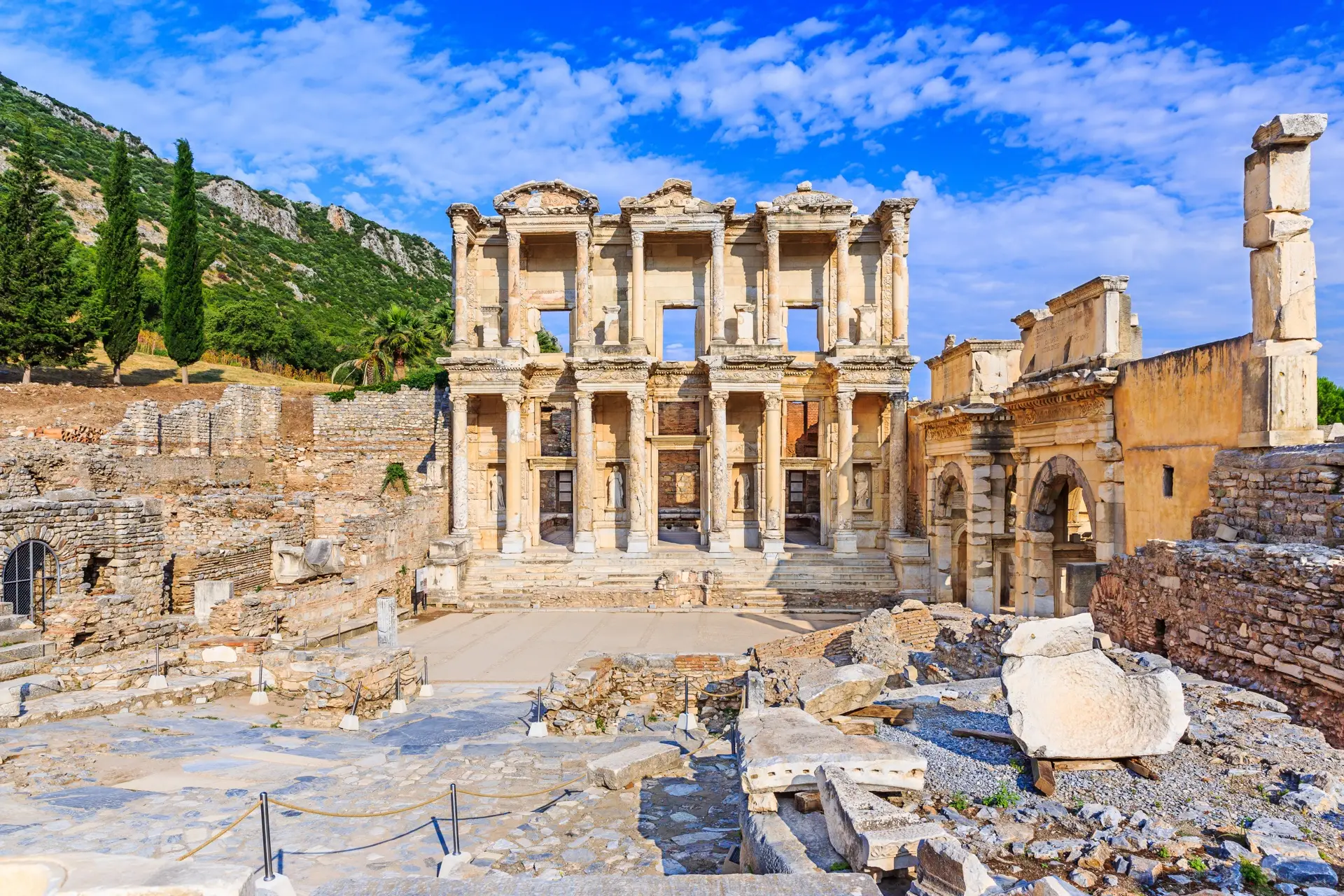
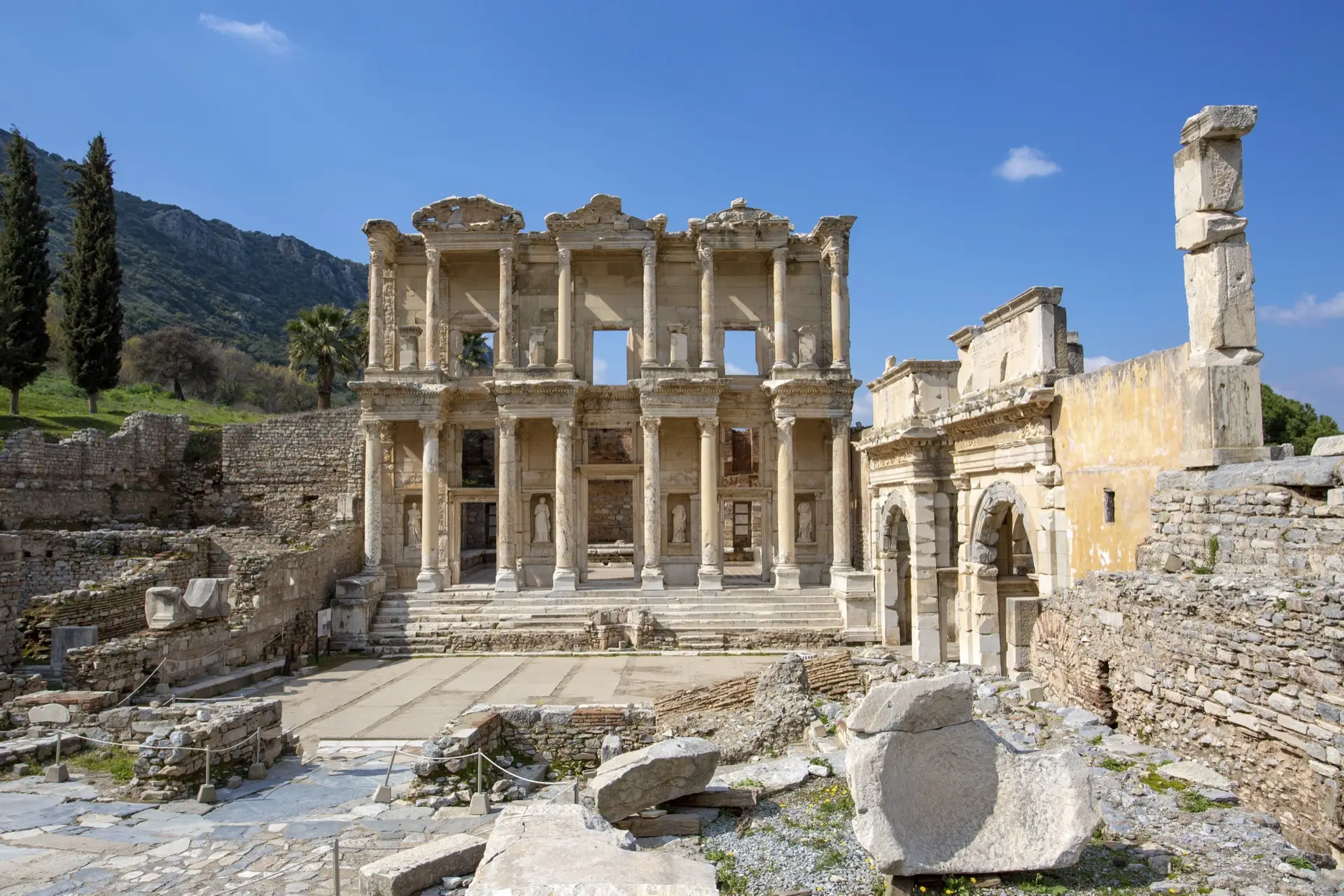
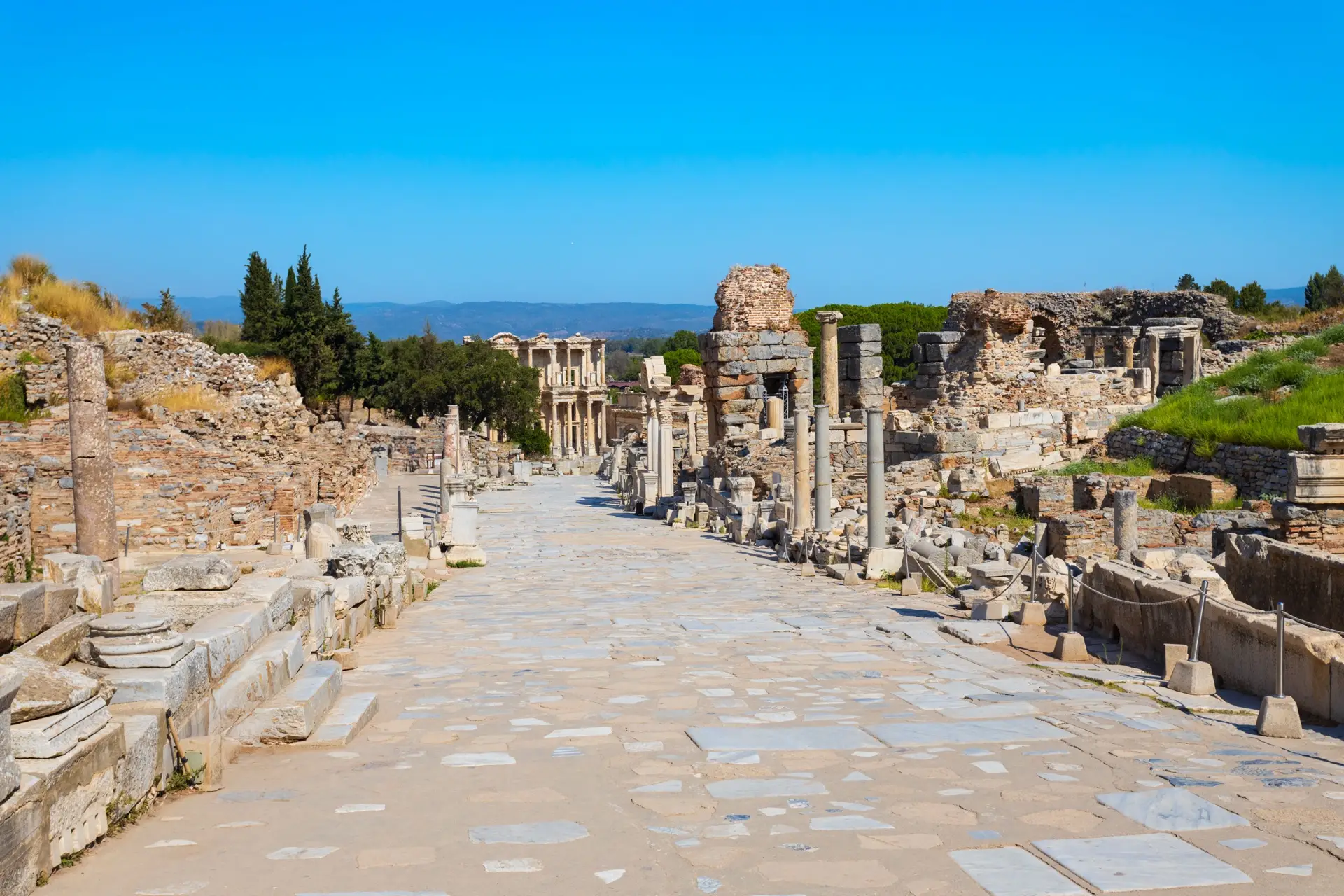
The Library of Celsus closes the bottom of Curetes Street — the reason most families come, and the reason to be at the gate at opening.
Ephesus Entrance Fee and Opening Hours: What Your Ticket Covers
Entry to Ephesus is €40, or €52 with the Terrace Houses, and the gates open at 08:00 every day of the year. The €40 ticket covers the ancient city and the Ephesus Experience Museum. It does not cover the Terrace Houses, which are a supplement, and it does not cover the sites outside the fence: the House of the Virgin Mary, the archaeological museum in Selçuk and the Basilica of St John each carry their own ticket. That is where most family budgets go wrong. The site is run by the Ministry of Culture and Tourism, so prices are set nationally and sold through the state system at muze.gov.tr and at the gate.
Site
Entry
Time to allow
Included in our private tours
Ephesus Ancient City (with the Ephesus Experience Museum)
€40
2–3 hours
Yes
Ephesus + Terrace Houses combined ticket
€52
3–4 hours
Yes
House of the Virgin Mary
about 700 TL
45 minutes
Yes
Ephesus Archaeological Museum, Selçuk
€10
About an hour
On request
Basilica of St John
€6
30 minutes
On request
Temple of Artemis
Free
15–20 minutes
Yes
Şirince village
Free (parking charged)
1–2 hours
On request
Opening hours. The gates open at 08:00. In the long summer season the site stays open until 19:30, with the ticket office closing at 19:00. In winter both close earlier, in the region of 17:00–17:30. Ephesus is open every day of the year. Hours shift with the season and occasionally with excavation work. Check the site page on the Ministry’s museum portal the week the family travels, because it is the only source that is never out of date.
How you pay. Card is the reliable option for a family paying four or five entries at once. State ticket offices in Turkey take Visa and Mastercard and Turkish lira in cash. Euro and dollar cash are refused at the window, even though the prices are quoted in euros. Families travelling independently should buy online in advance or bring a card, not a wallet of euros.
The Museum Pass question. The Museum Pass tickets, meaning the Aegean regional pass and the countrywide Museum Pass Türkiye, cover Ephesus and the state museums around it. They do not cover the House of the Virgin Mary, which is administered separately. A pass only pays for itself if a family is stringing several state sites together over the same week: Ephesus, the Selçuk museum, Pergamon, Hierapolis at Pamukkale. For a single Ephesus day it does not.
Children. Children under eight enter state sites free under the current national tariff. From eight upwards it is the full adult price, with no student or senior reduction for foreign passports. On our own tours the pricing works differently. Children aged 0–3 travel at 30% of the adult rate, ages 4–6 at 60%, and from seven the adult rate applies. Every entry ticket on the route is already inside that price.
What is actually inside the €40. The main ticket now bundles the Ephesus Experience Museum, a projection hall near the Lower Gate that reconstructs the city in light on the walls. It is 25–30 minutes, it is air-conditioned, and it works well as the last stop after the walk rather than the first. The Terrace Houses supplement is the other €12. That decision has its own section below.
At Turkey Family Tours, every ticket named above as “yes” is bought before you arrive, including the Terrace Houses. Nobody queues, and no parent stands at a window counting lira while the children wait in the sun. Ask for a costed Ephesus day →
How to Visit Ephesus: Getting There from İzmir, Selçuk, Kuşadası and Istanbul
Ephesus is 3 km from Selçuk, 19 km from the Kuşadası cruise berths and 55 km from İzmir airport, on the edge of a small market town in İzmir province. Nothing about reaching it is difficult. The only real decision is whether a family is making it a day out of a beach base, a stop on a longer route, or a fly-in-fly-out day from Istanbul.
Starting from
Distance
Driving time
Option without a car
Selçuk town centre
3 km
5 minutes
Dolmuş minibus or a short taxi
Kuşadası cruise berths
19 km
20–25 minutes
Port taxi or a booked transfer
Kuşadası town / hotels
20 km
20–25 minutes
Dolmuş to Selçuk, then a second one
İzmir Adnan Menderes Airport
55 km
50–60 minutes
Suburban train to Selçuk, then taxi
İzmir city centre
80 km
1 hour 15
Train from Basmane, about 90 minutes
Pamukkale / Denizli
200 km
2 hours 45
Intercity coach to Selçuk
Bodrum
150 km
2 hours 15
Coach via Söke
Istanbul
—
1 hour flight + 1 hour drive
Domestic flight to İzmir, then road
From İzmir airport — the sensible arrival
İzmir Adnan Menderes is the airport for Ephesus, and it is closer to the ruins than it is to central İzmir. Domestic flights from Istanbul run all day and take about an hour, through the airport run by the state airports authority. A family landing before 10:00 can be walking Curetes Street before noon. The İZBAN suburban train also runs from the airport towards Selçuk. It is the cheapest option and takes a little over an hour, but it leaves a family 3 km from the gate with the luggage.
From Kuşadası and the beach resorts
“Ephesus from Kuşadası” is the single most common way families arrive, because the resort strip along that coast fills with them every summer and the ruins are 19 km inland. A taxi from the marina area runs to the Lower Gate directly. The public alternative is a two-stage minibus: Kuşadası to Selçuk otogar, then the Ephesus dolmuş or a five-minute taxi. Doable, but a family spends an hour of the cool morning on the wrong problem.
From Istanbul in a single day
This works, and it is the most-asked version of the trip. The shape is fixed by the flight timetable. An early departure from Istanbul, landing at İzmir around breakfast, a private vehicle waiting airside, then Ephesus and the Selçuk sites through the middle of the day, and an evening flight back. It is a long day at 13–14 hours door to door, but it puts the whole site inside a family trip that never leaves an Istanbul hotel. We run it as a fixed product: our Ephesus day trip from Istanbul is USD 550 per person with return flights, a private car, a licensed guide and every entry ticket included. The costed fly-in day and its timings sets out what fits and what does not.
Driving yourself
Both gates have paid car parks and the road in from the Aydın–İzmir motorway is straightforward. The catch is the shape of the site. It is a one-way downhill walk, so a family that parks at the Upper Gate finishes 3 km from the car. Independent drivers either park at the Lower Gate and walk up and back, or park at the top and take a taxi from the bottom gate at the end. There is usually a rank waiting. Fuel and tolls are the reason a self-drive day rarely undercuts a private transfer by as much as families expect.
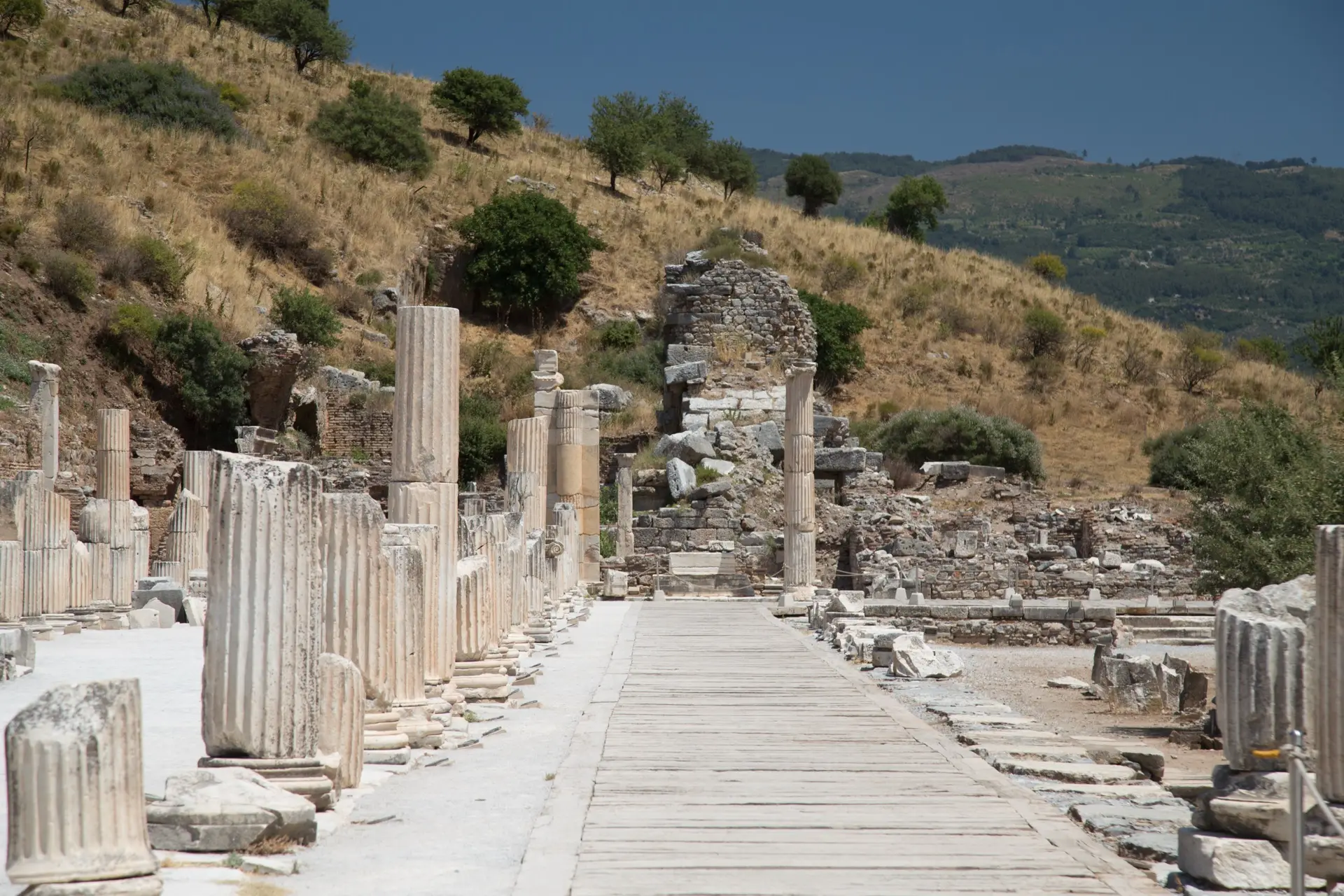
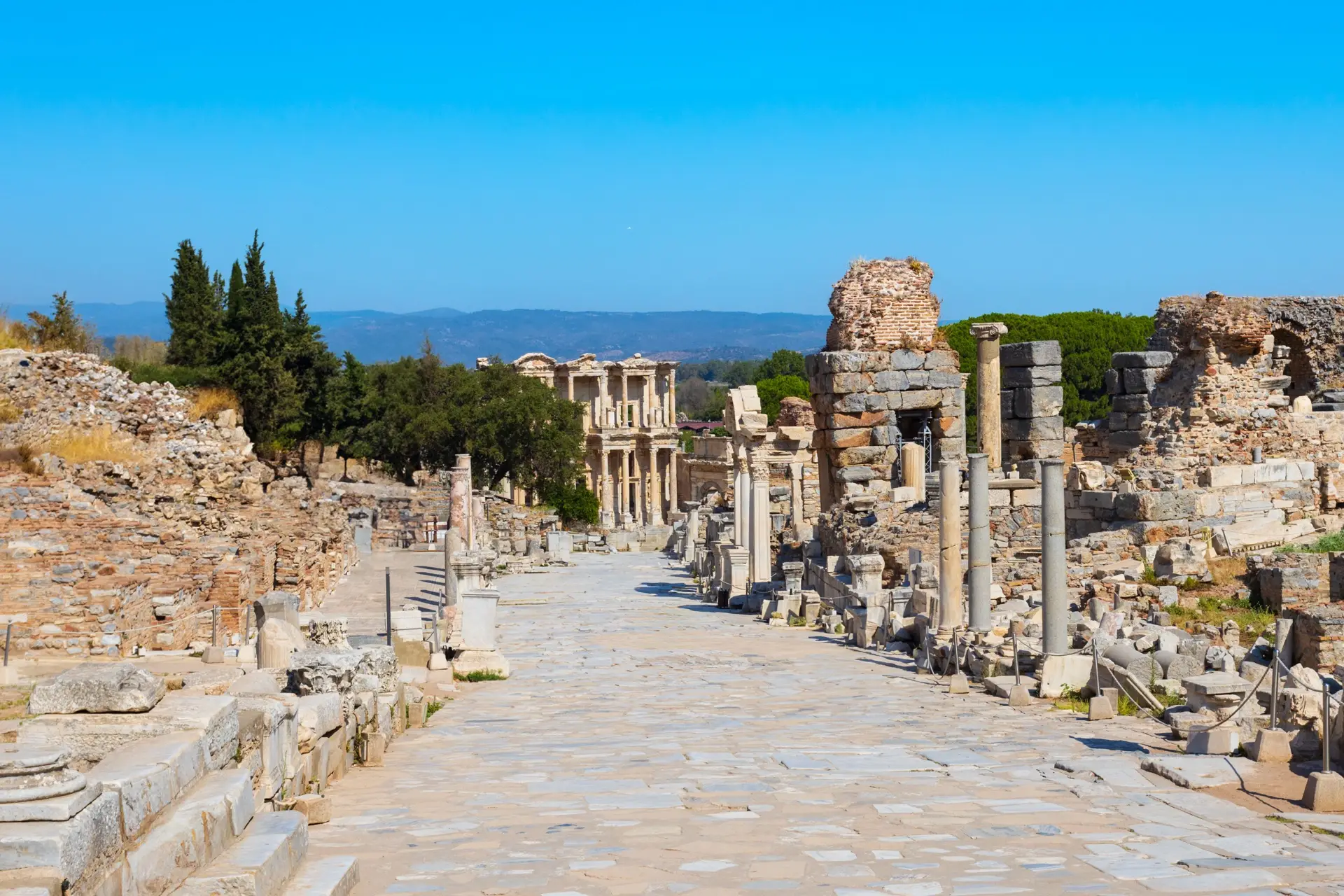
The walk is downhill from the Upper Gate — roughly 3 km of marble, gravel and stone from top to bottom.
Upper Gate or Lower Gate — the One Decision That Changes the Day
Start at the Upper Gate if a vehicle can collect you at the other end. Ephesus has two entrances about three kilometres apart and the site slopes downhill between them, so entering at the top means the family walks the city one way instead of climbing back up through it in the heat. Both gates sell the same ticket. Without transport, the Lower Gate is the practical choice, because the family returns to its own car — but it covers the same ground twice.
The Upper Gate (Magnesia Gate, the southern one) puts a family at the top of the ancient city, beside the State Agora and the Odeon. From there the route runs downhill along Curetes Street, past the Temple of Hadrian and the Terrace Houses. It arrives at the Library of Celsus at the natural low point, then finishes at the Great Theatre and the harbour road. The city reveals itself in the order it was built to be entered, and gravity does most of the work.
The Lower Gate (the northern one, nearer Selçuk) puts a family next to the Great Theatre. It is where the car parks are busiest, where the Ephesus Experience Museum sits, and where independent families most often land because it is the first one signposted from town. Starting here means the best of the site is uphill from the family, and the family walks the same ground twice.
Upper Gate (Magnesia)
Lower Gate (northern)
Direction of walk
Downhill, one way
Uphill, then back down
First major monument
Odeon and State Agora
Great Theatre
Distance walked
About 3 km, one way
Up to 6 km if the family goes the full length and returns
Coach and cruise traffic
Lighter early
Heavy from about 09:30
Needs a vehicle at the other end
Yes
No
Best for
Anyone with a driver, families, hot months
Independent families without transport
The reason a private vehicle changes the visit more than anything else is exactly this: your driver drops your family at the Upper Gate and collects it at the Lower Gate. The family walks three kilometres downhill and never retraces a step. Every Turkey Family Tours Ephesus day is built this way. In July and August that shape is the difference between finishing the site comfortably and finishing it exhausted.
Every Stop Inside the Ancient City, and What Each Is Worth
Fourteen stops make up the walk from the Upper Gate down to the Lower. Stopping properly at all fourteen adds up to close to four hours. Most families keep six or seven of them and finish in the two and a half to three hours the site really needs. The timings below assume a family stops, reads the panel and takes a photograph rather than sprint. With children under ten, expect to keep four or five of them and walk past the rest.
The Odeon — 15 minutes
A neat semicircular hall for about 1,400 people, first inside the Upper Gate. It served as the city’s council chamber (bouleuterion) and as a roofed concert space. Because it is small and intact, it is the best place on the site to explain how a Roman civic building worked, before anything spectacular distracts the family. Children take to it because they can sit in the seats and hear how well the acoustics still work.
The Odeon: council chamber and concert hall, and the first real building inside the Upper Gate.
The State Agora and the Prytaneion — 15 minutes
The administrative square, with the remains of a temple in the middle and, at its western end, the Prytaneion — the town hall, where a sacred flame was kept burning permanently for the city. The two large statues of Artemis now displayed in the Selçuk museum were found buried here. It reads as a field of stumps unless someone tells the family what stood where, which is the case for a licensed guide at this end of the site. It is also the stretch where children switch off, so keep it brief and move on.
Domitian Square and the Memmius Monument — 10 minutes
The point where the flat upper city tips into the downhill street. The Temple of Domitian was the first in Ephesus dedicated to an emperor, and the fragment of a colossal statue from it sits in the museum. Across the square, the Memmius Monument commemorates a grandson of the dictator Sulla. Do not linger. The good part starts fifty metres on.
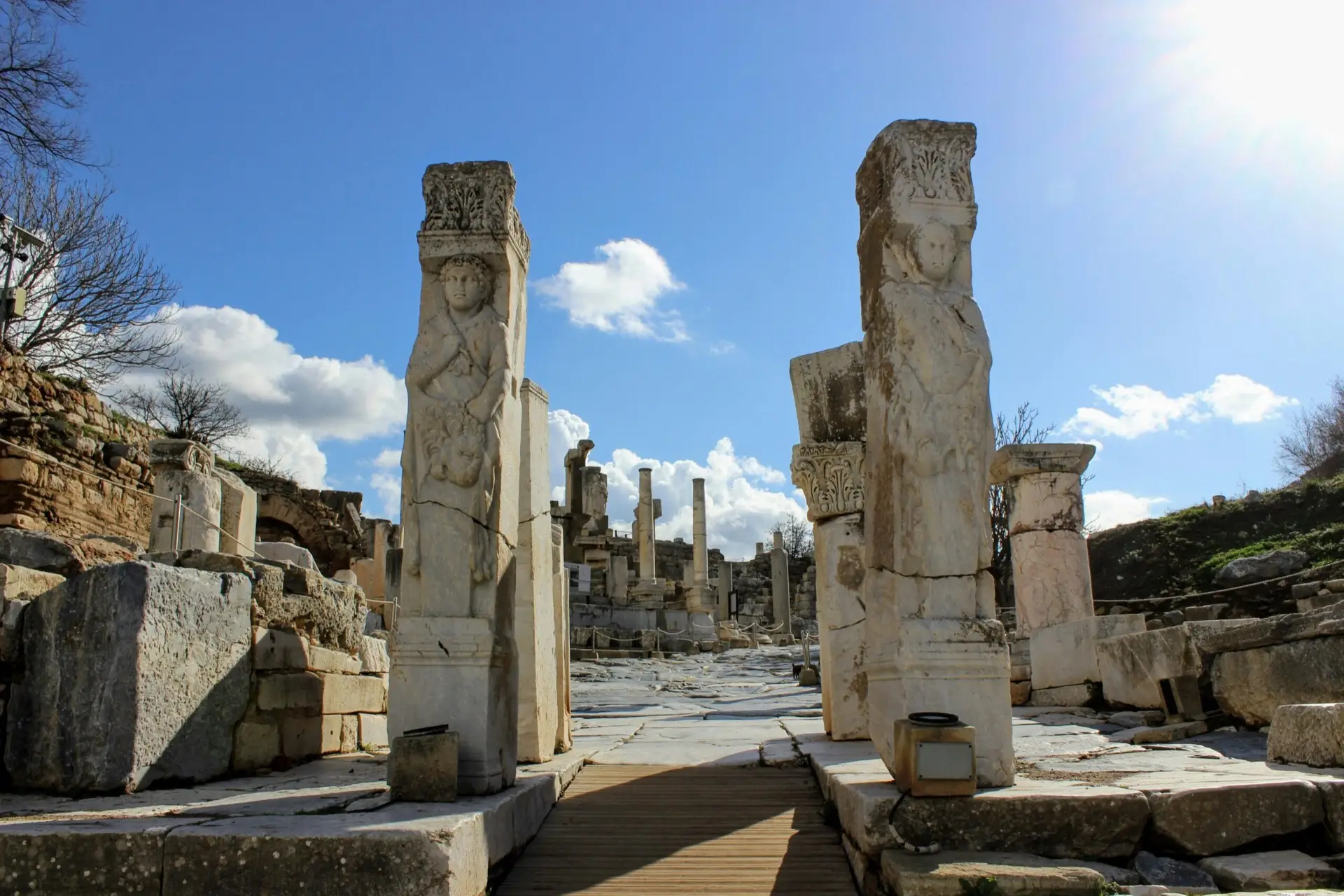
The Gate of Heracles and Curetes Street — 25 minutes
Two carved panels of Heracles in his lion skin mark the top of the street and the point where wheeled traffic was stopped. Below them, Curetes Street runs 210 metres downhill. There is marble paving with cart ruts, a colonnade on both sides, mosaic floors surviving in the covered walkways, and statue bases naming the men who paid for the city. This is the spine of the visit, and everything else hangs off it. It is also where most family photographs get taken.
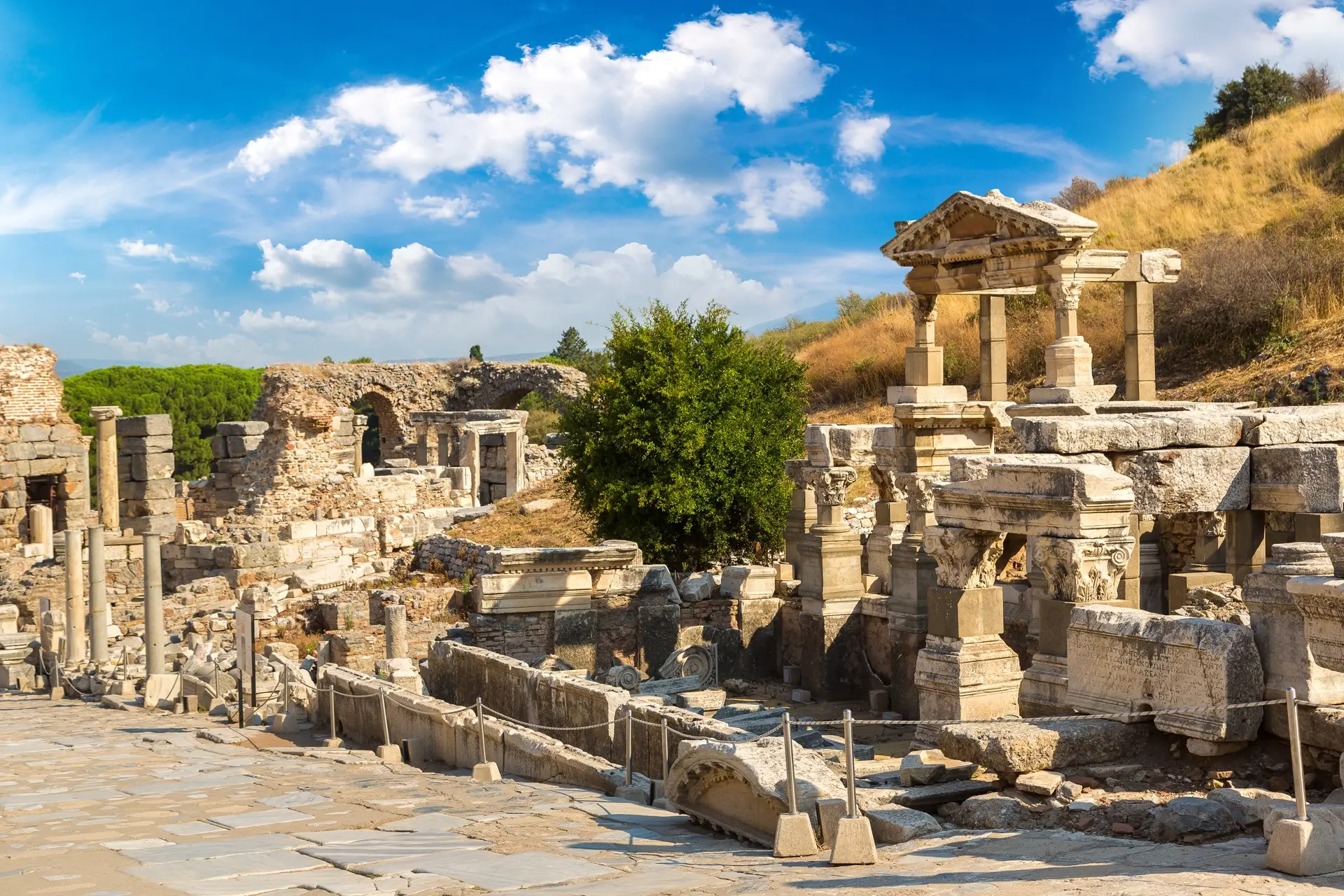
The Fountain of Trajan — 10 minutes
A two-storey fountain house from about AD 104, once holding a colossal statue of the emperor standing over a globe with water pouring from beneath his foot. Enough of the facade is re-erected to show the scale. The surviving foot and globe explain the arrangement to children better than any drawing.
The Temple of Hadrian — 10 minutes
The most photographed single facade on Curetes Street after the library: a small, delicate arch with Tyche on the keystone and a Medusa head in the porch, framed by four columns. The reliefs in place are casts. The originals are in the museum in Selçuk, which is a decent argument for adding that museum if a family has a full day.
The public latrines and the Scholastikia baths — 10 minutes
A rectangular room lined with marble seats over a running drain, with a pool in the middle. No stop on the site gets a bigger reaction from children, and none is a better lesson in how a Roman city actually functioned: running water, drainage, and no privacy whatsoever. The bath complex behind it belonged to the same block.
The Library of Celsus — 30 minutes
Built around AD 117 by a consul as a monumental tomb for his father, the governor Celsus, whose sarcophagus is still in a chamber beneath the floor. The two-storey facade was re-erected from its fallen pieces in the 1970s. The columns at the ends are deliberately shorter than those in the middle, so the front reads as wider than it is. The four statues in the niches, Wisdom, Knowledge, Intelligence and Virtue, are copies, and the originals went to Vienna. Stand back across the square to photograph it, and be here early. After 10:00 this is where every group in the city converges, and a family photograph without forty strangers in it stops being possible.
The Gate of Mazaeus and Mithridates and the Commercial Agora — 15 minutes
The triple arch beside the library was built by two freed slaves in honour of Augustus. It opens into the commercial market of the port city: 110 metres a side, once colonnaded, where the goods coming off the ships were sold. It is flat, open and hot. It is also where a family understands that Ephesus was a business before it was a monument, which is a harder sell to a nine-year-old at noon than the theatre is.
Marble Street — 10 minutes
The processional way running from the library towards the theatre, grooved by carts and lined on one side by the wall of the agora. The famous scratched slab on the pavement, with its foot, coin and female head, is usually explained as an advertisement for the brothel across the street. That reading is a guide’s story rather than a proven fact, and good guides say so while still telling it.
The Great Theatre — 25 minutes
Cut into Mount Pion and enlarged under successive emperors until it seated about 25,000, this is the largest surviving building of the ancient city. It is also where the silversmiths’ riot against Paul unfolded in Acts 19. Climbing partway up the seating gives the best single view in Ephesus: the theatre bowl in front of the family and the colonnaded harbour road running dead straight into the plain behind. Access to the upper tiers is periodically restricted for conservation, so the view your family gets depends on the year.
The Great Theatre seated about 25,000. Harbour Street runs from its foot towards the plain where the sea used to be.
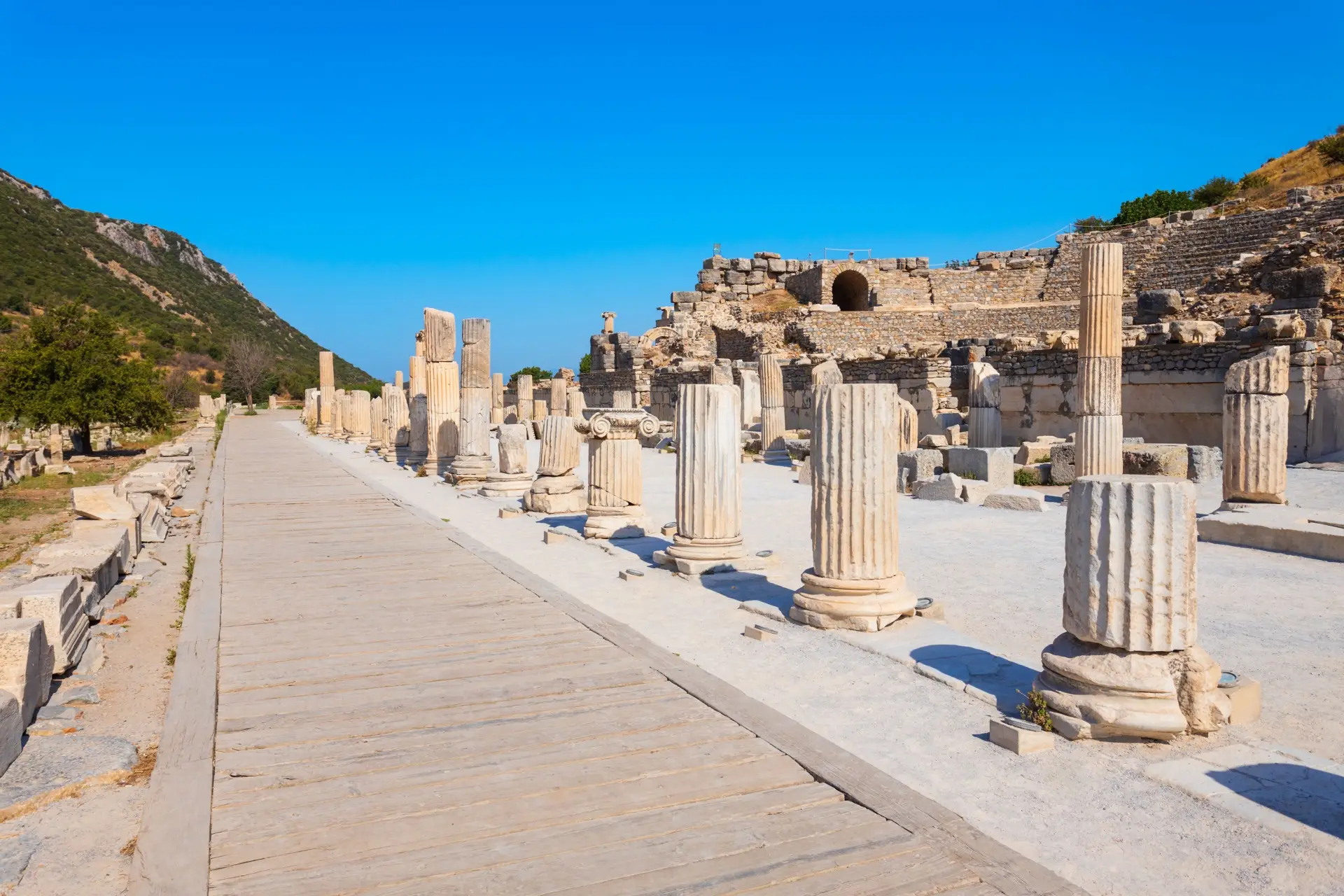
Harbour Street (the Arcadian Way) — 15 minutes
A 500-metre colonnaded avenue from the theatre to the vanished harbour, once lit by street lamps — one of very few streets in the ancient world recorded as having lighting at night. Today it ends in reeds and farmland. That emptiness is the clearest illustration of why Ephesus died, and the easiest thing on the site to explain to children: the sea used to be at the far end of it.
The Ephesus Experience Museum — 30 minutes
A projection hall near the Lower Gate, included in the main ticket, where the city is rebuilt in light and sound across the walls of three rooms. It is not a substitute for the ruins and it will not teach a family much. But it is air-conditioned and it lasts about half an hour, and after three hours in the sun it lands better as a finish than as a start.
The Church of the Virgin Mary — 15 minutes
Near the Lower Gate, off to the left as the family leaves: a long ruined basilica that hosted the ecumenical council of AD 431, the meeting that confirmed the title Theotokos. Most families walk straight past the turning. If the councils mean something to your family it is the most historically weighted stone on the site. If they do not, ten minutes is plenty.
Are the Terrace Houses Worth the Extra Ticket
The Terrace Houses cost €12 on top of the €40 Ephesus entry, taken as a €52 combined ticket, and they take 30–45 minutes. For most adults they are worth it. For a family with restless children at the end of a hot morning they are not, and they are the one part of Ephesus that is genuinely optional.
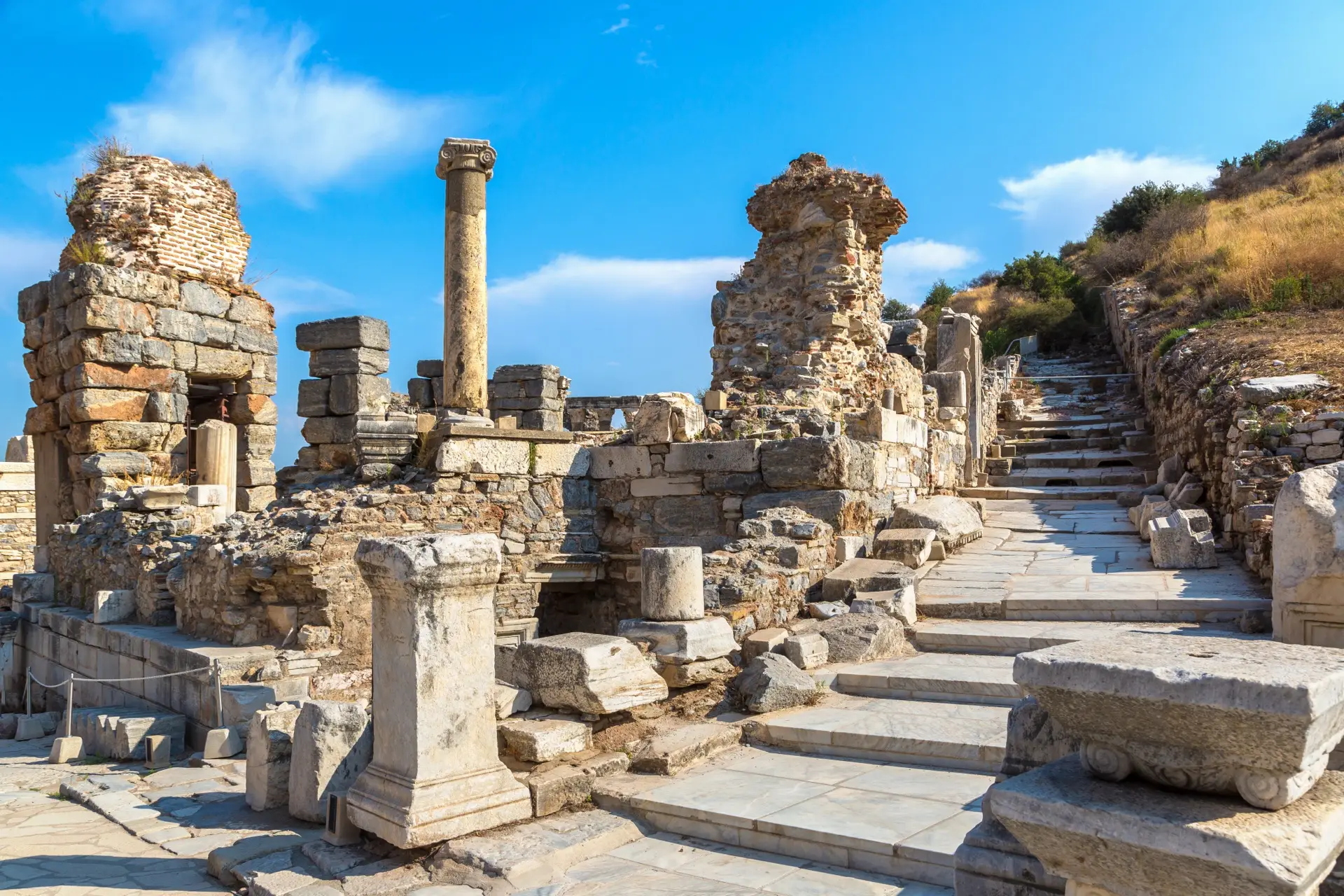
What a family gets is a covered excavation of seven wealthy houses stacked up the hillside opposite the Temple of Hadrian, roofed over and crossed by steel walkways at several levels. Inside are mosaic floors, marble wall panels and frescoes still on the walls in the rooms where they were painted. This is domestic decoration of the Roman elite, preserved because the hillside collapsed on top of it. There is a courtyard with a mosaic of Medusa, a room painted with theatre scenes, and a hall of reassembled marble panels that took decades to piece together.
Consider it if…
Skip it if…
The family cares about how people actually lived, not just civic monuments
The family is on a cruise call with a fixed return time
The family has three hours or more on site
Your children are already flagging — it is 30–45 minutes of steps
Mosaics and wall painting interest the family more than columns
Stairs are a problem: the walkways are the only route through
It is the hot part of the day — the roof gives real shade
The family is also doing the Selçuk museum and the Virgin Mary house in the same day
One practical note that trips families up: the Terrace Houses are inside the main site, halfway down Curetes Street, but the ticket is checked at their own door. If a family has only the €40 ticket the door does not reliably sell the upgrade, so decide before entering the site. On our tours the combined ticket is bought in advance by default. If a family tells us on the day that they would rather use the time elsewhere, nothing is lost but the supplement.
The hillside above Curetes Street: under the modern roof are the seven Terrace Houses.
The Christian Ephesus: Mary’s House, St John and the Council of 431
Ephesus has four Christian sites, and three of them sit outside the ancient-city fence with their own tickets and opening times: the House of the Virgin Mary 7 km above the ruins (about 700 TL, 45 minutes), the Basilica of St John on Ayasuluk Hill (€6, half an hour) and the Cave of the Seven Sleepers. The fourth, the ruined Church of the Virgin Mary where the council of AD 431 met, is inside the ticketed site. A large share of the families who come here are not primarily interested in Roman architecture at all. Ephesus is one of the earliest addresses of the Christian church, and the pilgrimage half of the visit needs planning as its own half-day rather than as an afterthought.
The House of the Virgin Mary
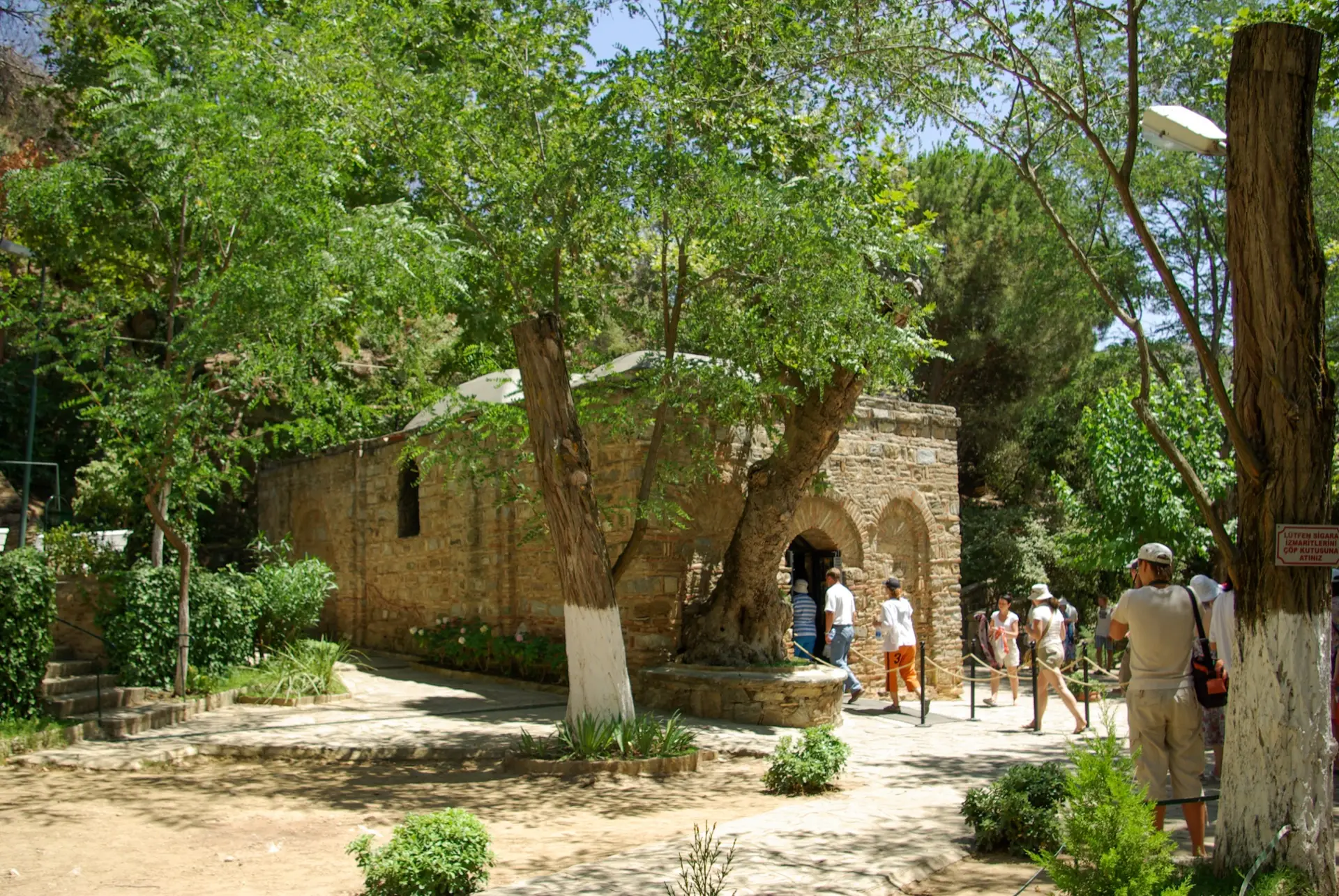
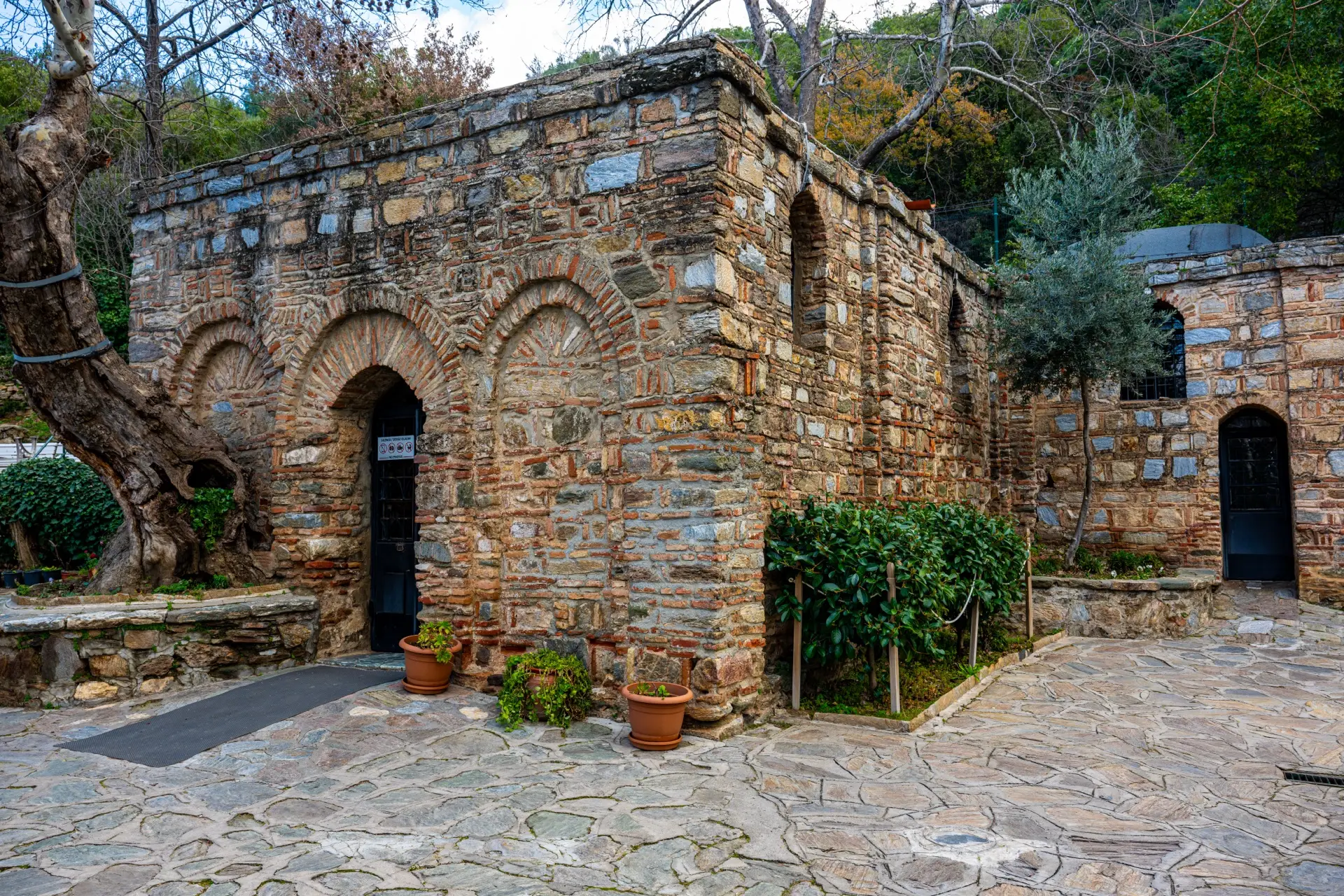
Seven kilometres above the ruins, at the top of a wooded road on Mount Bulbul, stands a small stone chapel. It is identified as the house where the Virgin Mary is said to have spent her last years in the care of St John. The identification rests on a nineteenth-century vision, later investigated and found to match a real ruined building. The Catholic Church has never pronounced on its authenticity. It has treated the site as a place of pilgrimage for well over a century, and several popes have visited. Entry is about 700 TL and it is not covered by the Museum Pass.
What a family finds is a single dim room, a spring below, a wall where visitors tie written petitions, and a queue. It takes 45 minutes including the drive up. It is quiet in a way the ruins never are, and pilgrims of two faiths come here. Families with older children usually find the calm a relief after the walk. Go early or late. The middle of the day brings the coaches up from the port, and the queue with small children in it is the part families remember.
The House of the Virgin Mary sits 7 km above the ruins — a separate ticket, a separate drive, and 45 minutes well spent.
The Basilica of St John on Ayasuluk Hill
In Selçuk itself, on the hill above the town, Justinian built a vast six-domed basilica in the sixth century over the traditional burial place of St John the Evangelist. The domes are gone, but the plan is complete and walkable, and the marble tomb is marked in the floor under the crossing. The view from the terrace takes in the Temple of Artemis below, the İsa Bey Mosque next door and the castle above. Entry is €6 and it takes half an hour. It is included in the UNESCO inscription along with the ancient city, and it is the site most day-trip families miss entirely. Children like it more than the ancient city, because the walls are low enough to see the whole plan at once.
The Church of the Councils and the Seven Churches
Ephesus is the first of the seven churches addressed in the Book of Revelation, and the ruined Church of the Virgin Mary inside the archaeological site — described in the walking list above — is where the Council of Ephesus met in AD 431 and settled the dispute over the title Theotokos. For groups following the seven churches route through western Turkey, Ephesus is the anchor, and Smyrna, Pergamon, Thyatira, Sardis, Philadelphia and Laodicea all fall within reach of it. We build that route as a private family itinerary when asked. It needs four days to be worth doing properly.
The Cave of the Seven Sleepers
A hillside of rock-cut tombs on the way back into Selçuk. The legend has seven young men sheltering from persecution and waking two centuries later, a story that survives in more than one religious tradition. It is viewed through a fence, it takes ten minutes, and it earns its place only if the family is already driving past.
Around Selçuk: the Museum, Artemis and Ayasuluk Hill
Four stops sit within ten minutes of the gate: the Ephesus Archaeological Museum in Selçuk (€10, about an hour), the Temple of Artemis (free, fifteen minutes), the İsa Bey Mosque of 1375 and the restored Ayasuluk Castle on the hill above, half an hour for the last two together. They are what turn Ephesus from a morning into a full day. They are also the ones that rescue an afternoon when children have had enough of ruins, because two of them are a museum and a village lunch rather than more stone.
The Ephesus Archaeological Museum, Selçuk
Everything portable from the excavations is here, five minutes from the ruins and catalogued on the national culture portal. The two great statues of Artemis of Ephesus stand in their own room, covered in what are variously read as breasts, eggs or bull testicles. Then come the frescoes and small finds from the Terrace Houses, the original reliefs from the Temple of Hadrian, and the giant fragments of the emperor Domitian. Entry is €10, an hour is enough, and it is the single best-value addition to an Ephesus day. Seeing the objects after the buildings they came from is the right order, and it is air-conditioned when the family has had enough sun.
The Temple of Artemis
One of the Seven Wonders of the Ancient World is now a marshy field with one reassembled column standing in it, usually with a stork nesting on top. Entry is free and it takes fifteen minutes. Its value is entirely in the contrast: a temple four times the footprint of the Parthenon, reduced to a single pillar. The Basilica of St John stands on the hill above it and a mosque beside it, so three religions sit in one view. Manage expectations before the family stops, particularly with children who have been promised a Wonder of the World, and it works well. Arrive expecting a standing temple and it disappoints everyone.
İsa Bey Mosque and Ayasuluk Castle
Below the basilica stands the İsa Bey Mosque of 1375, one of the finest surviving buildings of the Aydın emirate. Its columns were quarried from the ruins of Ephesus itself. The castle on the summit above has been restored and opened in recent years. Together they are half an hour, they cost a family almost nothing, and they close the loop on the site’s last thousand years — the part the ancient city cannot tell a family.
Şirince Village: the Hill Stop That Rescues the Afternoon
Şirince is a hill village nine kilometres above Selçuk, 20–25 minutes from the Lower Gate, and an hour to ninety minutes is what it is worth. It is a village of Greek stone houses left behind by the 1923 population exchange, now given over to fruit wine, olive oil, lace and lunch. It sits about 250 metres higher than the ruins, which is the practical point: it is measurably cooler and it is shaded. Most Turkey Family Tours Ephesus days stop here for lunch for exactly that reason.
The main lane is frankly touristy, and families are offered tastings of peach and pomegranate wine every twenty metres. Climb two streets above it, though, and a family gets shuttered stone houses, vines and a view down the valley that explains why people never left.
What an hour and a half in Şirince actually buys a family:
A shaded lunch off the site during the worst two hours of heat, which is the single best use of early afternoon in July and August.
Cold water and real toilets after three kilometres of marble with neither.
Something for children who have had enough ruins — cats, steep lanes, a village bakery, stalls selling dried fruit.
The lace and olive-oil stalls, which are the one shopping stop on this coast that families ask for rather than get driven to.
A church at each end of the village, St John the Baptist below and a ruined chapel above, both free and both empty by mid-afternoon.
Twenty minutes back down to the main road, so it costs the itinerary almost nothing.
Allow an hour to ninety minutes plus the twenty-minute drive each way. It is the reason a private vehicle beats a coach here: a family goes up when the coaches have gone down. Most families with older children prefer it to a second archaeological site. It is also the natural stop if the family is heading on to Pamukkale afterwards, as the two-day Ephesus and Pamukkale tour does.
Şirince: Greek stone houses, fruit wine and a lunch that gets a family off the site during the worst of the heat.
The Ephesus Cruise Port: Shore Days from Kuşadası
Ephesus is 19 km from the Kuşadası cruise berths, 20–25 minutes each way. On a standard call, alongside at 07:00 or 08:00 and all aboard at 16:30 or 17:00, a family has a comfortable seven hours ashore, which is more than the site needs. The mistake is not lack of time. It is spending the good hours in a queue behind other people’s buses.
Kuşadası’s Ege Port handles in the region of 620 ship calls and close to a million passengers in a full season, across eight berths. The ruins are the reason nearly all of them come. That single fact governs the rhythm of the site. Crowding at Ephesus is not really a function of the calendar. It is a function of how many hulls are alongside that morning, and a family arriving at ten on a four-ship day meets all of them.
Time ashore
What genuinely fits
Back on board with
4 hours
Ancient city only, Upper to Lower Gate
30–60 minutes to spare
5–6 hours
Ancient city + Terrace Houses + House of the Virgin Mary
1 hour to spare
7–8 hours
All of the above + Selçuk museum or Şirince and lunch
1 hour to spare
Overnight call
Add the Basilica of St John, Artemis and the old town of Kuşadası
Evening in port
How to time it against the other ships
The ship’s own excursion coaches leave the pier in a block, usually between 08:30 and 09:15, and they nearly all enter at the Lower Gate. If your family is ashore independently and standing at the Upper Gate at 08:00, the family walks downhill through an empty city. It meets those groups coming the other way around the library at about ten o’clock, by which point it is past them. That single hour of offset is worth more than any other decision a family makes on a call day.
Independent versus the ship’s excursion
The genuine risk of going independently is the sailing time: a ship will not wait for a family, whereas it will wait for its own coach. That risk is what a licensed operator manages for a family. We plan the day against your all-aboard time and build a written return margin into the itinerary. In exchange the family gets a private vehicle rather than a 45-seat coach, and a guide talking to your family rather than to a microphone. There is no compulsory carpet or leather demonstration, and the family leaves at the hour that suits the children. If your call is short, or the family includes someone whose mobility is uncertain, the ship’s own tour is the more forgiving choice and we will say so.
What a family should settle before the ship berths:
All-aboard time in writing, and a return margin of at least 90 minutes against it.
Which gate you enter — Upper if a vehicle is meeting you, Lower if you are on your own.
Terrace Houses in or out. On a short call with children, out.
Whether the House of the Virgin Mary matters to the family, because it adds 45 minutes and a separate ticket.
Lunch plan. Şirince if the family has seven hours ashore, the port if it has four.
No shopping stops, stated up front. This is the hour most families lose without noticing.
The same street at 08:00 and at 11:00 is two different visits. On a heavy ship day the gap is bigger still.
How Long You Actually Need
The ancient city alone is two to three hours at a normal family pace, or three to four if you add the Terrace Houses. Everything after that is a question of how many surrounding sites the family adds. Here is the arithmetic.
You have
What to do
What you give up
Half a day (4 hrs)
Ancient city, Upper to Lower Gate, with the Terrace Houses
Mary’s house, the museum, Şirince
One full day
Ancient city + Terrace Houses + House of the Virgin Mary + Selçuk museum
Şirince, a proper lunch
One day, family pace
Ancient city + Terrace Houses + Şirince and lunch
The museum and the basilica
Day trip from Istanbul
Ancient city + Terrace Houses + Mary’s house, flights both ways
Everything in Selçuk town, and an early night
Two days, based in Selçuk
All of the above plus the basilica, Artemis, the castle and Şirince at leisure
Nothing
If a family is fitting Ephesus into a longer route, one full day on the ground is the right allocation. That is what our 7-day Istanbul, Cappadocia and Ephesus tour gives it. Adding a second day here costs a family either Pamukkale or Cappadocia. The 7-day itinerary breakdown shows how that day sits against the flights either side of it.
Two to three hours covers the ancient city. Everything after that is a decision about the sites around it.
What an Ephesus Day Costs a Family of Four
A full independent day at Ephesus costs a family of four about €594–724, and tickets are less than half of it. The figures below are for two adults and two children aged nine and twelve, doing one full day from a Kuşadası base: the ancient city with the Terrace Houses, the House of the Virgin Mary, the Selçuk museum and lunch in Şirince. State entry prices are set nationally and quoted in euros. Everything else is a market rate and moves.
Item
Independently
Note
Ephesus + Terrace Houses combined ticket
€208
€52 each; children under eight would be free
House of the Virgin Mary
about €76
roughly 700 TL per person, cash or card
Ephesus Archaeological Museum
€40
€10 each, worth it after the ruins
Transport for the day
€90–130
taxi to the Upper Gate, pick-up at the Lower Gate, on to Şirince and back
Licensed guide, hired for the site
€120–180
booked in advance, not taken at the gate
Lunch and water
€60–90
Şirince prices, four people
Day total
€594–724
before anything goes wrong
Two things surprise families about that column. The first is how little of it is the famous ticket: entry to the ancient city is barely a third of the day. The second is that the two variable lines, transport and guide, are the ones that decide whether the day works, and they are the two hardest to arrange well from a hotel lobby the night before.
Where the money goes wrong. Four mistakes account for most of the overspend we hear about:
Buying a Museum Pass for one site. The Aegean regional pass only pays for itself across Ephesus, Pergamon and Hierapolis at Pamukkale. For a single day it is a loss.
Taking a guide at the gate. The rate is higher, the licence is unverifiable, and the shopping stop usually follows.
Two taxis instead of one vehicle. Families who start at the Upper Gate without arranging the pick-up pay twice and wait in the sun for the second car.
A carpet or leather stop sold as culture. It is free to attend and costs a family an hour of the cool part of the day, which is the most expensive hour it has.
On a private day with Turkey Family Tours, every line in that table sits inside one quoted price, including the Terrace Houses supplement and the tickets outside the fence. Our fly-in Ephesus day from Istanbul is USD 550 per person with return flights, and shore days from the port are quoted per family against your ship’s call times. Children are priced by age: 0–3 at 30% of the adult rate, 4–6 at 60%, and the adult rate from seven. Ask us to cost the whole day →
Children, Older Walkers and What the Site Provides
Ephesus suits children from about six upwards better than almost any other archaeological site in Turkey, because enough is standing for a child to picture the rest. The constraint is not interest, it is ground and heat: three kilometres of uneven marble with almost no shade over the first half. Ephesus is a working excavation rather than a managed attraction, and the ground tells a family so within five minutes. Knowing that before a family arrives is most of the preparation, particularly with young children or grandparents in the group. Families weighing the wider practicalities of the country will find them in our guide to travelling in Turkey with children.
What the walking is like
From the Upper Gate to the Lower Gate is about three kilometres, downhill overall but not evenly. Curetes Street is a steady slope on polished marble, slippery when wet and uneven everywhere. Trainers or walking sandals, not smooth soles. There is almost no shade between the Upper Gate and the library — the colonnades that once roofed the pavement are the very thing that fell down.
With children
The stops that hold children are specific and predictable. They are the latrines, the theatre where they can climb and test the acoustics, the cart ruts on Marble Street, and the Experience Museum at the end. The stops that lose them are the State Agora and the long stretch of the Commercial Agora. A pushchair is possible on the main street. It is genuinely awkward on the side routes and impossible in the Terrace Houses, so a carrier is easier for anyone under three. Families should bring more water than they think, start at 08:00, and plan to be off the site by lunchtime in summer.
Limited mobility and grandparents
The main route is walkable at a slow pace by anyone comfortable with three kilometres on uneven ground. The Terrace Houses are the exception and are effectively out of reach for anyone who cannot manage several flights of steel stairs. Wheelchair users generally do better entering at the Lower Gate, where the ground near the theatre and Harbour Street is flattest. Cover the lower city rather than attempting the full descent. A private vehicle that can meet the family at either gate removes the hardest part of the problem. Conditions change with excavation work, so if mobility is the deciding factor, tell us before booking and we will confirm the current state of the routes rather than guess.
Facilities on site
There are toilets and a café at both gates and toilets near the theatre, but almost nothing in between — use them at the gate the family starts from. Water and cold drinks are sold at both entrances at tourist prices. Bring a full bottle each. There is no shade to sit in along Curetes Street, no ATM inside, and phone signal is fine throughout. Hats and sunscreen are not optional between May and September.
What families actually need in the bag, based on the days we run here:
One litre of water per person, filled at the gate. The kiosks inside are 500 metres apart and priced accordingly.
Hats for every child and sunscreen applied before the family enters, not halfway down Curetes Street.
Closed shoes with grip. The marble is polished by two thousand years of feet and is genuinely slippery after rain.
A carrier rather than a pushchair for anyone under three, because the side routes and the Terrace Houses defeat wheels.
A card, not euro cash, for the gate and the cafés. Euro notes are refused at state ticket offices.
Something for the children to look for — the Medusa head, the cart ruts, the scratched pavement near the library. A short list beats a long lecture.
A light layer in spring and autumn, because the wind off the plain is cool until the sun is properly up.
When to Come — Heat, Shade and the Ship Calendar
April, May, September and October are the best months to visit Ephesus, with the site at 18–30°C and bearable through the whole day rather than just the first two hours. Ephesus is open 365 days a year, but between June and September it sits at 33–38°C on white marble with no cover. The difference between a good family visit and a punishing one is a matter of month and hour rather than luck.
Season
Conditions on site
Crowds
Verdict
April–May
18–27°C, green hills, wild flowers on the slopes
Building, heavy on cruise days
Best overall
June
28–33°C, dry and bright
Busy
Good if the family starts at 08:00
July–August
33–38°C, no shade, marble radiating heat
Peak, both cruise and land
Only very early or after 16:00
September–October
24–30°C, warm sea, softer light
Steady, easing through October
Best for families
November–March
10–17°C, some rain, shorter hours
Quiet, site almost empty
Excellent if the family accepts the marble is slippery
Two rules beat every other piece of timing advice for families visiting Ephesus. First, be at the gate when it opens at 08:00 — a family gets the library to itself and is finished before the worst of the heat. Second, on any day between May and October, assume the site fills between 09:30 and 13:00 as the ships and the coach tours arrive, and empties again after about 15:30. Late afternoon is the second-best window, and the light on the library facade is better then than in the morning. Current forecasts for the coast are published by the Turkish State Meteorological Service. For how the Aegean fits against the rest of the country, our guide to the best time to visit Turkey compares the regions month by month.
There is no shade between the Upper Gate and the library. In July that single fact decides what time a family arrives.
Where to Base Yourself
Four bases put Ephesus between five and seventy-five minutes from the family’s hotel door: Selçuk at 5 minutes, Kuşadası at 25, Şirince at 25 and İzmir at 1 hour 15. They suit completely different family trips. Where each base falls inside a wider route is covered in our guide to planning a trip to Turkey.
City hotels, restaurants, an evening on the waterfront
Too far for an 08:00 arrival at the gate without an early start
For most of the families we plan for, the answer is one night in Selçuk or Kuşadası on a route between Cappadocia and Pamukkale. That is long enough to reach the gate at opening, and short enough that the coast is not eating days from the rest of the country. If Ephesus is the whole reason for the trip, two nights in Selçuk and a day in Şirince is a better holiday than either. Hotels on our routes are booked and confirmed as part of the itinerary, which is set out on the 8-day Istanbul, Cappadocia, Pamukkale and Ephesus tour.
What to Skip, and What Not to Pay For
One hour is the standard length of the shopping stop built into most coach days on this coast, and for a family it is the first thing to cut. Several other things sold around Ephesus are not worth a family’s time or money either. None of them appear on our private Ephesus itineraries. This is the part most operators leave out.
The carpet, leather and jewellery “demonstrations.” Almost every coach tour on this coast ends at a workshop where the guide receives commission on what you buy. It costs a family an hour, it is presented as cultural content, and it is the most common complaint we hear about other people’s Ephesus days. None of our tours include one, in Selçuk or anywhere else.
Guides selling at the gate. A licensed guide is genuinely worth having at Ephesus — most of what survives is foundation rather than standing facade, and the difference is explanation. But hire one who is licensed and booked, not one who approaches the family in the car park. Guiding in Turkey is a regulated profession. Individual guides are licensed by the Ministry of Culture and Tourism and carry a badge, while agencies hold a licence from TURSAB; our own licence number is 13538 and every guide on our tours carries a Ministry badge.
The Cave of the Seven Sleepers as a destination. Ten minutes through a fence. Fine if the family is passing, but not worth a detour.
The Temple of Artemis with high expectations. Free and fifteen minutes, but if the words “Seven Wonders” have the family picturing a standing temple, read the section above first.
A second archaeological site in the same day. Priene, Miletus and Didyma are genuinely good and an hour south, but stacking them onto Ephesus produces a day no family enjoys. Give them their own morning or leave them.
Buying separate tickets one by one. If a family is visiting three or more state sites in the same week, price up the Museum Pass first. For a single day at Ephesus it does not pay.
Midday in July. Not a scam, just a mistake. The gate opens at 08:00 for a reason.
Is Ephesus Worth Visiting? The Verdict
Ephesus is worth visiting: two to three hours buys a family the most complete ancient city that can be walked in the Mediterranean, and the moment Curetes Street opens onto the library facade is the one families come for. There are conditions attached, though, and they are worth knowing before a family builds a trip around it.
It is worth it if you want to walk a real city rather than look at a monument. It is worth it if the Roman world or early Christianity interests anyone in the family, if the family can reach the gate early or late, and if it accepts three kilometres on hard ground. Families with children between about six and fifteen do better here than at almost any other archaeological site in Turkey, because enough is standing for a child to imagine the rest. Younger children need the shorter version of the day.
It is a harder sell if your only window is the middle of a July day, or if walking distance is a real constraint for someone in the family. It also disappoints anyone expecting the interpretation to come to them. The on-site panels are thin, and without a guide much of the upper city stays anonymous. It is least rewarding as a rushed stop bolted onto a long drive. Give it a morning or give it a miss.
Against the other headline sites in the country: Ephesus gives a family more standing architecture than anywhere in Turkey except Istanbul, and more of a coherent city than Pergamon, Hierapolis or Aphrodisias. It is not landscape in the way Cappadocia is, and it is not spectacle in the way Pamukkale is. It is the one where a family understands how people lived. Most first-time family routes through Turkey should include it, and our ranking of where to go in Turkey puts it where the evidence puts it. If a family is weighing it against Cappadocia or the travertines, our guide to what Cappadocia gives a family and our guide to the travertine terraces at Pamukkale make the same case for those two.
A fifth of the city has been excavated. It is still the most complete one a family can walk on this coast.
Our Private Tours That Include Ephesus
Turkey Family Tours is a TURSAB-licensed Turkish operator, no 13538. We run Ephesus as a private family day with a private vehicle and driver, a dedicated licensed local guide, and every entry ticket bought in advance, including the Terrace Houses. No coach, no shopping stops, and no fixed departure time to drag a family out of bed for. Prices are per person in USD and fall as the group grows. A 25% deposit confirms a date, and the remaining 75% is paid on arrival in Turkey, in cash or by card. Every family enquiry is answered with a costed itinerary within 24 hours.
Children are priced by age on every one of them: ages 0–3 at 30% of the adult rate, 4–6 at 60%, and from seven the adult rate. The full range is on our private Turkey tours page, and the Ephesus-specific departures sit under Ephesus tours. Longer routes that reach the Aegean are set out in the 14-day private Turkey tour. We are rated 5.0 from 33 reviews on TripAdvisor, and we are a Skylux-accredited agency.
Want Ephesus planned around your dates rather than a coach timetable?
Tell us when you are travelling, who is coming and where you are starting from — Istanbul, a Kuşadası berth or an İzmir flight. You get a costed private itinerary back within 24 hours, tickets included, no obligation.
Entry to the ancient city, which now includes the Ephesus Experience Museum, is €40 per adult. The combined ticket that adds the Terrace Houses is €52. Everything outside the fence is charged separately. The House of the Virgin Mary is about 700 TL, the Selçuk museum €10 and the Basilica of St John €6. The Temple of Artemis is free. State ticket offices take cards and Turkish lira, but they will not accept euro or dollar cash even though prices are quoted in euros. Children under eight enter free, and from eight upwards it is the full adult rate. On our private Ephesus day tours every ticket is bought in advance and included in the price your family is quoted.
The gates open at 08:00 every day of the year, including public holidays, though state museums can open late on the first morning of a religious holiday. Through the long summer season the site closes at 19:30, with the last tickets sold at 19:00. In winter both times move earlier, to roughly 17:00–17:30, so a late afternoon arrival in January leaves a family very little. Hours shift with the season and occasionally with excavation work, so check the Ministry portal in the week the family travels rather than trusting a printed guidebook. Being at the gate when it opens is the single most useful decision families make here, because the first hour is quiet and cool. Our month-by-month timing guide sets out how the seasons compare across Turkey.
Allow two to three hours for the ancient city walked at a normal pace, or three to four if you add the Terrace Houses. A full day lets a family finish the ruins in the morning and add either the House of the Virgin Mary and the Selçuk museum, or Şirince village and a proper lunch. Families with younger children should plan for the shorter version, because the heat matters more than the distance. Two days based in Selçuk covers everything inside the UNESCO area without rushing anyone. On a week-long route through Turkey, one full day is the right allocation, as our 7-day Turkey itinerary shows against the flights either side of it.
Start at the Upper Gate if a family has a vehicle that can collect it at the other end. The site slopes downhill from there. A family walks about 3 km one way instead of climbing back through the heat, and the family meets the monuments in their original sequence. Without transport the Lower Gate is the practical choice, because the family returns to its own car, but covers the same ground twice and may walk closer to 6 km. Both gates sell the same ticket and both have toilets and a café. Every family day we run starts at the top and finishes at the bottom, including the private day trip from Istanbul.
For most adults, yes. The supplement is €12 on top of the €40 entry, taken as a €52 combined ticket, and it buys covered access to seven Roman houses stacked up the hillside with mosaic floors and wall paintings still in the rooms where they were made. It takes 30–45 minutes and the modern roof gives real shade in summer. Skip it if your children are already tired, if stairs are a problem, or if a cruise call has the family working to a fixed all-aboard time. Decide before entering the site, because the supplement is not always sold at the door. Our 2-day Ephesus and Pamukkale tour includes it by default.
It is 19 km and 20–25 minutes by road. From the cruise berths a taxi or a booked private transfer goes straight to either gate. The public route is a minibus from Kuşadası to the Selçuk bus station, then a second one or a short taxi. It is cheap, but it costs a family the cool part of the morning. On a ship day the timing matters far more than the method. The excursion coaches leave the pier in a block between 08:30 and 09:15, and nearly all enter at the Lower Gate. Families who reach the Upper Gate by 08:00 stay an hour ahead of them. We run pier-to-pier private shore days with a written margin against all-aboard.
Yes, by air rather than by road. The flight timetable fixes the shape of the day. An early departure from Istanbul, landing at İzmir around breakfast, then about an hour by road to the site. The ancient city and the House of the Virgin Mary fill the middle of the day, and an evening flight brings the family back. Door to door it runs 13–14 hours, which is long for children under six but manageable from about seven upwards. Our private version costs USD 550 per person and includes return flights, a private vehicle with driver, a licensed local guide and every entry ticket. The private tour options for the day shows exactly what fits.
It is one of the better ancient sites in Turkey for children, because enough is standing for them to picture the rest. The stops that land with children are predictable. The public latrines, the Great Theatre where they can test the acoustics from the stage, the cart ruts cut into Marble Street, and the air-conditioned Experience Museum at the finish. The constraints are heat and distance, roughly 3 km with almost no shade. Start at 08:00, carry more water than the family expects to need, and plan to be off the site by lunchtime between June and September. A pushchair works on the main street but not in the Terrace Houses. Our Turkey travel guide covers pacing for families across the country.
Most of the site survives as foundations rather than standing walls, and the on-site panels are thin, so a guide changes how much of it a family understands. That is most obvious in the upper city, where the State Agora and the Prytaneion read as rubble without explanation. Hire one who is licensed and booked in advance rather than one who approaches the family in the car park. Guiding is a regulated profession in Turkey: individual guides are licensed by the Ministry of Culture and Tourism and carry a badge, while agencies hold a TURSAB licence. Turkey Family Tours is TURSAB-licensed under no 13538, and every guide on our privately guided family itineraries carries a Ministry badge.
No. For a family it sits 7 km above the ruins on Mount Bulbul, it is administered separately, and it costs about 700 TL per person. It is not covered by the Museum Pass either, which catches out a lot of independent visitors who assume one ticket covers the whole UNESCO area. Allow 45 minutes including the drive up through the pines. What a family finds is a small stone chapel, a spring below it and a wall of written petitions, visited by pilgrims of two faiths. Go early or late, because the coaches come up from the cruise port through the middle of the day. Our Ephesus day tour by plane includes it as standard.
April, May, September and October. Temperatures sit between 18 and 30°C, the light is good and the site is bearable through the whole day rather than just the first two hours. July and August reach 33–38°C on white marble with no shade, so they work only very early or after 16:00. November to March is quiet, green and cheap, with shorter opening hours and marble that turns slippery in the rain. Crowding follows the cruise calendar more than the calendar month, so a Tuesday with four ships alongside is busier than a Saturday with none. Our guide to the best time to visit Turkey compares the Aegean with Cappadocia and Istanbul.
Partly, and the answer depends on which part. The flattest ground is at the lower end of the city, around the Great Theatre and Harbour Street. Wheelchair users generally enter at the Lower Gate and cover the lower city rather than attempting the full descent. The 3 km route from the Upper Gate is uneven marble with a steady slope, walkable slowly by anyone comfortable on rough ground. The Terrace Houses are reached only by steel stairs and are effectively out of reach otherwise. Conditions change with excavation work, so tell us in advance and we will confirm the current routes rather than guess.
A private day at Ephesus from Istanbul, with return flights, a private vehicle with driver, a licensed local guide and all entry tickets, starts at USD 550 per person. Adding Pamukkale over two days is USD 990. Where Ephesus sits inside a longer route, the day itself is absorbed. A 7-day Istanbul, Cappadocia and Ephesus tour starts at USD 2,450 per person, and an 8-day version that adds Pamukkale starts at USD 2,790. Prices are per person and fall as the group grows. Children are priced by age: 0–3 at 30% of the adult rate, 4–6 at 60%, and the adult rate from seven. See the 7-day tour page for what each day includes.
Seven days is the working minimum for a first trip that includes Ephesus properly, and that means Istanbul, Cappadocia and Ephesus with one full day each and domestic flights between them. Eight days adds Pamukkale, which sits 2 hours 45 from Selçuk and pairs naturally with the Aegean leg. Anything under six days forces a family to choose between Cappadocia and the coast, and families almost always regret cutting Cappadocia. Two weeks lets a family add Gallipoli and the Mediterranean without moving hotels every night. Our 8-day Turkey itinerary sets out how the Ephesus and Pamukkale days fit together with the driving between them.
For the school-holiday peaks, three to four months ahead is sensible, because the constraint is rarely the site and almost always the hotels and the internal flights. April, May, September and October fill first for families. Outside those windows four to six weeks is usually enough, and we have built good days at ten days’ notice more than once. Cruise shore days are the exception: match your booking to the moment your sailing itinerary is confirmed, because berth times move. We answer every enquiry with a costed itinerary within 24 hours, so it costs nothing to test a date early. Send us your dates and we will tell you whether they still work.
A 25% deposit confirms your dates and is non-refundable, because it is what we use to hold hotels, guides and internal flights. The remaining 75% is paid on arrival in Turkey, in cash or by card, so nothing large sits on a family’s credit card for months before travel. Cancellation within seven days of the start date, or a no-show, is charged in full. Before that the deposit is the only loss. Quoted prices are fixed once confirmed and do not move with exchange rates. Everything is booked through Turkey Family Tours as a TURSAB-licensed agency, no 13538. The terms are restated on every tour package page before the family commits.
Yes, and it is the stop that rescues the afternoon. Şirince is a village of Greek stone houses nine kilometres above Selçuk, left behind by the 1923 population exchange and now given over to fruit wine, olive oil, lace and lunch. It is 20–25 minutes from the Lower Gate and sits about 250 metres higher than the ruins, so it is measurably cooler and shaded — which is the whole point in July and August. Entry is free and only the parking is charged. Allow an hour to ninety minutes plus the drive each way. Climb two streets above the main lane and the tastings give way to shuttered stone houses and a view down the valley. Our 2-day Ephesus and Pamukkale tour stops there for lunch.
Where Ephesus Fits in a Turkey Route
One full day is what Ephesus needs inside a longer route, and almost no family flies to Turkey for it alone. It is a single stop on the western loop, and the real question is what it sits between.
The classic seven days, Istanbul then Cappadocia then Ephesus, gives each place a proper day and moves by domestic flight rather than by road. That is the shape of our one-week route through the country, and it is the version most first-time families should book. Eight days adds Pamukkale, which is two and three-quarter hours from Selçuk and pairs naturally with Ephesus in the same leg; the full catalogue sits under our private Pamukkale tours and Cappadocia tours. The 8-day itinerary sets out how the driving day works. Beyond that, adding Gallipoli and the Mediterranean coast turns it into a fortnight: the 10-day private tour and the 12-day version both keep Ephesus as a full day rather than a stop on the way somewhere else.
If a family is still deciding how many days the country needs, our country-wide planning guide works through the arithmetic and the ten-day route shows what a slower version looks like. Our month-by-month weather and crowd comparison tells a family when the Aegean and Cappadocia are good at the same time. For the two places most often paired with Ephesus, start with the Pamukkale guide and the Cappadocia guide. If the trip starts in the city, the Istanbul guide and our private Istanbul tours cover the days either side of the flight, and families with under a week to spend usually end up on the five-day two-city route instead. What families eat along the way is a bigger part of the trip than most expect, and our Turkish food guide covers what children actually order.
One full day is the right allocation for Ephesus on a week-long route — enough for the city, the Terrace Houses and Mary’s house.
Ephesus rewards planning more than most places in Turkey. Almost everything that goes wrong there is a scheduling problem rather than bad luck: the heat, the crowds, the wrong gate, the missed museum, the hour lost in a carpet shop. Get the timing right and it is the best day of the trip.
The best time to visit Turkey in October: a warm, settled autumn shoulder season with ~90% Cappadocia balloon mornings and thin crowds — private tour itineraries and costs. TURSAB-licensed.
Pamukkale guide: white travertines, Cleopatra’s Antique Pool, Hierapolis ruins, best time to visit, family tips. Natural wonder on Turkey’s southwest coast.
A first family trip to Turkey runs five to fourteen days across five regions: Istanbul, Cappadocia, Ephesus, Pamukkale and the Mediterranean coast. Private tours run from USD 190 for a day in Istanbul to USD 4,450 for fourteen days.
Blue Mosque Istanbul explained: a working mosque with no entrance ticket, ~08:30 opening and five daily prayer closures, plus dress code, headscarves and the half-day Sultanahmet route past Hagia Sophia 200 metres away.
A day-by-day private Turkey route built around US school breaks and direct flights from 12 American gateways — fixed quote in US dollars within 24 hours.
Turkey is safe to visit for families. A TURSAB-licensed operator covers travel advisories, Istanbul safety, earthquake zones and why a private guided tour is the safest choice.
Gallipoli & Troy travel guide: Anzac Cove, Lone Pine, Chunuk Bair and the war cemeteries, plus ancient Troy — with the private day trip from Istanbul at USD 430 pp.
A 10 day Turkey itinerary day by day: Istanbul, Cappadocia cave-hotel nights, Pamukkale, Ephesus, Troy and Gallipoli — nightly stops, transport logic and the one-flight route that makes it work.
✦ Tailor-Made
Let's Plan Your Private Turkey Trip
Tell us about your family — we reply within 24 hours.
 English
 Dutch
Dutch Japanese
 Korean
 Chinese