 English
 Dutch
Dutch Japanese
 Korean
 Chinese
How Many Days in Cappadocia? A Trip-Length Guide
How many days in Cappadocia? Two nights covers the Göreme valleys, an underground city and the sunrise hot air balloon; one day works from Istanbul but skips the balloon.


Quick Answer: The Gallipoli battlefields sit on a peninsula 310 km from Istanbul, about five hours by road. The ground divides into three sectors — Anzac, Helles and Suvla — and the Anzac sector holds what most visitors come for: Anzac Cove, Lone Pine, the Nek and Chunuk Bair, all within 7 km of each other on one ridge road. The cemeteries and memorials are open ground with no gates and no tickets, but no public bus serves the ridge, so a car or a guided vehicle is the only practical way in. Four hours covers the Anzac sector; adding the Çanakkale Martyrs’ Memorial fills a full day, and Troy across the strait makes it two. On Anzac Day, 25 April, everyone attending needs a free Attendance Pass booked months ahead. We run it privately from USD 430 per adult as a day trip from Istanbul, USD 820 over two days, with a licensed local guide. Turkey Family Tours is TURSAB-licensed (no 13538). Get a Private Quote →
Most people arrive at the Gallipoli battlefields expecting a museum and find a landscape instead. The trenches are grassed over, the cemeteries are gardens, and the distances that decided the campaign are still there under your feet. This guide covers the three sectors and the sites inside each one — Anzac Cove, Lone Pine, Chunuk Bair and the Turkish memorials — what the ground is actually like to walk, how far everything sits from Istanbul and from each other, the Anzac Day access rules that catch families out, and how Troy fits alongside. Distances, drive times, opening hours and ground conditions are the ones we work to on our own private Gallipoli days.
Planning a private Turkey tour?
We build family-paced private itineraries with hand-picked 4-5 star hotels and send a written plan and fixed price within 24 hours.
The fighting ran along about 35 km of a peninsula in Çanakkale Province, on the European side of the Dardanelles — Çanakkale Boğazı in Turkish — a waterway that narrows to 1.2 km at Chanak. The peninsula is only 20 km wide at its broadest, and the whole campaign was an attempt to open that channel. Ships could not force the strait, so armies were landed to take the high ground above it. The high ground was never taken, and every site in this guide sits inside that failure.
Anzac Cove is not the same as Gallipoli. Gallipoli is the whole peninsula and the whole 1915 campaign, fought across three sectors: Anzac, Helles and Suvla. Anzac Cove is a single beach inside the Anzac sector, where the Australian and New Zealand Army Corps — the corps whose initials gave the beach and the day their name — came ashore on 25 April 1915. On the ground the three sectors are separate battlefields, an hour apart at each end, with different nations, different dates and completely different scenery.

| Sector | Who fought here | What you see today | Time needed |
|---|---|---|---|
| Anzac (Arıburnu – Conkbayırı) | Australian, New Zealand and Ottoman | Anzac Cove, Beach Cemetery, Lone Pine, Johnston’s Jolly, the Nek, 57th Regiment, Chunuk Bair | 3–4 hours |
| Helles (Seddülbahir, peninsula tip) | British, French, Indian and Ottoman | Helles Memorial, V Beach, Seddülbahir castle, the Çanakkale Martyrs’ Memorial | 2–3 hours |
| Suvla (Anafartalar, north) | British and Ottoman | Salt lake, Green Hill and Hill 10 cemeteries, wide empty farmland | 1–2 hours |
Almost every one-day visit stays inside the Anzac sector, and with a single day that is the right call. It carries the highest concentration of sites, the shortest distances and the steepest ground, so it works as a battlefield in a way the other two do not. Helles deserves a second half-day, particularly for British and Indian families and for the Turkish memorials that most Anzac-focused itineraries skip. Suvla suits families who already know the campaign. Our one-day tour covers the Anzac sector and closes at the Çanakkale Martyrs’ Memorial; the two-day version runs the same ground unhurried and adds Troy. Helles is on neither — it needs a half-day of its own.
The idea belonged to Winston Churchill, then First Lord of the Admiralty: force the Dardanelles with ships, take Constantinople, knock the Ottoman Empire out of the war and open a supply route to Russia. The fleet tried on 18 March 1915 and lost three battleships to mines. So an army was sent instead, under Sir Ian Hamilton, against an Ottoman Fifth Army commanded by the German general Otto Liman von Sanders.
Landings began on 25 April 1915 at two places at once. British, French and Indian troops went ashore at the peninsula’s tip around Cape Helles. Australians and New Zealanders landed a little over 20 km up the Aegean coast, north of where they intended, on a beach later called Anzac Cove.
Neither force broke through. Within days both sides had dug in, and the campaign became a siege fought on ridges, in some places with the opposing trenches 8 metres apart. A second attempt in August — the Battle of Sari Bair, a night march into the hills behind Anzac combined with a fresh landing at Suvla — briefly put New Zealand troops on the summit of Chunuk Bair before it was lost again.
The evacuation ran through December and finished on 9 January 1916. It was the most successful operation of the campaign: both beachheads were emptied almost without casualties, using rifles rigged to fire themselves and boots wrapped in sacking.
| Country | Dead | Where they are commemorated |
|---|---|---|
| Ottoman Empire | at least 87,000 | Çanakkale Martyrs’ Memorial, 57th Regiment, dozens of village cemeteries |
| United Kingdom | about 21,000 | Helles Memorial, Cape Helles cemeteries |
| France | about 10,000 | Morto Bay French cemetery |
| Australia | 8,709 | Lone Pine Memorial and the Anzac cemeteries |
| New Zealand | 2,779 | Chunuk Bair, Hill 60, Twelve Tree Copse |
| India | about 1,700 | Helles Memorial |
Allied dead across the campaign came to around 44,000, and the total on both sides passed 130,000. Figures are from the New Zealand Ministry for Culture and Heritage and the Commonwealth War Graves Commission.
The whole area is a Turkish national historic site, administered by the Çanakkale Battles Gallipoli Historic Site Directorate, which lists more than 50 Turkish memorials and cemeteries inside its boundary. The Commonwealth cemeteries within it are maintained separately by the CWGC.
That produces two practical consequences for a visit:
The cove is 600 metres long, bounded by the Arıburnu headland at the north end and a spur the soldiers named Hell Spit at the south. Standing on it, the first thing that registers is how small it is, and the second is how immediately the ground goes up.
About 16,000 Australians and New Zealanders came ashore here on the first day. For most of them it was their first time under fire, and by that evening around 2,000 were dead or wounded. The boats had drifted north of the intended beach, which put them under the wrong hills, and units were mixed together before they had climbed twenty metres.
Today there is a small car park, the Arıburnu Cemetery at the north end, and the inscription wall carrying the words attributed to Atatürk addressing the mothers of the men buried here. Allow 30 minutes. The beach itself is shingle, the water is clear, and swimming is not permitted.
Five minutes south, Beach Cemetery sits just above the shoreline and holds the grave of John Simpson Kirkpatrick, the stretcher-bearer who used a donkey to carry wounded men down Shrapnel Valley until he was killed on 19 May 1915. Australian school groups come here specifically. It is also the easiest cemetery on the peninsula to reach with a pram or a wheelchair, since the path runs level from the road.
Two hundred metres north of the cove is a purpose-built terrace of grass and stone seating, quiet and largely empty outside 25 April, and the centre of everything on it, when the joint Australian and New Zealand Dawn Service is held here. Visiting on any other day takes five minutes and gives you the clearest view along the landing beaches, which is reason enough to stop.
The gully behind the cove is how everything and everyone moved up to the front line: water, ammunition, reinforcements, and the wounded coming back down. Shrapnel Valley Cemetery is 800 metres up it and holds 683 burials. Walking even part of the way changes the rest of the day, because the climb is what makes the trench positions above it make sense. It is a genuine uphill on loose ground, so allow 40 minutes return and skip it in the heat of the afternoon.
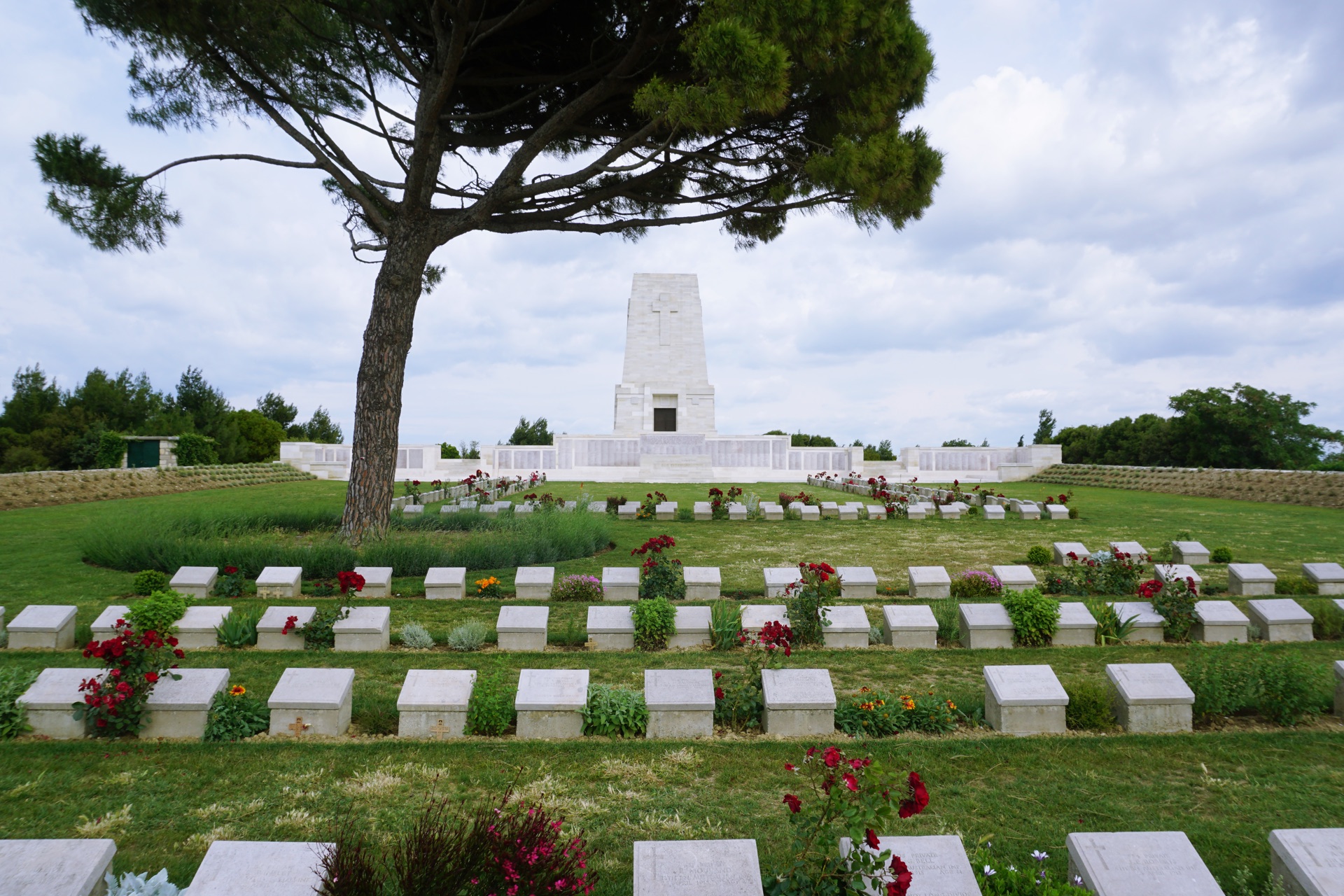
Lone Pine — Kanlısırt to the Turkish side — is the largest Australian site on the peninsula, 3 km uphill from Anzac Cove on the ridge road. The memorial pylon carries the names of more than 4,900 Australians and New Zealanders whose graves are unknown, and the cemetery around it holds 1,167 burials and commemorations, of which 504 are unidentified. From the cove the drive up takes about 8 minutes.
The battle it marks ran from 6 to 9 August 1915 and was fought largely underground, in trenches the Ottoman defenders had roofed over with pine logs. Australians dropped through the roof to fight in the dark. Seven Victoria Crosses were awarded for four days on a plot of ground you can walk across in ninety seconds.

The Australian national service on Anzac Day is held here at 10:00, after the Dawn Service down at the cove. Outside that morning the site is quiet, and 30 to 40 minutes is enough.
Directly across the road from Lone Pine, Johnston’s Jolly preserves original trench lines under the pines. This is the best place on the peninsula to see how close the two sides actually were: the Ottoman and Australian front trenches here sat within 15 metres of each other, and the tunnel entrances are still visible in the bank. The site takes 15 minutes and costs nothing, and it is the one stop that reliably makes the campaign concrete for teenagers.
The Nek — Cesarettepe in Turkish — is a ridge saddle roughly 50 metres wide and 30 metres deep, where four waves of Australian Light Horse charged Ottoman machine guns on the morning of 7 August 1915. The cemetery holds 326 burials and commemorations, of which 316 are unidentified, because the dead lay in no man’s land until after the war. You can stand at the Australian trench line and see the Ottoman one across open ground. Allow 15 minutes.
Between the Nek and Lone Pine the road runs along the crest with cemeteries every few hundred metres: Quinn’s Post, Courtney’s and Steele’s Post, and the 57th Regiment site on the Turkish side of the same ridge. At Quinn’s the opposing trenches were about 8 metres apart, close enough that both sides threw grenades by hand and used periscopes instead of raising a head. Stopping five minutes at each adds 45 minutes to the day, and on our own itineraries we build that time in.
Chunuk Bair — Conkbayırı in Turkish, Hill 261 on the campaign maps — is the summit at the top of the ridge road, and it is the only place on the peninsula where you can see both the Aegean and the Dardanelles at the same time. That view is the entire reason men died for it. From here the guns that stopped the fleet were within reach.
New Zealand troops took the summit before dawn on 8 August 1915, after a night march through the ravines behind Anzac. The Wellington Battalion found the crest empty and held it through the day against repeated counter-attacks, in the open, without water. Their commander, Lieutenant Colonel William Malone, aged 53, was killed that afternoon. The battalion lost 313 men dead. Two days later the position was retaken and never regained.
Across the five days of the August offensive New Zealand lost more than 880 dead and close to 2,500 wounded — from a force that had landed on the peninsula only months earlier. The New Zealand Ministry for Culture and Heritage account is the clearest short version if you want to read it before you stand there.
Three monuments share the Chunuk Bair summit. The New Zealand Memorial carries 849 names of men with no known grave. Chunuk Bair Cemetery below it holds 632 burials, of which only 10 are identified. And a few metres away stands the Turkish memorial to Mustafa Kemal and the 8th Division, with a line of restored trenches running between them. Two nations commemorated on one hilltop is unusual anywhere, and it is the reason many New Zealand families rate this the most important stop of the day. Families planning the trip from New Zealand should build the itinerary around this summit rather than the cove.
The New Zealand national service on Anzac Day is held here at 11:30, after the Australian service at Lone Pine. It draws a noticeably smaller and quieter crowd than the morning at the cove.
By vehicle the summit is 10 minutes from Lone Pine on a sealed road, and the car park is 80 metres from the memorial on a gentle slope. Anyone can do it.
Walking it is a different proposition. From the Anzac Commemorative Site to Lone Pine is about 3 km of continuous climb, and Lone Pine to Chunuk Bair another 3.5 km. On Anzac Day, when the road closes to traffic and everyone covers it by walking after a night without sleep, that is close to 7 km uphill in the morning sun. Families with young children and grandparents routinely underestimate it. Turkey Family Tours plans the Anzac Day route around that climb, which is the main reason our arrangements differ from a coach itinerary.
The Ottoman army lost at least 87,000 dead on this peninsula — more than every Allied nation combined — and the site directorate lists 56 Turkish memorials and cemeteries inside the historic area. Three of them matter on a normal visit: the 57th Regiment memorial on the Anzac ridge, the Çanakkale Martyrs’ Memorial at Morto Bay, and the shore batteries at Kilitbahir. Most itineraries written for Australian and New Zealand families treat all of this as one photo stop, which is where the day loses half its meaning.
On the same ridge as Quinn’s Post and Lone Pine, a few hundred metres from the Australian cemeteries, this is a symbolic cemetery opened on 10 December 1992. The 57th Infantry Regiment held the ridge on the first morning of the landing under Mustafa Kemal’s order that it should not attack but die where it stood. The regiment was effectively destroyed, and no unit numbered 57 has been raised in the Turkish army since.
The site has a colonnade of name panels, a mosque, an ablution fountain and a statue of an elderly veteran with his granddaughter. Turkish visitors treat it as a place of prayer, so keep voices down and dress conservatively. Allow 20 minutes. It sits directly on the Anzac ridge route, which means adding it costs no driving time at all.
Down at Morto Bay near the peninsula’s tip stands a four-legged stone arch 41.7 metres high, opened on 21 August 1960 and visible from ships in the strait. This is the national memorial to the Turkish dead of the campaign, with a symbolic cemetery, a museum below the platform and a wall of names.
It sits in the Helles sector rather than the Anzac one, about 35 minutes from Lone Pine, which is why coach days built entirely around Anzac Cove skip it. Our own day trip makes the drive and closes there. If you have two days, or if you are on the peninsula on a Turkish national date, it belongs on the itinerary. Allow 45 minutes including the museum.

The naval side of the campaign is easy to miss because it happened before the landings. On 18 March 1915 an Allied fleet tried to force the strait and lost three battleships to mines and shore fire. The guns that did it are still in place at Rumeli Mecidiye Battery below Kilitbahir castle, together with the statue of Corporal Seyit, who carried shells to a gun whose crane had been destroyed.
The plaque long gave the shell’s weight as 276 kg. When researchers later weighed the surviving round on precision scales it came out at 215 kg — the original figure was an Ottoman unit of weight misread as kilograms. Guides who tell you the smaller number are the ones who have checked.
Above the battery, the words Dur Yolcu — halt, traveller — are laid out in white stone across the hillside, large enough to read from the Çanakkale waterfront on the opposite shore. If you are crossing on the ferry, stand on the port side and watch for it.
The one indoor site inside the Anzac sector, and the only stop on a Gallipoli day where the clock genuinely matters. The centre runs 11 exhibition rooms, three of them on moving platforms, in a fixed 63-minute presentation. Counting entry and the walk between rooms, allow 1 hour 15 minutes.
| Detail | What to plan around |
|---|---|
| Opening hours | 08:30–17:00 |
| Closed | Tuesdays — the single biggest planning trap on the peninsula |
| Sessions | Timed, 50 people per session, advance booking needed |
| Arrive | 30 minutes before your session time |
| Language | Turkish narration; your guide translates, so a private guide matters here |
Our view after running it with a lot of families: it works very well for children between 8 and 14, who often find the outdoor cemeteries hard to engage with, and it is skippable for adults who have read about the campaign. We ask families which they would rather have, because it takes the same time as three battlefield stops.
The tip of the peninsula is flatter, emptier and far less visited than the Anzac ridges, and for British, Irish and Indian families it is the reason to come. This is where the other half of the campaign happened, and where a great many more men died.
The Helles Memorial stands on the headland: an obelisk over 30 metres high carrying more than 20,000 names. It serves both as the memorial to the whole campaign and as the place of commemoration for the men of the United Kingdom and India with no known grave, along with the Australians who died at Helles rather than Anzac. To reach it you follow the Eceabat–Bigalı road past the Kabatepe museum, then a rough track of about 500 metres at the junction. The CWGC record for the memorial is worth reading before you go.
A collier, the River Clyde, was run aground here on 25 April 1915 with sally ports cut in her sides so troops could pour out onto a bridge of lighters. Ottoman machine guns covered the whole beach. The water reportedly ran red for fifty metres out. V Beach Cemetery sits directly behind the sand, and the Ottoman fort of Seddülbahir stands at the far end, restored and open. Around the headland, W Beach — Lancashire Landing, where six Victoria Crosses were won before breakfast — has its own cemetery on the cliff above. Both are quiet swimming beaches today.
France committed a full corps to Helles and lost around 10,000 men, a fact that surprises most English-speaking visitors. The cemetery at Morto Bay uses black metal crosses in tight ranks instead of stone, with ossuaries behind. It sits a few minutes from the Çanakkale Martyrs’ Memorial, so the two pair naturally into one stop.
North of the Anzac sector, a fresh British landing went ashore at Suvla Bay in August 1915 to break the deadlock. It failed for reasons that are still argued about, largely to do with hesitation on the first day while the hills above were nearly undefended. The bay is a wide, quiet arc of sand today with the Salt Lake behind it and a handful of small cemeteries scattered around the plain.
There is very little to see and no interpretation on the ground, which is why itineraries skip it. Give it an hour if you have a specific connection to the 10th (Irish) or 11th Division, or if you want to understand why the campaign as a whole failed and not only what happened at Anzac. Ask for it in advance; it is not a spontaneous detour.
Helles adds 2 to 3 hours to a peninsula visit, including the drive down and back. It does not fit inside a single day that starts and ends in Istanbul — the arithmetic simply does not work. It fits comfortably into a two-day trip, into a morning from Çanakkale before crossing to Troy, or into any itinerary where you sleep on the peninsula — which is why Helles sits outside both our day trip and our 2-day Gallipoli and Troy tour — it is a half-day to add on request rather than a standard stop.
Troy — Hisarlık on Turkish maps — sits on the Asian shore, about 30 km south of Çanakkale and roughly 30 minutes by road once you are across the water. It is the city of Homer’s Iliad, identified with the mound by Heinrich Schliemann in the 1870s. It has nothing to do with 1915 and everything to do with why people fought over this strait for three thousand years, which is the argument for putting the two into one trip.
The site was inscribed on the UNESCO World Heritage List in 1998. What you walk through is not one city but nine superimposed settlements, spanning roughly 3000 BC to AD 500, cut into by more than a century of excavation trenches. Schliemann’s enormous cut through the middle of the mound is itself now part of the site’s history.
Expect stonework rather than skylines. The strongest remains are the sloping limestone walls and the ramp of Troy VI, the east gate and tower, the Roman odeon and bouleuterion, and the Bronze Age houses at the centre of the mound. A raised timber walkway runs the full circuit, which makes it manageable in 90 minutes and passable with a pram over most of its length.
Set the expectation before you go: this is nine cities stacked on one hill, not a standing classical city, and families who arrive expecting Ephesus leave flat. Almost nothing on the ground explains itself — there is no reconstructed street and no theatre to sit in — so a guide changes the visit more here than at any other site in Turkey. The museum does half that job on its own, which is why it comes first.
The museum opened in 2018 at the site entrance in Tevfikiye village: a rust-coloured cube of 11,200 m² with 3,000 m² of exhibition space, descending through the periods as you spiral down. It took a European Museum of the Year special commendation in 2020, and it is a considerably better building than most visitors expect this far from a big city.
Go to the museum before the ruins, not after. The finds are displayed by layer, so the mound outside becomes legible instead of confusing. Allow 60 to 75 minutes.
| Site | Hours | Closed | Time needed |
|---|---|---|---|
| Archaeological Site of Troy | 08:30–20:00, ticket office to 19:30 | Open daily | 90 minutes |
| Troy Museum | 08:30–20:00, ticket office to 19:30 | Open daily | 60–75 minutes |
| Kabatepe Simulation Centre | 08:30–17:00 | Tuesdays | 75 minutes |
| Battlefields and cemeteries | Open ground, no gate | Never | 3–4 hours |
Both Troy hours are as published by the Turkish Ministry of Culture and Tourism for the archaeological site and the museum. Closing moves earlier in the winter season, so a late-afternoon arrival between November and March needs checking rather than assuming.
There are two wooden horses in the area and visitors constantly confuse them. The one at the site entrance is a climbable replica with a stair and windows, built for the site. The other stands on the Çanakkale waterfront and is the actual prop from the 2004 film, donated to the city afterwards. Neither is ancient. Both are enjoyable, and the second one is free.

Eceabat, the town on the peninsula where most visits begin, is about 310 km from Istanbul: about 5 hours by private vehicle, 5.5 to 6.5 hours by intercity coach. The same distance therefore takes anywhere between five and seven hours depending on how you travel it, and that spread is what decides whether Gallipoli is a day trip or an overnight. Our day trip from Istanbul runs the fast version at USD 430 per adult; the two-day tour takes the pressure off it entirely.
| How you travel | Time each way | Rough cost | The catch |
|---|---|---|---|
| Private vehicle with guide | about 5 hours | Included in tour price | None — you stop where you want and the guide is with you on the ground |
| Self-drive hire car | about 5 hours | USD 45–80 per day plus fuel and tolls | Motorway tolls need an HGS sticker; the battlefields have no signage in English |
| Intercity coach to Eceabat or Çanakkale | 5.5–6.5 hours | USD 12–20 per person | Drops you in town with no way to reach the sites |
| Group day tour from Istanbul | 5–6 hours | USD 80–150 per person | 16 to 18-hour day, fixed stops, 40 people on one bus |
| Fly to Çanakkale | 1 hour flying | Varies | Limited schedule; you still need ground transport at both ends |
The bridge opened on 18 March 2022 with a main span of 2,023 metres, the longest in the world, as part of a 321 km motorway running from Istanbul down to Balıkesir. It crosses the strait between Gelibolu on the European shore and Lapseki on the Asian one.
Two things follow from that, and travel articles routinely get both wrong. The battlefields are on the European shore, so a Gallipoli visit does not cross the bridge at all — what has actually improved is the motorway leading down to the peninsula, which took roughly an hour off the old road. Troy is on the Asian shore, so it does use the crossing; but from Eceabat the 25-minute ferry to Çanakkale is far quicker than driving north to the bridge and back down.
Practical version: bridge for Istanbul to Troy direct, ferry for Gallipoli to Troy.
Car ferries run between Çanakkale and Eceabat around the clock, roughly hourly through the day and every two hours overnight, and the crossing takes about 25 minutes. There is a second, shorter route to Kilitbahir. Foot passengers do not book. Vehicles queue and board on arrival, and the queue is only a problem on national holidays and Anzac Day.
Stand outside on the crossing if the weather allows. You are sailing the water the fleet could not force on 18 March 1915, with the Dur Yolcu hillside on one side and the Çanakkale waterfront on the other, and for most families it is the moment the two shores of the campaign connect.
It is entirely doable, and two things will trip you up. Turkish motorways bill electronically through the HGS system; hire cars normally carry a transponder but you should confirm it at the desk, because the alternative is a fine issued weeks later against the rental agreement. And the peninsula itself has almost no English signage — the brown historical-site boards are in Turkish, several key cemeteries are signposted only by name, and satellite navigation will happily route you down a farm track towards the coast.
Download the map area offline before you leave Çanakkale. Mobile coverage on the ridge is patchy, particularly between the Nek and Chunuk Bair. Fuel up in Eceabat or Çanakkale; there is no station on the battlefield roads.
The Anzac sector packs eight stops into 7 km of ridge road, and no public bus serves any of them. That is the most common planning failure we see: families book a coach to Eceabat, arrive, and discover there is no way to reach the battlefields 13 km away. Taxis exist but will not wait through eight stops, and the local minibuses run between towns, not up the ridge.
Visiting independently is still perfectly possible — the sites are open ground with no gates, no tickets and no closing time — but it requires a vehicle of your own. In practice that means a hire car from Çanakkale, a driver arranged from Eceabat, or a private tour that solves the transport and the interpretation together.
| From | To | Distance | Driving time |
|---|---|---|---|
| Eceabat | Anzac Cove | 13 km | 18 minutes |
| Eceabat | Kabatepe Simulation Centre | 10 km | 13 minutes |
| Anzac Cove | Lone Pine | 3 km | 8 minutes uphill |
| Lone Pine | The Nek | 1.5 km | 4 minutes |
| Lone Pine | Chunuk Bair | 3.5 km | 10 minutes |
| Chunuk Bair | Çanakkale Martyrs’ Memorial | 32 km | 40 minutes |
| Eceabat | Çanakkale (by ferry) | Across the strait | 25 minutes plus wait |
| Çanakkale | Troy | 30 km | 30 minutes |
Add it up and the Anzac sector is compact: from the cove to the summit is 7 km of road carrying eight stops. The distances that break a schedule are the ones down to Helles and across to Troy, both around 40 minutes from the ridge, which is exactly why a one-day itinerary from Istanbul cannot hold them.
One narrow sealed lane climbs from the cove up past Lone Pine and the Nek to Chunuk Bair, with pull-in parking at each cemetery, usually room for three or four cars. Coaches use the same road, and when two meet on a bend one of them reverses. This is the practical argument for a smaller vehicle: a minivan parks at the Nek and at Johnston’s Jolly, a 45-seat coach does not, and its passengers walk the last stretch or skip the stop.
The surface is fine in a normal car. There are no barriers on the seaward side and the drop is real, so it is not a road to take at speed or in fog, which does settle on the ridge in winter mornings.
If you are driven between the stops, expect about 2 to 3 km of walking in total across the day, all of it in short stretches of 50 to 300 metres between the parking and the site. That is comfortably within reach of most grandparents.
The exceptions are Shrapnel Valley, which is an 800-metre climb on loose ground, and the Chunuk Bair cemetery below the summit, which is down a steep flight of steps and back up again. Both are optional and both are worth saying no to if the legs are not there. Anzac Day is the one occasion when walking is not optional, and that number is closer to 7 km.
Access varies more than most guides admit, and it matters if anyone in your group has limited mobility.
| Site | From the car park | Pram or wheelchair |
|---|---|---|
| Anzac Cove | Level, 50 m | Yes |
| Beach Cemetery | Level, 80 m | Yes |
| Lone Pine | Gentle slope, 100 m | Yes, with help on the grass |
| Johnston’s Jolly | Uneven ground among trees | Difficult |
| The Nek | Short path, slight slope | Yes |
| Chunuk Bair | 80 m, gentle rise | Yes |
| Chunuk Bair Cemetery | Down a flight of steps, steep slope | No |
| Shrapnel Valley | 800 m uphill on loose ground | No |
| Troy | Timber walkway circuit | Most of it, yes |
A Gallipoli visit runs to one of three lengths: 4 hours on the ground covers the Anzac sector, a full day adds the Çanakkale Martyrs’ Memorial on the Dardanelles shore, and two days brings Troy across the strait into the same trip. Cape Helles, further south again, needs a half-day of its own on top. From Istanbul the one-day version is a 13 to 15-hour door-to-door commitment because of the 310 km each way. Below is what each shape actually looks like, hour by hour, taken from the days we run.
| Time | What is happening |
|---|---|
| 06:30 | Hotel pick-up in Istanbul |
| 06:30–11:30 | Drive south, one comfort stop at about the halfway point |
| 11:30–12:15 | Kabatepe area, orientation, the shape of the ground explained |
| 12:15–13:00 | Anzac Cove, Arıburnu, Beach Cemetery |
| 13:00–13:45 | Lunch in Eceabat or a packed lunch on the ridge |
| 13:45–15:15 | Lone Pine, Johnston’s Jolly, the Turkish trenches, the Nek, 57th Regiment |
| 15:15–15:45 | Chunuk Bair and the New Zealand Memorial |
| 15:45–16:30 | The Çanakkale Martyrs’ Memorial on the Dardanelles shore |
| 16:30–21:30 | Drive back to Istanbul |
That is a 13 to 15-hour day depending on the traffic out of Istanbul: about 10 hours in the vehicle and 4.5 hours on the ground, with the comfort stops making up the rest. It works, and it covers the entire Anzac sector properly. What it cannot include is Cape Helles or Troy, and it is hard going for anyone over 75 or under 6. Families with young children almost always do better on the two-day shape. The peninsula is also the only long day out of Istanbul with no flight in it, which is why the pick-up is 06:30 rather than the 04:00 that the Ephesus, Cappadocia and Pamukkale days need.
Day one runs the Anzac sector at half the pace and closes at the Çanakkale Martyrs’ Memorial in the late afternoon, when the light on the strait is at its best. You sleep in Eceabat or cross to Çanakkale. Day two crosses to Troy in the morning, does the museum and the site, and drives back to Istanbul in the afternoon, or continues south towards İzmir and Ephesus.
The difference is not the number of stops. It is that you stand at Chunuk Bair without a driver looking at his watch, and that you see the campaign as two shores instead of one hillside. If the trip has any family connection to it at all, take the two days. On our 2-day Gallipoli and Troy tour the second morning is deliberately unhurried for exactly this reason. Families continuing south can run the same two days as the front half of a 4-day route through Troy, Ephesus and Pamukkale, ending with an evening flight back from Denizli at USD 1,370 per adult. All three lengths, with what each includes, are compared side by side on our Gallipoli tours from Istanbul page.
Three days suits researchers, families tracing a specific grave, and Anzac Day itself, where the services set the schedule and you work around them. Outside those cases the third day starts repeating ground you have already walked. Families with more time usually spend it better by folding the peninsula into a longer itinerary such as our 10-day Turkey private tour.
On 25 April the peninsula operates under completely different rules from the other 364 days, and almost nothing you read about a normal visit applies. If you are coming for Anzac Day, read this section as the operational one.
Yes. Everyone attending the commemorations needs a free Attendance Pass, registered in advance through the Australian Department of Veterans’ Affairs, and it applies to every attendee aged 2 and over — children included, one pass each. Registration opens towards the end of the preceding year, the pass is checked at the entry point, and there is no on-the-day alternative: families who arrive without one are turned back at the control. Details and the registration link sit on the DVA Anzac Day at Gallipoli page. Anzac Day itself — 25 April, the anniversary of the 1915 landing — is a national day of remembrance in both Australia and New Zealand, which is why the peninsula fills the way it does.
The road to the Anzac Commemorative Site closes during the afternoon of 24 April. You arrive that afternoon or evening, pass through security, and then you stay on the site until the Dawn Service the following morning. That means a night outdoors, in April, on the coast, in temperatures that regularly drop to 5–8°C with wind coming off the water.
| Rule | Detail |
|---|---|
| Folding chairs | Not permitted — people bring them every year and hand them in at the gate |
| Sleeping | On the grass and terraces; a plastic ground sheet is the single most useful item you can carry |
| Bags | Small only, searched at entry |
| Toilets | Portable, and the queues at 03:00 are long |
| Food | Bring your own; limited on site |
| Alcohol | Prohibited |
The Dawn Service is at the Anzac Commemorative Site at first light. The Australian service at Lone Pine follows mid-morning, and the New Zealand service at Chunuk Bair after that. Turkish commemorations run in parallel at the 57th Regiment site.

Here is the detail that catches families out, and that a lot of published guides get wrong. Vehicles do not run between the services. You walk. From the Commemorative Site up to Lone Pine is about 3 km of climb, and Lone Pine on to Chunuk Bair is another 3.5 km higher again. That is close to 7 km uphill by walking, after a night with no sleep. The gap in the printed programme is not spare time — it is the walk.
If anyone in your family cannot manage 7 km of hill on no sleep, choose one service and plan around it instead of attempting all three. Nobody regrets attending the Dawn Service alone. Plenty of families regret attempting the full circuit with children or grandparents in the group.
Accommodation in Eceabat, Çanakkale and Gelibolu sells out for the 24–25 April nights, typically six to nine months ahead, and rates rise sharply. Ferries and the peninsula roads run under traffic control all day. If Anzac Day is the reason for your Turkey trip, it is the fixed point everything else is built around and it needs booking before the flights — earlier than any other date in this guide. Families flying in for it usually book with us from Australia or from New Zealand around nine months out.
A large share of the families we take to Gallipoli are looking for one specific man. The peninsula holds 31 Commonwealth cemeteries, 56 Turkish memorials and cemeteries and one French cemetery, spread across roughly 33 km of ground — so finding the right one on the day, without a record already in your hand, is not realistic. Do the research before you travel. Standing in the right cemetery without knowing which panel to look at is a wasted morning.

Five archives cover almost every family who asks us, and all five are free to search from home. Start with the Commonwealth War Graves Commission register, which returns the cemetery or memorial plus the plot, row and grave number in one search. Then go to the national archive of the country he served with for the service file itself — that is where you learn which day and which sector, and it is what lets a guide put you on the right piece of ground instead of the right cemetery.
| If you are looking for | Search here | What you get |
|---|---|---|
| Any Commonwealth serviceman | CWGC casualty records, free | Cemetery or memorial, plot, row, grave number |
| An Australian | Australian War Memorial Gallipoli records and the DVA nominal rolls | The full digitised service file, usually including where he fell |
| A New Zealander | Auckland Museum Online Cenotaph and Archives New Zealand | Service record and unit history |
| A British or Irish soldier | CWGC plus the National Archives at Kew | Records are patchier; many were lost in 1940 |
| An Ottoman soldier | Çanakkale Savaşları Gelibolu Tarihi Alan Başkanlığı | Names on the memorial walls; individual records are rare |
Here is the arithmetic that explains why so many families end up at a name panel instead of a headstone. The 31 Commonwealth cemeteries on the peninsula hold roughly 22,000 graves between them, against some 34,000 Commonwealth servicemen who died in the campaign. The gap — more than 12,000 men — is made up of those never recovered or never identified, and they are commemorated by name on the memorials instead.
The distinction matters more here than at any other battlefield. Of the men at Lone Pine Cemetery, 504 of 1,167 are unidentified. At Chunuk Bair Cemetery only 10 of 632 are named. At the Nek, 316 of 326 are unidentified. If your relative has no known grave, his name is on a memorial panel — Lone Pine for most Australians and New Zealanders at Anzac, Chunuk Bair for the New Zealanders of the August offensive, Helles for the British and Indian dead and for Australians who fell at Helles.
Print the CWGC record and carry it. The registers sit in bronze boxes at each cemetery entrance, but on a hot afternoon with a family waiting, having the plot and row already written down is the difference between finding him and not.
When a booking mentions a relative, Turkey Family Tours looks the record up before the trip, plans the route so that cemetery is reached in good light and with time to spare, and leaves the rest of the group at the vehicle so nobody is standing over your shoulder. If you want to lay something, bring it from home — there are no florists on the peninsula. Our guides carry a folding trowel for a poppy or a small cross, which is permitted; anything planted or fixed is not. There is no extra charge for any of this on a private Gallipoli day; it is simply how the day gets built.
September and October are the most comfortable months at Gallipoli, at 20–28°C with light crowds, and April to mid-June is the best-looking, with green ground and wildflowers on the ridges. July and August reach 30–35°C with no shade anywhere on the ridge line. The peninsula is exposed in every season: no cover on the ridges, no shelter at the cove, and the wind that made the landing difficult has not gone anywhere.
| Period | Conditions | Verdict |
|---|---|---|
| April to mid-June | 15–25°C, green ground, wildflowers, some rain | Best. The landscape looks as the accounts describe it |
| 25 April | Cold nights, huge crowds, road closures | A different trip entirely — see above |
| July and August | 30–35°C, no shade, dry and dusty | Hard going, but it is the ground the August offensive was fought on |
| September and October | 20–28°C, calm, quiet | Best on comfort alone. Our usual recommendation |
| November to March | 5–14°C, wind, rain, short daylight | Bleak but powerful; fewer people than any other time |
Crowds are concentrated: April around Anzac Day, and cruise-ship days when coaches come up from Çanakkale. Outside those, even in high summer, you can stand at the Nek alone. Starting at 09:00 puts you an hour ahead of the coach flow all day.
In spring the ridge is green, the scrub is in flower and red poppies come through around the cemeteries. It is the version of the peninsula that photographs in the way people expect, and the resemblance to the landing accounts is closest then. By late June the same slopes are straw-coloured and by August they are hard, pale and dusty — which is, for what it is worth, exactly the condition the August offensive was fought in, thirst included.
Winter is the underrated one. Between November and March the wind comes hard off the strait, the sea turns grey, and a family can spend a whole morning on the ridge without meeting anyone else. The trade-off is daylight: sunset before 17:30 means a day trip from Istanbul loses its last stop, so winter visits work far better on the two-day shape.
The cove faces west, so late afternoon is the good hour there and the middle of the day is flat and glaring. Chunuk Bair looks back across the whole battlefield and out to the İmroz horizon, at its clearest in the first two hours after sunrise. So a day that starts high on the ridge and finishes at the water gets the better light at both ends, and it finishes where the landing began.
A normal Gallipoli day means 2–3 km of walking across eight stops on loose gravel and uneven cemetery ground, with no shade anywhere on the ridge line and no shop between Kabatepe and Eceabat. That makes closed shoes and 1.5 litres of water per person the two items families most often get wrong. Our vehicles carry chilled water, sunscreen, spare hats and wet wipes as standard, so what follows is the short list of what you bring yourself.
| Item | Why |
|---|---|
| Closed walking shoes | Loose gravel, tree roots, uneven cemetery ground. Sandals fail at Shrapnel Valley |
| Hat and sunscreen | There is no shade anywhere on the ridge line |
| 1.5 litres of water per person | Only Kabatepe and Eceabat sell anything |
| Windproof layer | The sea wind is constant even in July |
| Long trousers or skirt for the Turkish sites | The 57th Regiment site includes a working mosque |
| Printed CWGC record | If you are looking for a specific grave |
| Snacks | No food on the battlefields at all |
| Plastic ground sheet | Anzac Day only, and it will be the best thing in your bag |
Leave the drone at home. Flying over the historical area needs written permission and the fine is not theoretical. Leave metal detectors as well — the peninsula is a protected historical area and removing anything from the ground, including a spent case picked up on a path, is a criminal matter rather than a souvenir question.
Also worth reconsidering: heels and smooth-soled shoes of any kind, a large backpack you will carry up eight separate slopes, and a heavy camera bag. Most families photograph far less here than they expect to. The one item nobody packs and everybody wants is a small towel — in spring the cemetery grass stays wet until mid-morning and people sit down on it.
These are working cemeteries and, on the Turkish side, places of prayer. Walking between the headstones is accepted and normal; sitting or standing on them is not. At the 57th Regiment site, cover shoulders and knees and take shoes off if you enter the mosque. Turkish school groups come through constantly and are usually delighted to say hello to Australian and New Zealand families — on a lot of our days that exchange is the moment the trip stops being a history lesson.
Four bases serve the battlefields, and only two of them are worth considering for a family. Çanakkale sits across the strait with the deepest hotel supply and a waterfront; Eceabat is 10 minutes from the Anzac sector but small; Gelibolu is 45 minutes north; and staying in Istanbul turns the whole thing into a 15-hour day trip. The two-day version of our Gallipoli and Troy tour uses the Çanakkale side for the night.
| Base | Suits | Trade-off |
|---|---|---|
| Eceabat | Anyone starting on the battlefields at 09:00 | Small town, limited dinner options, simple hotels |
| Çanakkale | Families who want a promenade, restaurants and better hotels | The 25-minute ferry each way |
| Gelibolu | Anyone driving in from Istanbul late | 45 minutes from the Anzac sector |
| Istanbul, day trip only | Tight itineraries | 13 to 15 hours, and Helles and Troy are out |
Our default for families is Çanakkale. The hotel standard is a step up, children get a waterfront to run along in the evening, the film horse is a two-minute walk, and the morning ferry across is genuinely enjoyable instead of a chore. Eceabat wins only if you need to be at Anzac Cove at first light.
Be realistic about this. Çanakkale is a university town of about 190,000 people, not a resort, and the top of the market is a comfortable 4-star business hotel on the waterfront — not a luxury property. Eceabat is smaller again, with family-run pensions and one or two simple hotels.
On our own trips Turkey Family Tours uses hand-picked 4-5 star (boutique) hotels where the town supports it and a good waterfront property in Çanakkale where it does not. Family rooms and connecting rooms exist but are limited, which is the real reason to book early — not the price, the room type. Families coming from the higher end of the Istanbul market should treat this as one modest night in the middle of a stronger trip; our Turkey travel guide sets out where the hotel standard climbs again.
Çanakkale’s promenade fills up after dark with families, students and fishermen. Fish restaurants line the waterfront, there is an ice-cream row that children locate unaided, and the clock tower area is walkable and safe. It makes the two-day version feel like a proper stop rather than an overnight on the way somewhere. Eceabat, by contrast, is finished by 21:00.
The Gallipoli battlefields are free: open ground, no gate, no ticket at any cemetery or memorial. What a visit costs is transport, a guide who can read the ground, and the two ticketed sites — the Kabatepe Simulation Centre and, across the strait, Troy. In practice families spend USD 80–150 per person on a group coach day or USD 430 per adult on a private vehicle and licensed guide of their own.
| Item | Typical cost |
|---|---|
| Battlefields, cemeteries, memorials | Free |
| Kabatepe Simulation Centre | Modest entry, timed session |
| Troy site and Troy Museum | Museum Pass covers both |
| Çanakkale–Eceabat ferry, foot passenger | A few dollars |
| Lunch on the peninsula | USD 10–18 per person |
| Hotel in Çanakkale, family room | USD 70–140 per night outside April |
| Group coach day tour from Istanbul | USD 80–150 per person, 40 on the bus |
| Our private Gallipoli day trip from Istanbul | USD 430 per adult, based on two adults sharing the vehicle and guide |
| Our 2-day Gallipoli and Troy tour | USD 820 |
The arithmetic families actually face: four people on a group coach pay roughly USD 320–600 for a fixed 40-person day. The same family on our private Gallipoli day trip pays USD 430 per adult, with ages 4 to 6 at 40% less and under 4 at 70% less. Private costs more, plainly. What the difference buys is the choice of stops, the pace, and the freedom to stand at one grave for as long as it takes — none of which a 40-seat timetable can give you. The full breakdown of how Turkey trips price out sits in our Turkey tour cost guide. For the USD 430 day trip and the USD 820 two-day Troy route priced line by line, see the private Gallipoli tour options.
Only if Troy is in the plan. The battlefields, cemeteries and memorials are all free, so on a pure Gallipoli day the pass has nothing to cover. Add Troy and it begins to pay for itself, and if the wider trip takes in Ephesus, Hierapolis at Pamukkale and the Istanbul sites, the country-wide Museum Pass is comfortably worth buying. On our tours entrance fees are included, so the question does not arise.
Three things fall outside most budgets:
The larger hidden cost on a group coach day is time: an 18-hour door-to-door schedule built around collecting forty people from twelve hotels, against 15 hours on a private day with one pick-up. Whether three lost hours count as a cost depends entirely on who is travelling with you.
Gallipoli is worth a full day for families with a connection to the campaign and for Australian and New Zealand visitors, and it is a poor choice for anyone expecting ruins or a spectacle. Roughly one booking in three that reaches us for the peninsula mentions a named relative; those families almost always call it the strongest day of the trip. We would rather set the expectation before you book than after.
It is worth it if you have a family connection, if the campaign means something to you, if you are Australian or a New Zealander for whom this is close to a national site, or if you would rather stand somewhere significant than photograph something spectacular.
It is not worth it if you are expecting ruins, monuments or a spectacle. There is very little to look at. Trenches have softened into shallow grass depressions. The cemeteries are beautiful but quiet. Families who want scale and stonework are far better served by Hierapolis at Pamukkale or the ruins on the Mediterranean coast covered in our Antalya travel guide.

Practically, yes. There is almost no interpretive signage in English on the peninsula, the trench lines have weathered into shallow depressions in the grass, and the eight Anzac-sector stops are separated by a ridge road with no bus. A licensed local guide is what turns a series of hillsides into a day you can follow: which unit held which crest, why the boats landed 1.5 km north of the intended beach, which panel carries your relative’s name. Families who drive themselves see the same ground and take home a fraction of it. Every Gallipoli day we run includes a guide who works the peninsula regularly, not a city guide sent down for the day.
Gallipoli works from about age 8, and works properly from 12. Under 8 it is a long day of cemeteries with nothing to climb on and we say so honestly when families ask. Between 8 and 12 it lands if you use the Kabatepe simulation and let the guide tell it as a story: the boys were seventeen, the trenches were this close, they threw notes and tins of food across to each other. Over 12, especially for children who have covered the campaign at school, it lands hard and properly.
Three things make the difference on a family day:
Children are priced at 7 and over as adults, 4 to 6 at 40% off and 0 to 3 at 70% off on every Turkey Family Tours itinerary, and the vehicle carries child seats on request.
Turkey Family Tours is a licensed Turkish operator, TURSAB member 13538, and we run the peninsula privately: a private vehicle with driver and a dedicated licensed local guide, at your pace. There is no shared coach and no fixed route. Six of our itineraries include the battlefields. Which of the six fits a family is a separate question from what sits on the ground, and our private Gallipoli tours page sets the USD 430 day trip against the USD 820 two-day route, and both against the coach and small-group products families usually compare them with.
| Tour | Shape | Price |
|---|---|---|
| Gallipoli day trip from Istanbul | The full Anzac sector and the Martyrs’ Memorial, back the same night | USD 430 per adult |
| Gallipoli and Troy, 2 days | The same ground unhurried, a night on the strait, then Troy and the museum | USD 820 per adult |
| Gallipoli, Ephesus and Pamukkale, 4 days | The battlefields and Troy first, then Ephesus and Pamukkale, flying back from Denizli | USD 1,370 per adult |
| 10-day Turkey private tour | Gallipoli inside a full country itinerary | USD 3,320 |
| 11-day Turkey fully by road | No internal flights; Gallipoli on day 10 | USD 3,795 |
| 14-day Turkey private tour | The unhurried version, with Gallipoli and Troy built in | USD 4,450 |
What is included as standard: private vehicle and driver, a licensed guide who works the peninsula regularly rather than a city guide sent down for the day, all entrance fees, and hotel pick-up. Children are priced at 7 and over as adults, 4 to 6 at 40% off, and 0 to 3 at 70% off. A 25% deposit confirms the date and the balance is due on arrival. We answer enquiries within 24 hours, and we hold a 5.0 rating from 41 reviews on TripAdvisor.
If you are building a longer trip, our Turkey travel guide covers how the regions fit together, and the city guides for Istanbul, Pamukkale and Antalya handle the stops that usually sit either side of the peninsula. Families travelling from Australia, New Zealand, Canada and the United Kingdom have their own pages with flight routings, timing and Anzac Day planning.
Yes, the ground itself is completely open: 31 Commonwealth cemeteries, the memorials and the trench lines have no gates, no tickets and no closing time. Getting to them is the problem. No public bus serves the ridge road, the eight main Anzac-sector stops are spread across 7 km of hill, and taxis from Eceabat will not wait through a full circuit. That leaves a hire car, a private driver or a tour. Families who drive themselves manage the logistics but lose the interpretation, because there is almost no English signage on the peninsula. Our private Gallipoli day trip from Istanbul solves both at once.
Eceabat, the town at the edge of the battlefields, is about 310 km from Istanbul. That is about 5 hours by private vehicle on the motorway and 5.5 to 6.5 hours by intercity coach, which stops more often. A return day trip therefore runs to roughly 15 hours door to door, of which about 10 hours are in the vehicle and 4.5 hours on the ground. The 1915 Çanakkale Bridge shortened the run to Troy but not to the battlefields, which sit on the European shore and never needed a crossing. Distances for the rest of the country sit in our Turkey travel guide.
Practically, yes. The battlefield has almost no interpretive signage in English, and the trench lines that decided the campaign have weathered into shallow depressions in the grass that most families walk straight past. Without someone explaining what happened on the specific piece of ground under your feet, the day becomes scenery with a long drive at each end. A licensed local guide also matters for families tracing a relative, because knowing the cemetery is not the same as knowing the plot and row. Every Gallipoli itinerary Turkey Family Tours runs includes a guide who works the peninsula regularly, not a city guide sent down from Istanbul for the day.
Four hours on the ground covers the Anzac sector properly: Anzac Cove, Arıburnu, Beach Cemetery, Lone Pine, Johnston’s Jolly, the Nek, the 57th Regiment memorial and Chunuk Bair. Adding the Çanakkale Martyrs’ Memorial takes it to a full day, because it sits 35 km south of the Anzac sector down a slow road. Cape Helles, further south again, needs a half-day of its own. Adding Troy across the strait makes it two days, since the ferry plus the drive costs about 2.5 hours of movement. Families with a named relative to find should assume the longer shape; the search itself takes time you cannot compress.
From Çanakkale, yes, at a rush. From Istanbul, no. The 25-minute ferry crossing plus the drive south to Troy adds around 2.5 hours of movement to a day that already contains 10 hours of driving, and something has to give — usually the Anzac sector, cut to two stops. Families who want both properly should take the 2-day Gallipoli and Troy tour, which runs the whole Anzac sector on day one, sleeps on the strait, and gives Troy and the Troy Museum a full unhurried morning before driving back. The site itself needs 90 minutes and the museum another 60 to 75, so a rushed Troy is barely worth the crossing.
Yes. Every attendee aged 2 and over needs a free Attendance Pass, registered in advance through the Australian Department of Veterans’ Affairs, and there is no on-the-day alternative. Registration opens late in the preceding year and the pass is checked at the entry control. Two other rules catch families out: the road to the Anzac Commemorative Site closes on the afternoon of 24 April, so you spend the night outdoors on the site at 5–8°C, and vehicles do not run between the three services — the walk from the Dawn Service to Chunuk Bair is close to 7 km uphill.
No, and the distinction matters when you plan. Anzac Cove is one shingle beach about 600 m long, inside the Anzac sector, which is itself one of three battlefronts on a peninsula roughly 60 km from end to end. The Helles sector at the southern tip and the Suvla sector to the north were both larger in ground and in casualties. Most visitors mean the Anzac sector when they say Gallipoli, because that is where Anzac Cove, Lone Pine, the Nek and Chunuk Bair sit — all within 7 km of each other on one ridge road, and all reachable in a single morning.
Lone Pine, Kanlısırt in Turkish, is the Australian site on the lower ridge, 3 km up from Anzac Cove. It holds 1,167 burials and a memorial pylon carrying more than 4,900 names of men with no known grave. Chunuk Bair, Conkbayırı, is the summit another 3.5 km higher: the New Zealand ground, taken briefly by the Wellington Battalion on 8 August 1915, where the New Zealand Memorial and the Turkish memorial to Mustafa Kemal sharing the same crest. On Anzac Day the Australian service is held at Lone Pine and the New Zealand service at Chunuk Bair.
It suits children from about 8 and works properly from 12, particularly for anyone who has covered the campaign at school. Under 8 it is a long day of cemeteries with nothing to climb on, and we tell families that before they book. Two things change the day for younger children: the Kabatepe Simulation Centre, which is loud, indoor and aimed at the 8–14 bracket, and pairing the peninsula with Troy, where there is a horse to climb into. Children are priced at 4 to 6 at 40% off and 0 to 3 at 70% off on every itinerary we run.
For children between 8 and 14 it is usually the strongest part of the day; for adults it is optional. The presentation runs a fixed 63 minutes across 11 rooms, three of them on moving platforms, with sessions capped at 50 people and narration in Turkish. It opens 08:30–17:00 and is closed on Tuesdays, and you should arrive 30 minutes before your session. The real cost is time: with entry and the walk between rooms it eats about an hour and a quarter, the same as three battlefield stops, so on a one-day trip it is a genuine trade-off we put to families in advance.
September and October are the most comfortable, at 20–28°C with calm air and few coaches. April to mid-June looks best, with green ridges, wildflowers and poppies around the cemeteries, which is the version that matches the campaign accounts. July and August reach 30–35°C with no shade anywhere on the ridge line, though that is exactly the ground the August offensive was fought on. November to March is bleak, windy and almost empty, and the short daylight means a day trip from Istanbul loses its final stop. Avoid 25 April unless Anzac Day is the point of the trip.
Group coach tours from Istanbul run USD 80–150 per person on a 40-seat bus with an 18-hour door-to-door schedule. Our private day trip is USD 430 per adult, based on two adults travelling together, with the vehicle, driver and licensed guide to yourselves, and the two-day Gallipoli and Troy tour is USD 820. Children aged four to six pay 40% less and under-fours 70% less, while ages seven and over pay the adult rate. Private costs more than a coach seat rather than less, and what it buys is the pace, the choice of stops and a guide who is answering only your questions. The battlefields themselves are free. A full line-by-line breakdown of Turkey pricing sits in our Turkey tour cost guide.
For an ordinary date, 4 to 8 weeks is comfortable and short notice is often workable, because a private vehicle does not depend on filling seats. Anzac Day is the exception in every direction: accommodation in Eceabat, Çanakkale and Gelibolu sells out for the 24–25 April nights typically six to nine months ahead, and the Attendance Pass has its own registration window late in the preceding year. Families flying in from Australia or New Zealand generally book around nine months out, because the flights and the peninsula hotels lock in at the same time. Outside April, a 25% deposit holds the date and the balance is due on arrival.
A 25% deposit confirms the date and the balance is due on arrival in Turkey, so you are not paying the full amount months ahead of a trip. Turkey Family Tours is TURSAB-licensed, no 13538, which is the Turkish travel agency registration that makes an operator legally accountable for the itinerary it sells. We answer enquiries within 24 hours, and we hold a 5.0 rating from 41 reviews on TripAdvisor. For exact cancellation windows on your dates, ask when you enquire — they differ between an ordinary Tuesday in October and the 25 April peak.
Turkey Family Tours runs the peninsula privately from Istanbul at USD 430 per adult for a day trip and USD 820 per adult for the two-day version with Troy, both including a licensed local guide, a private vehicle with driver, all entrance fees and hotel pick-up. A 25% deposit confirms the date, the balance is due on arrival, and we reply to every enquiry within 24 hours. If you are tracing a relative, send the name with your enquiry and we will have the record pulled before you land. Get a Private Quote →



Tell us about your family — we reply within 24 hours.