 English
 Dutch
Dutch Japanese
 Korean
 Chinese
5 Day Turkey Itinerary: Istanbul and Cappadocia Day by Day
Three nights in Istanbul, one in a Göreme cave hotel, two 75-minute flights: the 5 day Turkey itinerary day by day — what it costs, when to go, and where to bend the route.


Quick Answer: A Cappadocia cave hotel is a room carved into the region’s soft volcanic tuff, the same rock that forms the fairy chimneys. The stone keeps interiors in a cool, stable band of around 19–22 °C through the hottest summer afternoons, with no air conditioning involved. Rooms run from budget doubles under USD 100 to terrace suites over USD 250 a night, and the right choice depends less on the hotel name than on three decisions: which village (Göreme, Uçhisar or Ürgüp), whether you need a sunrise hot air balloon terrace, and whether the room layout works for children. One to two nights is the sweet spot for most families. For the full breakdown by trip length, see how many days in Cappadocia is enough. Our private Cappadocia tours include a hand-picked boutique cave hotel night — the 2-day tour from Istanbul runs USD 895 pp, flights and entrances included. Turkey Family Tours is TURSAB-licensed (no 13538). Get a Private Quote →
The three cave-hotel villages sit within a 15-minute drive of each other, most properties hold only 10–35 rooms, and the sunrise show starts as early as 05:15 — so the decisions that matter are the village, the room category and the terrace direction, in that order. Everything below is organised around those three choices.
Planning a private Turkey tour?
We build family-paced private itineraries with hand-picked 4-5 star hotels and send a written plan and fixed price within 24 hours.
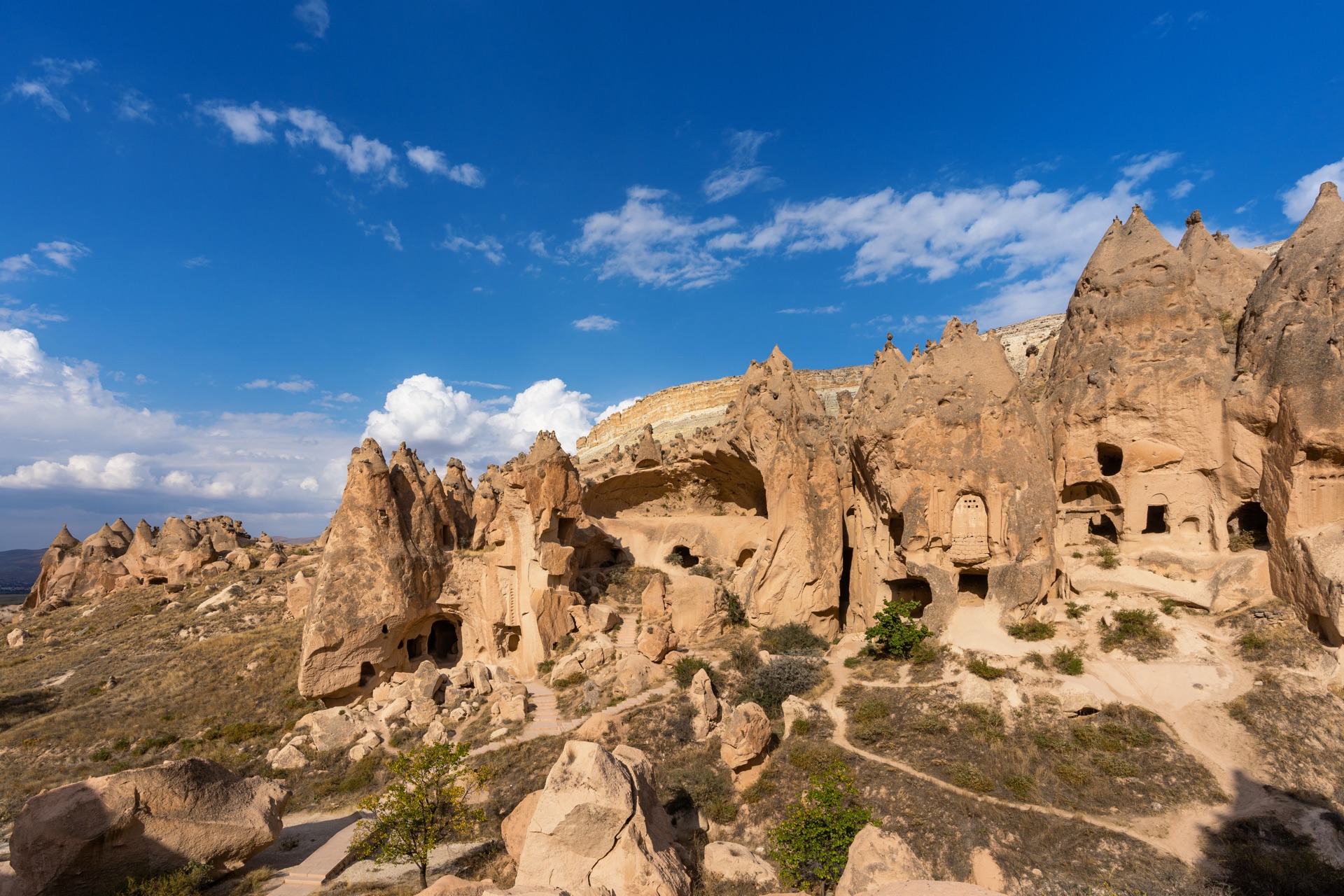
A Cappadocia cave hotel is carved into volcanic tuff — the soft, workable rock left by eruptions of Mount Erciyes (3,917 m) and its neighbouring volcanoes millions of years ago, the same stone that erosion shaped into the region’s fairy chimneys. People have cut homes, churches and storerooms into this rock for well over a thousand years; the Göreme National Park and Rock Sites of Cappadocia UNESCO listing protects the densest concentration of them. A cave hotel room is the modern continuation of that tradition: part of the room — sometimes all of it — sits inside the rock, finished with stone arches, carved niches and modern bathrooms.
The rock is the point. Tuff insulates so well that cave interiors stay around 19–22 °C through a 33 °C August afternoon with no air conditioning — and hold their warmth through winter with only modest heating. That single physical fact explains most of what makes the category special:
For one to two nights: yes, almost without qualification — the cave night is the stay families mention first when they write to us after the trip. You sleep inside a rock that people have inhabited for centuries, wake at 05:30, walk onto a stone terrace, and watch dozens of hot air balloons lift off the valley floor in front of you. Children remember it the way they remember their first snow.
The honest caveats, worth reading before you pay for a terrace suite:
Cave hotels hold far fewer family rooms than a resort — often just a couple of true family suites per property — and travelling with children changes the checklist. After years of placing families in cave rooms, these are the points that decide whether the night works or turns into a stair-and-nap battle:
The pattern repeats every season: the child who refused to nap the whole trip sleeps eleven hours in the cave room’s cool dark, and the teenager who would not wake for anything is first on the terrace at 05:30. That last point matters for planning: if your children are under 6, a terrace-forward cave hotel is not a consolation prize — it is the main event. One parent can fly while the rest of the family watches the same sky from the terrace with breakfast. Our Cappadocia hot air balloon guide covers the age rules and how families split the morning.
The village decides more of your experience than the hotel does. All three sit within a 15-minute drive of each other and of the main sights — the choice is about atmosphere, walkability and what you see from the terrace.
| Village | Character | Hot air balloon view | Best for |
|---|---|---|---|
| Göreme | The heart of it — cave hotels stacked above the town, restaurants and shops in walking distance, liveliest streets | Closest to the launch fields; hot air balloons rise directly overhead and drift past cliff-face terraces | First visits, families who want to walk everywhere, the classic terrace photo |
| Uçhisar | The highest point of the region, built around a honeycombed rock castle; quieter and more polished, 10 minutes from Göreme | Widest panorama — you watch the whole valley fill with hot air balloons from above | Second visits, travellers who want calm evenings and big-view terraces |
| Ürgüp | A proper small town with a life of its own beyond tourism — more space, easier parking, strong restaurant scene | Hot air balloons visible at a distance on most mornings rather than overhead | Longer stays, larger family groups, travellers who prefer a town base |
A Göreme cave hotel puts the whole experience in walking distance: properties climb the ridge above the town, restaurants and shops sit below, and the launch valleys are close enough that hot air balloons drift directly over the terraces on flight mornings. It is the busiest of the three villages — and the one that feels most like the photographs.
Uçhisar sits on the region’s highest point around its honeycombed rock castle, ten minutes from Göreme. The village is quieter and more polished, and its height gives terraces the widest panorama — you watch the whole valley fill with hot air balloons from above rather than overhead.
Ürgüp is a working small town rather than a village shaped by tourism: more space, easier parking, a strong restaurant scene, and cave properties scattered through its old quarter. Hot air balloons show at a distance on most mornings rather than straight overhead — the trade for a roomier, calmer base.
All three villages work — on our private tours the driver handles every transfer, so the usual argument for staying central weakens and the terrace-and-atmosphere question decides. Our rundown of the sights within reach of each village gives visit times and entry costs; the official destination overview is at Go Türkiye.
Cappadocia cave hotel prices run from under USD 100 a night to USD 250+ terrace suites, and three things set where a room lands: how much of it is genuinely carved rock, whether it opens onto a terrace, and the view.
| Category | Typical nightly band | What you get | Family fit |
|---|---|---|---|
| Standard cave double | under USD 100 | Compact carved room, often deeper in the hillside, shared terraces | Fine for a short stay; usually too small for four |
| Cave suite | USD 100–250 | Larger carved space, arched sitting area, better position on the cliff | The practical family tier — room for an extra bed, closer to the terraces |
| Terrace / view suite | USD 250+ | Private or semi-private terrace facing the launch valleys, premium finish | The sunrise-at-the-door experience; book earliest, smallest supply |
Two buying rules protect families from the wrong room and the wrong bill. First, pay for position, not size: a mid-tier suite on a high, valley-facing row beats a bigger room buried at the back. Second, read the room category, not the hotel rating — every cave property sells both its best and its darkest rooms under the same name. On a package, the per-night maths disappears into one fixed USD quote — see how our tours handle the cave night below.
The photograph that sells Cappadocia — a stone terrace, breakfast table, and a sky full of hot air balloons — is real, but it follows a schedule. Flights launch around first light: pickups run from roughly 04:30–05:00, and the first envelopes lift around first light — 05:15–05:45 in the summer months, closer to 07:00 in winter. From a cliff-face terrace in Göreme or a high terrace in Uçhisar, the show runs 45–75 minutes as successive waves launch, drift with the valley wind, and descend.
The launch fields sit in the valleys north and west of Göreme, so “hot air balloon view” needs a direction, not just a claim: a terrace facing those valleys sees the mass ascent; a terrace facing the other way sees stragglers. When you book — or when we book for you — that orientation is the single question worth asking.
No. Shared rooftop terraces put every guest in front of the same sky; a private terrace only changes whether you watch it in a bathrobe. Families usually get more from a mid-tier room plus the shared rooftop than from stretching to the most expensive suite.
Cave hotels are small — most hold 10 to 35 rooms — and the family-suite category is a fraction of that. Availability, not price, is the real constraint, and it moves with the hot air balloon seasons. Weather data for the region comes from the Turkish State Meteorological Service (MGM); the pattern for booking pressure looks like this:
| Travel window | Pressure | Book by |
|---|---|---|
| April–June (spring peak) | High — strongest flight season, school holidays land in it | 3–4 months ahead for family suites |
| July–August (summer peak) | Highest — cliff-face rooms for late August fill by May | 4–5 months ahead |
| September–October (autumn window) | High but kinder — September is the easiest warm-season month to book | 2–3 months ahead |
| November–March (quiet season) | Low — widest choice, snow-dusted terraces, fewer flight mornings | 2–6 weeks ahead |
If your dates are fixed by school holidays, work backwards from the table and lock the room before flights and everything else — in Cappadocia the cave hotel is the scarce piece, not the airfare. Month-by-month conditions are covered in our Best Time to Visit Turkey hub and the Turkey in September guide.
Every Turkey Family Tours itinerary that touches Cappadocia includes the cave hotel night as standard — a hand-picked boutique cave property, chosen for the things this guide covers: position on the cliff, terrace orientation toward the launch valleys, and rooms that actually work for families. You do not book the room, compare categories or guess at stair counts; we hold the room as part of the package and match it to your group.
Every package is fully private: licensed guide, private vehicle, domestic flights and entrance fees included, one fixed USD quote. Tell us your dates and children’s ages via Plan My Trip and we reply within 24 hours with the itinerary and the cave-night details worked out.
The small practical questions families ask us before their first cave night, answered plainly:
Yes — for one to two nights, a cave hotel is consistently the most-remembered stay of a Turkey trip. You sleep inside volcanic rock that stays cool and stable — around 19–22 °C on the hottest afternoons — in near-total silence, and wake to hot air balloons rising past the terrace at sunrise. The honest caveats: it is an experience stay rather than a resort (no pools or elevators), every property involves stone stairs, and rooms vary hugely within the same hotel — ask for the room’s position on the cliff, not its name. Plan the cave night as the centrepiece of the Cappadocia leg rather than the whole holiday, and it earns its reputation. Our 2-day private Cappadocia tour builds the trip around exactly that night.
Cappadocia cave hotel prices sort into three consistent bands: standard cave doubles run under USD 100 a night, cave suites — the practical family tier — sit around USD 100–250, and terrace or view suites facing the launch valleys start at USD 250+. Breakfast is typically included, and expect the top of each band in the April–June and September–October peaks. Two rules protect your budget: pay for position on the cliff rather than raw size, and read the specific room category rather than the hotel rating. On our private tours the cave night is included in the fixed package price, so the comparison work disappears — the 2-day tour runs USD 895 pp with flights and entrances included.
All three sit within a 15-minute drive of the main sights, so the choice is atmosphere rather than logistics. Göreme is the classic first-visit base: cave hotels stacked above a walkable town, closest to the hot air balloon launch fields, hot air balloons drifting directly past the terraces. Uçhisar is the region’s highest village — calmer, more polished, with the widest panorama over the whole valley. Ürgüp is a proper small town: more space, easier logistics, hot air balloons visible at a distance rather than overhead. Families on a first trip usually choose Göreme for the walkability; on a private tour with a driver, the argument for staying central weakens and the terrace view decides.
They can be excellent — with the right room. The 19–22 °C rock interior makes summer naps and early bedtimes easier than any air-conditioned room, the silence is absolute, and children treat carved passages like a castle. The checklist that matters: book a family suite or connecting arrangement early (the scarcest category in every village), ask how many stone steps lead to your specific room, and pack a night light for the darker interiors. One more planning fact: aviation rules set a minimum age of 6 for hot air balloon flights — younger children watch the sunrise show from the terrace instead, which from a cliff-face position is most of the show anyway.
Most cliff-side properties in Göreme and Uçhisar have terraces facing the launch valleys — but “hot air balloon view” depends on direction, not marketing. The launch fields sit in the valleys north and west of Göreme; a terrace facing them sees the mass ascent, the other side sees stragglers. The show follows the flight schedule: first envelopes lift around first light — 05:15–05:45 in summer, later in winter — and the sky stays full for 45–75 minutes. You do not need a private terrace — shared rooftops put every guest in front of the same sky. Set one alarm, watch the ascent, go back to bed: that is the normal cave-hotel morning. Flight mornings are weather-gated, which is why two nights beat one.
Damp, no — dark, sometimes, and it is worth understanding both. Volcanic tuff is porous and breathes; well-run cave rooms are notably dry, and the rock’s cool, stable interior keeps condensation away. Light is the real variable: a deep carved chamber can be genuinely windowless, while an arched room opening onto a terrace is as bright as any hotel room. The difference is the room category, not the hotel — the same property sells both. If natural light matters to your family, ask specifically for a front-row or terrace-facing room; if you love the cocoon effect, the deep rooms are the quietest, darkest sleep you will ever have. Modern bathrooms, hot water and heating are standard across the category.
Work backwards from the season. For July–August, the cliff-face rooms fill months ahead — late-August dates effectively close by May, so book 4–5 months out. April–June needs 3–4 months, especially where school holidays land. September–October is strong flying season with kinder availability — September is the easiest warm-season month to book, at 2–3 months out. Winter needs only weeks and offers snow-dusted terraces. The structural reason to book early: cave hotels are small (10–35 rooms) and the family-suite category is a fraction of that — availability, not price, is the constraint. In Cappadocia, lock the room before the flights; the cave hotel is the scarce piece of the trip.
Yes — every Turkey Family Tours itinerary that includes Cappadocia comes with a hand-picked boutique cave hotel night as standard, chosen for cliff position, terrace orientation toward the launch valleys, and rooms that work for families. The 2-day Cappadocia tour from Istanbul runs USD 895 pp with one cave night, flights and entrances included; the 5-day Istanbul & Cappadocia tour (USD 1,690 pp) includes two. You skip the category-guessing this guide exists to solve — tell us your dates and children’s ages via Plan My Trip and we reply within 24 hours with the room matched to your group.
The cave hotel is the piece of a Cappadocia trip you cannot improvise: the good rooms are few, the family category is fewer, and the terrace you wake up on decides the memory. Choose the village for your pace, the category for your family, and the dates by the booking table above — or hand the whole question to us.
Start with a package that includes the cave night:
What to do right now if a cave stay is on your list:
For the wider region — valleys, underground cities and how Cappadocia fits a longer route — see the region’s 15 main stops and the Turkey travel guide.
Turkey Family Tours — TURSAB-licensed operator (no 13538). Private guided tours of Turkey.



Tell us about your family — we reply within 24 hours.