 English
 Dutch
Dutch Japanese
 Korean
 Chinese
Tipping in Turkey: How Much to Tip & Who to Tip
Tipping in Turkey explained: an at-a-glance table for restaurants, guides, drivers, hotels and taxis — plus cash-vs-card and which currency to carry.



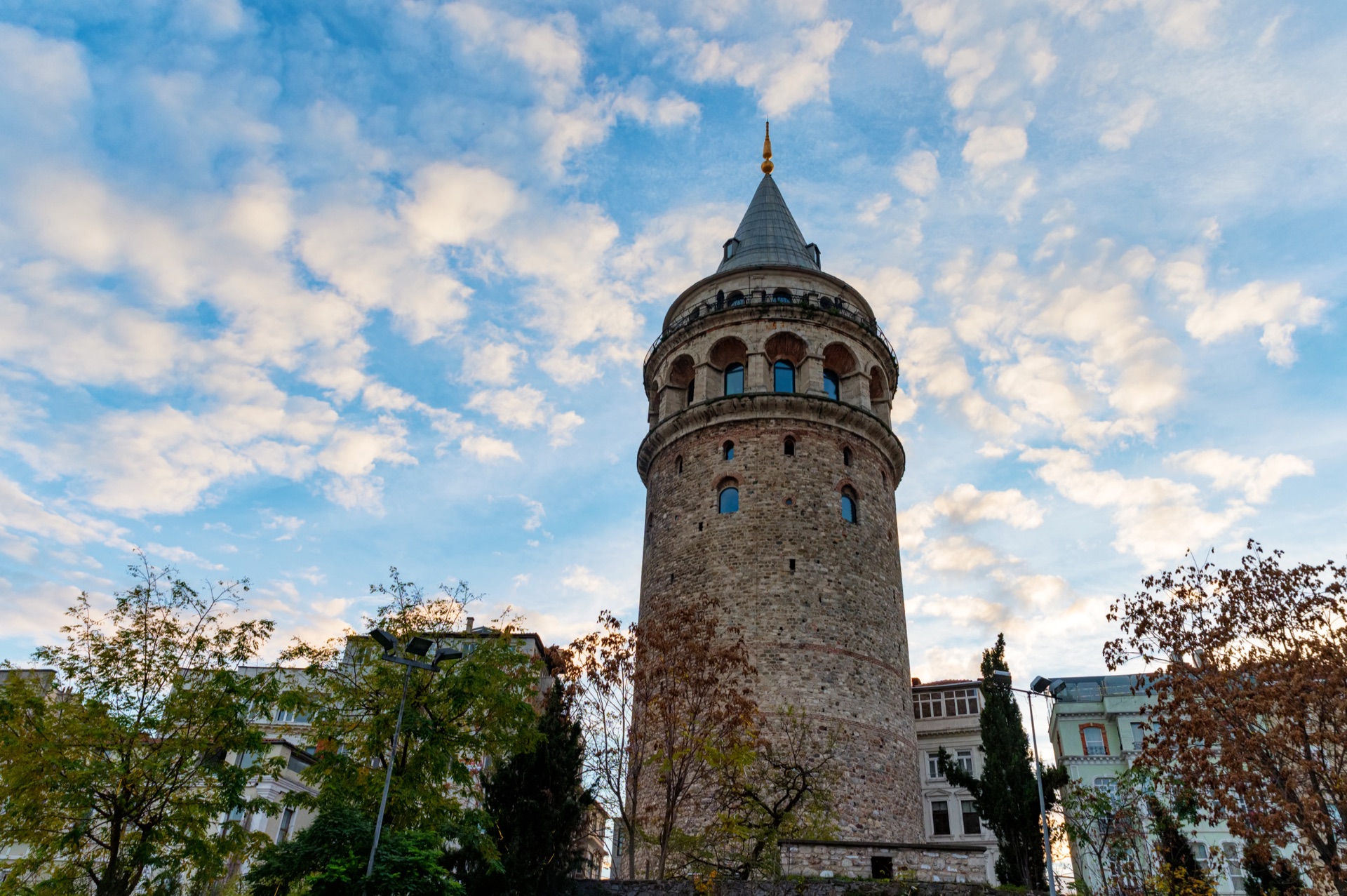
Quick Answer: Galata Tower in Istanbul charges foreign visitors €30, about USD 33, and opens every day. The daytime museum session runs 08:30 to 18:30 with the ticket desk closing at 18:14; a separate evening session runs 18:30 to 23:00 on its own ticket, outside the Istanbul Museum Pass. Allow 60 to 90 minutes for the whole visit, because the lift reaches only the seventh floor and the last two levels up to the 51.65-metre balcony are climbed on a narrow spiral stair. Arrive between 08:30 and 09:30 and the wait is usually under ten minutes. The view over the Golden Horn, the historic peninsula and the Bosphorus is the reason to pay; the small museum floors underneath are a five-minute walk-through. On our 5-day private Istanbul package from USD 1,435 per person that early slot is built into the day and the entrance fee sits inside the price. Turkey Family Tours is TURSAB-licensed, licence 13538. Get a Private Quote →
Galata Tower is the stone cylinder every Istanbul photograph seems to be taken from, or taken of. It stands on the hill above Karaköy on the European side — Galata Kulesi in Turkish, in the Beyoğlu district of Istanbul — the Genoese put it there in 1348, and today it is a ticketed museum with a wraparound balcony 51.65 metres up. It is also the sight visitors most often ask us about twice: once before the trip, when the ticket price looks high next to everything else in the city, and again on the day, when the queue outside the door is longer than the visit inside — on a summer afternoon that can mean over an hour on the pavement for a twenty-minute look from the balcony. This guide answers both questions with the numbers — what you pay, when the line is shortest, what the balcony actually shows, and the two physical facts about the climb that nobody selling tickets mentions.
Planning a private Turkey tour?
We build family-paced private itineraries with hand-picked 4-5 star hotels and send a written plan and fixed price within 24 hours.
Galata Tower charges foreign visitors €30, and that single number is where most families hesitate. The Hagia Sophia entrance fee is €25, for a building that has stood since 537 and holds a thousand years of mosaic. So the tower asks more than the most important structure in the city, and it gives you one balcony. Put that way it sounds indefensible, and a large share of the complaints online are exactly this comparison made out loud. The defence is that you are not buying a monument, you are buying an angle: the balcony at 51.65 metres sits between the two halves of the old city rather than across water from them, so the panorama reads as one continuous city.
Whether that angle is worth €30 depends on three answers, and all three are settled before you reach the door: the weather, the hour you arrive, and whether everyone in the group can climb stairs.
If you have a clear afternoon, decent weather, and you actively want the photograph of the Golden Horn with the historic peninsula behind it, the ticket earns itself. Visitors who plan the climb, arrive early and stay fifteen to twenty minutes on the balcony almost never regret it. The complaint pattern belongs to families who queued forty minutes on a hot afternoon for a view they were only mildly curious about.
The balcony has no interior refuge and no cover. In rain or heavy haze you pay full price for a wet parapet and a grey smear where the Bosphorus should be. Istanbul gets its wettest stretch between December and March, and on those days the ticket buys a grey parapet — keep it for lunch.
This is the one that catches families out, and it has nothing to do with money. The lift does not reach the top — the detail is below — and there is no refund once you have discovered that at floor seven.
| Detail | What to expect |
|---|---|
| Entry fee | €30 foreign visitors · reduced domestic rate for Turkish citizens |
| Daytime session | 08:30–18:30, ticket desk closes 18:14 |
| Evening session | 18:30–23:00, separate ticket, last admission around 22:00 |
| Museum Pass | Valid in the daytime session only, not in the evening one |
| Closed days | None — open every day of the week |
| Time needed | 45 minutes for the view alone; 60–90 minutes with the museum floors and the queue |
| Height | 62.59 m total; balcony at 51.65 m; nine storeys |
| Lift | Reaches floor seven; the last two levels are stairs |
| Food inside | None since the 2020 museum conversion |
The published foreign-visitor rate is €30, payable in euros or the lira equivalent at the door. Galata Tower is run by the Ministry of Culture and Tourism, so that figure sits on the national fee schedule rather than being set by an operator, and Turkish citizens pay a much lower domestic rate on the same schedule. Every third-party page you find charging €33 to €36 is a reseller adding a margin to a ticket you can buy yourself at the entrance or on the ministry’s own Müze İstanbul portal.
This is the single most profitable misunderstanding on the internet. The queue at Galata is not a ticket queue, it is a capacity queue: one lift, a narrow stair and a small balcony mean the building admits people in batches regardless of what they are holding. A pre-purchased voucher, a “fast track” upgrade or a guide standing next to you does not move you forward. We say this as an operator who would benefit from telling you otherwise.
The official Istanbul Museum Pass is €105 for five days across thirteen sites, and Galata Tower is one of them. The pass admits you to the daytime session, with the same 18:14 desk cut-off as everyone else. Two things are worth knowing before you count on it: the pass does not include Hagia Sophia, which is the site most people assume it covers, and it is not accepted in the evening session at Galata, which is sold as a separate ticket.
Do the sums before buying. For a family the sums matter more, because the pass is bought per head: it pays off if you are working through Topkapı Palace, the Archaeological Museums, Galata and two or three more inside five days. If Galata and one other site is the whole plan, single tickets cost less. Our guide to how many days Istanbul needs sets out which itinerary lengths make the pass sensible.
Galata Tower is open every day and sells two separate tickets: a daytime museum session from 08:30 to 18:30, with the ticket desk closing at 18:14, and an evening session from 18:30 to 23:00, with last admission about an hour before close. The Istanbul Museum Pass is valid in the daytime session only. Almost every conflicting set of opening hours online comes from someone quoting one of the two sessions as if it were the whole day.
The standard museum session opens at 08:30 and the ticket desk closes at 18:14, with the building clearing by 18:30. This is the session the Museum Pass works in, and the session that fills with tour groups from mid-morning, which is why families travelling independently do best before 09:30. The tower is open every day, with no weekly closing day, which separates it from most other museums in the city — the Grand Bazaar closes on Sundays, for instance, and several state museums close on Mondays.
After the daytime session clears, the tower reopens for an evening programme running to 23:00, with last admission roughly an hour before close. It is a separate ticket bought on the night, it is not covered by the Museum Pass, and it is the only way to stand on the balcony with the city lit. If a lit skyline is what you want, this session is the answer — but check it is running on the date you plan, because the evening programme is seasonal and the tower publishes changes at short notice on its official site.
The hour everybody wants is the hour the tower changes shift. In summer, Istanbul’s sunset falls after 20:00 and therefore inside the evening session; in winter it falls before 17:30 and therefore inside the daytime one. Turn up at 18:00 in November holding an evening plan and you will find the desk about to shut. Check the sunset time for your date first, then pick the session that contains it.
The tower admits 100 visitors an hour and no more — a cap written into its visitor policy when the museum reopened after restoration — and that single number explains the queue better than any advice about seasons. Demand above 100 people an hour does not get in faster; it stands outside. So the wait swings from zero to over an hour across one day: on a July afternoon the line fills the small square at the base and exceeds an hour, while at 08:30 on a February morning you walk straight in. Arrive between 08:30 and 09:30 and the wait is usually under ten minutes; arrive after 16:00 and it can pass an hour, because everyone wants the low light. Budget 60 to 90 minutes for the whole visit — fifteen to twenty of those on the balcony, the rest queue, lift and stair.
| When you arrive | Typical wait | Verdict |
|---|---|---|
| 08:30–09:30 | 0–10 minutes | Best window all year, in every season |
| 09:30–11:30 | 10–25 minutes | Workable; groups begin arriving |
| 11:30–16:00 | 25–50 minutes | The crush — avoid in July and August |
| 16:00–18:14 | 40–60+ minutes | Worst of the day; everyone wants the low light |
| Evening session | 10–30 minutes | Quieter than late afternoon, and the city is lit |
| Any time in rain | Under 10 minutes | Short queue, poor view — rarely a good trade |
Inside, the visit is genuinely short: 15 to 20 minutes on the balcony and about 5 minutes through the display floors is a complete, unhurried visit. What stretches it is everything around that — the queue outside, the lift wait, the stair, and the second stair queue coming down, because the descent shares the same narrow spiral. Put 60 to 90 minutes in your day plan and you will not be rushed. Anyone budgeting twenty minutes is planning for the building and forgetting the crowd.
Because several state museums in the historic peninsula close on Mondays, a chunk of the city’s tour traffic redistributes elsewhere that morning — and because Galata never closes, an early Monday arrival is reliably the emptiest hour of the week. It is the slot we put families in whenever the itinerary allows it.
The door is on the small square at the top of the hill, and every approach ends with a climb — which matters, because the walk up happens before the queue rather than after it.
The lift stops at floor seven and does not reach the balcony. It is the one line ticket sellers leave out, and the reason a visit that looks like a lift ride is not one. The lift carries you to the seventh floor, and from there the last two levels are climbed on a tight spiral stair set into a wall 3.75 metres thick. The shaft it winds through is narrow by design: the tower measures 8.95 metres across on the inside, so two-way traffic on that stair is shoulder to shoulder. The descent uses the same stair, in the opposite direction, sharing it with people coming up.
Anyone who cannot manage two flights of steep, narrow, uneven stone steps will not reach the view, and there is no alternative route and no refund at that point. In practice that means travellers with knee or hip problems, anyone using a walking frame, and wheelchair users. Older family members who walk comfortably on the flat quite often find the stair harder than they expected, because the treads are shallow and the turn is tight.
A pushchair cannot be taken beyond the lift landing and there is no formal storage. Families travelling with a toddler need one adult prepared to carry the child up and down, or one adult willing to wait below. Deciding that in the queue, with a tired two-year-old, is the wrong moment to work it out.
The walkway rings the tower at 51.65 metres and is barely wide enough for two people to pass. At busy hours it moves as a slow one-way shuffle, which is fine, but it does mean you cannot stand still in one spot for twenty minutes. Take the full circle once, decide which side you want, then come back to it.
From the balcony at 51.65 metres the circle runs south over the Golden Horn to the historic peninsula, with Süleymaniye on its ridge and the domes of Sultanahmet behind it; east down the Bosphorus to the Asian shore; north and west across the apartment roofs of Beyoğlu. The structure is 62.59 metres tall and stands on a hill about 61 metres above sea level, which makes Galata far from the highest viewpoint in Istanbul — and that is precisely why it works: high enough to see over the roofs, low enough that the city still reads as streets and boats rather than as a map.
The strongest side. Below you is the Golden Horn with the Galata Bridge across it and the fishing rods along its rail; beyond it the old city rises with Süleymaniye Mosque on its ridge, and further right the domes and minarets of Sultanahmet — the Blue Mosque and Hagia Sophia sitting almost side by side. This is the photograph people come for.
The water channel opens between two continents, with ferries crossing it constantly and the first Bosphorus bridge in the distance. If you are also planning a Bosphorus cruise, seeing the strait from above first makes the boat ride legible — you spend the cruise recognising things instead of guessing at them.
These sides are the least photographed and the least composed: the dense apartment roofs of Beyoğlu and Cihangir, satellite dishes, laundry lines, the tower blocks of the modern business district on the horizon. Worth thirty seconds, because it answers the question children ask about how fourteen million people actually live here.
Visibility decides everything. Clear days after rain are exceptional. Summer haze flattens the distance and the Asian shore softens to an outline. The clearest stretches of the Istanbul year fall in late spring and early autumn, which is also when the light in the last hour before closing is worth planning around.
Since 2020 Galata Tower has been a museum rather than a viewing platform with a restaurant on top: nine storeys of display floors below the balcony, worth five to ten minutes on the way up, with no restaurant and no café anywhere in the building. The cylinder is 16.45 metres wide at the base and the usable rooms inside are small, because the walls take up so much of the diameter.
Panels and screens on the Genoese colony, the tower’s spells as a prison and a fire-watch station, and the restorations that changed its roof. They are competent and they are quick — context on the way up rather than the reason for the ticket.
This trips people up constantly, because for decades there was one. The upper floors held a restaurant and an evening venue until the 2020 conversion, when both were removed and the space given to the museum and the balcony. Search results and older guidebooks still describe dinner with a view at the top of Galata Tower; that has not been possible for years. Eat before or after, in the streets below.
Phones and cameras are fine throughout. The balcony’s railing and mesh sit at an awkward height for wide shots, so shoot through the gaps rather than over the top, and go up before you go down — the light does not wait for the queue.
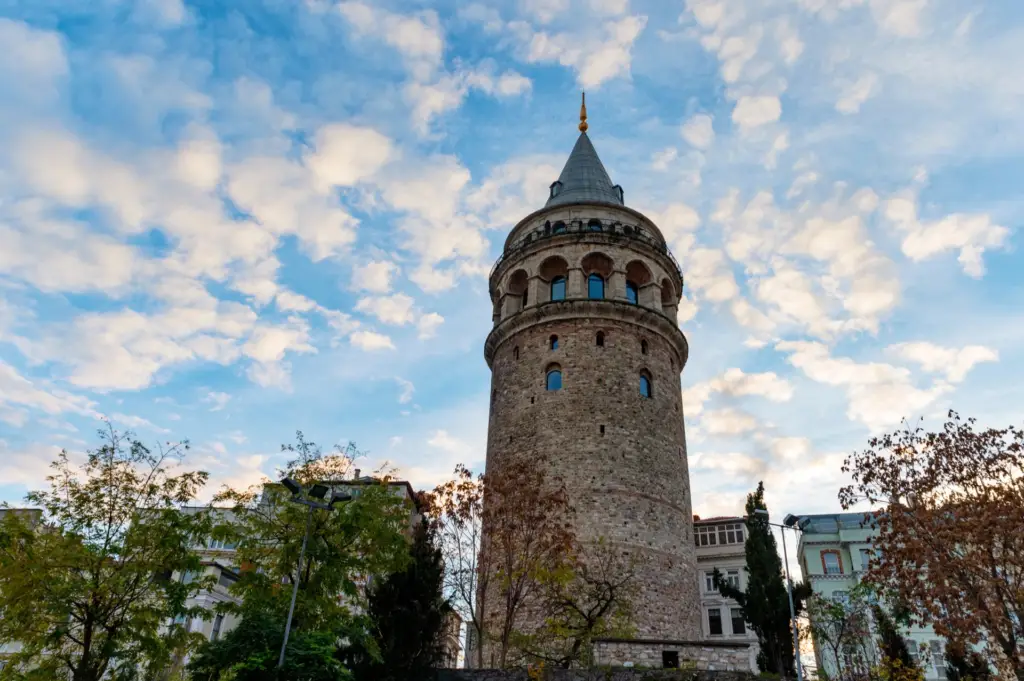
The tower you climb was built in 1348 by the Genoese, who held Galata as a self-governing trading colony across the water from Byzantine Constantinople. They called it Christea Turris, the Tower of Christ, and it was the high point of the wall ring around their quarter — a watchtower before it was ever a view.
After the Ottoman conquest in 1453 the colony’s walls came down but the tower stayed, used at various points as a prison and a store. From 1717 it took on the job it kept longest: fire watch. Watchmen scanned a city built largely of wood and signalled the alarm from the top — a function that outlasted every empire in the neighbourhood.
The story every guide tells: Hezârfen Ahmed Çelebi is said to have fixed wings to himself, launched from the tower and glided across the Bosphorus to Üsküdar on the Asian side. The single source is the traveller Evliya Çelebi, writing decades later. Treat it as a good story rather than a documented flight, which is roughly how Istanbul treats it too.
The pointed cone on top is not medieval. Fires and earthquakes took the upper structure repeatedly, and the current silhouette dates from a restoration in 1965–67, with the building reopening as a museum in 2020 and further restoration work on the roof completed in 2024. Detailed structural figures and the full restoration record are set out on the tower’s reference entry.
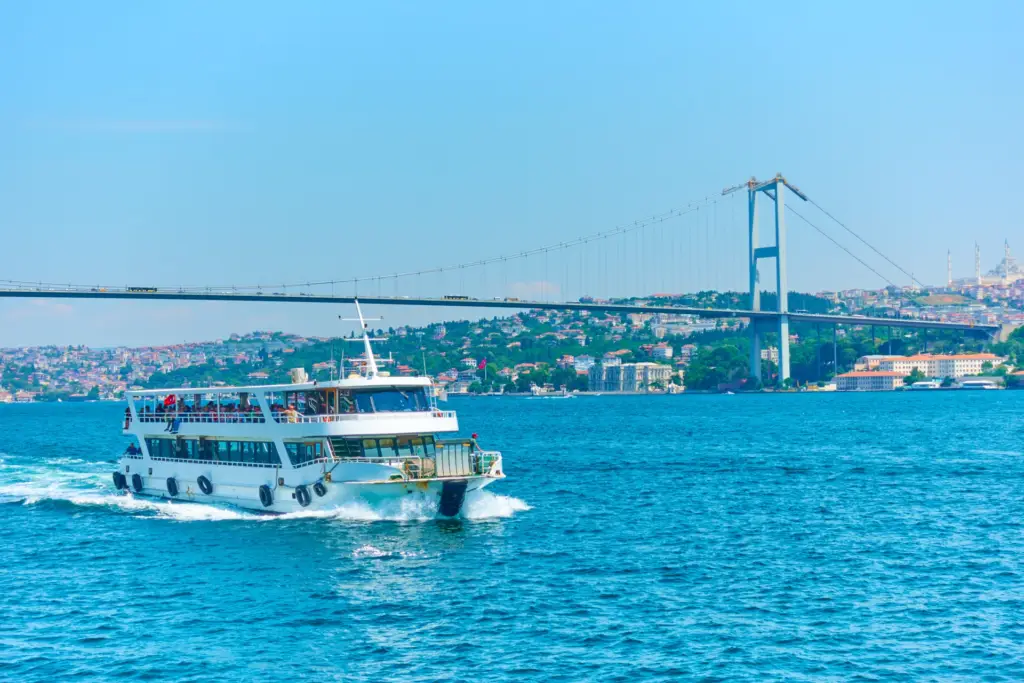
The best photograph of Galata Tower is taken from outside it, and the places that give you that shot are nearly all free: the lower deck of the Galata Bridge, the rooftop terraces on the side streets around the tower, a cross-Bosphorus ferry for a few lira, and Çamlıca Hill on the Asian side. Only the balcony itself, at €30, puts you above the city rather than across from it — and it is the one view with the tower missing from the frame.
| Viewpoint | Cost | What you get |
|---|---|---|
| Galata Tower balcony | €30 | 360° panorama; the tower is not in your photo |
| Rooftop terraces on Galata’s side streets | Price of a coffee | Golden Horn view and the tower in frame; seats and shade |
| Galata Bridge, lower deck | Free | The tower on its hill above the water — the classic postcard angle |
| Cross-Bosphorus ferry | A few lira | Moving view of both shores at sea level; 20 minutes |
| Çamlıca Hill, Asian side | Free to the park | Highest wide view of the city; 40 minutes away by road |
None of these replaces standing at 51.65 metres with the city turning underneath you. But if the wait runs past an hour, or the €120 for a family of four is better spent elsewhere that day, or someone in the group cannot take the stair, the view is not lost — it is just seen from a different spot. A cross-Bosphorus ferry costs a few lira and shows you the shores at water level; our breakdown of what a Turkey trip actually costs sets these small admissions against the bigger lines in a budget. On a guided day the choice is made for you in the right direction: the private Istanbul Old City tour, from USD 190 per person, spends its ticket budget on Hagia Sophia and Topkapı rather than on a viewpoint.
Galata Tower works best for children aged 6 to 11, who take the spiral stair as an adventure and the height as the point of the morning. Under 5 it is rarely worth the queue, because a pushchair cannot pass the lift landing and the last two floors have to be carried; teenagers give the balcony about fifteen minutes and are satisfied. The building hands a child a lift, then a tight spiral stair, then a high edge, and how well that sequence lands divides by age more sharply than any other Istanbul sight on our family itineraries.
No pushchair beyond the lift, a stair that must be carried, a narrow balcony where a small child needs holding, and a view that means little at that age. Small children under the museum’s stated age threshold enter free, so the loss is not the ticket — it is the hour in the queue. We normally suggest families with toddlers skip the climb and spend the time on the waterfront instead.
This is the age the tower works best. The stair is an adventure rather than an obstacle, the height is genuinely exciting, and the Hezârfen flying story does more work than any display panel — tell it at the bottom of the stair and the climb has a point. Give them a job on the balcony: find the Blue Mosque, find the bridge, count the ferries.
Fifteen minutes and satisfied, usually. The view earns its ticket with this group, the museum floors do not. Pair it with the streets below, where the interest actually is.
The tower is one entry in a longer ledger: our guide to Istanbul sightseeing by age band applies the same under-5 to teenager ruling across fifteen stops, ferry and cistern included.
Galata sits on day four of our 5-day private Istanbul package, from USD 1,435 per person, and the reason it sits there rather than on day one is the queue. Days one to three cover the historic peninsula, which puts Galata on a morning when the family is already used to early starts — and an early start is the only tool that works on this particular door.
Across a whole Istanbul itinerary, our children’s pricing sits at 40% off for ages 4–6 and 70% off for ages 0–3, with full adult rates from age 7 — the same structure that applies on every private package in the catalogue. Museum entry ages are set separately by the Ministry.

A licensed local guide cannot shorten the capacity queue — nobody can. What the guide does is decide whether you join it at all on the day. If the line is round the square at 14:00, the itinerary flips: the group takes the streets below first and returns at a better hour, or the climb moves to another morning. That judgement, made on the spot with the day still rearrangeable, is worth more than any “fast track” label.
The €30 admission is included in the package rather than collected on the day, alongside every other listed entrance on the itinerary. Quotes are fixed in writing before you travel, held with a 25% deposit, and we reply to enquiries within 24 hours.
Galata is one stop among the private guided days we run across Istanbul, which start at USD 190 for the Old City full day.
After the tower, day four continues by walking down through Karaköy and then crosses the Bosphorus by private vehicle to the Asian side, finishing at Çamlıca Hill for the wide view — the two heights in one day, deliberately. If Istanbul is the front half of a longer route, the same city days open our 5-day Istanbul and Cappadocia tour and the 8-day classic circuit.
Galata Tower entry is €30 for foreign visitors, roughly USD 33, set on the Ministry of Culture and Tourism fee schedule rather than by an operator. Turkish citizens pay a lower domestic rate on the same schedule. Third-party pages selling the same entry at €33 to €36 are resellers adding a margin; the official price is payable at the door in euros or the lira equivalent. The Istanbul Museum Pass covers the daytime session, though not the separate evening one. On our 5-day private Istanbul package the admission is already inside the quoted price, so nothing is collected on the day.
Galata Tower is worth visiting on a clear day if the view is something you actively want, and hard to defend otherwise. The balcony sits at 51.65 metres between the old city and the Bosphorus, which is an angle no other paid viewpoint in Istanbul offers. Against that, the ticket is €30 — more than Hagia Sophia charges — the queue can pass an hour on summer afternoons, and the museum floors inside are brief. In grey weather, or if anyone in the group cannot climb stairs, skip it and take the view from a rooftop terrace or the Galata Bridge instead.
Galata Tower is open every day with no weekly closing day, and runs two separate ticketed sessions. The daytime museum session runs 08:30 to 18:30, with the ticket desk shutting at 18:14. An evening session then runs from 18:30 to 23:00, on its own ticket, with last admission about an hour before close. Most conflicting hours online come from someone quoting one session as if it were the whole day. Because the evening programme is seasonal, confirm it on the tower’s official site for your date before planning around it. Sunset is the hour that catches people out, since it falls inside the evening session in summer and inside the daytime one in winter — check the sunset time for your date, then book the session that contains it.
Galata Tower needs 60 to 90 minutes in the day plan, even though the visit itself is short. Inside, 15 to 20 minutes on the balcony and about five minutes through the display floors covers everything without rushing. The rest is queue: the line outside, the wait for the lift, the climb, and the descent on the same narrow spiral stair. Arriving at 08:30 compresses the whole thing to well under an hour; arriving at 16:00 in July can double it. Twenty minutes is a plan for the building, not for the crowd, and it is the reason so many itineraries run late after Galata.
Galata Tower has a lift, but it stops at floor seven and does not reach the balcony. The last two levels are a tight spiral stair cut through walls 3.75 metres thick, used in both directions by people going up and coming down. Anyone who cannot manage two flights of steep, narrow stone steps will not reach the view, and there is no refund at that point. Pushchairs cannot go past the lift landing and there is no storage, so families with toddlers need one adult ready to carry the child or to wait below. The balcony at the top is narrow enough that it moves as a slow one-way shuffle at busy hours.
No — the line at Galata Tower cannot be skipped, and we say that as an operator who would profit from claiming otherwise. The wait at Galata is a capacity queue, not a ticket queue: one lift, one narrow stair and a small balcony mean visitors are admitted in batches whatever they are holding. Pre-booked vouchers, “fast track” upgrades and a guide beside you all move at the same speed. The only thing that genuinely works is the hour you choose — arrive at 08:30, ideally on a Monday morning, and there is usually no line to skip. The worst window is 16:00 to closing, when everyone arrives at once for the low light and the wait can pass an hour.
There is no restaurant and no café at the top of Galata Tower any more. The upper floors held a restaurant and an evening venue for decades, but both were removed in the 2020 conversion that turned the building into a museum under the Ministry of Culture and Tourism. What is up there now is nine storeys of display floors and the balcony, with no food or drink served inside. Older guidebooks and a good deal of search-result copy still describe dinner with a view up there, which has not been possible for years. The rooftop terraces on the streets below serve the same view with a table.
The Istanbul Museum Pass includes Galata Tower in the daytime session but not in the evening one. The pass costs €105 for five days across thirteen sites and admits pass holders to Galata during the standard museum hours, with the same 18:14 desk cut-off everyone else has. The evening session is sold as a separate ticket the pass does not cover. Two things catch visitors out: the pass does not include Hagia Sophia, which is the site most people assume it covers, and it only pays for itself if you visit roughly four or more of the thirteen sites inside the five days. For a two-museum trip, single tickets cost less.
It belongs on the Beyoğlu side of the trip, not on an Old City day. Topkapı, Hagia Sophia and the Blue Mosque sit together on the historic peninsula; Galata is across the Golden Horn and reaching it costs a crossing either way. On our 5-day private Istanbul package the climb opens day four, after three days on the peninsula, so the skyline you look down on is one you can already name. Because the visit itself runs 60–90 minutes, it pairs naturally with Karaköy below and a Bosphorus crossing after. Slotting it into day one wastes the view on a city you have not met yet.
For the April–June and September–October peaks, three to four months out is comfortable; hotel availability in the Old City drives that lead time far more than the tower does. Galata itself is never the constraint, because admission is bought on the day and the entrance fee is already inside a package price. What early booking buys is the 08:30 slot on the morning that suits the rest of your route. We reply to enquiries within 24 hours with a day-by-day plan and a fixed price in USD, and a 25% deposit secures the dates. Winter trips can be arranged much closer in. Our Istanbul trip-length guide shows how many days each shape needs.
The day gets rearranged, which is the practical difference between a private guide and a timed ticket. Because the tower admits 100 visitors an hour, an afternoon line can pass an hour and no ticket type moves you up it. Your guide sees the line, and the group takes Karaköy, the Mevlevi lodge or the streets below first and returns at a quieter hour — or the climb shifts to another morning entirely. Nothing is forfeited, because the €30 admission is paid inside your package rather than as a dated voucher. On the payment side, a 25% deposit confirms the dates and the remaining 75% is paid on arrival, by cash or card.
Galata Tower is a small decision inside a bigger one: which hour you climb it, and what the rest of the day does around it. That is the part a licensed local guide handles on our 5-day private Istanbul package from USD 1,435 per person — the early window at the tower, the entrance fee already inside the price, and an itinerary that can move if the queue says so. Turkey Family Tours is a TURSAB-licensed operator, licence 13538, every trip is fully private, and every quote is fixed in writing before you travel.



Tell us about your family — we reply within 24 hours.