 English
 Dutch
Dutch Japanese
 Korean
 Chinese
Best Time to Visit Turkey: Month-by-Month Guide for Private Tours
The best time to visit Turkey, month by month: ~90–95% Cappadocia hot air balloon reliability from May to October, sea temperatures, school-holiday windows and booking lead times.



Quick Answer: Turkey in July is hot and mostly dry, hottest in the Aegean valleys and mildest on the Cappadocia plateau. Istanbul averages 29.7 °C (85 °F) by day, Cappadocia 28.5 °C (83 °F) with nights near 14 °C (57 °F), Antalya 34.2 °C (94 °F) and the valley around Ephesus 36.4 °C (98 °F). The sea runs from about 28 °C (82 °F) off Antalya to 24–25 °C (75–77 °F) on the windier Aegean. Ephesus and Pamukkale open at 08:00, when it is coolest for walking. Hot air balloons over Cappadocia fly on about 90–95% of July mornings. A private Turkey tour in July costs from USD 1,690 per adult (two adults sharing) for the 5-day Istanbul & Cappadocia route to USD 4,450 for 14 days, with hand-picked 4-5 star hotels, a licensed local guide in every region and a private vehicle with driver. Turkey Family Tours is TURSAB-licensed (no 13538). A 25% deposit confirms the booking; 75% is paid on arrival. Get a Private Quote →
Turkey in July is not one climate. On the same afternoon the valley below Ephesus averages 36.4 °C (98 °F), Istanbul 29.7 °C (85 °F) and Cappadocia 28.5 °C (83 °F). By dawn Cappadocia has dropped to 13.7 °C (57 °F). The sea runs from about 24 °C (75 °F) on the Aegean to 28 °C (82 °F) off Antalya. Turkey weather in July changes that much from region to region, so a family route and the hours of each day are planned around it, stop by stop. The weather figures are the 1991–2020 July normals of the Turkish State Meteorological Service (MGM) for twelve cities. The sea readings are ten-year averages and the daylight times come from the NOAA solar calculator. This page is the July chapter of our month-by-month guide to the best time to visit Turkey.
Planning a private Turkey tour?
We build family-paced private itineraries with hand-picked 4-5 star hotels and send a written plan and fixed price within 24 hours.
July is a good time to visit Turkey when the trip is built around the heat, not against it. Day highs run from 28.5 °C (83 °F) in Cappadocia to 36.4 °C (98 °F) in the Aegean valley by Ephesus. Rain almost stops: Antalya averages half a wet day in the month. The sea is at swimming temperature on every coast, and the days are the longest of the year after June. What July asks of a family is an early start. The big open-air sites are at their best in the first two hours after the 08:00 opening and at their hardest in mid-afternoon.
| Question | The July answer | Source |
|---|---|---|
| How hot by day? | 28.5–36.4 °C (83–98 °F) on a standard route; Cappadocia coolest, Aydın near Ephesus hottest | MGM normals, 1991–2020 |
| How cool at night? | 13.7 °C (57 °F) in Cappadocia; 19.5–22.9 °C (67–73 °F) on the coast and in Istanbul | Same record |
| Will it rain? | Rarely: 0.5 wet days in Antalya, 3.5 in Istanbul, 2.3 in Cappadocia | Same record |
| How warm is the sea? | About 28 °C (82 °F) off Antalya, 24–25 °C (75–77 °F) on the Aegean | Ten-year sea averages |
| How long are the days? | Istanbul 15 h 05 min on 1 July, 14 h 25 min on 31 July | NOAA solar calculator |
| Hot air balloon odds | 90–95% of July mornings fly | Month-by-month table in our hot air balloon guide |
July works for a family that wants the sea to be part of the trip and not an optional extra. Water off the Turquoise Coast averages about 27–28 °C (81–82 °F), so children can swim for as long as they like without getting cold. Our two weeks in Turkey route gives four straight days to that coast, at Fethiye and Antalya. It works for families whose only long break falls in the summer. It also works for families who like long evenings: in Istanbul the sun sets at 20:40 on 1 July, and dinner outside is comfortable on every stop. Cappadocia is the easiest region of the month. Days there stay below 30 °C on average and the nights are cool enough to sleep with the window open.
July is hard work in the inland Aegean. Aydın, the weather station nearest Ephesus, averages 36.4 °C (98 °F) by day, and Denizli, below Pamukkale, 34.8 °C. Both sites are open marble and white travertine with little shade. A family that arrives at Ephesus at noon walks the main street in the hottest part of the day, with no shade on the marble. An 08:00 start finishes the same walk before the late-morning heat. July is also a busy month at the headline sites, and the queues build fastest after mid-morning. Families who struggle in the heat, or who cannot start early, will find May, June or September easier. Our June guide and September guide cover those months.
July gives a warm sea at 28.2 °C (83 °F) off Antalya, half a wet day in Antalya across the month and 15 hours of daylight in Istanbul on 1 July. It asks for early starts, sun protection and a route that places the hottest stops at the right point in the trip. Our 10 day Turkey itinerary runs Ephesus and Pamukkale as day trips from three nights at Kuşadası, so both can start at the 08:00 opening. For visas, money and getting around, see our Turkey travel guide.
Turkey in July averages 29.7 °C (85 °F) by day in Istanbul and between 33 °C and 36 °C (91–98 °F) on the Aegean and Mediterranean coasts and in the inland valleys. The plateau is cooler: Cappadocia averages 28.5 °C (83 °F), with nights of 13.7 °C (57 °F). The table lists the July normals for the twelve stations that matter on a Turkey route, with the highest July temperature on record at each. A normal is the average of thirty Julys, so a single week can run a few degrees either side.
| Station (nearest stop) | Day high | Night low | Rain | July record |
|---|---|---|---|---|
| Aydın (Ephesus) | 36.4 °C (98 °F) | 20.7 °C (69 °F) | 7.1 mm | 44.8 °C (113 °F) |
| Denizli (Pamukkale) | 34.8 °C (95 °F) | 20.5 °C (69 °F) | 14.7 mm | 43.9 °C (111 °F) |
| Antalya | 34.2 °C (94 °F) | 22.9 °C (73 °F) | 4.7 mm | 45.0 °C (113 °F) |
| İzmir | 33.3 °C (92 °F) | 22.6 °C (73 °F) | 4.2 mm | 43.2 °C (110 °F) |
| Muğla (inland Aegean) | 33.2 °C (92 °F) | 21.1 °C (70 °F) | 4.3 mm | 44.6 °C (112 °F) |
| Bursa | 31.0 °C (88 °F) | 17.3 °C (63 °F) | 22.3 mm | 43.8 °C (111 °F) |
| Çanakkale (Gallipoli, Troy) | 30.9 °C (88 °F) | 19.5 °C (67 °F) | 14.4 mm | 40.5 °C (105 °F) |
| Ankara | 30.4 °C (87 °F) | 15.9 °C (61 °F) | 14.5 mm | 41.0 °C (106 °F) |
| Konya | 30.2 °C (86 °F) | 16.0 °C (61 °F) | 7.6 mm | 40.6 °C (105 °F) |
| Istanbul | 29.7 °C (85 °F) | 20.5 °C (69 °F) | 22.1 mm | 40.6 °C (105 °F) |
| Nevşehir (Cappadocia) | 28.5 °C (83 °F) | 13.7 °C (57 °F) | 9.4 mm | 39.5 °C (103 °F) |
| Erzurum (eastern highlands) | 26.6 °C (80 °F) | 11.1 °C (52 °F) | 28.8 mm | 35.6 °C (96 °F) |
Source: MGM long-term July normals, 1991–2020.
Istanbul averages 29.7 °C (85 °F) by day and 20.5 °C (69 °F) at night in July. That is 2.6 degrees warmer than June and the same as August. Rain falls on about 3.5 days in the month, 22.1 mm in all, usually as a short summer shower. The city sits between two seas, so a breeze off the Bosphorus takes the edge off most afternoons on the water. The old city on the hill away from the shore feels hotter, and that is where Hagia Sophia, the Blue Mosque and Topkapı Palace are. Our Istanbul travel guide covers the districts in detail.
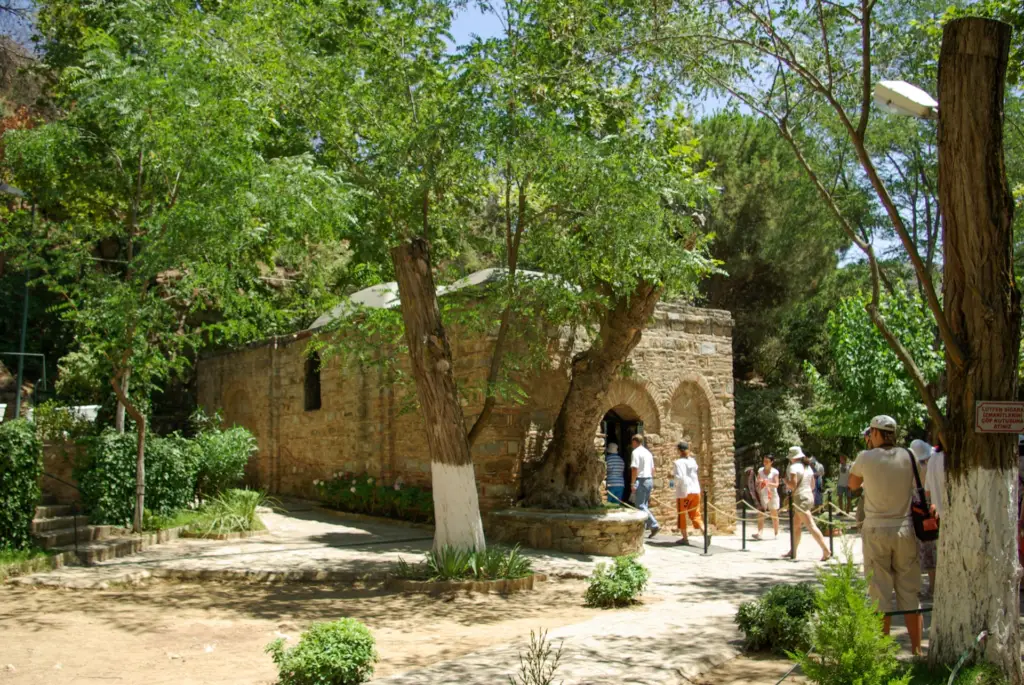
Ephesus is the hottest stop on most routes. Aydın, the nearest weather station, averages 36.4 °C (98 °F) by day in July, with nights of 20.7 °C. The July record there is 44.8 °C (113 °F). Ephesus, a UNESCO World Heritage Site, lies 3 km from Selçuk in a valley that holds the heat, and the site is almost entirely open stone. İzmir, on the coast to the north, averages 33.3 °C. On our private Ephesus tours, a visit at 08:00 walks Curetes Street and reaches the Library of Celsus before the late-morning heat. Our Ephesus travel guide has the full walking route.
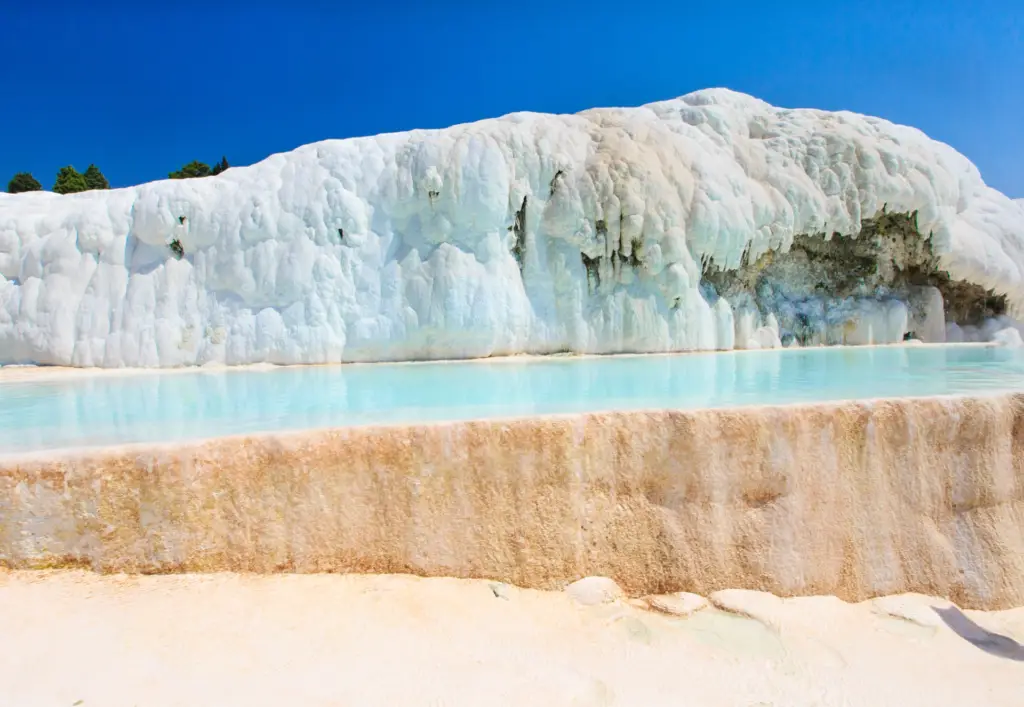
Denizli, below Pamukkale, averages 34.8 °C (95 °F) by day in July and 20.5 °C at night. The travertine terraces are white and reflect the sun, and families walk them barefoot. In the early morning the stone is comfortable underfoot. By early afternoon it is warm and the glare is strong enough to need sunglasses. Hierapolis-Pamukkale, on the plateau above the terraces, has more ruins than shade. All three entrances open at 08:00, and that first hour is the one to use. The Pamukkale travel guide explains which gate to use and why.
Antalya averages 34.2 °C (94 °F) by day and 22.9 °C (73 °F) at night in July, with 11.7 hours of sunshine a day and half a rainy day in the whole month. The nights are the warmest on the route, and air conditioning matters more here than anywhere else. The sea off the city beaches averages about 28 °C (82 °F). The ancient sites near Antalya, Perge and Aspendos, are best seen in the morning, with the afternoon kept for the water. Our Antalya travel guide covers Kaleiçi old town and the coast.
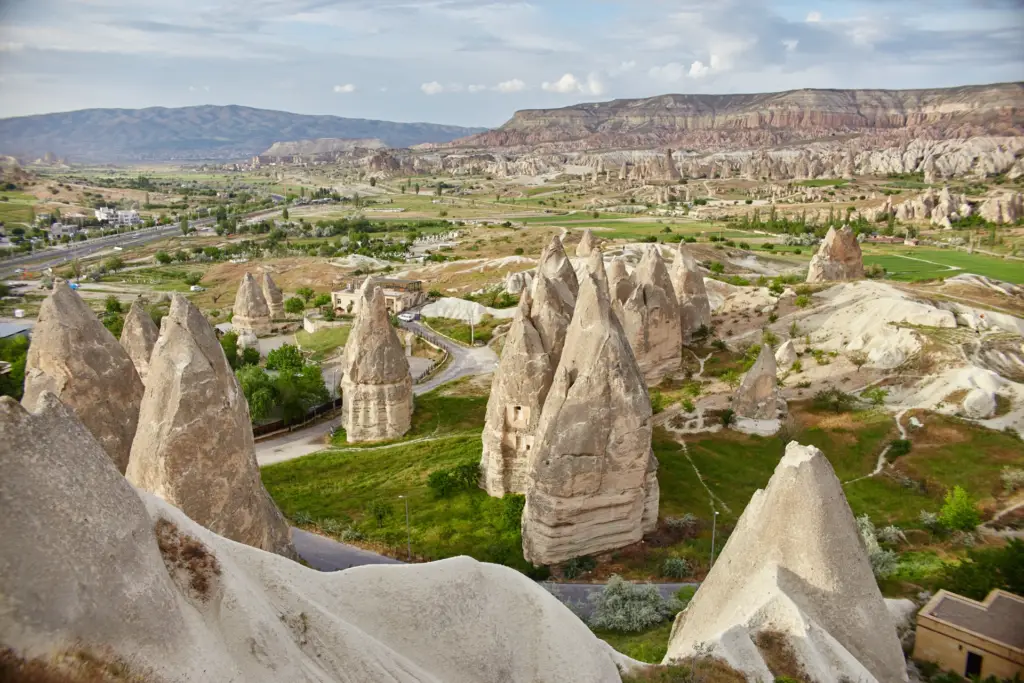
Cappadocia is the coolest region on a standard route in July. Nevşehir averages 28.5 °C (83 °F) by day and 13.7 °C (57 °F) at night, a difference of 14.8 degrees. The plateau sits at over 1,000 metres, and the dry air cools quickly after sunset. July is also dry here, with 9.4 mm of rain against 37.5 mm in June. The section on Cappadocia in July below covers the nights, the hot air balloons and the valley walks in detail.
Çanakkale averages 30.9 °C (88 °F) by day and 19.5 °C at night in July. The Gallipoli peninsula and Troy are close to the sea, and the days here are several degrees cooler than at Ephesus. The memorials and cemeteries of the Gallipoli Historical Site are open ground with little shade, so the morning suits them best. The archaeological site of Troy is smaller and fits easily into a morning. The Gallipoli travel guide covers the peninsula route. Our private Gallipoli tours from Istanbul page compares the USD 430 day trip with the USD 820 route via Troy.
Turkey in July is too hot only at three stops, and only in the afternoon. The valley near Ephesus averages 36.4 °C (98 °F), Pamukkale 34.8 °C (95 °F) and Antalya 34.2 °C (94 °F). Istanbul, at 29.7 °C (85 °F), and Cappadocia, at 28.5 °C (83 °F), stay below 30 °C (86 °F). On a well-planned route the open ruins are walked from the 08:00 opening, and the hot afternoon goes to the sea or an indoor museum.
Only one station on a standard route averages above 35 °C in July: Aydın, near Ephesus, at 36.4 °C (98 °F). Denizli is close behind at 34.8 °C and Antalya at 34.2 °C. On a typical July afternoon in these three places the thermometer reaches the mid-30s, and on a hot week it goes higher. Istanbul, Cappadocia and Çanakkale average between 28 °C and 31 °C (82–88 °F) by day. That is warm, but it is the temperature at which most families still walk comfortably with water and a hat.
On the coast the nights stay warm: Antalya averages 22.9 °C (73 °F) at night and İzmir 22.6 °C, so the air never really cools. On the Cappadocia plateau the night falls to 13.7 °C, so the body recovers overnight. After a warm night, a 30 °C day in Istanbul can feel harder than a 28 °C day in Cappadocia. On the coast the sea cools a family down; on the plateau the night does.
| Stop | Day high | Night low | Day–night gap |
|---|---|---|---|
| Cappadocia (Nevşehir) | 28.5 °C | 13.7 °C | 14.8 °C |
| Ephesus area (Aydın) | 36.4 °C | 20.7 °C | 15.7 °C |
| Pamukkale (Denizli) | 34.8 °C | 20.5 °C | 14.3 °C |
| Istanbul | 29.7 °C | 20.5 °C | 9.2 °C |
| Antalya | 34.2 °C | 22.9 °C | 11.3 °C |
The Aegean valley has the widest gap, 15.7 °C, but its night low of 20.7 °C (69 °F) is still a warm night. Only in Cappadocia, at 13.7 °C (57 °F), does the night turn genuinely cool.
Every station on the route has a July record far above its average. Antalya’s is 45.0 °C (113 °F), Aydın’s 44.8 °C, Denizli’s 43.9 °C and Istanbul’s 40.6 °C. These are extremes and not a normal July week. Stories online about 40 °C at Ephesus describe a heat wave, not the average. A heat wave usually lasts a few days. When one arrives during a tour, a private schedule can move a site to an earlier hour. A fixed group tour cannot.
Young children and grandparents feel July heat first. The practical rules are simple. Keep open-air sites to the morning, drink before feeling thirsty and carry more water than seems necessary. Plan an indoor stop, a museum, a covered bazaar or lunch in the shade, for the early afternoon. A private vehicle with air conditioning waiting at the site exit turns a hot walk into a short one. Our guide on whether Turkey is safe for families covers health and practical questions beyond the weather.
In Istanbul the sun rises at 05:35 on 1 July and sets at 20:40, giving 15 hours and 5 minutes of daylight. Ephesus and Pamukkale open their gates at 08:00. The first two hours after opening are the coolest and quietest of the day. The long evening gives a second window for walking, dinner and photographs. A July route is planned around those two windows.

| Place | 1 July | 15 July | 31 July |
|---|---|---|---|
| Istanbul | 05:35–20:40 (15 h 05) | 05:44–20:36 (14 h 52) | 05:58–20:23 (14 h 25) |
| Göreme, Cappadocia | 05:19–20:09 (14 h 50) | 05:28–20:05 (14 h 38) | 05:41–19:54 (14 h 13) |
| Selçuk, Ephesus | 05:51–20:37 (14 h 46) | 05:59–20:33 (14 h 34) | 06:12–20:22 (14 h 10) |
| Antalya | 05:41–20:20 (14 h 40) | 05:49–20:17 (14 h 28) | 06:01–20:06 (14 h 05) |
| Çanakkale | 05:48–20:48 (15 h 00) | 05:57–20:43 (14 h 47) | 06:11–20:31 (14 h 21) |
Sunrise and sunset times from the NOAA solar calculator, local time (UTC+3). By 15 August Istanbul has 13 h 52 min of daylight, more than an hour less than on 1 July.
Ephesus and all three Pamukkale entrances open at 08:00 every day; the Ministry of Culture and Tourism museum portal lists current hours for each site. At that hour the air has not yet reached the day’s high, and the tour coaches have not yet arrived; at Ephesus they build up from about 09:30. A family that walks the main street from 08:00 finishes the site before 11:00. On a private tour the driver and guide are ready at the hotel door for that early start.
Each region on the route has an indoor or shaded stop for the early afternoon. In Istanbul it is the Grand Bazaar‘s covered streets, the Basilica Cistern underground or a ferry on the Bosphorus. In Selçuk it is the Ephesus Museum and lunch in the shade. At Pamukkale it is the Hierapolis Archaeology Museum in the old Roman baths. In Cappadocia it is an underground city, where the air stays cool whatever the weather above. A private guide builds these into the day in the right order, so that the open ground comes first.
With sunset at 20:40 in Istanbul on 1 July, a family can walk the Galata Bridge, take a ferry across to the Asian side or eat outside by the water in daylight. In Antalya the old town of Kaleiçi is at its liveliest after dark, and the harbour stays warm late into the evening. In Cappadocia the sunset over Rose Valley comes at about 20:09 early in the month, and the air cools fast once the sun is down.
At Ephesus the difference between 08:00 and noon is larger than anywhere else on the route. The valley averages 36.4 °C as a day high, and the main street runs downhill over open marble with almost no shade. An early visit enters at the upper gate, walks downhill past the Odeon and the Library of Celsus, and leaves at the lower gate where the vehicle waits. That direction means no uphill walk in the heat. Our Ephesus guide explains the one-way route in detail.
In July the Mediterranean off Antalya averages about 28.2 °C (83 °F) and the Aegean off Kuşadası about 24.5 °C (76 °F), a gap of almost four degrees. The air temperature on both coasts is similar, about 33–34 °C (91–93 °F) by day. The difference is the sea itself. For a family that wants long swims, the Turquoise Coast between Antalya and Fethiye has the warmer water. The Aegean is still well above swimming temperature, and many swimmers prefer its fresher water in the heat.
| Coast | June | July | August |
|---|---|---|---|
| Antalya (Mediterranean) | 25.2 °C (77 °F) | 28.2 °C (83 °F) | 29.5 °C (85 °F) |
| Fethiye (Mediterranean) | 24.1 °C (75 °F) | 27.1 °C (81 °F) | 28.5 °C (83 °F) |
| Bodrum (southern Aegean) | 22.9 °C (73 °F) | 24.7 °C (76 °F) | 26.0 °C (79 °F) |
| Kuşadası (Aegean, near Ephesus) | 23.1 °C (74 °F) | 24.5 °C (76 °F) | 25.1 °C (77 °F) |
| Çanakkale (Dardanelles) | 21.8 °C (71 °F) | 24.2 °C (76 °F) | 24.7 °C (76 °F) |
| Istanbul (Bosphorus) | 21.2 °C (70 °F) | 23.9 °C (75 °F) | 24.5 °C (76 °F) |
Monthly sea-surface averages from seatemperature.info, based on the last ten years of readings.
The Aegean summer has its own wind, the meltem, known in English as the Etesian wind. It is a strong, dry north wind that blows from about mid-May to mid-September. It is usually strongest in the afternoon and often drops at night, and on a strong day it can reach force 7–8 on the Beaufort scale. On land the meltem makes the Aegean coast feel fresher than the thermometer says. At sea it raises waves on the exposed beaches. A strong meltem day is a good day for the ruins and a poor day for a boat trip.
At about 24.5 °C in July, the Aegean near Ephesus is warm enough for a long swim and cool enough to feel refreshing after a hot morning at the ruins. Kuşadası has town beaches close to Ephesus, and the sea here warms by less than one degree (0.6 °C) between July and August. Families staying near Ephesus can swim in the late afternoon once the day’s sightseeing is done. On windy days the sheltered bays are calmer than the open beaches.
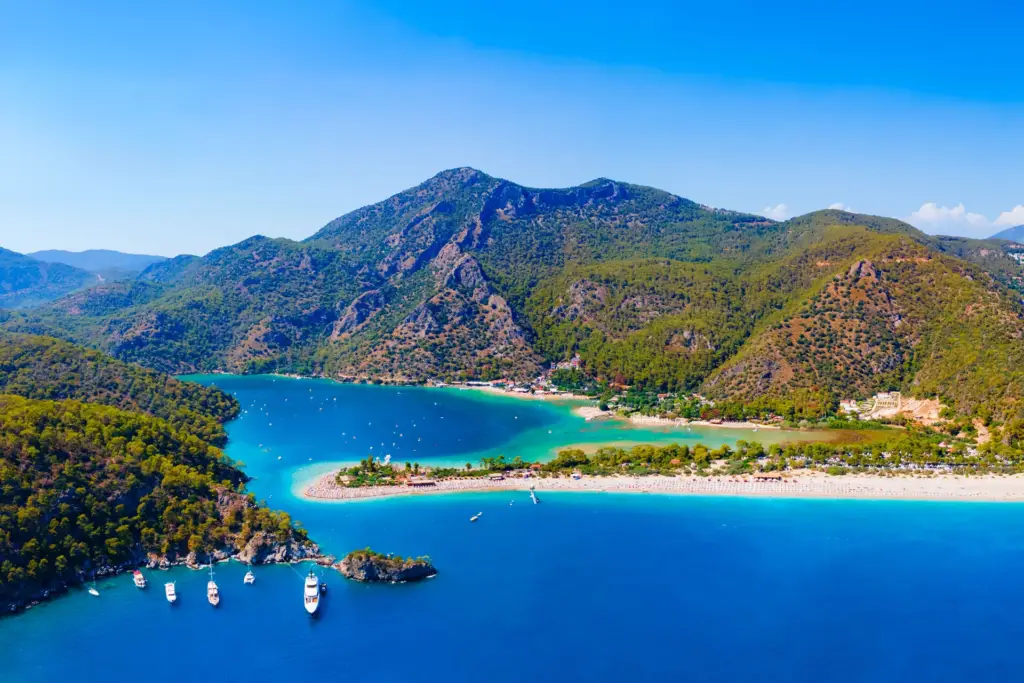
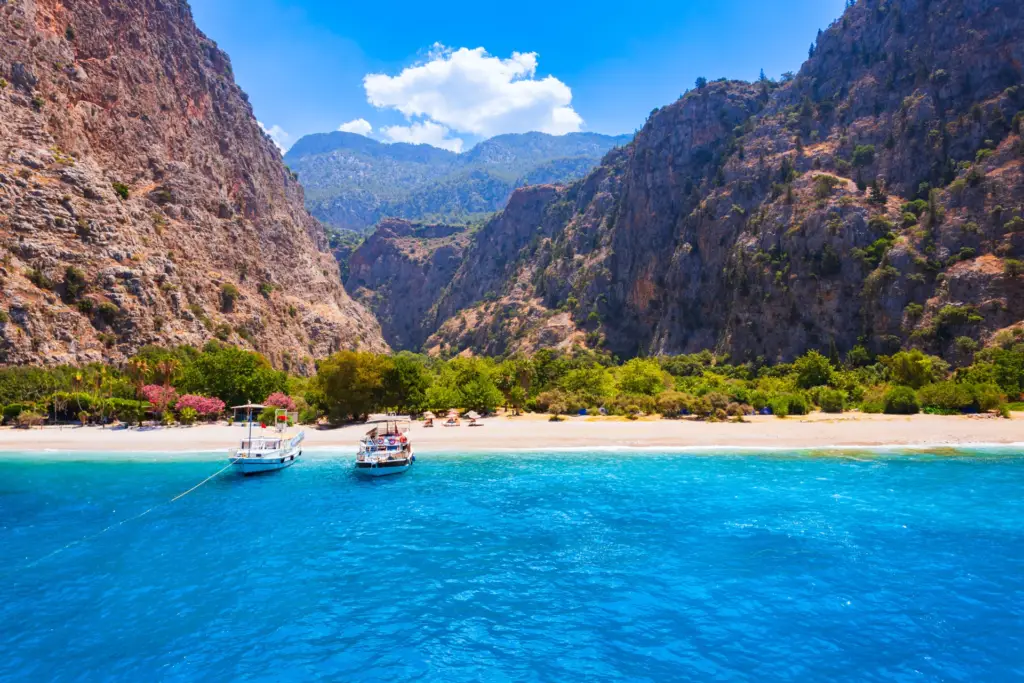
The Mediterranean from Antalya to Fethiye is the warmest sea on the route in July, at 27–28 °C (81–82 °F). The water is warm enough for small children to stay in for a long time. Fethiye has the Ölüdeniz lagoon and boat days to the bays of the Lycian coast. Antalya has Konyaaltı beach to the west of the old town. A route that ends on this coast gives the last days of the trip to the water, which suits families who want beach days at the end.
The sea around Istanbul averages 23.9 °C (75 °F) in July and the Dardanelles 24.2 °C. Both are warm enough to swim, but neither is part of a sightseeing day in the city. In Istanbul the water is for looking at from a ferry. At Gallipoli, the beach at ANZAC Cove is a place of remembrance and not a swimming stop. The swimming on a July route belongs to the Aegean and Mediterranean days.
Cappadocia in July averages 28.5 °C (83 °F) by day and 13.7 °C (57 °F) at night. No other stop on the route has nights this cool. The days are dry and bright, with 11.9 hours of sunshine on average, and hot air balloons fly on about 90–95% of July mornings. The Göreme National Park and rock sites are on the UNESCO World Heritage List. For a family coming from Istanbul or the coast, the plateau is where July feels easiest. Cappadocia is a short flight from Istanbul, as our guide to flying there with children explains, and our Cappadocia travel guide covers the valleys day by day.

Nevşehir’s July normals give a day high of 28.5 °C and a night low of 13.7 °C, a swing of 14.8 °C (about 27 °F). In Istanbul the same gap is only 9.2 °C. The Aegean valley near Ephesus has a slightly wider gap, 15.7 °C, but its nights stay above 20 °C. The plateau lies at over 1,000 metres, and the dry air loses its heat quickly once the sun goes down. In practice, a family in T-shirts at 17:00 wants a jumper by 22:00. The hot air balloon pickup before sunrise is the coldest part of the whole July trip. Cave rooms, cut into the rock, stay cooler than the air outside on a July afternoon. Our guide to Cappadocia cave hotels explains how the rooms work.
In July hot air balloons over Cappadocia fly on about 90–95% of mornings, the same rate as June and August. The flights take off around sunrise, which falls between 05:19 and 05:41 in Göreme across the month. Flights depend on calm air before dawn, and in July most mornings qualify. When the wind or the Directorate General of Civil Aviation stops the flights, a booked hot air balloon flight is rebooked for the next morning or refunded in full. Every route of seven days or more already includes two nights in Cappadocia, so there is a second morning if the first is cancelled. The hot air balloon guide has the month-by-month table.
Our hot air balloon guide notes that July heat haze reduces visibility at middle altitude, and that August is drier with better visibility. For photographs, the first hour after sunrise and the last hour before sunset give the sharpest light. That fits the July timetable anyway: valleys early, indoor sites in the early afternoon, viewpoints in the evening. Uçhisar Castle and the ridges above Göreme are good sunset points.
The valley walks in Cappadocia are open ground, and in July they are best before about 10:00. Rose Valley, Red Valley and Love Valley have paths between rock chimneys, orchards and cave churches, and the shade is patchy. A morning walk of two or three hours is comfortable at this time of year. In July the underground cities are a welcome cool stop for children, because the air inside stays cool whatever the weather above. Derinkuyu and Kaymaklı are the best known, and Kaymaklı is the one on our private Cappadocia tours. The Göreme Open-Air Museum, with its painted cave churches, suits the late morning.
| Time | A July day in Cappadocia | Why then |
|---|---|---|
| Before sunrise | Hot air balloon flight (optional) | Calm air; 90–95% of July mornings fly |
| Early morning | Valley walk | Coolest daylight hours, sharpest light |
| Late morning | Göreme Open-Air Museum | Painted churches are indoors |
| Early afternoon | Underground city, lunch | Cool air below ground |
| Late afternoon | Avanos pottery workshop | Indoors, out of the afternoon sun |
| Sunset (about 20:00) | Viewpoint above Göreme or Uçhisar | Evening light; air starts cooling fast |
Istanbul in July averages 29.7 °C (85 °F) by day and 20.5 °C (69 °F) at night, with rain on about 3.5 days. The water on three sides of the city brings a breeze most afternoons. The difficulty in July is not the heat on its own but the heat combined with queues at the famous sites. A private day in the old city that starts early and moves between indoor and outdoor stops handles both.
Hagia Sophia, the Blue Mosque, Topkapı Palace and the Basilica Cistern are all part of the Historic Areas of Istanbul. They stand within a few minutes’ walk of one another, and all four are busiest from mid-morning. Queues at Topkapı and Hagia Sophia stand in the open, and in July that is the uncomfortable part of the day. We start at the first site of the day as early as it allows, and use the indoor halls of Topkapı and the underground cistern for the warmer hours. Our guide to visiting Hagia Sophia explains the visitor route, and the Blue Mosque guide covers prayer times and the dress rules. The private Istanbul Old City tour covers these sites in one day from USD 190 per person.
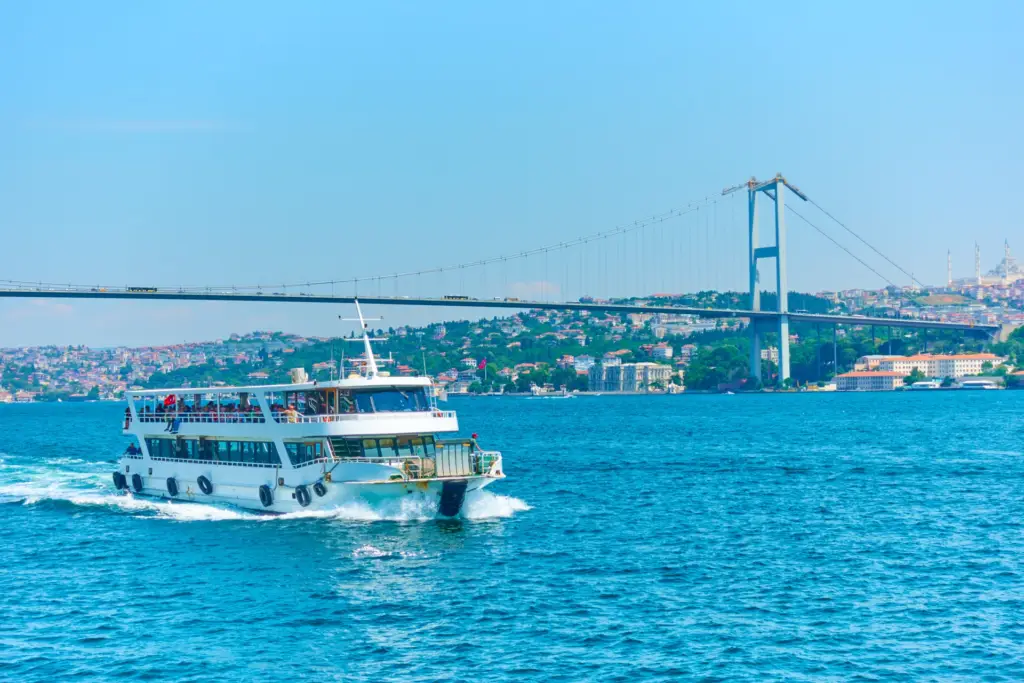
The public ferries between the European and Asian shores take about twenty minutes, and the open deck catches the breeze off the Bosphorus. A private boat along the strait passes the palaces and wooden mansions on both banks. In July the water around the city averages about 23.9 °C, and the air on deck feels noticeably cooler than in the old city. Our Bosphorus cruise guide compares the public ferries with a private boat.
July evenings in Istanbul are long. The sun sets at 20:40 on 1 July and at 20:23 on 31 July, so dinner can be outside by the water in daylight. Our Turkish food guide lists the summer dishes worth ordering. Karaköy, Kadıköy and the villages along the Bosphorus stay lively late. For families with children, the Galata Bridge at sunset, with the fishermen and the view back to the mosques, is an easy evening walk. Our Istanbul with kids guide lists the places that keep children interested.
The coolest region on a standard Turkey route in July is Cappadocia, at 28.5 °C (83 °F) by day and 13.7 °C (57 °F) at night. Istanbul comes next at 29.7 °C (85 °F), with the sea breeze on its side. The coolest place in the country is the eastern highlands, where Erzurum averages 26.6 °C (80 °F), but that region lies well away from the classic route. The hottest stops are the inland Aegean valleys and Antalya.
| Rank (coolest first) | Place | Day high | Night low |
|---|---|---|---|
| 1 | Erzurum, eastern highlands | 26.6 °C (80 °F) | 11.1 °C (52 °F) |
| 2 | Cappadocia (Nevşehir) | 28.5 °C (83 °F) | 13.7 °C (57 °F) |
| 3 | Istanbul | 29.7 °C (85 °F) | 20.5 °C (69 °F) |
| 4 | Konya | 30.2 °C (86 °F) | 16.0 °C (61 °F) |
| 5 | Ankara | 30.4 °C (87 °F) | 15.9 °C (61 °F) |
| 6 | Çanakkale | 30.9 °C (88 °F) | 19.5 °C (67 °F) |
| 7 | Antalya | 34.2 °C (94 °F) | 22.9 °C (73 °F) |
| 8 | Denizli (Pamukkale) | 34.8 °C (95 °F) | 20.5 °C (69 °F) |
| 9 | Aydın (Ephesus) | 36.4 °C (98 °F) | 20.7 °C (69 °F) |
The central plateau is the cool part of a July route. Cappadocia, Konya and Ankara all average about 28–30 °C by day, and their nights drop to between 13 °C and 16 °C. That is a real difference from the coast, where nights stay above 20 °C. The two Cappadocia nights on every route of seven days or more give the body a rest from the coastal heat. Our guide to how many days to spend in Cappadocia sets out two-night and three-night plans.
Istanbul is cooler than any coastal stop further south. At 29.7 °C by day it is 6.7 degrees cooler than the valley near Ephesus. The breeze off the Bosphorus and the Sea of Marmara helps. The nights, at 20.5 °C, are warm, though, so a hotel with good air conditioning matters. Our guide to how many days to spend in Istanbul helps size that first stop. For a family arriving from a cooler climate, Istanbul makes a gentle first stop in July before the hotter regions.
The eastern highlands around Erzurum are the coolest part of Turkey in July, with day highs of 26.6 °C and nights of 11.1 °C. They are not on our standard routes, which are built around Istanbul, Cappadocia, the Aegean and the south coast. We plan private tours anywhere in Turkey on request, though, and the east can be added as a separate leg. Tell us what you have in mind through the plan-my-trip form.
On the coast the coolest part of the day is the early morning. At Antalya the night low is 22.9 °C, and the first hours after sunrise are the time for Perge, Aspendos or the old town. On the Aegean the meltem freshens the afternoons. On the coast the sea itself cools a family down, and in July it is warm enough for long swims.
At Ephesus the coach traffic builds from about 09:30 every July morning, 90 minutes after the 08:00 opening. A private family schedule reaches each site at opening time, before the tour groups arrive.
July falls in the summer school holidays, when many families can travel. Turkish families also travel in July, heading for the coast and visiting the historic sites. Cruise ships call at Kuşadası for Ephesus, and tour coaches run on fixed timetables that bring them to the same sites at the same hours. We do not quote a visitor number for July here, because we could not confirm a current official monthly figure. What we see on the ground is steady: the queues peak between mid-morning and early afternoon.
In Istanbul the longest queues are at Topkapı Palace, Hagia Sophia and the Basilica Cistern. At Ephesus the busy stretch is the main street and the Library of Celsus once the coaches arrive, from about 09:30. At Pamukkale the terraces fill from late morning. In Cappadocia the Göreme Open-Air Museum is the site most likely to have a queue at the gate. The valleys, the underground cities outside the two most famous ones, and the smaller sites such as Hierapolis beyond the theatre are quieter even in July.
A private tour avoids the worst of the July crowds. It starts at the 08:00 opening, earlier than the coaches, so the first site is done before the rush. That is not possible on a fixed group timetable. Our private Ephesus tour page and the Pamukkale guide show how each site is paced.
July has one fixed public holiday in Turkey: 15 July, Democracy and National Unity Day. It is a single day. Many travel sites also list the Aspendos Opera and Ballet Festival as a July event, but in recent years it has been held in September.
15 July, Democracy and National Unity Day, is an official public holiday in Turkey, observed every year on the same date. It is a one-day holiday that commemorates the events of 15 July 2016. It does not change the length of a July trip.
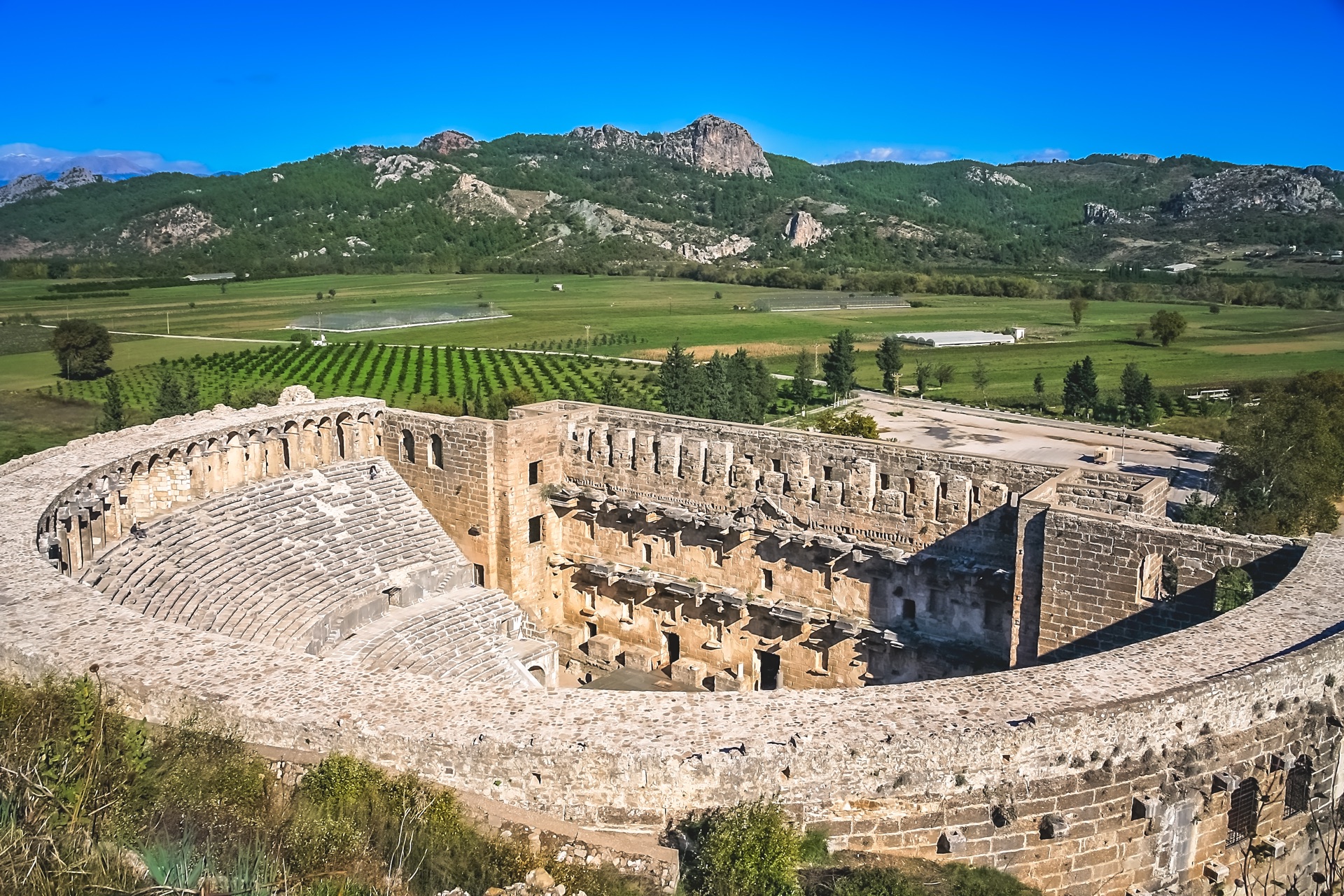
The Aspendos International Opera and Ballet Festival is held in the Roman theatre at Aspendos, near Antalya. Several travel sites still list it as a June or July event. The festival, organised by the Turkish State Opera and Ballet, opened its 26th edition on 1 September, according to the Ministry of Culture and Tourism, and in recent years it has run in September. If a performance in the Roman theatre is the reason for the trip, plan for September and check the programme once it is published. In July the theatre is best visited early, before the late-morning heat.
Some Turkish holidays follow the lunar calendar and move by about eleven days each year, so check the public holiday calendar against your dates before fixing a trip. The best time to visit Turkey guide shows how the holidays fall across the year.
Ephesus at 36.4 °C (98 °F) and Pamukkale at 34.8 °C (95 °F) are the two hottest stops on a July route, so the order of a route decides which days carry the heat. The table lists our private routes with their July character and the price per adult for two travellers. Every route includes hand-picked 4-5 star hotels with breakfast, a licensed local guide in every region, a private vehicle with driver and the domestic flights where the route uses them.
| Private tour | Route | July note | From (USD pp, 2 pax) |
|---|---|---|---|
| 5-Day Istanbul & Cappadocia | Istanbul → Cappadocia → Istanbul | The two coolest stops only | 1,690 |
| 5-Day Istanbul | Old City, Bosphorus, Asian side | Ferries and the Bosphorus breeze | 1,435 |
| 7-Day Istanbul, Cappadocia & Ephesus | Istanbul → Cappadocia → Ephesus | Ephesus at 08:00 on the last touring day | 2,450 |
| 8-Day with Pamukkale | Istanbul → Cappadocia → Pamukkale → Ephesus | Two hot days back to back, both started early | 2,790 |
| 10-Day with Gallipoli & Troy | Istanbul → Cappadocia → Pamukkale → Ephesus → Pergamon, Troy → Gallipoli | Ends on the Dardanelles, the coolest stop on the Aegean side (30.9 °C (88 °F)) | 3,320 |
| 10-Day Istanbul, Cappadocia & Antalya | Istanbul → Cappadocia → Antalya → Pamukkale → Ephesus | Two days on the warmest sea | 3,490 |
| 11-Day by Road | Istanbul → Ankara → Cappadocia → Konya → Pamukkale → Ephesus → Troy → Gallipoli | No internal flights; air-conditioned vehicle throughout | 3,795 |
| 12-Day Cappadocia & Turquoise Coast | Istanbul → Cappadocia → Antalya → Fethiye → Pamukkale → Ephesus | Four nights on the Mediterranean | 4,150 |
| 14-Day Gallipoli, Ephesus & Cappadocia | Istanbul → Gallipoli → Ephesus → Pamukkale → Fethiye → Antalya → Cappadocia | Hot stops first, cool plateau last | 4,450 |
Prices per adult for two travellers. For four travellers the 7-Day route is USD 2,085 per adult and for six USD 1,990; the 8-Day route is USD 2,345 and USD 2,225. Children aged 4–6 receive a 40% discount and children aged 0–3 a 70% discount.
The 14-Day route takes the hottest stops, Ephesus and Pamukkale, in the first week while everyone is fresh. It then moves to the Turquoise Coast for the sea, and ends with three days and two nights in Cappadocia, where the nights drop to 13.7 °C (57 °F). Families finish the trip on the coolest ground of the route.
Several of our routes finish at Ephesus and fly back to Istanbul from İzmir. In July some families prefer to end with the sea. The 12-Day route already gives four nights on the Mediterranean, with sea temperatures of 27–28 °C. Tell us in the request form if you would like the last days by the sea.
On every route that includes Ephesus, we plan the site for the morning. With the gates opening at 08:00 and the valley averaging 36.4 °C (98 °F) by afternoon, the site is walked before the late-morning heat. Where Pamukkale is on the same route, it gets its own early start the day before or after. The 2-Day Ephesus and Pamukkale tour from USD 990 puts both sites into a short trip from Istanbul, and the 4-Day Gallipoli, Troy, Ephesus and Pamukkale tour from USD 1,370 adds the Dardanelles.
The 11-Day by-road route uses no internal flights. In July the drives run in an air-conditioned private vehicle, and the long stretches, such as Cappadocia to Pamukkale via Konya, cross the cooler central plateau. The route ends up the Aegean coast at Troy and Gallipoli, where July days average 30.9 °C (88 °F), several degrees below Ephesus. It suits families who prefer the road to airports, from USD 3,795 per adult for two.
Days of 28–36 °C (82–97 °F) and a Cappadocia night of 13.7 °C (57 °F) set the packing list for Turkey in July: light, loose cotton or linen for the day and one warm layer for the evenings in Cappadocia. The Blue Mosque and Hagia Sophia ask for covered shoulders and knees, and women cover their hair. Closed shoes with grip matter at Ephesus, and sun protection matters everywhere. The table sets out what to wear by region.
| Region | Daytime | Early morning and evening | Extra |
|---|---|---|---|
| Istanbul | Light cotton or linen, 29.7 °C by day | T-shirt; light shirt on the ferry | Long skirt or trousers and a scarf for the Blue Mosque |
| Cappadocia | T-shirt and sun hat, 28.5 °C | Jumper or light jacket; nights 13.7 °C | Warm layer for the balloon pickup |
| Ephesus and Pamukkale | Loose, light clothes; 35–36 °C | T-shirt | Closed shoes; sandals for the travertines |
| Antalya and Fethiye | Beachwear and cover-up, 34.2 °C | Light clothes; nights 22.9 °C | Swimwear and sun cream |
| Gallipoli and Troy | Light clothes, 30.9 °C | Light layer; nights 19.5 °C | Respectful clothes at the memorials |
Light linen covers the shoulders and knees for the Blue Mosque and still feels cool in 30 °C heat. At the Blue Mosque and Hagia Sophia, men and women cover their shoulders and knees, and women also cover their hair. Scarves are usually available at the entrance, but a light one in the bag saves time. Loose long trousers or a long skirt work better in July than jeans. The Blue Mosque guide explains the visiting rules.
Pack one warm layer even in July, for Cappadocia. The night low there is 13.7 °C (57 °F), and a hot air balloon pickup before sunrise, or a late dinner outside, is cool enough for a jumper or a light jacket. It is the only place on a July route where most families need one. A thin fleece that folds into a daypack is enough.
Ephesus is a walk of about 3 km, mostly downhill, on ancient marble paving, uneven and in places polished smooth by centuries of feet. Closed walking shoes with grip are the right choice. At Pamukkale, shoes come off on the travertine terraces, so a pair that slips off easily and a small bag to carry them help. Flip-flops are for the beach, not the ruins.
July sunshine in Turkey is strong. Antalya averages 11.7 hours of sunshine a day and İzmir 12.4. The UV index forecast from the State Meteorological Service shows the daily strength of the sun. A wide-brimmed hat, sunglasses, a high-factor sun cream and a refillable water bottle are the essentials. Children need a hat and sun cream at every open-air site, not just at the beach. Light long sleeves are often cooler than bare arms in the full sun at Ephesus or Hierapolis.
July and August are almost the same month for heat: Istanbul averages 29.7 °C (85 °F) in both, and Antalya 34.2 °C (94 °F) against 34.1 °C (93 °F). June is about three degrees Celsius cooler everywhere. What separates the three is the sea, which keeps warming through August, and the daylight, which falls by more than an hour between mid-June and mid-August. The table compares them side by side.
| Measure | June | July | August |
|---|---|---|---|
| Istanbul day high | 27.1 °C (81 °F) | 29.7 °C (85 °F) | 29.7 °C (85 °F) |
| Ephesus area (Aydın) day high | 33.5 °C (92 °F) | 36.4 °C (98 °F) | 35.9 °C (97 °F) |
| Cappadocia day / night | 24.9 / 11.7 °C | 28.5 / 13.7 °C | 28.7 / 13.6 °C |
| Cappadocia rain | 37.5 mm | 9.4 mm | 8.4 mm |
| Sea off Antalya | 25.2 °C (77 °F) | 28.2 °C (83 °F) | 29.5 °C (85 °F) |
| Sea off Kuşadası | 23.1 °C (74 °F) | 24.5 °C (76 °F) | 25.1 °C (77 °F) |
| Istanbul daylight (15th) | 15 h 06 min | 14 h 52 min | 13 h 52 min |
| Hot air balloon flight rate | 90–95% | 90–95% | 90–95% |
June is the gentlest of the three summer months for family sightseeing. Istanbul averages 27.1 °C and the valley near Ephesus 33.5 °C, about three degrees below July. The sea off Antalya is about 25 °C and still warming. June is also Cappadocia’s last wet month of the season, with 37.5 mm of rain. Our June guide covers the month in detail.
July brings the heat of August with the long days of June. On 15 July Istanbul still has 14 h 52 min of daylight, an hour more than in mid-August, and the sea off Antalya has passed 28 °C. Cappadocia turns dry in July, with 9.4 mm of rain against 37.5 mm in June. For a family that wants both long days of sightseeing and a warm sea, July gives the most of both.
August has the warmest sea of the year, about 29.5 °C (85 °F) off Antalya, and, as our hot air balloon guide notes, drier air with better visibility over Cappadocia. The air is as hot as in July. The days are shorter, with sunset in Istanbul at 20:05 on 15 August. Our August guide covers the month in detail.
Book a July trip four to six months ahead, so that the domestic flights and the cave hotel in Cappadocia can be secured at the times a family route needs. A written day-by-day plan comes back within 24 hours of your request, priced per person in USD.
For July, four to six months ahead gives the widest choice of flights and hotels. A route with two nights in Cappadocia and an early Ephesus start depends on the right flight times. Bookings closer to the date are still possible. The route may then need a different flight time or a different hotel, and we tell you that when we send the plan.
A 25% deposit confirms the booking, paid by secure online link or bank transfer. The remaining 75% is paid on arrival in Turkey, in cash or by card. Children aged 7 and over pay the adult rate; children aged 4–6 receive a 40% discount and children aged 0–3 a 70% discount. Turkey Family Tours is licensed by TURSAB, licence 13538, and holds a 5.0 rating from 41 reviews on Tripadvisor.
The price of a private tour covers the hotels with breakfast, a licensed local guide in every region and a private vehicle with driver. It also covers all airport transfers, the entrance fees listed in the itinerary and the domestic flights on routes that use them. It does not cover lunches and dinners, drinks, tips, international flights, travel insurance or the optional hot air balloon flight. The Turkey tour cost guide explains what moves the price up or down, and our trip-planning guide covers the steps from first idea to booking.
| Included | Not included |
|---|---|
| Hand-picked 4-5 star hotels with breakfast, including a Cappadocia cave hotel | Lunches and dinners |
| Licensed local guide in every region | Drinks, tips and personal expenses |
| Private vehicle with driver and all airport transfers | International flights and travel insurance |
| Entrance fees listed in the itinerary | Optional hot air balloon flight |
| Domestic flights on routes that use them | — |
July is a good time to visit Turkey for a trip that combines sightseeing with the sea, as long as the days start early. Day highs run from 28.5 °C (83 °F) in Cappadocia to 36.4 °C (98 °F) near Ephesus. Rain is rare, and the sea is warm on every coast. Hot air balloons fly on 90–95% of mornings, and Istanbul still has almost 15 hours of daylight. The hard part is the afternoon heat at the open-air sites, so on our routes Ephesus and Pamukkale are visited from the 08:00 opening. Our month-by-month guide compares July with the rest of the year, including the cooler shoulder months.
July is hot, but a well-timed route keeps it manageable. Only the inland Aegean averages above 35 °C, with 36.4 °C (98 °F) near Ephesus and 34.8 °C at Pamukkale. Istanbul averages 29.7 °C (85 °F) and Cappadocia 28.5 °C, with nights of 13.7 °C on the plateau. Heat waves above 40 °C do happen, but they usually last a few days. The answer is the timing of each day: open-air sites from 08:00, museums, lunch and indoor stops in the early afternoon, and viewpoints or old-town walks after 17:00. Our section on sightseeing hours that work in July sets out a full day, hour by hour, for families with children and grandparents.
July and August are almost equally hot in Turkey. Istanbul averages 29.7 °C by day in both months, Antalya 34.2 °C in July against 34.1 °C in August, and the valley near Ephesus 36.4 °C against 35.9 °C. The difference lies elsewhere. The sea off Antalya is about 1.3 °C warmer in August, at 29.5 °C, while July has about one hour more daylight in mid-month. Cappadocia is dry in both months, with under 10 mm of rain. Both months are clearly hotter and drier than June. For a family choosing between the two, the sea and the length of the day decide it, not the air temperature. Our August guide covers the later month in detail.
Istanbul averages 29.7 °C (85 °F) by day and 20.5 °C (69 °F) at night in July, on the state weather record for 1991–2020. The Bosphorus, the Golden Horn and the Sea of Marmara surround the city, so a breeze usually comes off the water in the afternoon. Showers are short and rare. The sea around the city is about 23.9 °C. For families, the practical plan is Hagia Sophia and Topkapı Palace at opening time, the Grand Bazaar or the Basilica Cistern at midday, and a ferry or the Galata Bridge in the evening. Our Istanbul travel guide covers the districts and how to move between them.
Cappadocia is not too hot in July. It is the coolest stop on a standard route, with 28.5 °C (83 °F) by day and 13.7 °C (57 °F) at night, so a warm layer is needed for the evenings and the hot air balloon pickup. July is also dry on the plateau, with 9.4 mm of rain in the month. Hot air balloons fly on about 90–95% of July mornings. If the authorities cancel a flight for wind, it is rebooked for the next morning or refunded in full. Every route of seven days or more includes two nights in Cappadocia. Our private Cappadocia tours show how the days are paced.
The sea in July averages about 28.2 °C (83 °F) off Antalya and 27.1 °C off Fethiye on the Mediterranean. The Aegean is cooler, about 24.5 °C (76 °F) off Kuşadası and 24.7 °C off Bodrum, where the summer meltem wind blows from the north. Istanbul and the Dardanelles are close to 24 °C. All of them are warm enough to swim. For long, calm swims with young children, the Mediterranean is the easier choice, while the Aegean feels fresher on the hottest days. A route that ends with beach days works best on the south coast, around Antalya, Kaleiçi and the old harbour. Our Antalya travel guide covers the beaches and the old town.
Ephesus is the hottest stop on most July routes, but it is comfortable when visited early. Aydın, the nearest weather station, averages 36.4 °C (98 °F) by day, and the site is open marble with almost no shade. The gates open at 08:00, and tour coaches arrive from about 09:30. Our families enter at the upper gate and walk about 3 km downhill to a vehicle waiting at the lower gate, so the visit is done before 11:00. Water, a hat and closed shoes with grip are the essentials. Our private Ephesus tours are built around this early start.
July is one of the busiest months at Turkey’s headline sites, because it falls in the summer school holidays. The queues follow the same timetable every day. At Ephesus the coaches arrive from about 09:30, and in Istanbul the lines at Hagia Sophia and Topkapı Palace grow through the late morning. A private tour that starts at the 08:00 opening sees the first site before the rush. Crowds thin again after 17:00, and the rest of the country is calmer. The valleys of Cappadocia, Hierapolis above the Pamukkale terraces and smaller sites such as Aphrodisias stay quiet even in high summer. Our section on July crowds shows the busy hours site by site.
June, July and August suit different trips. June is about three degrees cooler, with a sea near 25 °C off Antalya and 37.5 mm of rain in Cappadocia. July has the heat of August with more daylight: 14 h 52 min in Istanbul on 15 July against 13 h 52 min on 15 August. August has the warmest sea, about 29.5 °C off Antalya, and drier air with better visibility for hot air balloon flights. For families who want long sightseeing days and a warm sea on the same trip, July gives the most of both. For families who mind the heat most, June is the gentler month. Our June guide covers the cooler option.
Pack light, loose clothes in cotton or linen, a wide-brimmed hat, sunglasses and closed shoes with grip for Ephesus. Add one warm layer for Cappadocia, where nights average 13.7 °C (57 °F), especially for the hot air balloon pickup before sunrise. For the Blue Mosque and Hagia Sophia, bring long trousers or a long skirt that cover the knees and a light scarf for women. Swimwear is for the coast, where the sea is 24–28 °C. Children need a hat and sun cream at every open-air site, because July gives about 12 hours of sunshine a day on the coast. Our Blue Mosque guide explains the dress rules for the working mosques.
On a classic route, Cappadocia is the cooler choice, and the difference shows most at night. The plateau drops to 13.7 °C (57 °F) after dark, against 20.5 °C in Istanbul and 22.9 °C in Antalya. The Dardanelles, with Gallipoli and Troy, are the coolest stop on the Aegean side at 30.9 °C (88 °F) by day. The eastern highlands are cooler still, with Erzurum at 26.6 °C (80 °F), but they lie far from the usual route. For a family that minds the heat, two nights in Cappadocia in the middle of the trip give everyone a break from the coast. Our guide on how many days to spend in Cappadocia helps with the split.
Our private tours in July cost from USD 1,690 per adult for two travellers on the 5-day Istanbul and Cappadocia route, to USD 4,450 for 14 days. The price per adult falls as the group grows: the 7-day route is USD 2,450 for two and USD 2,085 for four. Children aged 4–6 receive a 40% discount and children aged 0–3 a 70% discount. Every price includes hand-picked 4-5 star hotels with breakfast, a licensed local guide in every region, a private vehicle with driver and the domestic flights on routes that use them. Meals, tips and the hot air balloon flight are extra. Our Turkey tour cost guide explains what moves the price.
Book a July trip four to six months ahead. That gives the widest choice of domestic flight times and cave hotel rooms in Cappadocia, and both matter on a route with an early Ephesus start. A 25% deposit confirms the booking, and the remaining 75% is paid on arrival in Turkey, in cash or by card. Cancellations inside seven days of arrival are charged in full, and the deposit is not refundable. Later bookings are still possible, but the route may then need a different flight time or hotel. A written day-by-day plan comes back within 24 hours of a request. You can send your dates through our trip request form.
A good July route puts the hottest stops early in the day and gives the family somewhere cool or a sea to rest. The 14-day route takes Ephesus and Pamukkale in the first week, moves to the Turquoise Coast, and ends with two nights in Cappadocia. The 12-day route gives four nights on the Mediterranean, where the sea is 27–28 °C. For a shorter trip, the 5-day Istanbul and Cappadocia route keeps to the two coolest stops. On every route with Ephesus, the site is visited from the 08:00 opening. Our table of private tour routes for July gives each route’s July character and price.
Send your July dates, the number of adults and children and the children’s ages through the plan-my-trip form. A written day-by-day route comes back within 24 hours, priced per person in USD. For July we place Ephesus and Pamukkale on early starts, and plan two nights in Cappadocia on routes of seven days or more. Turkey Family Tours holds TURSAB licence 13538. Every route uses hand-picked 4-5 star hotels, a licensed local guide in every region and a private vehicle with driver. A 25% deposit confirms the booking; 75% is paid on arrival. The contact page lists every way to reach us.



Tell us about your family — we reply within 24 hours.