 English
 Dutch
Dutch Japanese
 Korean
 Chinese

Turkey in June: Peak Hot Air Balloon Season & Private Tour Guide
The best time to visit Turkey in June: long days, peak Cappadocia balloon season and a warm coast before the July heat — private tour itineraries and costs. TURSAB-licensed.


Quick Answer: The best places to visit in Turkey fall into five regions. Istanbul (Hagia Sophia, Topkapı Palace, the Grand Bazaar) and Cappadocia (sunrise hot air balloons and cave hotels) lead the list; the Aegean corridor (Ephesus, Pamukkale, Bodrum), the Antalya–Turquoise Coast shore (Kaleiçi, the Ölüdeniz lagoon) and the Gallipoli–Troy arc on the Dardanelles complete it. A first trip pairs Istanbul with Cappadocia; ten days adds the Aegean and the battlefields, and two weeks connects all five regions in a single loop. The 12 destinations below are the places we plan and run private Turkey tours around every week, from a guided Old City day at USD 190 to the full 14-day route at USD 4,450 per person. Each entry says what the place is, how long it needs and how it fits a route. Turkey Family Tours is TURSAB-licensed (no 13538). Get a Private Quote →
The best places to visit in Turkey, on this page, are the places we take guests ourselves — the same 12 destinations, week after week, with a licensed local guide and a private vehicle. That changes what a “best places” list can tell you. Instead of a photo caption, each entry below says what the place actually is, how long it needs, and how it connects to the others across five regions. A few entries (Bodrum, Kaş) are places we do not sell at all; they are on the list because no fair shortlist of Turkey can skip them. Our Turkey travel guide holds the deeper region-by-region detail.
Last updated: July 2026 · Reviewed by Fatih, TFT Founder · TURSAB-licensed tour operator
The best places to visit in Turkey cluster into five regions, and the clusters matter more than any ranking: you plan a trip by picking regions, then giving each one enough nights. Every well-known ranking of Turkey’s destinations is really these five regions in a different order. The table below is the whole article in one view — what each region holds, the days it needs, and which kind of trip it anchors.
| Region | Signature places | Days it needs | Best for |
|---|---|---|---|
| Istanbul & the Bosphorus | Istanbul | 2–4 | First-timers, history, food |
| The Dardanelles arc | Gallipoli battlefields · Troy | 1–2 | Battlefield history, teenagers |
| Central Anatolia | Cappadocia | 2–3 | Landscapes, hot air balloons, cave hotels |
| The Aegean | Ephesus · Pamukkale · Pergamon · Bodrum | 2–3 | Ancient cities, thermal terraces |
| Antalya & the Turquoise Coast | Antalya · Fethiye & Ölüdeniz · Kaş · Saklıkent | 3–5 | Beach weeks, couples, Roman theatres |
Every stop on this list eats differently — testi kebab in Cappadocia, künefe on the Antalya coast, the olive-oil table around Ephesus — and our guide to the 25 dishes worth crossing Turkey for maps each one to its home city.
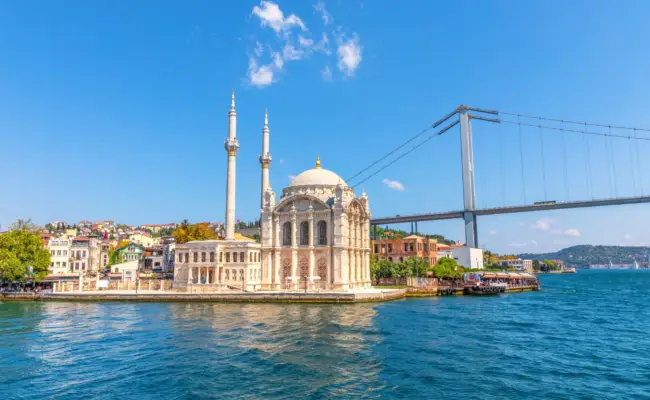
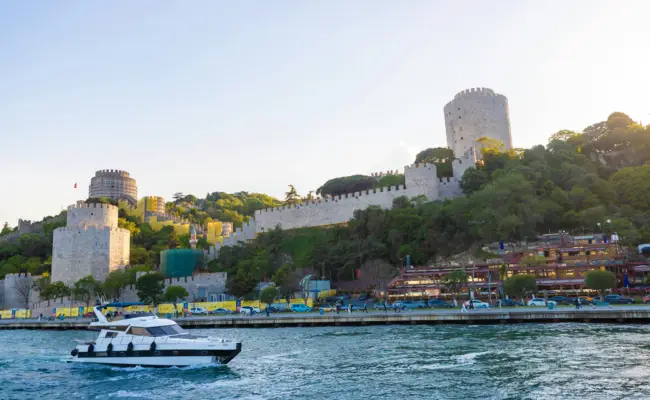
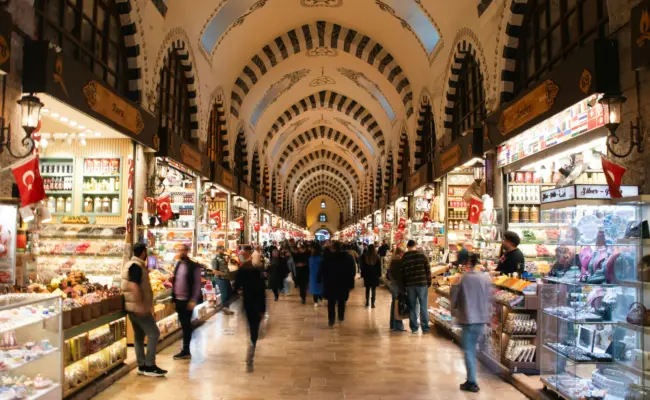
Istanbul is the only major city that spans two continents, and the one place no Turkey trip skips. The essentials cluster within a few hundred metres of each other in the UNESCO-listed old town. Hagia Sophia (raised in 537), Topkapı Palace and the Blue Mosque with its 20,000-plus hand-painted İznik tiles sit minutes apart; the Grand Bazaar, still a working market after five centuries, closes the square. Between the big four sit the Basilica Cistern’s forest of underwater columns and Süleymaniye’s terrace over the Golden Horn. Add a Bosphorus crossing and, with an extra day, the food streets of Kadıköy on the Asian side. One operational note: crowds at Topkapı and Hagia Sophia thin sharply before 09:00 — mornings are for monuments, afternoons for the bazaar. Give it two to four nights — our Istanbul travel guide maps it neighbourhood by neighbourhood, and our private Old City day tour (USD 190) covers the heavyweights in one guided sweep. For the day count itself, how many days to spend in Istanbul weighs four days against five.
A five-hour drive west of Istanbul, the Gallipoli peninsula holds the 1915 battlefields: the landing beach at ANZAC Cove, the trenches at Lone Pine, the Turkish 57th Regiment Cemetery and the ridge at Chunuk Bair. The peninsula today is green, windblown and quiet, more national park than monument — which is exactly what makes the preserved trench lines land so hard. The Commonwealth war cemeteries here are among the most moving places in the country, and the day consistently lands hardest with teenagers. It works as a long day trip from Istanbul (USD 430) or, better, paired with Troy on a 2-day tour; our Gallipoli travel guide tells the campaign’s story in full.
Across the Dardanelles from Gallipoli sits Troy — not a legend but a real mound, the mound Heinrich Schliemann first dug into in the 1870s, where archaeologists went on to find nine cities stacked on each other across some 3,500 years. The wooden horse replica by the gate takes the family photograph; the excavation trenches behind it hold the Bronze Age walls that made Homer’s story stick. Half a day does it, which is why it pairs so naturally with Gallipoli overnight — the same two days open our 10-day and 2-week routes.
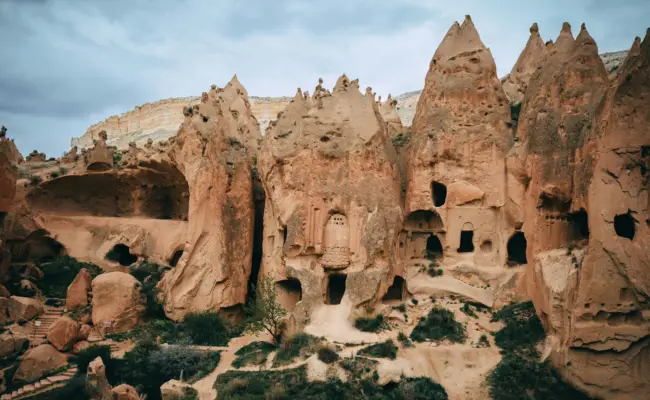
Cappadocia is a volcanic landscape where erosion carved the tuff into fairy chimneys, and people answered by carving homes, churches and whole underground cities into the rock. The Göreme Open-Air Museum keeps Byzantine frescoes that still hold their colour, Kaymaklı descends storey below storey underground, and the sunrise hot air balloon flights (steadiest September–October and April–May) are the single most requested morning we arrange. Between them run the Red, Love and Pigeon valleys, with sunset from Uçhisar Castle, the region’s highest point. Sleep in a cave hotel — it is the room children describe first when they get home. Two nights minimum, reached by a 75-minute flight from Istanbul. Our Cappadocia guide maps the valleys; the 2-day tour from Istanbul (USD 895) is the compact version.
Ephesus is the best-preserved classical city in the eastern Mediterranean: marble streets, Hadrian’s Temple, the terraced facade of the Library of Celsus and a Great Theatre that seated 25,000. The Temple of Artemis site, one of the Seven Wonders of the Ancient World, sits minutes away. The site walks in two to three unhurried hours; in summer, go at opening or after 16:00, when the marble stops radiating heat. You can fly down for a guided day trip from Istanbul (USD 550), but it earns a coastal overnight in Kuşadası on any longer route. Our Ephesus guide walks the site stone by stone.
At Pamukkale, thermal springs have poured white calcite terraces down a hillside for millennia — the name means “cotton castle,” and the calcite is warm and ridged underfoot, softer than it looks in photographs. Footwear is banned to protect the stone. Above the terraces sits Roman Hierapolis, a spa city since the 2nd century BC, UNESCO-listed together with the travertines, with an optional 36°C swim over toppled columns in Cleopatra’s Antique Pool. Arrive before the midday coaches and the terraces feel like yours. It pairs with Ephesus on a 2-day flight-based tour (USD 990); the Pamukkale guide has the practical detail.
Pergamon is the quiet achiever of the Aegean: a cable car lifts you to an acropolis with the steepest theatre of the ancient world (around 10,000 seats cut into a 36-metre slope) and a library that once held some 200,000 scrolls, which is why parchment (“pergamena”) carries the city’s name. It rarely justifies its own base, but it slots perfectly into the coast road between Ephesus and Troy, which is exactly where our 10-day route places it.
Bodrum is Turkey’s busiest resort peninsula: the Castle of St. Peter above the harbour, whitewashed lanes, beach clubs, and the home port of the traditional wooden gulet yachts whose three-night loops along the Aegean coves are the classic Turkish sailing holiday. We do not sell Bodrum (it is beach-resort territory rather than guided-touring ground), but the shortlist would be incomplete without it. If your trip leans this way, it swaps naturally into the coast-heavy version of a 2 week Turkey itinerary in place of the battlefield days.
Antalya is the Roman heart of Turkey’s Mediterranean coast: Kaleiçi’s walled Ottoman old town wraps a harbour founded two millennia ago, the theatre at Aspendos still stages performances on Roman stone, Perge keeps its 3rd-century BC Hellenistic gate, and the Düden waterfalls drop straight off a cliff into the sea. It is also the coast’s main international airport hub, which is why most Turquoise Coast trips open or close here rather than in the smaller towns. Our Antalya travel guide covers the region; the 10-day tour with Antalya (USD 3,490) builds it into the classic loop.
Fethiye is a harbour town on the site of ancient Telmessos, with the Turquoise Coast’s three signature stops within half an hour: the lagoon at Ölüdeniz, the icy wade up Saklıkent Gorge, and Kayaköy, the stone village emptied in the 1923 population exchange and left standing ever since. Paragliders drift over the lagoon all afternoon. Fethiye is where our longer routes slow down on purpose — it holds two of the four coast days on the 14-day tour and anchors the 12-day Turquoise Coast route (USD 4,150), which gives it two full nights between Cappadocia and Pamukkale.
Kaş is a small bohemian harbour town halfway between Fethiye and Antalya: boat days out to the sunken Lycian ruins of Kekova, scuba diving on a coast famous for its visibility, and an evening square that fills with café tables rather than tour buses. It is the coast’s couples town more than its family base, and we plan it as a stop on the Fethiye–Antalya coastal drive rather than selling it as a package of its own — Kaş rewards unscheduled time, and that is the one thing a packed route cannot give it.
Saklıkent is an 18 km canyon whose 300-metre walls narrow to a few metres, with a walkway bolted above the current and a snowmelt river you wade, gasping, in high summer. It is a half-day out of Fethiye and the coolest place on the coast in August, in the literal sense — children treat it as an adventure park built by geology. It fills the morning of the Fethiye day on our 14-day route (USD 4,450).
A shortlist of the best places to visit in Turkey is defined by what it leaves out, so here is the reasoning on five places that often appear on longer lists:
None of these are bad choices. They are second-trip choices — and the fact that a list ranks well is never a reason to route a family past what fits their days.
The 12 best places to visit in Turkey sort into trips by one variable: how many days you have. Two regions fit five days, the historic loop fits ten, and all five regions connect in a single two-week sweep — the day-by-day version of each plan lives in its own itinerary guide.
| Days | What fits | The plan |
|---|---|---|
| 5 days | Istanbul + Cappadocia (places 1 and 4) — the two most distinct experiences, one 75-minute flight apart | 5 day Turkey itinerary |
| 7 days | Istanbul, Cappadocia and Ephesus (1, 4 and 5) — three regions on three internal flights, from USD 2,450 per person | 7 day Turkey itinerary |
| 8 days | The four headline regions — Istanbul, Cappadocia, Pamukkale and Ephesus (1, 4–6) — on three internal flights, two nights in a Göreme cave hotel | 8 day Turkey itinerary |
| 10 days | The classic loop: Istanbul, Cappadocia, Pamukkale, Ephesus, Pergamon, Troy and Gallipoli (1–7) | 10 day Turkey itinerary |
| 12 days | Istanbul, Cappadocia and the full Turquoise Coast (9–12), flights doing the long jumps | 12-day Turquoise Coast tour |
| 14 days | All five regions — the history arc, four coast days and Cappadocia to finish | 2 week Turkey itinerary |
The distances behind those combinations are friendlier than the map suggests — one rule covers them: fly the long jumps, drive the scenic ones.
| Leg | How | Time |
|---|---|---|
| Istanbul → Cappadocia | Domestic flight (~760 km by road) | ~75 min |
| Istanbul → Gallipoli | Private drive along the Marmara coast | ~5 h |
| Istanbul → Ephesus | Flight to İzmir, then a short drive | ~1 h + drive |
| Fethiye → Antalya | The Turquoise Coast road under the Taurus mountains | 4–5 h |
| Antalya → Cappadocia | Morning domestic flight | Short hop |
Every route reshapes before you confirm — send your dates and pace through Plan My Trip and a day-by-day proposal with a fixed USD price comes back within 24 hours. Turkey Family Tours is TURSAB-licensed (no 13538), and every departure is private to your family.
Of all the best places to visit in Turkey, start with places 1 and 4: Istanbul and Cappadocia are the country’s two most distinct experiences, they connect with a single 75-minute flight, and together they answer the question most first-timers are really asking — is Turkey for us? (It usually is.) The 5-day version is the proven shape. Everything else on this list becomes the reason for the second trip — and that is the better order anyway: the coast means more once you have stood in the places the coast’s ruins were built from. Resist the urge to add a third region to a first week; it is the one regret we hear most often. For timing, April–June and September–October flatter every region on the list at once; the month-by-month picture is in our Best Time to Visit Turkey guide. Once the regions are picked, the remaining decisions — length, season, route, flights, budget and paperwork — are walked through in order in our guide to how to plan a trip to Turkey.
The top 5 places to visit in Turkey, by every measure we see as an operator, are Istanbul, Cappadocia, Ephesus, Pamukkale and the Antalya coast. Istanbul carries the empires, Cappadocia the landscapes and the sunrise hot air balloons, Ephesus the best-preserved classical streets in the region, Pamukkale the white travertine terraces, and Antalya the Roman-theatre-and-beach combination. The strongest sixth candidate is Gallipoli — less photographed, but the day guests talk about longest. All five headline places connect in a single loop with one domestic flight; our 10-day route shows the classic order, day by day.
The nicest part of Turkey to visit depends on what you came for: Istanbul for history and food, Cappadocia for landscapes unlike anywhere else on earth, and the Turquoise Coast between Fethiye and Antalya for the Mediterranean at its clearest. Couples tend to rate Kaş and the coast highest; families most often name Cappadocia’s cave hotels and the Ölüdeniz lagoon. If one answer is forced, the Istanbul–Cappadocia pairing wins — it packs the two most distinct experiences into the shortest span, which is why it forms our 5-day route and the first half of every longer one.
For a first time in Turkey, go to Istanbul and Cappadocia — two to three nights in each, joined by a 75-minute flight. Istanbul delivers Hagia Sophia, Topkapı Palace and the Grand Bazaar inside one walkable district; Cappadocia adds the fairy-chimney valleys, a cave-hotel night and the optional sunrise hot air balloon. That pairing needs only five days, leaves the coast and the Aegean for a return visit, and avoids the first-timer trap of spreading a short trip across four regions. Practical questions (safety, dress, money) are answered in our Is Turkey Safe? guide.
USD 1,000 is enough for the on-the-ground costs of a short, self-planned trip to Turkey: roughly five days at mid-range hotels across two cities, inside the USD 700–1,200 band we quote for an independent 5-day plan. It excludes international flights, guiding and the extras that add up at the gates. It does not stretch to a multi-region route: an independent two weeks runs USD 1,800–3,000 per person before any guiding. The line-by-line maths, city by city, is in our guide to what a Turkey trip costs; fully guided private tours start at USD 1,690 for five days.
By the measure that matters (how much genuinely different experience fits in one trip), yes. A single two-week loop holds a two-continent metropolis, the 1915 battlefields, five UNESCO World Heritage sites, white travertine terraces and a valley where the hotels are carved into rock. The budget stays workable: an independent five days runs roughly USD 700–1,200 per person on the ground, and fully guided private touring starts at USD 1,690. Timing is forgiving too — anywhere from April to October over-delivers, and the month-by-month case sits in our Best Time to Visit Turkey guide. The commitment is the long flight; the country repays it.
Cappadocia, if the choice is forced — it is a two-to-three-day region of valleys, cave hotels and sunrise hot air balloons, while Pamukkale is a spectacular half-day site: the travertine terraces and Roman Hierapolis above them. The better news is that the choice is rarely real, because they sit on different axes. Cappadocia pairs with Istanbul on a five-day trip; Pamukkale belongs to the Aegean corridor beside Ephesus, reached on a 2-day flight-based tour or folded into the ten-day loop. If a route already runs the Aegean, Pamukkale costs one day to add — take both.
In one trip, count regions, not places: two regions in five days, four in ten, all five in fourteen. Five days does Istanbul and Cappadocia properly, on one flight. Ten days adds the Aegean and the Dardanelles (Ephesus, Pamukkale, Pergamon, Troy and Gallipoli) in the classic loop. Fourteen days is the first length that adds four full Turquoise Coast days without squeezing anything else out; the 2 week Turkey itinerary walks it day by day. The mistake we most often untangle is the reverse: six places in seven days, which turns a holiday into a transfer schedule. Fewer regions, held longer, always wins.
Istanbul — no other Turkish city combines a skyline of imperial mosques, water on three sides and more than 2,500 years of layered building. The runners-up split by taste: Antalya’s Kaleiçi for walled Ottoman lanes above a Roman-era harbour, and Göreme in Cappadocia, which is less a city than a village grown into a stone landscape. For natural beauty the vote usually leaves the cities entirely: the lagoon at Ölüdeniz and the Kekova shoreline near Kaş carry the coast. The neighbourhood-by-neighbourhood case for the winner is in our Istanbul travel guide.
The list is the easy half; the route is where a trip is won. Tell us your dates, party size and pace through Plan My Trip and we reply within 24 hours with a day-by-day proposal and a fixed USD price — two regions or all five, whichever your calendar allows.
A curated list of the most popular travel packages based on different destinations.

The best time to visit Turkey in June: long days, peak Cappadocia balloon season and a warm coast before the July heat — private tour itineraries and costs. TURSAB-licensed.

How to choose a Cappadocia cave hotel: Göreme vs Uçhisar vs Ürgüp compared, room categories from under USD 100 to USD 250+ terrace suites, which terraces face the hot air balloon launch valleys, and when to book for a cliff-face room.
The best time to visit Turkey, month by month: ~90–95% Cappadocia hot air balloon reliability from May to October, sea temperatures, school-holiday windows and booking lead times.

A Cappadocia hot air balloon flight costs USD 250–350 per person (it varies by month). Best months, photography tips, flight-day timeline and cave hotels — plus how a private tour protects against weather cancellations.
A day-by-day private Turkey route built around Singapore’s school windows and the 11-hour Changi–Istanbul direct — fixed quote within 24 hours.
Tipping in Turkey explained: an at-a-glance table for restaurants, guides, drivers, hotels and taxis — plus cash-vs-card and which currency to carry.

A 10 day Turkey itinerary day by day: Istanbul, Cappadocia cave-hotel nights, Pamukkale, Ephesus, Troy and Gallipoli — nightly stops, transport logic and the one-flight route that makes it work.
A private Turkey trip runs from USD 190 for a day tour to USD 1,690 for 5 days and USD 4,450 for two weeks — domestic flights, a licensed local guide, hotels and entrance fees included, with per-day costs broken down route by route.



Tell us about your family — we reply within 24 hours.