Turkey in December: Weather, Snow & Hot Air Balloon Odds
Quick Answer:Turkey in December is a winter city month: Istanbul works on every day of it, and the coast is mild but wet. The weather in Turkey in December gives daytime highs of 16.7 °C (62 °F) in Antalya, 11.8 °C (53 °F) in Istanbul and 6.2 °C (43 °F) in Cappadocia, where nights fall to −1.3 °C (30 °F). Cappadocia hot air balloons fly on roughly 50–55% of December mornings, so routes with three Cappadocia nights hold three mornings for one flight. Christmas Day is a normal working day in Turkey and only 1 January closes the sites. A private Turkey tour in December runs USD 1,645–5,395 per adult. It includes hand-picked 4-5 star (boutique) hotels, breakfasts, admissions, domestic flights, and a private vehicle with driver and a licensed local guide in every region. Turkey Family Tours is TURSAB-licensed (no 13538), and your written day-by-day plan with a fixed quote arrives within 24 hours. Get a Private Quote →
Turkey in December splits into two trips that look nothing alike. One is an Istanbul trip that works on any day at 11.8 °C (53 °F). The other is a Cappadocia trip that hangs on the morning sky, with nights at −1.3 °C (30 °F). Istanbul’s 15 or 16 rain days barely touch an indoor itinerary. Cappadocia is stunning and flies on roughly half its mornings. The temperature in Turkey in December comes first, region by region, then the routes we run in winter and the lead times each one needs.
By Fatih — Founder & Tour Director, Turkey Family Tours · TURSAB licence 13538 · Last updated: September 2026
Planning a private Turkey tour?
We build family-paced private itineraries with hand-picked 4-5 star hotels and send a written plan and fixed price within 24 hours.
Is Turkey Worth Visiting in December? What the Month Actually Looks Like
Turkey is worth visiting in December for families who want Istanbul, quiet monuments and a winter landscape, and the wrong choice for families who want beaches or a guaranteed hot air balloon morning. December is Turkey’s low season on 26 of its 31 days. The exception is the year-end week from 24 December to 3 January, which books like a peak month. The rest of the month gives families short queues and wide hotel availability. Konya adds the Şeb-i Arus ceremonies from 7 to 17 December. Istanbul carries most winter routes, because its great monuments are indoor and stay open in the rain. Cappadocia is beautiful and unreliable in equal measure, with a hot air balloon fly rate near 50–55% of mornings. Nine hours of daylight sets the pace of a December day: three or four stops, not six. The 5 day Turkey itinerary fits that pace: three of its four nights are in Istanbul, and a December date adds Cappadocia nights for a second launch morning.
A fixed departure with twenty people on a coach cannot rebuild a morning when the launch field is iced over. A private December route can.
Where to go in Turkey in December, and what to do there
Five places carry a December route. Each is chosen for what it does in winter, not in July.
Istanbul. Hagia Sophia, Topkapı, the Basilica Cistern and both bazaars are covered, and the year-end lights go up along Nişantaşı from mid-month.
Cappadocia. Valley walks over frost, the underground cities at Kaymaklı and Derinkuyu, and three mornings held for one hot air balloon flight.
Konya. The Şeb-i Arus ceremonies from 7 to 17 December, the only fixed event on Turkey’s winter calendar.
Antalya. Aspendos, Perge and the old harbour at 16.7 °C (62 °F), with a sea to look at rather than swim in.
Pamukkale. A 36 °C thermal pool in 12 °C air, and Hierapolis almost to yourselves. Our 8-day Turkey route reaches it as a day trip from two Kuşadası nights, alongside Ephesus at 14.2 °C.
Who December works for
Families whose first priority is Istanbul. Hagia Sophia, Topkapı, the Basilica Cistern, the Grand Bazaar and the Spice Bazaar are all weatherproof.
Families with a fixed year-end break. The window between school terms is the one time many parents can take ten to fourteen days together.
Families who want space inside the monuments. A December morning at Topkapı bears no resemblance to a July one.
Families drawn to the winter landscape. Snow over the fairy chimneys is one of the sights of Turkey, whether or not you fly above it.
Who should choose another month
Anyone whose trip is built around the hot air balloon photograph. Roughly half the December mornings do not fly. September and October both run near 90%.
Families wanting beach and sea time. The Mediterranean sits near 20 °C (68 °F) in early December, and the 16.7 °C air above it ends a swim before the water does.
Anyone who cannot absorb a re-planned day. Midwinter carries a higher chance of a weather-driven change than any other season.
Families who need long daylight. Nine hours of light closes the sites before a six-stop day is done.
Turkey in December Weather: 16.7 °C in Antalya, 6.2 °C in Cappadocia and Rain on Half of Istanbul’s Days
Antalya reaches 16.7 °C (62 °F) by day in December, Istanbul 11.8 °C (53 °F), and Cappadocia only 6.2 °C (43 °F), with nights at −1.3 °C (30 °F). Is Turkey cold in December? Yes inland and no on the coast. Cappadocia and Konya sit below freezing before dawn on most mornings, and snow lies on the valleys for days after a front, while Antalya’s afternoons stay in the mid-teens and its sea is still near 20 °C (68 °F). Istanbul sits between the two, cool rather than cold and wetter than either, with rain on 15 or 16 days. The ten-degree spread between Antalya and Cappadocia is the most useful number for planning a winter route, because one family can stand in both inside three days.
Mediterranean coast (Antalya, Side, Alanya): 16.7 °C (62 °F) by day, 7.7 °C (46 °F) at night, about twelve rain days carrying 251 mm, sea near 20 °C (68 °F) early in the month, around 4.8 hours of sunshine a day.
Istanbul and Marmara: 11.8 °C (53 °F) by day, 6.5 °C (44 °F) at night, rain on 15 or 16 days for 99 mm, and wind off the Bosphorus that takes the felt temperature toward 7 °C (45 °F).
Central Anatolia (Cappadocia, Konya): 6.2 °C (43 °F) by day, −1.3 °C (30 °F) at night, about twelve days with rain or snow, around 3.1 hours of sunshine, frost most mornings.
Aegean and inland Aegean (Ephesus, Pamukkale): 14.2 °C (58 °F) at Ephesus and 12.4 °C (54 °F) at Pamukkale by day, 4–8 °C (39–46 °F) at night, and the wettest coast after Antalya at 146 mm in Izmir.
Eastern Anatolia (Erzurum, Kars): −5.7 °C (22 °F) as the monthly mean at Erzurum, deep snow and closed passes; no standard family route runs east of Cappadocia in December.
Daytime highs fall by four to six degrees against November in every region, and by about two degrees again into January. Rain is the bigger change. Antalya records the highest monthly total in the country, 251 mm, more than twice Istanbul’s 99 mm, but delivers it in short heavy bursts across about twelve days. Every figure here comes from the long-term station records held by the Turkish State Meteorological Service, measured over decades at a provincial station.
Which part of Turkey is warmest in December? The Antalya coast, at 16.7 °C
Antalya weather in December is the mildest in Turkey and also the wettest. The Mediterranean coast between Antalya and Alanya holds an average daytime high of 16.7 °C (62 °F), nights at 7.7 °C (46 °F), and 251 mm of rain across about twelve days, so the mild afternoons come with one heavy shower in them.
Muğla, behind Fethiye and Marmaris, reads a fraction warmer at 17.2 °C (63 °F), but the resorts there are shut. Izmir and Ephesus follow at 14.2 °C (58 °F), Pamukkale at 12.4 °C (54 °F) and Istanbul at 11.8 °C (53 °F). Cappadocia at 6.2 °C (43 °F) and Konya at 6.7 °C (44 °F) mark the cold end, both with nights below freezing. By the Antalya sea temperature record the sea reads near 20 °C (68 °F) in the first week, warmer than the air above it. That is a look-at-it temperature for a family in December, not a swim-in-it one, and the beach clubs along the coast are closed. We plan the Antalya leg with an indoor alternative attached to each outdoor site. The old harbour and the Roman theatre at Aspendos are worth the gamble; a full beach day is not.
Region
Station
Daytime high
Night low
Days with rain or snow
Monthly rainfall
Marmara
Istanbul
11.8 °C (53 °F)
6.5 °C (44 °F)
15–16
99 mm
Central Anatolia
Cappadocia (Nevşehir)
6.2 °C (43 °F)
−1.3 °C (30 °F)
12
48 mm
Central Anatolia
Konya
6.7 °C (44 °F)
−2.2 °C (28 °F)
10
43 mm
Aegean coast
Izmir (for Ephesus)
14.2 °C (58 °F)
7.6 °C (46 °F)
13
146 mm
Inland Aegean
Pamukkale (Denizli)
12.4 °C (54 °F)
4.3 °C (40 °F)
12
89 mm
Mediterranean
Antalya
16.7 °C (62 °F)
7.7 °C (46 °F)
12
251 mm
Sultanahmet holds Hagia Sophia, the Blue Mosque and the Basilica Cistern within a five-minute walk of each other. That is why a rainy December day here loses nothing.
Is Istanbul very cold in December? Cool, wet and windy rather than cold
Istanbul is not very cold in December by the thermometer: 11.8 °C (53 °F) by day and 6.5 °C (44 °F) at night, above freezing on almost every date. It feels colder than that. Rain falls on 15 or 16 days, 99 mm across the month, and wind off the Bosphorus takes the felt temperature toward 7 °C (45 °F) on the water. Snow settles in the city on only a few days in most winters and rarely stays. The practical effect on a guided day is small. The Old City sites sit within walking distance of one another, and almost all of them are indoor. A licensed local guide reorders a family’s morning to put the Basilica Cistern or the Grand Bazaar into the wettest hour. Site-by-site winter opening days are in our Istanbul travel guide; the stops that fill a wet hour for a six-year-old are in Istanbul with kids.
Cappadocia in December: frost before dawn, 18 °C inside the cave
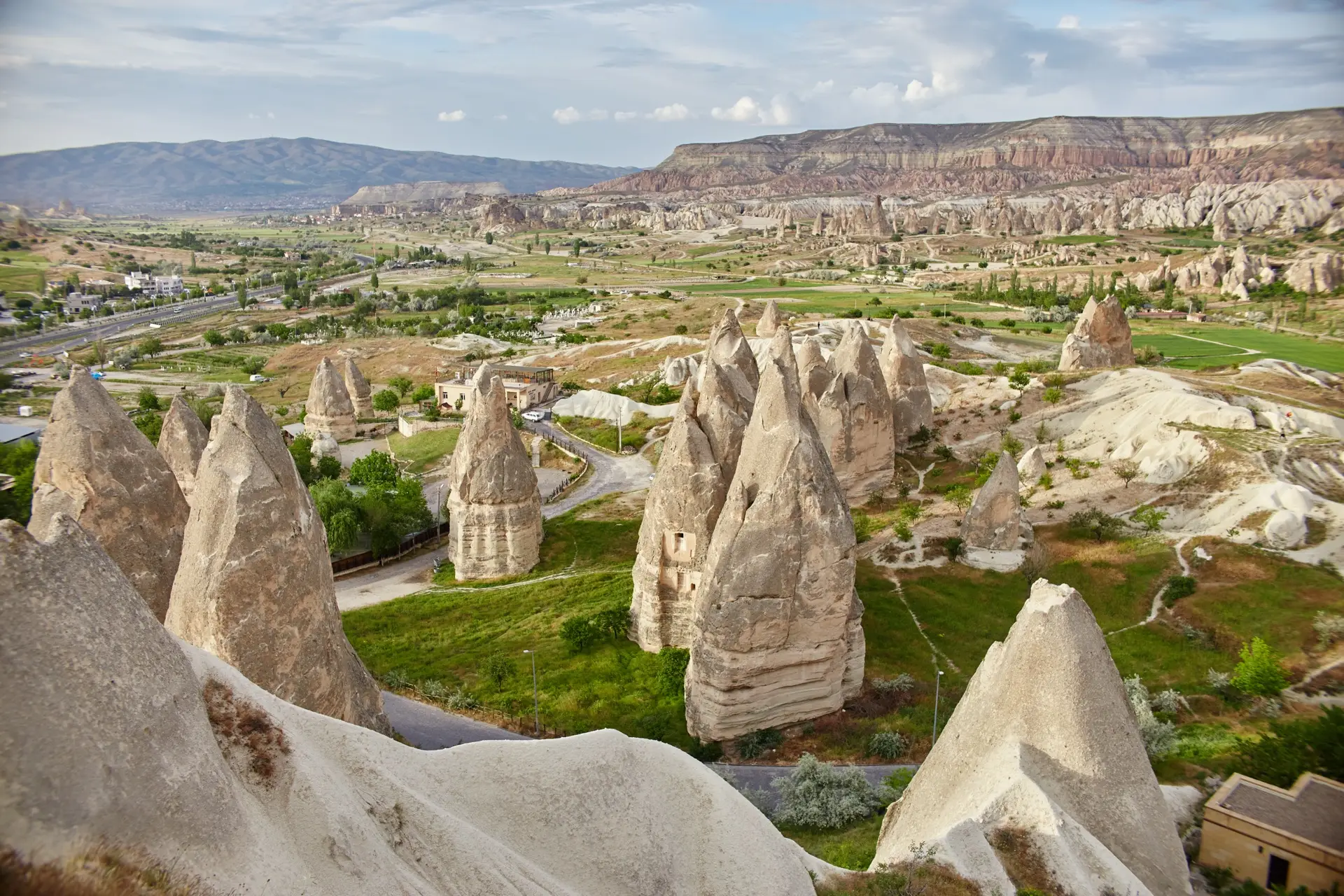
Cappadocia sits above 1,000 metres, and December nights average −1.3 °C (30 °F) at the Nevşehir station, with afternoons at 6.2 °C (43 °F). Göreme itself, a little lower, usually runs a degree or two milder. Cave hotel interiors hold a steady 18–20 °C because rock is a good insulator, so the cold is an outdoor problem rather than an indoor one. The month is dry by coastal standards, 48 mm across about twelve days, and much of that arrives as snow. The valleys under frost or snow photograph better than at any other time of year. The Göreme National Park UNESCO World Heritage listing covers the rock-cut churches that fill most of a winter touring day there. Our Cappadocia travel guide sets out which valley walks stay dry underfoot.
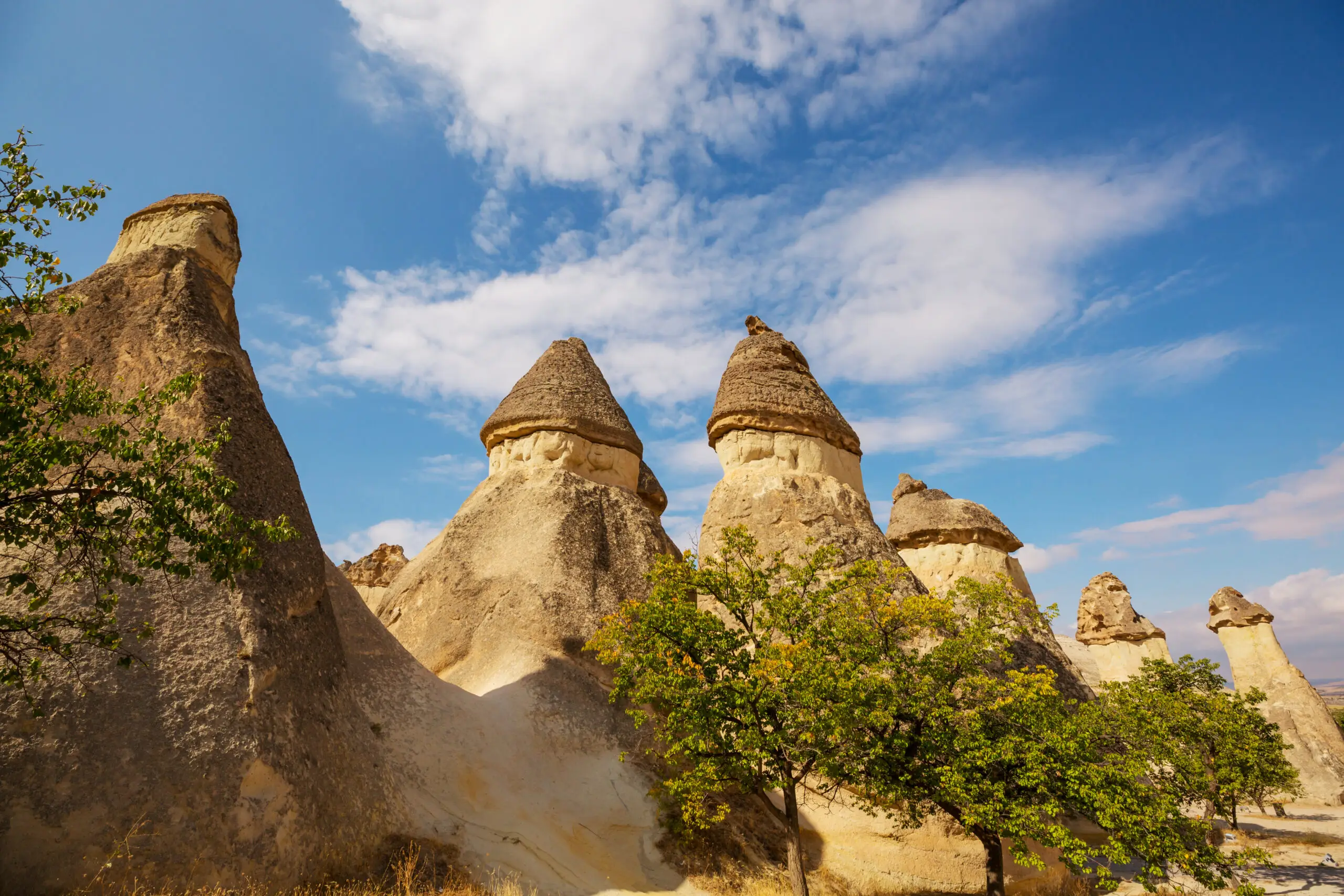
Paşabağ’s mushroom-capped chimneys under a clear sky. In December the same ground carries frost until mid-morning and holds snow for days after a front, at 6.2 °C by day and −1.3 °C at night.
Ephesus and Pamukkale in December: jacket weather at 12–14 °C
Izmir averages 14.2 °C (58 °F) by day in December, which makes Ephesus comfortable walking weather in a jacket. Pamukkale runs cooler at 12.4 °C (54 °F), and the travertine terraces are cold underfoot when you take your shoes off. The thermal pool beside them stays near 36 °C all winter, and the contrast with cold air is the reason to go. The Hierapolis-Pamukkale UNESCO World Heritage listing covers the Roman city above the terraces. Most families who come in winter have it almost to themselves. Our Pamukkale travel guide and Ephesus travel guide set out what each site needs in cold weather.
The Great Theatre at Ephesus. At 14.2 °C the marble street is comfortable walking in a jacket in December, and the site closes in the late afternoon under winter hours.
Nine Hours of Daylight — How Winter Changes the Shape of a Touring Day
Istanbul gets about nine hours and thirteen minutes of daylight at the solstice, against fifteen hours in June. By the Istanbul sunrise and sunset tables, the sun rises at 08:26 and sets at 17:39 on the winter solstice, 21 December. Turkey keeps one time zone all year and does not put its clocks back in autumn. That is why an Istanbul sunrise reads so late in December. Cappadocia, further south, runs a little longer at roughly nine and a half hours. A guided day starting at 09:00 has about seven usable hours of light. Seven hours fits three or four stops at a comfortable family pace, not six. We build a December day backwards from the site’s winter closing hour rather than forwards from breakfast. Outdoor ground goes into the 10:00–15:00 warm band, and indoor anchors hold the two ends. Families who run a summer itinerary in December visit their last two sites in the dark.
What we change in a winter day plan
Three or four stops instead of six. The pace stays comfortable and nothing gets cut at the end of the day.
Indoor anchors at the ends. A museum, a bazaar or an underground city holds the early and late hours.
Shorter driving legs. Nobody enjoys a three-hour transfer in the dark, so December routes use domestic flights between regions more often than road transfers.
Sunset over the Bosphorus lands at a civilised hour, and families with young children see it without a fight over bedtime. Golden light at Ephesus arrives mid-afternoon, not at 19:00, which suits children who fade by five o’clock. Our how many days in Cappadocia guide sets out how the same ground stretches across more days in winter.
Winter Fly Rates and the Three-Morning Rule in Cappadocia
Hot air balloons fly on roughly 50–55% of December mornings in Cappadocia, against about 90% in October. That gap decides whether December suits a family whose trip is built around the sunrise flight. The launch call is made at first light by the civil aviation authority, not by the operator. Wind speed, visibility and the state of the launch field decide it. Snow on the ground does not automatically ground a flight, but strong surface wind always does. Because one morning in two does not fly, every winter route Turkey Family Tours builds with three Cappadocia nights holds three consecutive mornings for one flight. The flight is booked for the first morning and rolls forward if the launch is called off. If all three mornings are grounded, the hot air balloon fee is refunded in full. The rest of the itinerary runs unchanged, because a private route is rebuilt on the morning itself.
Uçhisar castle rock above the valleys. In December the launch decision is made at first light, which is why routes with three Cappadocia nights hold three mornings, never one.
How many Cappadocia mornings do you need?
One morning is a coin toss. Roughly half of December mornings do not fly, and there is no second attempt.
Two mornings take the odds to around three in four. Better odds, but still short of what a winter trip should carry.
Three mornings take it close to nine in ten. This is the winter standard we build into every route with a flight in it.
The cost is Cappadocia nights, not a new route. The 5-Day Istanbul and Cappadocia Tour leaves a single morning, while the 7-day route carries two, or three when the Ephesus leg is swapped for a Cappadocia night.
What a winter flight is actually like
Hotel pickup runs around 06:15 to 06:45 in December, with launch close to sunrise, near 07:50. Both are far later than in summer, because sunrise comes later. You wait on a cold field while the envelope inflates, and that half hour is the coldest of the trip. Once airborne, the burners above the basket keep the air warm. Snow over the fairy chimneys with the valley floor white is a better photograph than the summer version. Full detail sits in our guide to hot air balloon flights in Cappadocia.
Hot air balloons over Göreme at sunrise. In December the launch call comes at first light and goes the wrong way on roughly half the mornings, which is why our routes with three Cappadocia nights hold three mornings for one flight.
If a hot air balloon flight is the reason for the trip rather than a bonus inside it, book another month. We say that to families every winter, it costs us bookings, and it is still the right advice. Turkey in May and Turkey in October both carry fly rates near 90%.
Winter Opening Hours: What Closes Early and What Stays Open
Turkey switches its ministry-run museums and archaeological sites to winter hours from the start of October to the start of April. The winter timetable shortens a touring day at both ends. Ticket offices shut before the gates do, often by a full hour, so a late arrival can mean no entry at all. Most archaeological sites close earlier still, in the late afternoon, with last entry half an hour to an hour before that. The exact dates and hours are set by circular each year, and they do move. We confirm every site’s hours when we build your itinerary, because last winter’s timetable is not good enough. Current hours for each site sit on the Ministry of Culture and Tourism museum service.
Sites where the shorter afternoon matters
Ephesus. A late-afternoon slot loses its last hour in winter, and the marble street is slippery after rain. Mid-morning is the better booking.
Hierapolis and the Pamukkale travertines. The terraces close earlier than in summer, though the thermal pool runs on its own hours.
Göreme Open Air Museum. The painted churches are dim on an overcast afternoon, so we put them in the brightest part of the day.
Topkapı Palace. Winter closing plus a weekly closed day means the order of your Istanbul days matters more than in summer.
The valleys of Göreme. Under ground like this, the Kaymaklı and Derinkuyu underground cities hold a steady temperature whatever the weather does above, and they are the sites a December day is rebuilt around.
What stays open regardless
The Grand Bazaar keeps normal trading hours all winter and closes on Sundays, while the Spice Bazaar trades seven days. Hagia Sophia is a working mosque and stays open outside prayer times, and the Basilica Cistern runs into the evening. The underground cities of Kaymaklı and Derinkuyu hold a steady temperature below ground whatever the weather does above. Families with children under six spend most of a December day inside buildings like these. Our guide to Istanbul and valley-by-valley Cappadocia notes list opening patterns site by site.
Where December Works — and Where It Doesn’t
Four of Turkey’s main touring regions hold up well in December, three are workable with caveats, and two are a straight no. The table below is the verdict we give families on the phone. It is built on what a region gives you in winter, not on what it gives you in July.
Destination
December verdict
Why
Istanbul
Strong
Indoor monuments, short queues, full restaurant and bazaar life, normal hours through the year-end week
Cappadocia
Good, with one caveat
Snow-covered valleys and warm cave hotels; hot air balloon fly rate near 50–55%
Konya
Strong in December only
Şeb-i Arus (whirling dervish) ceremonies run 7–17 December; the rest of the year the city is a half-day stop
Antalya and the Mediterranean
Good
Mildest air in the country at 16.7 °C, empty Roman sites, heaviest rainfall, no swimming
Ephesus and the Aegean
Workable
Comfortable at 14.2 °C with no crowds, but early closing and slippery marble after rain
Pamukkale
Workable
Thermal pool excellent in cold air; travertine terraces cold underfoot
Bodrum and the coastal resorts
Avoid
Most hotels, restaurants and boat operations close for the season
Gallipoli and Troy
Workable
Open, quiet and cold; an exposed day outdoors that suits older children, run as a private Gallipoli tour
Eastern Turkey
Avoid
Deep winter conditions, limited family accommodation and long exposed road legs
Cities and covered sites reward December, while coastlines built for swimming and regions built for long drives do not. Our best places to visit in Turkey guide covers each region across the full year. Our 730 km road comparison explains why we fly rather than drive that leg in winter.
Şeb-i Arus in Konya: The Whirling Dervishes Week You Can Only See in December
Konya holds the Şeb-i Arus ceremonies from 7 to 17 December every year. These are the whirling dervish ceremonies that mark the anniversary of Rumi’s death in 1273. Rumi was the 13th-century poet buried in Konya, and this is the only major event on Turkey’s winter cultural calendar. The closing night on 17 December is the largest, and it is the one that fills Konya’s hotels. The Mevlevi sema ceremony is inscribed on the UNESCO Representative List of the Intangible Cultural Heritage of Humanity. What families see is a formal ceremony rather than a show: musicians, a slow procession, and the turning itself. The dervishes turn in near silence, dressed in white, and children usually sit through it without fidgeting. It lasts about an hour.
How it fits a route
Konya sits roughly three hours from Cappadocia by road, which makes it an extension, not a separate trip. We build it as an overnight when a family’s December dates overlap the ceremony window. The city’s other draw, the Mevlana Museum, holds Rumi’s tomb and takes about two hours. Outside those eleven days Konya is a half-day stop at most. December is the only month we suggest the detour, and ceremony seating needs arranging three to four months ahead.
December Snow in Turkey: Roads, Mountain Passes and the Buffer Day
Snow falls on Cappadocia during a typical December and usually clears from the main roads within a day. In Göreme it lingers on the north-facing slopes for days after the roads are clear. Central Anatolia can also close a mountain pass for a few hours. That is why our winter routes use domestic flights between regions rather than long road transfers. It is also why we leave a buffer day in longer itineraries. Practical winter notes for the whole country sit in our Turkey travel guide and how to plan a trip to Turkey guide.
Crowds, Availability and Booking Lead Time in December
December is really three different windows, and treating them as one month is the most common planning mistake we see. The first fortnight is the quietest touring period of the year outside January. The middle stretch adds the Konya ceremony crowd and the first year-end arrivals. From around 24 December to 3 January the country behaves like a peak season. Cave hotels and Bosphorus-view rooms fill months ahead. Hagia Sophia on a mid-December weekday takes minutes to enter, and the same building on 31 December does not.
1–15 December: the quiet fortnight
Early December delivers space inside the monuments. Families photograph the Blue Mosque courtyard without a queue behind them. Guides spend fifteen minutes on a single mosaic instead of moving you along. Family rooms in the cave hotels are easier to secure because occupancy is low. Restaurant tables need no reservation, so a family eats where it wants to eat. For families with young children, the drop in walking and waiting matters more than anything on the invoice.
16–23 December: the ceremony window
The middle of the month is still quiet nationally, with one exception. Konya fills for the Şeb-i Arus ceremonies, and hotel rooms in that city are genuinely scarce around 17 December. Istanbul begins to firm up in the last few days of this window as year-end arrivals start. Cappadocia is unchanged in this window and still easy to book at short notice. If your dates are flexible, this is the window we point families toward when they want the ceremony without the year-end rates.
24 December to 3 January: the year-end window
Christmas Day is a normal working day in Turkey, so the monuments and bazaars run their usual winter hours on 25 December. Christmas week weather sits at the December average: about 11 °C (52 °F) by day in Istanbul, 16 °C (61 °F) in Antalya and 6 °C (43 °F) in Cappadocia, with frost inland before dawn. Across the year-end break, Cappadocia’s cave hotels are the constraint rather than the flights. There are only so many rooms carved into rock that sleep a family of four, and they sell first. Istanbul hotel rates on the Bosphorus-facing tier climb toward summer levels. Domestic flights to Kayseri and Nevşehir fill on the two days either side of 1 January. The one closure to plan around is 1 January, an official holiday. Istanbul does mark the turn of the year visibly, with lights along Abdi İpekçi and Teşvikiye in Nişantaşı. İstinye Park runs a winter market that keeps children busy for an afternoon.
Departure window
Recommended booking lead
What drives it
1–15 December
8–12 weeks
Easiest window of the winter; hotel and guide availability both wide
16–23 December
3–4 months
Konya rooms and ceremony seating around 17 December; the rest of the country stays easy
24 December – 3 January
4–5 months
Cave hotel family rooms and year-end domestic flights sell out first
Turkey Family Tours returns the written plan within 24 hours, and a 25% deposit holds it. The remaining 75% is paid on arrival, in cash or by card.
Turkey in December Itinerary: Private Routes From One Day to Fourteen
A December route runs shorter and tighter than a summer one, because nine hours of daylight cannot carry a twelve-hour itinerary. We plan December trips around two or three bases instead of five, and we keep one indoor anchor in every day. The routes below are the ones we run in winter. Land prices run from USD 1,645 to USD 5,395 per adult. Each price is a complete land arrangement, so nothing on the route arrives as a separate bill later.
Five days: Istanbul on its own
Istanbul alone is the strongest December build, and it is the one we recommend most often for a first winter visit. The 5-Day Private Istanbul Tour Package runs from USD 1,645 per adult. Hagia Sophia, Topkapı, the Basilica Cistern, the Grand Bazaar and the Spice Bazaar are all indoor or covered. Rain moves the order of a family’s day without cancelling it. Families with children under eight tend to prefer this build in winter, since there is no internal flight and no early start. If you want a single guided day instead, the Private Istanbul Old City Tour runs at USD 220 per adult.
Seven days: Istanbul and Cappadocia
Seven days is the shortest route where Cappadocia earns its place in winter. The 7-Day Private Turkey Tour runs from USD 2,815 per adult and adds Ephesus. In December we usually swap the Ephesus leg for a third Cappadocia night, which is what gives you three hot air balloon mornings instead of one. The 8-Day Istanbul, Cappadocia, Pamukkale and Ephesus route at USD 3,205 per adult adds the travertines. In December we start those site days early to beat the closing hour. The five-day Istanbul and Cappadocia build at USD 1,940 per adult works in December too. It leaves only one hot air balloon morning, and we say so at the quoting stage. For families already based in Istanbul, the 2-Day Cappadocia Tour from Istanbul at USD 1,030 per adult adds one flight morning to a city stay, and the Cappadocia day trip from Istanbul sees the valleys without a night at all.
Ten to twelve days: adding the coast or the battlefields
Ten days lets you reach the Mediterranean, where daytime highs stay in the teens. The 10-Day Istanbul, Cappadocia and Antalya route runs from USD 4,010 per adult. Antalya’s old harbour and Roman theatre are comfortable in winter light. The 10-Day tour with Gallipoli and Troy at USD 3,815 per adult suits families who prefer history to landscape. For a longer December window, the 12-Day Private Turkey Tour runs at USD 4,770 per adult. It spreads the same ground across more nights, which is exactly what short winter days need. The 14-day route at USD 5,395 per adult is the one families choose for the long year-end break.
The Çanakkale Martyrs’ Memorial above the Dardanelles. In December the same peninsula is quiet, cold and exposed, an outdoor day on the 10-day Gallipoli and Troy route that suits older children.
The route we would not sell you in December
We do not recommend the 11-Day Fully by Road route between mid-December and mid-February. It crosses Central Anatolia by minivan, and that is the ground most exposed to snow and ice. The route is excellent from April to November, when the same ground drives easily in full daylight. Booking it for a January window means accepting a real chance of a re-planned day. The route works again in the second half of February, when the roads are usually clear and the days are longer. See which routes work in February. Our full private tour range range and the tailor-made planning page show every option side by side.
Route length
Bases
Land price per adult
December verdict
1 guided day
Istanbul
USD 220
Strong — fully indoor-capable
5 days
Istanbul
USD 1,645
Strongest winter build
5 days
Istanbul + Cappadocia
USD 1,940
Works, but only one hot air balloon morning
7 days
Istanbul + Cappadocia (+ Ephesus)
USD 2,815
Best balance in December
8 days
Istanbul, Cappadocia, Pamukkale, Ephesus
USD 3,205
Good — expect early site closings
10 days
Istanbul, Cappadocia, Antalya
USD 4,010
Good — mildest air of any route
10 days
Istanbul, Gallipoli, Troy, Cappadocia
USD 3,815
Workable — battlefields are quiet, cold and exposed
12 days
Multi-region with domestic flights
USD 4,770
Good — pace suits short days
14 days
Multi-region
USD 5,395
Best fit for the year-end break
11 days
Fully by road
USD 4,365
Not recommended mid-December to mid-February
December Against November and January
November holds four to five degrees more daytime warmth than December, and January sits roughly two degrees below it. The gap between the three months is narrower than the calendar suggests. November keeps four or five degrees more warmth and a noticeably better hot air balloon fly rate. January is colder and quieter still, with the widest hotel availability of the year and the highest chance of a weather-shifted day. The January weather by city page shows which legs carry that risk. December’s advantage over both is the combination of low crowds and a real cultural calendar. Families choosing between the three months usually decide on the hot air balloon question alone. The temperature figures below are December, November and January normals from the same meteorological stations.
Dimension
November
December
January
Cappadocia hot air balloon fly rate
~75%
~50–55%
Flies less often than December
Istanbul daytime high
16.1 °C
11.8 °C
9.6 °C
Cappadocia daytime high
11.8 °C
6.2 °C
4.0 °C
Cappadocia night low
2.5 °C
−1.3 °C
−3.6 °C
Antalya daytime high
21.4 °C
16.7 °C
15.0 °C
Daylight in Istanbul
~9 h 50 m
~9 h 13 m at the solstice
~9 h 30 m and rising
Crowd level
Low season
Low season, except the year-end week
Lowest of the year
Cultural calendar
Thin
Şeb-i Arus in Konya; year-end in Istanbul
Thin
Chance of a re-planned day
Low
Moderate
Highest of the year
If your dates are flexible, November is the better month for a Cappadocia-led trip and December for an Istanbul-led one. The last month the coast is still open holds 21.4 °C in Antalya and flies on roughly 75% of mornings, against December’s 50–55%. That gap is the whole case for moving a Cappadocia-led trip four weeks earlier. Our best time to visit Turkey hub compares all twelve months on the same measures. October’s flying weather shows what the same landscape looks like before the cold arrives. At winter’s other end, a March visit keeps the same 09:00–17:00 museum hours but gains 80 minutes of daylight and an 18 °C Antalya coast.
What to Wear in Turkey in December: Frost Mornings, Wet Afternoons
What to wear in Turkey in December is set by two numbers: pack for freezing Cappadocia mornings and 11.8 °C (53 °F) Istanbul afternoons, because both sit inside the same week in December. Layers beat one heavy coat, since a family moves between a cold courtyard and a heated interior a dozen times a day. Cappadocia averages −1.3 °C at night and needs a warmer set than Istanbul. The Mediterranean coast at 16.7 °C needs a lighter one than both. The list below is what we send families before a winter departure.
A waterproof outer layer. Istanbul’s December rain is frequent but light, and an umbrella is awkward in a crowded bazaar.
Shoes with grip. Marble at Ephesus, cobbles in Sultanahmet and stone at Göreme all turn slick when wet.
Thermal base layers for Cappadocia. A hot air balloon launch field before sunrise is the coldest hour of the trip.
Gloves and a hat for children. Kids feel the wind on the Bosphorus and in the open valleys long before adults do.
One smart layer. Hotel restaurants and Şeb-i Arus ceremony seating both suit something warmer than a fleece.
Swimwear if the route includes Pamukkale. The thermal pools stay warm all winter, and children last longer in them than adults do.
A power bank. Cold drains phone batteries fast, and phones do most of the photography on a short winter day.
The thermal pool below the Pamukkale travertines. The water stays near 36 °C all winter in 12 °C air, which is the only reason swimwear is on a December packing list at all.
You do not need snow boots for a standard Istanbul and Cappadocia route. The packing list goes to every family about two weeks before departure.
Frequently Asked Questions — Turkey in December
It is worth visiting Turkey in December if your priority is Istanbul, culture and empty rooms more than beaches or guaranteed flying weather. Hagia Sophia, Topkapı and the Basilica Cistern are indoor, and December queues run a fraction of July’s. Cappadocia is beautiful under snow, but the hot air balloon fly rate sits near 50–55% of mornings. A hot air balloon-first trip is the wrong reason to come in December. The Mediterranean coast averages 16.7 °C by day, pleasant for walking and too cold for swimming. Families who want a city-led winter trip are well served by December. Families chasing the classic sunrise photograph should read our month-by-month comparison first.
Turkey at Christmas is 11.8 °C (53 °F) by day in Istanbul, 6.2 °C (43 °F) in Cappadocia and 16.7 °C (62 °F) in Antalya. The Christmas and New Year week is no warmer than the rest of December, and it is often the wettest stretch in Istanbul. Nights drop further, and Cappadocia sits below freezing before sunrise. Wind matters more than the thermometer on the Bosphorus, where 11.8 °C in the open feels closer to 7 °C. Turkey does not treat 25 December as a public holiday, so museums, bazaars and restaurants keep normal winter hours. Only 1 January is an official holiday, when some sites close. Our guide to Istanbul’s opening and closing days lists what stays open through that week.
The Mediterranean coast around Antalya is the warmest region in December, with an average daytime high of 16.7 °C (62 °F). The Aegean around Izmir is the next mildest at 14.2 °C, a good three degrees behind. The same coast also takes the heaviest December rainfall in Turkey, around 251 mm, which arrives in short heavy bursts. The sea still reads near 20 °C (68 °F) in early December, but the 16.7 °C air, the wind and the closed beach clubs end family swimming before the water does. What the coast gives you in winter is comfortable walking weather at Roman sites with almost no one else there. The Antalya travel guide covers which sites stay open through the winter season.
Hot air balloons fly in Cappadocia in December on roughly 50–55% of mornings, against about 90% in October. Flights are cancelled by wind, fog, snow or ice on the launch field. The decision is made by the civil aviation authority at first light. Nobody can promise you a December flight, and any operator who does is guessing. We plan three consecutive Cappadocia mornings in winter so a grounded first attempt still has two more chances. If all three are cancelled, the hot air balloon fee is refunded in full. Our Cappadocia hot air balloon guide explains how the call is made.
A private Turkey tour in December with Turkey Family Tours runs from USD 1,645 per adult for five days in Istanbul. Fourteen days across several regions runs USD 5,395 per adult. The land price covers the private vehicle with driver, a licensed local guide and hand-picked 4-5 star (boutique) hotels. Breakfasts, admissions and any domestic flights the route uses sit inside the same figure. Children pay less on every route: 40% off for ages 4–6 and 70% off for ages 0–3. Ages seven and above are priced as adults on every route we run. December brings wider hotel availability than summer, which usually means better rooms, not a different tour price. Full figures sit in our Turkey tour cost guide.
Plan five days for Istanbul alone and seven days minimum if you want Cappadocia in the same trip. Winter daylight runs about nine hours and thirteen minutes, so a December day fits three or four stops, not six. Adding a third region inside a week means spending your daylight in transfers. Ten to twelve days is the comfortable range for a multi-region winter route. The extra nights absorb a weather delay without collapsing the plan. Families travelling over the year-end break often take the fourteen-day route for that reason. Our how many days in Istanbul guide breaks the city portion down day by day.
For the first half of December, book eight to twelve weeks ahead; that fortnight is the easiest booking window of the whole winter. The Şeb-i Arus week in Konya, 7 to 17 December, needs three to four months, because the city’s hotels fill for the closing night. The year-end break from 24 December to 3 January needs four to five months, since cave hotels in Cappadocia hold few rooms that sleep a family of four and those sell first. Guides are the second constraint over that week, because the strongest English-speaking family guides in Istanbul are taken early. Turkey Family Tours returns a written day-by-day plan with a fixed price within 24 hours. Start with the plan my trip form and give us your dates.
Snow rarely cancels a Turkish itinerary, but it does reorder one, and a private route absorbs that better than a fixed departure. If a mountain pass or a flight closes, your licensed local guide rebuilds that day around indoor sites at no extra cost. The underground cities of Cappadocia and the covered bazaars of Istanbul exist for exactly these family days. Our booking terms stay the same all year: a 25% deposit confirms the trip. The remaining 75% is paid on arrival, and cancellations inside seven days are charged in full. The booking FAQ sets out every condition in full, including what happens to the deposit.
Istanbul is not very cold in December for a family: 11.8 °C (53 °F) by day, 6.5 °C (44 °F) at night, and frost on only a handful of mornings. Rain falls on 15 or 16 days, and the Bosphorus breeze pulls the felt temperature toward 7 °C (45 °F) on a ferry deck, so a hat, gloves and a waterproof layer matter more than a heavy coat. A December touring day in Istanbul is built indoors: Hagia Sophia, Topkapı, the Basilica Cistern and both bazaars are under cover, and a licensed local guide moves the wettest hour into one of them. The indoor stops that keep an under-eight busy on a grey afternoon are listed in our guide to Istanbul for children.
Wear layers, because a December day in Turkey moves between a cold courtyard and a heated interior a dozen times. Istanbul needs a waterproof outer layer and shoes with grip for wet cobbles at 11.8 °C (53 °F). Cappadocia needs a thermal base layer, a hat and gloves for mornings at −1.3 °C (30 °F), and the hot air balloon launch field before sunrise is the coldest hour of the trip. Antalya at 16.7 °C (62 °F) needs a light jacket and an umbrella for one heavy shower a day. Add swimwear if the route includes Pamukkale’s thermal pool. Our practical notes for the whole country cover what each region needs in winter.
Plan a December Trip with Turkey Family Tours
December gives you Istanbul at 11.8 °C (53 °F) with no queues, and Cappadocia at a coin toss. A December plan has to work with both, and that is what the quote we send you is built on. We are Turkey Family Tours, a TURSAB-licensed operator (no 13538). We run private, family-paced routes, with a licensed local guide and a private vehicle with driver in each region you travel through. Tell us your dates, your children’s ages and which of those two December trips you actually want. Then tell us whether a hot air balloon morning matters more to your family than a quiet Hagia Sophia. We will tell you honestly whether December suits that answer. Your itinerary comes back in writing within 24 hours, day by day, with a fixed price and no placeholders. Two or three refinement rounds are normal before you confirm.
How many days in Istanbul: four sees the headline sights, five sees the city. Decision matrix for 2–5 day trips, USD cost bands from the 220 guided day to the 1,645 five-day package, the Istanbul-vs-Cappadocia fork and the 5-day shape day by day.
The 12 best places to visit in Turkey across five regions — Istanbul to the Turquoise Coast, with the days each needs, how they connect, and which ones to save for a second trip.
A first family trip to Turkey runs five to fourteen days across five regions: Istanbul, Cappadocia, Ephesus, Pamukkale and the Mediterranean coast. Private tours run from USD 220 for a day in Istanbul to USD 5,395 for fourteen days.
Turkey in April splits at the 15th: showers and 17.4 °C highs in Istanbul in the first half, tulips, green Cappadocia valleys and a 21 °C coast in the second. Hot air balloons launch into 5 °C sunrises, and private land arrangements run USD 1,645–5,395 per adult.
Intrepid’s 15-day Best of Turkey, G Adventures’ Absolute Turkey and a private tour compared — group sizes, minimum ages, what each includes, and the per-person math for four travellers.
Private Gallipoli tours from Istanbul: the USD 495 day trip, the USD 945 two-day route with Troy, and Gallipoli inside 4- to 14-day private routes, plus what to book first for 25 April.
How to plan a trip to Turkey in seven decisions: trip length (7–10 days suits a first visit), season, route, flights, private tour vs DIY, budget and paperwork — with the 5–14 day route ladder, USD cost bands and the five planning mistakes that cost the most.
Turkey in October: 26.1C sea, 20.6C Istanbul days, 90% hot air balloon fly rate. Region-by-region weather, what to pack, and private family tour routes.
✦ Tailor-Made
Let's Plan Your Private Turkey Trip
Tell us about your family — we reply within 24 hours.
 English
 Dutch
 Japanese
 Korean
 Chinese