Where to Stay in Istanbul: Best Areas by Trip Length
Quick Answer:Where to stay in Istanbul is settled by night count, not by star rating. For two or three nights, take one base in the Old City, Sultanahmet or Sirkeci, because every headline sight sits inside a fifteen-minute walk of both. For four or five nights, still one base, but choose it by what you want the evenings to be: the Old City empties after dark, Galata and Karaköy do not. From six nights up, two bases stop being a hassle and become an upgrade, with half the stay beside the monuments, half across the water, and one deliberate transition day between them. The areas differ less in comfort than in commute, and the wrong base quietly adds 60 to 90 minutes of travel every day. Turkey Family Tours is TURSAB-licensed (no 13538) and runs private Istanbul tours from USD 220 per adult. Get a Private Quote →
Where to stay in Istanbul is decided by how many nights you have, not by star ratings or hotel photographs. Two or three nights means one base in the Old City. Six nights or more and two bases beat one, with a single transition day between them.
What we know about these areas comes from the day that starts in them: the 08:30 pickup, the walk to the first door, the point at 16:00 when a family decides whether to keep going or go back and lie down. So the six areas below are judged on who they suit, what they cost you and how far they put you from the things you flew here to see. The night-count rule comes first, because it changes the answer more than anything else does.
By Fatih — Founder & Tour Director, Turkey Family Tours · TURSAB licence 13538 · Last updated: August 2026
Planning a private Turkey tour?
We build family-paced private itineraries with hand-picked 4-5 star hotels and send a written plan and fixed price within 24 hours.
One Base or Two: Which Area Your Night Count Points To
Two nights and eight nights are not choosing between the same six areas, and advice written for one is actively bad for the other. The best area to stay in Istanbul is a different area at three nights than it is at eight. Almost every argument about neighbourhoods here is an argument about trip length wearing a disguise. Here is the rule we plan by, and it has three settings.
How many bases your night count justifies
Nights in Istanbul
Bases
Where
Why
2–3
One
Sultanahmet or Sirkeci
Every headline sight is within walking distance; a move would cost a usable half-day
4–5
One, chosen by evenings
Old City for monuments, Galata for nights out
Days still concentrate in the historic peninsula, but you now have evenings to spend
6+
Two
Old City first, then Galata, Beşiktaş or Kadıköy
One radius for a whole week wastes the city; the transition costs about an hour
Two to three nights: one base, and it should be the Old City
Three nights gives you roughly two and a half usable days once arrival and departure take their cut. Everything on the standard list sits inside one square kilometre of the historic peninsula: Hagia Sophia, the Blue Mosque, Topkapı, the Basilica Cistern, the Hippodrome and the Grand Bazaar. Sleeping anywhere else means importing yourself into that square kilometre twice a day. On a trip this short the answer is Sultanahmet or Sirkeci.
Four to five nights: still one base, chosen by your evenings
At four or five nights the sightseeing still concentrates in the Old City, but you now have enough evenings for the choice to matter. At this length the deciding question stops being “which area is closest to Hagia Sophia” and becomes “what do I want to walk out into at 19:30”. The Old City closes early and quietly. Galata and Karaköy do not. Both work. Our five-day Istanbul package uses a single Old City base for exactly this length, at USD 1,645 per adult, and adds the evenings back through where the guided days finish rather than where the hotel sits.
Six nights and up: two bases, deliberately
From six nights the arithmetic flips. One neighbourhood for a week means the same fifteen-minute radius every morning and the same tram every evening, and Istanbul is too large and too varied for that to be the best use of the time. Split it. Three or four nights in the Old City while the monuments are the job, then three across the Golden Horn or on the Asian side while the city itself is the job. The transition costs you a taxi and about an hour if you build it properly, which the splitting section below sets out step by step.
Longer routes make the split for you. On the 10-day itinerary or the two-week version, your Istanbul nights usually arrive as three at the start and two at the end. The full day-count logic, including what each extra day actually buys you, sits in our how many days in Istanbul guide. This page assumes the number is already decided and answers the next question.
Sultanahmet: The Everything-Within-Fifteen-Minutes Base
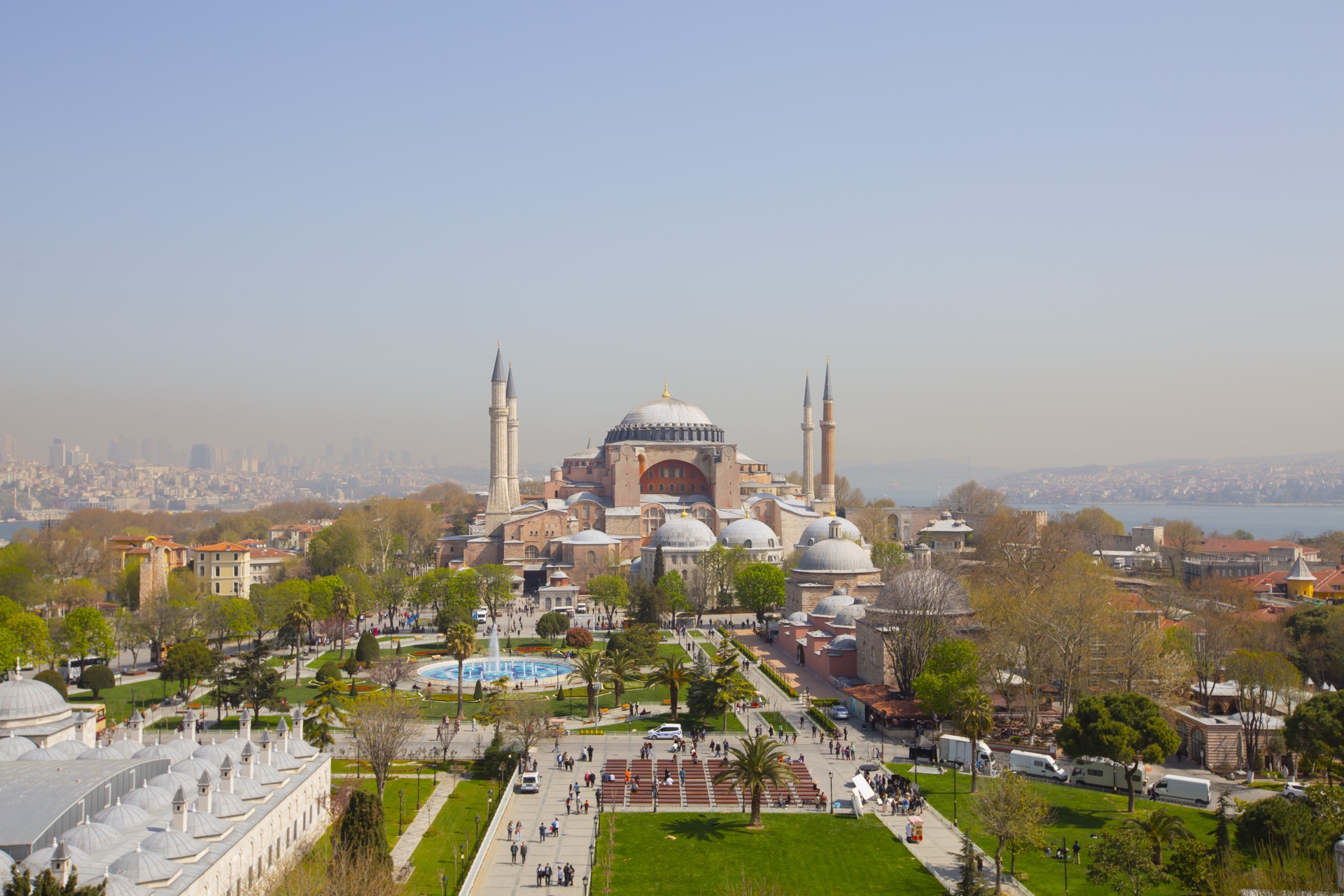
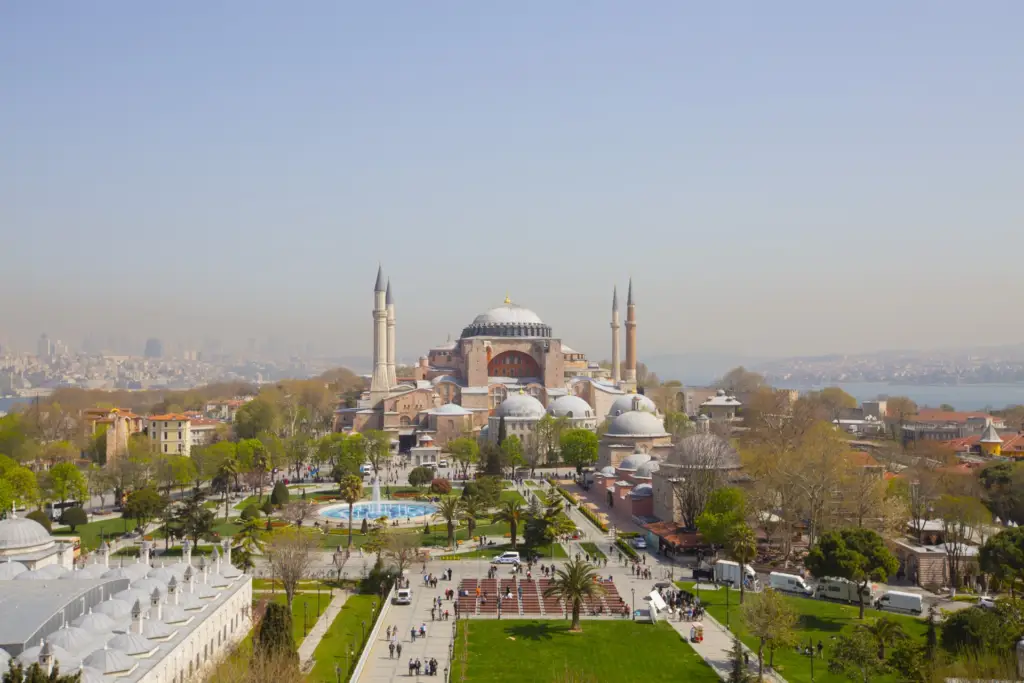
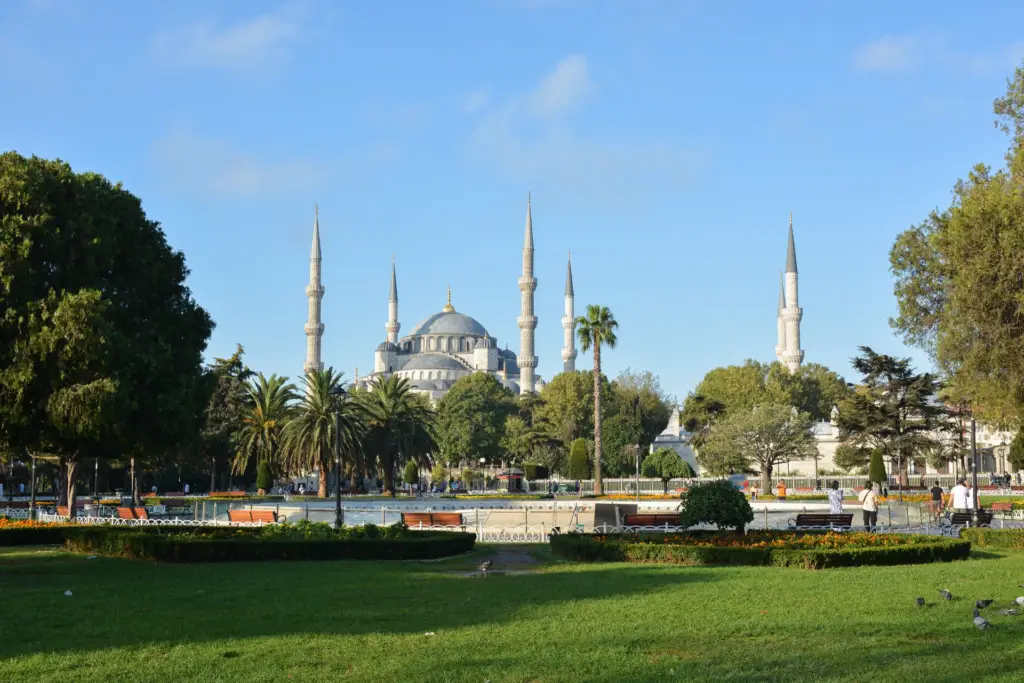
Eight of Istanbul’s headline sights sit inside a fifteen-minute walk of the Hippodrome, and Sultanahmet is the district wrapped around them. You can be standing in front of the world’s most photographed skyline ninety seconds after leaving your hotel door, before the tour coaches arrive. Nowhere else in the city gives you that.
Best for
First visits, short trips of two to four nights, early risers, and anyone whose priority is the monuments rather than the modern city. It is also the strongest base for families, because the shortest possible walk between hotel and sight is worth more than any hotel facility once children are tired. Guided days start here cleanly: our own private Istanbul tours pick up at the door, and the first stop is often reached by walking.
The trade-off
Sultanahmet is a monument district, not a living one. Restaurants aim at people who will eat there once, prices carry a location premium, and by 22:00 the streets are quiet in a way that reads as peaceful on night three and as dull on night six. The buildings are old, which means small lifts, no lifts, uneven thresholds and stairs to reception. The streets are cobbled and pitched. Carpet-shop approaches are frequent and practised. It is a lovely place to wake up and a limited place to spend an evening.
Getting around
The T1 tram runs through the district and links it to Sirkeci, Eminönü, Karaköy and Kabataş on one straight line, with one card and no changes. The Marmaray, the rail tunnel running under the Bosphorus, stops at Sirkeci and reaches the Asian side in about four minutes. Taxis reach the district easily by day. The narrow lanes make pickup points fiddly at night, which is why we give guests a named corner rather than an address when a driver is coming. From the Sultanahmet tram stop, the Hagia Sophia visitor entrance is about 5 minutes by walking, on the side facing Topkapı Palace rather than the square.
Everything in this frame is a ten-minute walk from everything else in it. That density is the entire case for sleeping in Sultanahmet, and the reason it feels hollow after dark once the day visitors have gone.
Sirkeci and Eminönü: Same Sights, Flatter Ground
Sirkeci sits ten minutes downhill from Sultanahmet, and Hagia Sophia is a twelve-minute flat-to-gentle walk from it. You give up almost nothing in distance and gain the two things Sultanahmet lacks: level streets and a working transport interchange on your doorstep.
Best for
Anyone arriving with real luggage, anyone with knees that have opinions, and any family building day trips out of the city. Sirkeci station is the Marmaray hub, Eminönü is the main ferry pier, and the T1 tram stops at both. A day trip from Istanbul, a Bosphorus boat and the Old City sights therefore all start within a few hundred metres of each other. It is also the practical choice for families who want the Old City but resent its evening premium.
The trade-off
Eminönü is a working transport and commerce district, which means it is loud, crowded and slightly chaotic from about 07:00 to 19:00. Ferry crowds, tram bells, porters, gulls. Choose a room off the main road and it is fine. Choose one facing it and you will hear the city work. The area is also thinner on atmosphere than its neighbours: it earns its place on logistics, not romance.
Getting around
This is the best-connected postcode in the historic city. Marmaray crosses to Üsküdar in about four minutes and runs far out in both directions. Public ferries run by Şehir Hatları leave Eminönü for Kadıköy and Üsküdar every fifteen to twenty minutes through the day, thinning out after about 21:00, and the Bosphorus boats covered in our Bosphorus cruise guide depart from the same waterfront.
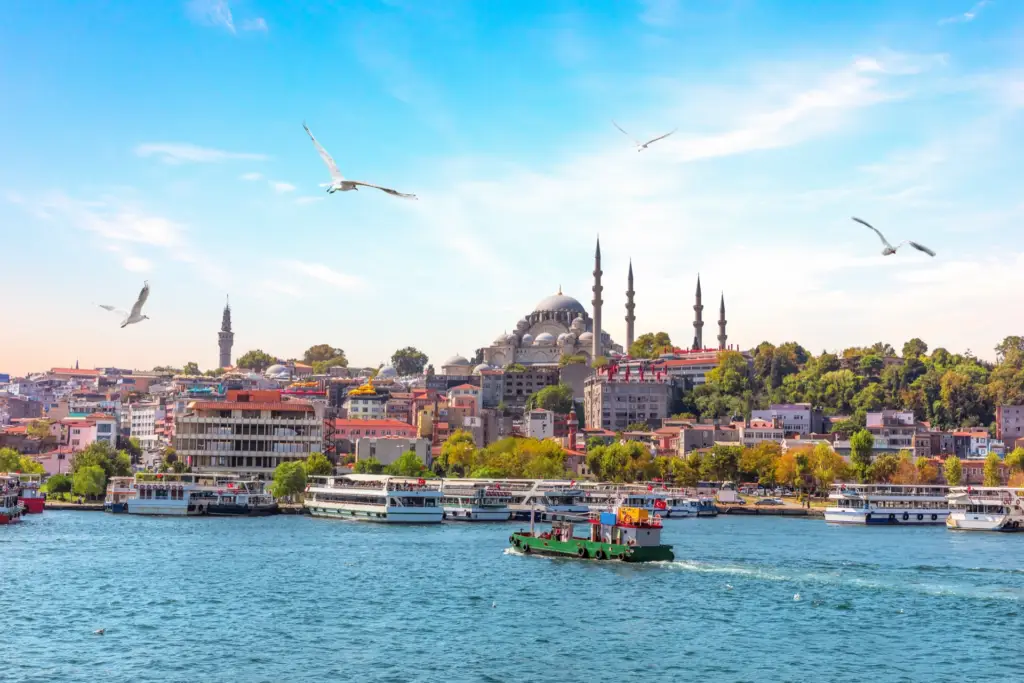
Eminönü from the water. Staying beside these piers turns the ferries from an attraction into your normal way of moving around the city, which is the quiet reason this area outperforms its reputation.
Galata and Karaköy: The Hinge Between Old and New
Galata and Karaköy sit four tram stops from Sultanahmet and stay open roughly four hours later. Both sit inside the wider Beyoğlu district, which also contains Taksim further up the hill, so a listing described as “Beyoğlu” can be a ten-minute walk from the water or a thirty-minute one. Karaköy at the waterline and Galata on the slope above it form the one area that is genuinely close to the monuments and genuinely alive at night. It is the base we recommend most often to families on a second trip, and to first-timers staying five nights or more.
Best for
Couples, families who plan a trip around eating, repeat visitors, and anyone whose stay runs five nights or longer. These streets hold the densest concentration of serious restaurants in central Istanbul. The dishes worth hunting are in our Turkish food guide, and the breakfast culture explained in our Turkish breakfast piece is at its densest here. Hotels tend to be design conversions of nineteenth-century apartment blocks: more character than the Old City, more taste than Taksim.
The trade-off
It is steep. Galata climbs from sea level to the tower in about 400 metres of pavement, and no amount of charm changes that at the end of a long day with luggage or a small child. Rooms in converted buildings are often small and the lifts smaller. Weekend nights around the tower are busy and loud until late. The walk to Hagia Sophia takes twenty-five minutes across the bridge, which is lovely once and tedious daily, so you will use the tram.
Getting around
The T1 tram at Karaköy puts you in Sultanahmet in four stops: Eminönü, Sirkeci, Gülhane, then Sultanahmet. The Tünel funicular, running since 1875, hauls you from Karaköy up to the bottom of İstiklal in ninety seconds and saves the worst of the climb. Ferries from Karaköy reach Kadıköy directly. If Galata Tower is on your list, staying here lets you go at opening or in the last hour, before the queue builds or after it clears.
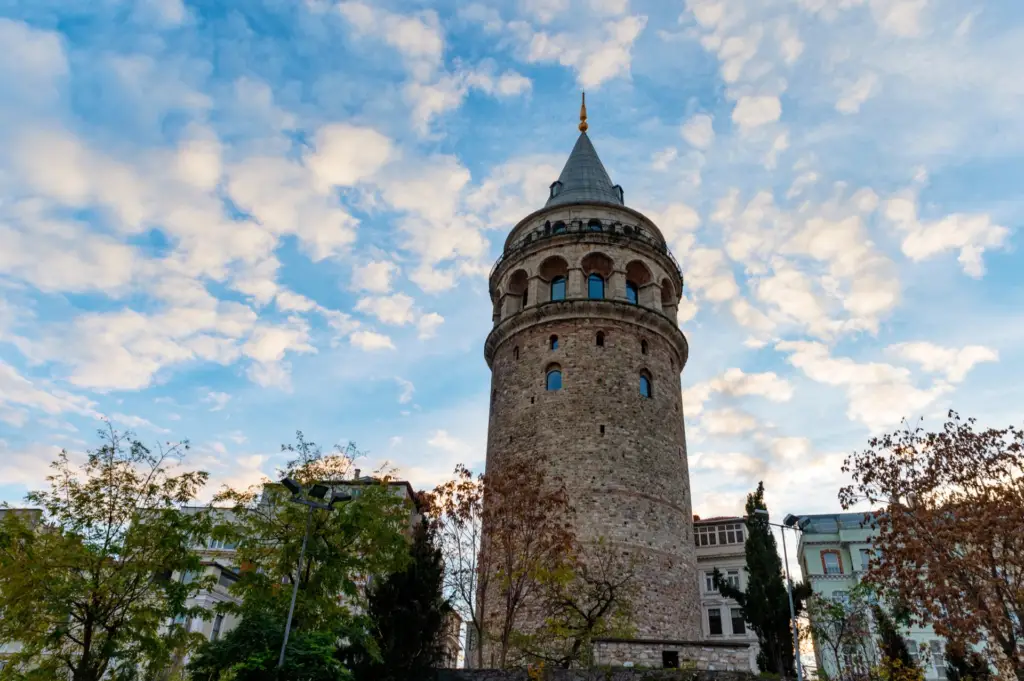
The tower is the landmark, but the streets around its base are the actual reason to stay here. The gradient visible in this frame is the actual reason some families should not.
Taksim and Beyoğlu: Widest Rooms, Longest Commute
Taksim buys you a predictable room and charges 25 to 35 minutes each way to the sights for it. This is where the international hotel brands are: proper lifts, proper air conditioning, family rooms that actually hold four people, and a bathroom that will not surprise anyone. That is a real advantage, and the commute is its price.
Best for
Families who want a known quantity, groups needing several rooms in one place, business trips with a sightseeing tail, and anyone arriving late from Istanbul Airport, because the airport buses terminate here and the M2 metro connects directly. It is also the widest price ladder in the city. You can spend very little or a great deal within three streets.
The trade-off
You are not in the historic city, and every sightseeing day begins with a commute. İstiklal Street is worth walking once and tiring to live beside. The side streets vary sharply within a hundred metres, some elegant and some not, and that difference is not visible in a booking photo. Noise is the common complaint, so pick a room on a courtyard rather than the street. We rarely base guided family days here for one reason only: a tired child 35 minutes from the hotel is a different problem from a tired child ten minutes from it.
Getting around
The M2 metro runs from Taksim and Şişhane down through the city. The F1 funicular drops from Taksim Square to Kabataş in about two minutes, where the T1 tram takes over for the Old City. That is one change and roughly half an hour door to door: not difficult, just relentless when you do it eight times.
Beşiktaş and the Bosphorus Shore: Paying for the Water
Beşiktaş, Ortaköy and Kuruçeşme sell one thing above all others: a window with tankers in it. It costs USD 150 to 280 a night in shoulder season, the steepest band in the city, and puts you 30 to 40 minutes from the Old City.
Best for
Second and third visits, honeymoons, longer stays where the monuments are already done, and families for whom the Bosphorus is the point rather than the backdrop. Beşiktaş itself is a real neighbourhood with a market, a young crowd and ferries in three directions, not just a hotel strip. Dolmabahçe Palace is walkable from most of it.
The trade-off
Cost, first. Waterfront rooms carry the steepest premium in the city, and the gap between a Bosphorus view and a side view in the same building can be double. Distance, second. You are 30 to 40 minutes from the Old City, and the coast road jams badly at rush hour. This is a poor choice for a short first trip and an excellent one for a long second trip.
Getting around
Ferries are the fast lane here. Beşiktaş to Üsküdar and Kadıköy runs constantly and beats the traffic without effort. Southbound, the coast road to Kabataş connects to the T1 tram, or take a taxi. The Bosphorus villages beyond, and the boat that strings them together, are covered stop by stop in the Istanbul travel guide.
Ortaköy, on the Bosphorus shore north of Beşiktaş. Waking up to this is the entire proposition of the water-side hotels, and the reason their room rates behave differently from the rest of the city.
Kadıköy and Üsküdar: The Case for the Asian Side
Kadıköy and Üsküdar run 30 to 40% below the historic peninsula and sit twenty minutes from it by ferry. Most first-time visitors never sleep here, and on a three-night trip they are right not to. For anyone else it deserves a serious look, because this is the only part of central Istanbul where a normal city comes at a normal price without giving up access.
Best for
Repeat visitors, long stays, families who travel for the food, and anyone using Istanbul as a base for several weeks. Kadıköy’s market streets and the Moda seafront are where the city’s own residents spend their weekends, and the eating is better and cheaper than anything on the tourist side of the water. Üsküdar is quieter and more conservative, with the best sunset view of the historic skyline in the city: the profile you came to see sits in front of you rather than underneath you.
The trade-off
Every sightseeing day involves a crossing. That crossing is a twenty-minute ferry, which is a pleasure rather than a chore, but it is also a timetable, and timetables thin out late at night. Hotel choice is narrower and skews to apartments and small independents. And if your trip is short, the crossing eats a meaningful percentage of your total waking hours.
Getting around
Ferries from Kadıköy and Üsküdar reach Eminönü, Karaköy and Beşiktaş all day. Marmaray from Üsküdar reaches Sirkeci in about four minutes. The M4 metro runs from Kadıköy directly to Sabiha Gökçen Airport, which quietly makes this the smartest last-night base for anyone flying out of SAW.
The Best Areas to Stay in Istanbul, Side by Side
The spread between the fastest and the slowest base is roughly 40 minutes each way, which over a five-day trip is most of a day. Walking times below are real times at a normal adult pace, not map estimates, and the evening verdict is what the streets are actually like at 21:00 on a weeknight.
Istanbul areas compared: who each one suits, and what it costs you
Area
Best for
Walk to Hagia Sophia
Evenings
Sultanahmet
First trips, 2–4 nights, families
2–10 min
Quiet, closes early
Sirkeci / Eminönü
Luggage, day trips, flat streets
12 min
Calm after the ferries stop
Galata / Karaköy
5+ nights, food, second trips
25 min (4 tram stops)
Busy, best in the city
Taksim / Beyoğlu
Big rooms, late arrivals, groups
30 min by metro + tram
Loud, very late
Beşiktaş / Bosphorus
Repeat visits, views, longer stays
30–40 min
Local, waterside
Kadıköy / Üsküdar
Lower rates, long stays, SAW flights
35–45 min via ferry
Genuinely local
One line does most of the work in each area, and knowing which one tells you what a base is really worth:
Sultanahmet and Sirkeci — the T1 tram, which links the Old City to Karaköy and Kabataş without a change
Sirkeci and Üsküdar — the Marmaray, crossing under the Bosphorus in about four minutes
Galata and Karaköy — the T1 again, plus the Tünel funicular for the hill and ferries to Kadıköy
Taksim and Beyoğlu — the M2 metro, fast north to south but one change away from the sights
Beşiktaş and the Bosphorus shore — ferry piers first, the tram at Kabataş second
Kadıköy and Üsküdar — ferries all day, and the M4 metro straight to Sabiha Gökçen
Proximity and atmosphere trade against each other almost perfectly in this city. There is no area that is both two minutes from Hagia Sophia and interesting at ten at night. Galata is the closest thing to a compromise, which is why it wins so often from five nights upward: it is the only base that keeps the Old City inside a 25-minute tram ride while still having somewhere to eat at 22:00. If the trip is short and the monuments are the point, Sultanahmet beats it outright.
What a Night Actually Costs, Area by Area
A 4-star boutique double with breakfast, the tier we book ourselves, runs from about USD 60 a night in Kadıköy to USD 450 on the Bosphorus waterfront. The bands below come from our own quoting over the past year. They are not the cheapest thing available in each area and not the top of the market. They are the middle, where most families actually land.
Nightly bands for a 4-star boutique double with breakfast, per room
Area
Shoulder (Mar–May, Oct–Nov)
Peak (Jun–Sep, holidays)
Sultanahmet
USD 95–160
USD 140–220
Sirkeci / Eminönü
USD 85–145
USD 125–200
Galata / Karaköy
USD 110–185
USD 165–260
Taksim / Beyoğlu
USD 80–150
USD 125–210
Beşiktaş / Bosphorus
USD 150–280
USD 220–450+
Kadıköy / Üsküdar
USD 60–110
USD 90–160
Bands reflect what we pay for the 4-star boutique tier we book for guests, sampled across the last twelve months. Rates move with the calendar and with events, so treat them as the shape of the market rather than a quote.
The costs the room rate hides
A cheaper area is not automatically a cheaper trip. Two taxis a day from Taksim, or a daily crossing from Kadıköy for four people, adds up faster than the nightly saving does over a fortnight. The reverse is also true. An Old City room that lets you walk everywhere removes a transport line from your budget entirely. Work out the daily cost of a base rather than the nightly one, and if tipping is on your mind while you do the sums, our tipping in Turkey guide sets the norms.
Where the package maths lands
Our 5-day Istanbul package prices four nights in a hand-picked 4-star boutique Old City hotel with breakfast, three guided days, a licensed local guide and all transfers at USD 1,645 per adult, dropping to USD 1,415 for a party of four and USD 1,315 for six. Children pay 40% less between four and six and 70% less under three. The comparison worth making is not room to room but week to week: what the whole week costs once guides, tickets and transfers are counted. Every route is priced that way in the Turkey tour cost guide.
Arriving: Which Area Is Easiest From Which Airport
Two continents and well over an hour of road separate Istanbul’s two airports, so the one you land at should decide where you sleep on your first and last nights, even when it has no bearing on the middle of the trip. Getting this wrong is the single most common planning error we correct.
Airport to area: private transfer times in normal traffic
Area
From Istanbul Airport (IST)
From Sabiha Gökçen (SAW)
Sultanahmet
55–75 min
65–90 min
Sirkeci / Eminönü
50–70 min
60–85 min
Galata / Karaköy
45–65 min
55–80 min
Taksim / Beyoğlu
45–65 min
55–80 min
Beşiktaş / Bosphorus
45–70 min
50–75 min
Kadıköy / Üsküdar
70–95 min
35–50 min
From Istanbul Airport, on the European side
The M11 metro runs from the terminal to Gayrettepe in about 25 minutes, where you change to the M2 for Şişhane and Taksim. Allow 50 minutes to an hour door to door once the change, the walk and the wait are counted. Airport buses run to Taksim and to Sultanahmet, take 90 minutes or more, and need no changes. A private transfer is the only option that gets four people and their suitcases to a cobbled Old City lane without a fight, which is why it is included in every package we run. That includes the two-day add-ons such as the Cappadocia trip from Istanbul, where a domestic flight makes the transfer timing tighter still. Live terminal information is published by Istanbul Airport, and the metro map and line times by Metro Istanbul.
From Sabiha Gökçen, on the Asian side
The M4 metro connects the terminal to Kadıköy in about 45 minutes, and from Kadıköy a ferry finishes the job. If you are flying in or out of Sabiha Gökçen and staying in the Old City, budget a real 90 minutes at rush hour and plan nothing for that evening. If you are landing here on a short trip, the Asian side is worth considering for at least the first night.
The last night is a separate decision
Whatever you did for the rest of the trip, the final night should sit on the same continent as your departure airport. A family that spends six lovely nights on the Bosphorus and then leaves from Sabiha Gökçen at 07:00 will remember the 04:15 alarm, not the view. We routinely move the last night for exactly this reason. The splitting section sets out how to make it painless.
Splitting a Stay Without Losing a Day
A well built hotel change costs about an hour, not a day. The objection to two bases is always the same wasted day, and it is a fair objection to a badly built transition and irrelevant to a good one. Done properly, the move adds a district you would otherwise only have passed through.
How the transition day is built
Check out at 11:00 and put the bags in the receiving hotel rather than the departing one, since most will hold them from mid-morning even when the room is not ready. The move itself takes 15 to 25 minutes by taxi across the Galata Bridge, or one ferry crossing if you are heading to the Asian side. Then spend the day on the receiving side, where the new district becomes that day’s sightseeing. You check in properly at 15:00 having lost nothing except the fifteen minutes you spent in a car.
The pairings that work
Old City then Galata — the standard, and the best first split. Monuments first while the legs are fresh, evenings second.
Old City then Kadıköy — for families who want the second half to feel like a different trip entirely. The crossing is the transition.
Galata then Beşiktaş — for repeat visitors skipping the monuments, working steadily north along the water.
Anywhere then Sirkeci or Kadıköy — the airport-driven last night, one or two nights only, chosen for the alarm clock rather than the view.
When not to split
Under five nights, do not. With very young children, do not, because packing twice costs more than the variety is worth. And if your Istanbul nights are already broken by a domestic flight to Cappadocia, as in the Istanbul and Cappadocia route or the IST, Sabiha Gökçen and Cappadocia airport comparison, you already have two bases and do not need a third. The same logic governs longer multi-centre Turkey holidays: one move per region, never two.
Which Area Suits Which Private Day
20 minutes at the wrong end of the morning is the difference between a good guided day and a long one. A guided day has a meeting point, a vehicle and a first door that opens at a fixed hour, and the distance between your bed and that first door is dead time you pay for in fatigue. On a full-day trip out of the city, such as Gallipoli and Troy leaving before dawn, that gap doubles.
Sultanahmet Park at the end of an afternoon. A base you can walk back to is what makes a lawn like this useful, and it is why the free-day row in the table below matters more to families than any hotel facility.
Matching your base to the days you plan to run
If your day is…
Best base
Why
A guided Old City day
Sultanahmet or Sirkeci
The first stop is reached by walking; no transfer at either end
A Bosphorus and palaces day
Beşiktaş or Karaköy
Boats leave from your doorstep
An early day trip out of the city
Sirkeci or Taksim
Fast vehicle access before 07:00 traffic
A food and markets day
Karaköy or Kadıköy
The day ends where you sleep, not an hour away
A free day with children
Sultanahmet
You can go back for a nap and come out again
That last row is the one families underestimate. Being able to return to the room at 14:00 and come out again at 16:30 changes what a day can hold, and the full argument with ages attached is in our Istanbul with kids guide. Our own private Old City day runs from USD 220 per adult and is built around exactly this rhythm. The wider set of guided days across the city follows the same principle: start near, finish near.
Three Areas We Do Not Book, and Why
Three areas come up constantly in searches and we book none of them. We have no affiliate arrangement with any hotel, so nothing is lost in saying why plainly.
Laleli and Aksaray
They look excellent on a map: a tram ride from everything, and rates 30 to 40% below Sultanahmet. On the ground they are wholesale trading districts built around suitcase commerce, with heavy late-night street activity and a character that surprises people who booked on price. The saving is real and so is the reason for it.
Airport hotels, on either side
A hotel next to Istanbul Airport puts you 40 km from the city with nothing around it. Unless your layover is under twelve hours, this converts your whole stay into a commute. For a genuinely early flight, Sirkeci or Kadıköy solve the same problem while leaving you somewhere worth being the evening before.
The far Bosphorus villages
Bebek, Arnavutköy and the villages north of them are beautiful, and they are where we take people on a boat day. Sleeping there means a 45 to 60 minute coast-road journey each way, on a road that jams reliably. For a two-week stay it can be wonderful. For anything shorter the commute costs more than the setting returns.
Four checks before you book any listing
The street, not the district. An apartment listed as “Sultanahmet” may sit fifteen minutes uphill in a residential lane. If the listing will not say which street it is on, that is the answer.
Walking time to a named monument, measured to Hagia Sophia or the Hippodrome rather than to a district name.
A lift, in writing. Old-city conversions routinely have four floors and a staircase, which matters more than star rating with luggage or a pushchair.
Room size in square metres rather than the words “family room”, which can mean two beds pushed into a double.
Where Our Own Guests Sleep
Four of the five nights in our Istanbul package sit in the Old City, in a hand-picked 4-star boutique hotel with breakfast, and the reasoning is operational rather than aesthetic.
A guided day that starts with a 35-minute transfer has spent its best hour in traffic. Starting by walking from the Old City means the first door of the morning opens before the coaches arrive, which is how our guided Old City day is sequenced. The vehicle is then used only for the parts of the day that need a vehicle, and an afternoon break becomes possible without writing off the rest of the day. When the trip continues to Cappadocia we apply the same logic and base guests in a cave hotel in Göreme: near the balloon fields, near the valleys, short mornings.
The hotel is named in your written quote, along with every other figure, before anything is paid. Bookings are held with a 25% deposit, the remaining 75% is paid on arrival in Turkey, and every enquiry gets a day-by-day plan and a fixed price within 24 hours. Every legally operating tour company in the country holds a licence from TURSAB, the national travel agency association; ours is 13538. If you would rather stay somewhere else entirely, whether that is a Bosphorus room, an apartment in Galata or a split across two districts, that is a normal request and we build the days around it.
Where the days themselves fit into a longer route is set out in our how to plan a trip to Turkey guide, and the seasonal picture that moves every price in the tables above is in the best time to visit Turkey hub. The historic peninsula’s protected core is a UNESCO World Heritage site, which is part of why building heights and hotel conversions there work the way they do.
Frequently Asked Questions — Where to Stay in Istanbul
Sultanahmet, for any first trip of two to four nights. Hagia Sophia, the Blue Mosque, Topkapı, the Basilica Cistern and the Hippodrome all sit within a ten-minute walk, so the district removes transport from your day entirely, and on a short trip that is worth more than atmosphere. Sirkeci, ten minutes downhill, is the better version of the same choice if you are travelling with heavy luggage or dislike hills. Stay elsewhere only if your trip runs five nights or longer, at which point Galata becomes a serious rival. How many nights you should give the city is worked through in our the day-count guide guide.
Sultanahmet under five nights, Galata at five nights and above. Sultanahmet is the best area in Istanbul to wake up in and one of the weaker ones to spend an evening in: you reach the monuments by walking before the coaches arrive, but restaurants aim at one-time customers, the streets are cobbled and pitched, and by 22:00 it is quiet. Galata sits four tram stops away and stays alive at night, which only matters once you have enough evenings for it to matter. On a trip of seven nights the right answer is usually both, in sequence.
European side for a first visit, Asian side for a second. Almost every headline sight is on the European side, and a short trip cannot afford a crossing at both ends of every day. From roughly six nights the calculation changes: Kadıköy and Üsküdar give you a normal working city, better everyday food and rates that run 30 to 40% below the historic peninsula, with a twenty-minute ferry that most families end up enjoying. Üsküdar to Sirkeci by Marmaray takes about four minutes. The Asian side is also the obvious base for anyone flying from Sabiha Gökçen.
From six nights, yes; below five, no. A well built transition costs about an hour: check out at 11:00, leave the bags at the receiving hotel, spend the day in the new district and check in at 15:00. Nothing is lost, because the new area becomes that day’s sightseeing. The standard pairing is Old City first and Galata second, monuments while the legs are fresh and evenings afterwards. Skip the split with very young children, where packing twice costs more than the variety returns. The transition guide above sets out the four pairings that work.
For a 4-star boutique double with breakfast, the tier we book, expect USD 95 to 160 a night in Sultanahmet in shoulder season and USD 140 to 220 at peak. Kadıköy runs about a third less and Bosphorus waterfront rooms roughly half as much again. Across the whole city the district spread is wider than the season spread, so changing area saves more than changing dates, though the best time to visit Turkey hub shows where those seasons fall and the two stack. Count the transport a base forces on you before comparing rates: two taxis a day erase the saving on a cheaper neighbourhood inside a week.
Taksim, Galata and Beşiktaş are the quickest from Istanbul Airport at 45 to 65 minutes by private transfer, with the Old City 10 to 15 minutes further out. The M11 metro reaches Gayrettepe in about 25 minutes, then the M2 continues to Şişhane and Taksim, so allow close to an hour door to door. From Sabiha Gökçen the order reverses completely: Kadıköy is 35 to 50 minutes away and the Old City can take 90 minutes at rush hour. Match your first and last nights to your arrival and departure airports even when the middle of the trip sits somewhere else entirely, because the alarm clock is what people remember.
Taksim is right for predictable rooms and wrong for short sightseeing trips. It holds most of the international chains, so it is where you find working lifts, reliable air conditioning and family rooms that genuinely sleep four, plus the airport bus terminus and the M2 metro. The cost is 25 to 35 minutes each way to the historic sights, every day of the trip. Side streets vary sharply within a hundred metres and street noise is the most common complaint, so choose a courtyard-facing room. For groups needing several rooms together it is often the only practical answer in the city.
Sultanahmet, for one reason that outranks every hotel feature: you can go back to the room at 14:00 for an hour and come out again at 16:30. A base you can return to mid-afternoon roughly doubles what a day with children can hold, which is why we put families there ahead of larger rooms further out. Sirkeci is the alternative if you are pushing a stroller, because its streets are flat where Sultanahmet’s are cobbled and pitched. Avoid Galata’s gradient and Taksim’s 35-minute commute with under-eights. Ages, stops and pacing are covered in our guide to Istanbul with children.
On the same continent as your departure airport, and preferably beside a station. For Istanbul Airport that means Sirkeci, Taksim or Galata. For Sabiha Gökçen it means Kadıköy, where the M4 metro runs to the terminal directly. Moving your final night is a normal, low-cost adjustment and it saves the 04:15 alarm that otherwise ends the trip badly. Airport hotels are rarely the answer below a twelve-hour layover, because they sit 40 km from anything and turn a last evening into a car park. We move this night for guests routinely, and it costs nothing to ask.
Three to four months for June to September and for school holidays, and six to eight weeks for shoulder season. Connecting and family rooms are the scarce category in old-city buildings, since most are converted houses with only a handful of them, so earlier dates mean a wider choice rather than a better rate. Booking through us works the same way: the hotel is named in your written quote, a 25% deposit holds the booking and the remaining 75% is paid on arrival in Turkey. Quotes are returned within 24 hours, so an early enquiry costs you nothing.
Yes, and that is how most of our itineraries are built. Our 5-day Istanbul package includes four nights in a hand-picked 4-star boutique Old City hotel with breakfast, three guided days, a licensed local guide and all transfers at USD 1,645 per adult. Children pay 40% less between four and six and 70% less under three. If you prefer a different area, an apartment or a split across two districts, we build the days around your choice instead. Every plan and price arrives in writing within 24 hours.
Plan Your Istanbul Days
Tell us the dates, the number of nights and who is travelling, through the short planning form or by WhatsApp. Turkey Family Tours, TURSAB-licensed (no 13538), sends back a day-by-day plan and a fixed quote within 24 hours, with the hotel named in writing and guided days only where they earn their place. If this page is all the help your trip needed, it is yours to keep. If you would rather have the area decision, the transfers and the timing handled, that is what the quote covers, for a single city or for a full private Turkey tour, and for itineraries built from scratch through tailor-made Turkey tours.
The 12 best places to visit in Turkey across five regions — Istanbul to the Turquoise Coast, with the days each needs, how they connect, and which ones to save for a second trip.
The Gallipoli battlefields in one guide: the three sectors, Anzac Cove, Lone Pine, Chunuk Bair, the Turkish memorials and Troy, with distances, drive times, ground conditions and the Anzac Day access rules.
Cappadocia travel guide: sunrise hot air balloons, cave hotels, the Göreme Open-Air Museum and the underground cities — with the 2-day private tour from Istanbul at USD 1,030 pp.
A private Turkey tour runs from USD 220 per person for one guided day to USD 5,395 for a 14-day circuit, with multi-day routes at USD 382 to 402 per person per day. Domestic flights, a licensed local guide, hotels and every site admission are inside the figure.
The full 11-day overland route — Istanbul to Gallipoli with no domestic flights: leg-by-leg drive times, the Silk Road stops flights skip, and one fixed quote from USD 4,365.
Galata Tower entry is €30 (about USD 33), open daily, ticket desk closes 18:14. Queue timings, the lift that stops at floor seven, and what the balcony shows.
✦ Tailor-Made
Let's Plan Your Private Turkey Trip
Tell us about your family — we reply within 24 hours.

 English
 Dutch
 Japanese
 Korean
 Chinese