Turkey in January: Coldest-Month Weather, City by City, and What Stays Open
Quick Answer:Turkey in January is the coldest month of the year: 9.6 °C (49 °F) by day in Istanbul, 15 °C (59 °F) in Antalya and 4 °C (39 °F) in Cappadocia, where nights average −3.6 °C (26 °F). Istanbul counts 16 wet days and three to five days with snowfall, with sunrise at 08:26 in mid-month. Hot air balloon flights in Cappadocia go ahead on about 50–60% of January mornings, so two Cappadocia nights give two launch windows. Museums, bazaars, Ephesus and Pamukkale stay open on winter hours, while beach clubs and most coastal boat trips are shut. A private Turkey tour in January costs from USD 1,645 per adult for five days in Istanbul to USD 5,395 for 14 days. Each route includes hand-picked 4-5 star boutique hotels, a licensed local guide and a private vehicle with driver in every region. Turkey Family Tours is TURSAB-licensed (no 13538). A 25% deposit confirms the booking; 75% is paid on arrival. Get a Private Quote →
Turkey in January is one country with three winters. Istanbul is wet and grey at 9.6 °C (49 °F). Cappadocia is dry and frozen at −3.6 °C (26 °F) before dawn. Antalya sits at 15 °C (59 °F) with the heaviest rain of the three. The figures on this page are the long-term January normals of the Turkish State Meteorological Service, city by city. Around them sit the things a family needs to plan the month: snow days in Istanbul, sunrise times, hot air balloon odds, opening hours and the private routes that still work. It is one chapter of our month-by-month guide to the best time to visit Turkey.
By Fatih — Founder & Tour Director, Turkey Family Tours · TURSAB licence 13538 · Last updated: September 2026
Planning a private Turkey tour?
We build family-paced private itineraries with hand-picked 4-5 star hotels and send a written plan and fixed price within 24 hours.
Is Turkey Worth It in January? The Coldest Month in Four Numbers
Turkey is worth visiting in January as a museum, bazaar and snow-valley month at 9.6 °C (49 °F) by day in Istanbul. January is the coldest month of the year in Turkey, and it is not a beach month anywhere in the country. Istanbul has 16 wet days in the month and about 9½ hours of daylight. A hot air balloon morning in Cappadocia flies 50–60% of the time. A family that accepts those four numbers gets the emptiest sites of the year at the per-adult price of any other month.
9.6 °C, 16 wet days, 9½ hours of light, 50–60% of mornings
The daytime high means a warm coat in Istanbul, and proper winter layers in Cappadocia at 4 °C (39 °F). The wet days mean the Istanbul programme is built around indoor sites, with the open-air ones placed on the driest forecast day. The daylight means touring starts after an 08:26 sunrise and ends at about 18:00. The fly rate means a route needs two Cappadocia nights if the hot air balloon matters to the family. Our 7 days in Turkey route gives two of its six nights to a Göreme cave hotel, which lifts a 50–60% morning to about 80% odds of one flight.
What the numbers do not show is how quiet the month is. Hagia Sophia, Topkapı Palace and the Library of Celsus have no queue worth the name after the first days of January. With a licensed local guide, the family’s time goes inside the monument instead of into a queue outside it.
Who January suits, and who should pick another month
January suits a family that wants history, food and winter scenery, and has 7 to 10 days to spend. At the long end, our 10 day Turkey itinerary spends three nights at Kuşadası, for Ephesus at 12.5 °C and a day trip to Pamukkale’s 36 °C thermal pool. It does not suit families whose children expect a pool and a beach.
January works for
Pick another month if
Museums, palaces and bazaars without queues
The trip depends on swimming: the sea is about 18 °C (64 °F)
Cappadocia valleys under snow, with a heated cave room
One hot air balloon morning must be guaranteed
Ephesus and Pamukkale at 11–13 °C, almost empty
The family dislikes rain: Istanbul has 16 wet days
Children who are fine in a coat and boots all day
The route relies on boat trips or beach clubs
New Year’s Eve on the Bosphorus at the start of the trip
Long summer evenings outdoors are the point
For a family swimming holiday the answer is June to September, and our best time to visit Turkey guide ranks all twelve months. For everything else on the list, Turkey is worth visiting in January.
The price of a January trip is the price of any month
Turkey Family Tours quotes one per-adult price for each route, and it does not move with the calendar. The five-day private Istanbul package is USD 1,645 per adult with two adults sharing, in January as in May. What changes is what a family gets on the ground: shorter days, emptier sites and a lower hot air balloon fly rate. The Turkey tour cost guide breaks the per-adult price into hotels, flights, guiding and entrance fees.
Turkey Weather in January, City by City: From 15 °C in Antalya to −3.6 °C Nights in Cappadocia
Turkey weather in January runs from a 15 °C (59 °F) afternoon in Antalya to a −3.6 °C (26 °F) night in Cappadocia. That is a spread of almost 19 degrees inside one country. Istanbul sits between the two at 9.6 °C (49 °F) by day and 4.2 °C (40 °F) at night. No single forecast covers a route that crosses all three. The table gives the January normals for nine cities on or near our private routes. All figures come from the Turkish State Meteorological Service long-term record, except the two Istanbul cells marked *.
City (region)
Average day high, January
Average night low
Wet days in the month
Rain, month total
Sunshine per day
Record January low
Istanbul
9.6 °C (49 °F)
4.2 °C (40 °F)
16
89 mm
2–3 h*
−12.6 °C*
Nevşehir (Cappadocia)
4.0 °C (39 °F)
−3.6 °C (26 °F)
12
45 mm
3.1 h
−21.2 °C
Kayseri (Cappadocia airport)
4.3 °C (40 °F)
−6.7 °C (20 °F)
13
36 mm
3.0 h
−32.5 °C
Antalya
15.0 °C (59 °F)
6.1 °C (43 °F)
12
226 mm
4.9 h
−4.3 °C
İzmir (Ephesus side)
12.5 °C (55 °F)
5.8 °C (42 °F)
13
135 mm
4.3 h
−8.2 °C
Denizli (Pamukkale)
10.7 °C (51 °F)
2.5 °C (37 °F)
12
90 mm
3.7 h
−10.5 °C
Çanakkale (Gallipoli, Troy)
9.7 °C (49 °F)
3.3 °C (38 °F)
12
91 mm
3.2 h
−11.0 °C
Ankara
4.4 °C (40 °F)
−3.1 °C (26 °F)
12
40 mm
2.6 h
−24.9 °C
Konya
4.8 °C (41 °F)
−4.1 °C (25 °F)
10
37 mm
3.2 h
−28.2 °C
* Istanbul sunshine and record low are from the Istanbul climate record for the Florya and Kireçburnu stations.
The coast is mild and wet, and the plateau is cold and dry. Every city has between 10 and 16 wet days, so the rain is spread evenly. What differs is how much falls: Antalya takes five times the rain of Cappadocia.
Istanbul: 9.6 °C by day, 16 wet days and under 3 hours of sun
Istanbul in January averages 9.6 °C (49 °F) by day and 4.2 °C (40 °F) at night. It is the greyest city on the route, with only two to three hours of sunshine a day. The cold is damp, and the wind off the Bosphorus makes it feel two or three degrees lower on the water. Frost is unusual in the old city. A family day in the old city loses little to the weather, because most of its main sites are indoors. Our Istanbul travel guide sets out the sites by district.
Hagia Sophia above Sultanahmet Square. In January the square is this empty for most of the day.
Cappadocia: 4 °C afternoons and −3.6 °C before sunrise
Cappadocia in January averages 4.0 °C (39 °F) by day and −3.6 °C (26 °F) at night in Nevşehir. Kayseri, where most flights land, drops to −6.7 °C (20 °F). The air is dry, with only 45 mm of precipitation in the month, and much of it falls as snow. A clear afternoon at 4 °C in still air feels milder than a wet 9 °C in Istanbul. Dawn is colder: a hot air balloon morning puts the whole family outside at the coldest minute of the day. The Cappadocia travel guide covers the valleys and towns in full.
Ephesus and Pamukkale: 12.5 °C on the coast, 10.7 °C inland
The Aegean in January averages 12.5 °C (55 °F) by day in İzmir, the nearest long-record station to Ephesus. Pamukkale sits inland at Denizli, at 10.7 °C (51 °F) by day and 2.5 °C (37 °F) at night. İzmir takes 135 mm of rain in the month, which arrives in fronts of a day or two. Between them the light is low and clear, and family photographs on the marble come out better than in July. The Ephesus travel guide explains the two gates and the walking route between them.
Antalya: 15 °C, 4.9 hours of sun and 226 mm of rain
Antalya in January averages 15.0 °C (59 °F) by day and 6.1 °C (43 °F) at night, with 4.9 hours of sunshine. That is about twice the sun of Istanbul. It is also 226 mm of rain, the highest figure in the table. Day by day, the Antalya travel guide lists the old town, the museum and the ancient cities nearby.
Ankara and Konya: the −3 °C to −4 °C plateau nights
Ankara and Konya in January average 4.4 °C and 4.8 °C by day, and −3.1 °C and −4.1 °C at night. They matter only on a route that crosses the plateau by road. Snow on the Ankara–Cappadocia and Konya–Pamukkale legs is the reason we steer families away from a fully by-road circuit in this month.
The Warmest Part of Turkey in January Is Also the Wettest: Antalya at 15 °C and 226 mm
The warmest part of Turkey in January is the Mediterranean coast around Antalya, at 15.0 °C (59 °F) by day. It is also the wettest part of any private route, with 226 mm of rain in the month. Both figures are true because the rain falls hard and briefly. Antalya has 12 wet days, fewer than Istanbul’s 16, and still keeps 4.9 hours of sun a day. A family spending a January week there should expect two days of heavy rain and five bright, cool ones.
Coastal city
Day high
Night low
Rain
Sunshine per day
Sea temperature, January
Antalya (Mediterranean)
15.0 °C (59 °F)
6.1 °C (43 °F)
226 mm
4.9 h
18–19 °C (64–66 °F)
İzmir / Kuşadası (Aegean)
12.5 °C (55 °F)
5.8 °C (42 °F)
135 mm
4.3 h
17–18 °C (63–64 °F)
Çanakkale (Dardanelles)
9.7 °C (49 °F)
3.3 °C (38 °F)
91 mm
3.2 h
about 13 °C (55 °F)
Istanbul (Marmara, Bosphorus)
9.6 °C (49 °F)
4.2 °C (40 °F)
89 mm
2–3 h
10–11 °C (50–52 °F)
The lower sea figure is the long-term January average from seatemperature.info. The upper one reflects recent winters in the Open-Meteo marine archive, which ran about a degree warmer.
15 °C is coat-off weather at noon, not beach weather
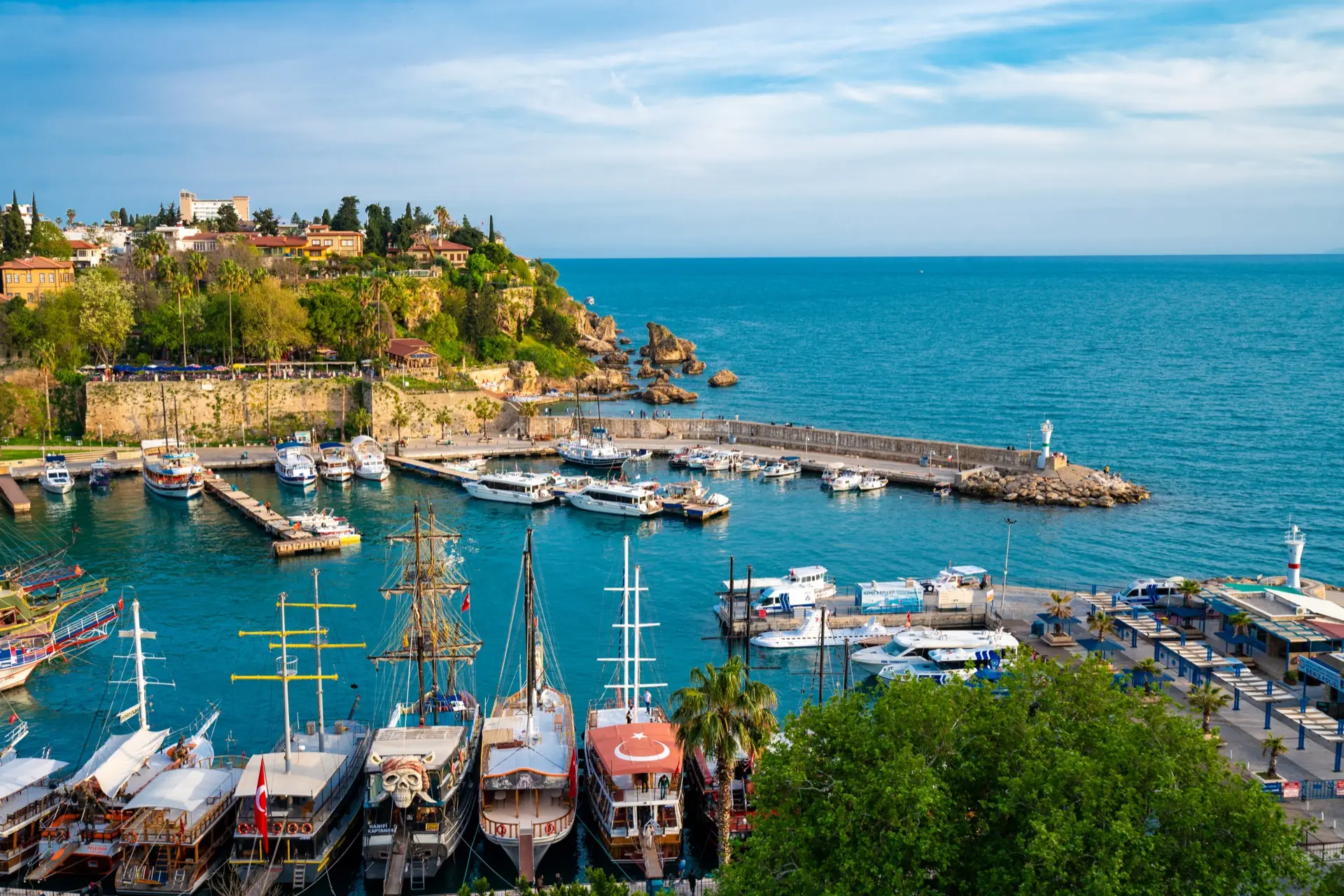
The sea at Antalya is about 18 °C (64 °F) in January, which is a quick dip for the hardy and no more. A 15 °C Antalya afternoon in the sun is a day for the harbour, the old town and lunch outdoors. It is not a day for the beach. Hotel pools outdoors are unheated and mostly empty. Families who want water in January get it from a heated indoor hotel pool, or from Pamukkale’s thermal pools further north.
Kaleiçi harbour in Antalya. The old town stays open all winter; most of the boats stay tied up.
What Antalya adds to a January route
Antalya adds three dry-site days to a winter route: Kaleiçi old town, the Antalya Museum, and the ancient cities of Perge and Aspendos. The Aspendos theatre seats about 15,000 and is often empty in January. Behind the city, the Taurus Mountains carry snow above roughly 1,500 m. A family can stand in a citrus garden at sea level and look at white peaks. The route that includes this coast is the 10-Day Turkey Tour Package: Istanbul, Cappadocia & Antalya, from USD 4,010 per adult.
Why the Aegean is the second-warmest choice
The Aegean coast near Ephesus is 2.5 degrees cooler than Antalya by day and takes 40% less rain. For families choosing one coastal leg, Antalya is the warmest place in Turkey in January. The Aegean has the stronger sites and the shorter flight. On a 10-day plan or longer there is room for both.
Does It Snow in Istanbul in January? Three to Five Snow Days, Rarely Settling
It does snow in Istanbul in January, on about three to five days of the month depending on the district. The city’s climate record gives 2.7 snowy days at Florya on the Marmara shore and 4.5 at Kireçburnu on the upper Bosphorus. Snow that falls rarely stays: almost half of Istanbul’s snowy spells leave no cover for longer than a day. For a family staying in the old city, the chance of seeing snow fall on any given January day is roughly one in ten.
Istanbul station
Where it is
Snowy days, December
Snowy days, January
Snowy days, February
Florya
Marmara shore, south-west
1.0
2.7
3.5
Kireçburnu
Upper Bosphorus, north
2.7
4.5
4.7
Bahçeköy
Belgrade Forest, far north
—
4.6
—
North of the city gets almost twice the snow of the old town side
The Black Sea decides where the snow lands. Cold air from the north picks up moisture over the water and drops it on the first land it meets. The upper Bosphorus and the northern forests get 4.5 to 4.6 snowy days in January. Sultanahmet, the old city peninsula on the Marmara side, behaves like Florya at under three. A family staying in the old town sees less snow than the city’s reputation suggests.
When a big snowfall does arrive: 80 cm and 104 cm on record
The deepest snow cover on record in the city is 80 cm, measured in early January of 1942. A later January storm left 104 cm in the northern suburbs. An ordinary snow day is 2 to 10 cm that turns to slush within 24 hours.
What a snow day changes, and what it does not
A snow day in Istanbul changes transport first and sightseeing last.
Flights: both Istanbul airports slow down for de-icing, and delays of a few hours are normal on a heavy day.
Bosphorus ferries: services pause in thick fog or strong south-westerly wind, more often than for snow itself.
Roads: the hills of Beyoğlu and the Bosphorus villages get slow; the tram along the old city keeps running.
Sites: Hagia Sophia, Topkapı Palace, the Basilica Cistern and the Grand Bazaar open as usual.
Photographs: domes and minarets under snow, on the three to five days a month it happens.
On a private family tour the day is simply re-ordered. The guide moves the Bosphorus cruise to a clearer day and brings the covered sites forward. Our private Old City day tour, at USD 220 per adult, is mostly indoors. Our Bosphorus cruise guide explains which boat suits which weather.
Ortaköy Mosque and the Bosphorus Bridge. The upper Bosphorus gets nearly twice the snow days of the old city.
New Year’s Eve in Istanbul, Then 30 Quiet Days: How the Month Splits
January in Turkey has one public holiday, 1 January, and one busy night, the New Year’s Eve before it. From 2 January the country is back at work, and the remaining 30 days are the quietest of the touring year. Families can choose either half. Arriving on 29 or 30 December puts New Year’s Eve on the Bosphorus at the front of the trip. Arriving on or after 2 January gives the empty-site version of the month from the first morning.
What changes
New Year days (30 December – 1 January)
Rest of January (2 – 31 January)
Istanbul hotels
Busiest nights of the winter; book with the trip
Widest choice of rooms all year
Dinner
Fixed New Year’s Eve menus, reserved ahead
Any table, same day
Main sites
Busy on 31 December and 1 January
Short or no queues
Banks and public offices
Shut on 1 January
Normal hours
Domestic flights
Fuller around the New Year
Easy to book and to change
Hot air balloon fly rate
50–60% of mornings
50–60% of mornings
31 December: fireworks over the Bosphorus at midnight
New Year’s Eve is the one night of winter when Istanbul fills up. At midnight fireworks go up along the Bosphorus, and the best views are from the water or from a shore-side table. Hotels and restaurants sell the evening as a fixed menu with music, and the good rooms go first. The streets around Taksim and İstiklal are crowded and heavily policed, and they are not where we send a family with children. A dinner table with a Bosphorus view is the calmer way to see the same fireworks.
The decorated trees and lights in Turkish shop windows are for New Year, not for Christmas. 25 December is an ordinary working day in Turkey. The celebration, the presents and the big family dinner all belong to the night of 31 December.
1 January: a slow holiday morning
1 January is a public holiday, so banks and public offices are shut and the city wakes late. For families it is a good day for a late start, a walk along the Bosphorus and one major site in the afternoon. Holiday timetables are set site by site, so that day’s hours are worth checking on each site’s own page. The first full touring day is better placed on 2 January.
2 to 31 January: the emptiest weeks of the year
From 2 January the sites are emptier than in any other month. There are no public holidays left in the month, and flights and cave hotels have space on almost any date. A family plan can change on the day without losing a room or a seat. A wet Tuesday and a dry Thursday can swap places.
Sunrise at 08:26: Planning Around a Late January Morning
The sun rises in Istanbul at 08:26 in mid-January and sets at 17:58, which gives about 9½ hours of daylight. Turkey keeps the same clock all year, three hours ahead of UTC. That is why winter mornings are dark and winter afternoons are longer than most families expect. The month also improves as it goes. Istanbul gains 44 minutes of daylight between 1 and 31 January. The times below are from the NOAA solar calculator, and they match the timeanddate.com tables for Istanbul.
Place
Sunrise – sunset, 1 January (local time, UTC+3)
Sunrise – sunset, 31 January
Day length, 1 → 31 January
Gain in the month
Istanbul
08:28 – 17:45
08:16 – 18:17
9 h 17 → 10 h 01
+44 min
Göreme (Cappadocia)
07:58 – 17:28
07:47 – 17:59
9 h 30 → 10 h 12
+42 min
Selçuk (Ephesus)
08:26 – 18:00
08:16 – 18:30
9 h 34 → 10 h 14
+40 min
Pamukkale
08:19 – 17:53
08:09 – 18:23
9 h 34 → 10 h 14
+40 min
Antalya
08:09 – 17:50
08:00 – 18:19
9 h 41 → 10 h 19
+38 min
A touring day that runs 09:00 to 17:00
A family touring day in January runs from about 09:00 to 17:00, which is seven to eight hours on the ground. That is enough for every day on our routes, because winter days have no midday heat to sit out. The order changes instead. Open-air sites go into the middle of the day, when it is warmest and brightest. Indoor sites take the first and last hour. In Istanbul that means the Hippodrome and the palace courtyards near noon, and the Basilica Cistern or the bazaars at the end.
The latest hot air balloon morning of the year
Sunrise in Göreme is at 07:58 on 1 January and 07:47 on the 31st. Hot air balloon flights launch around first light, so January has the latest pickup of the year. With children that counts: a summer flight means leaving the hotel in the middle of the night, and a January one means an early breakfast hour. The price is the cold: the launch field is at its −3.6 °C (26 °F) average low at exactly that time.
What to do with a 17:45 sunset
Dusk comes at about 17:45 at the start of the month, which leaves a family four hours before bed. In Istanbul a Turkish bath, a whirling dervish ceremony, a cooking class and a long dinner are all indoor evening plans. In Cappadocia a family evening belongs to the cave hotel, a fireplace and local food. One planned evening for every two free ones keeps children fresh for the mornings.
Cappadocia Under Snow: 50–60% Hot Air Balloon Mornings and What Fills a Grounded One
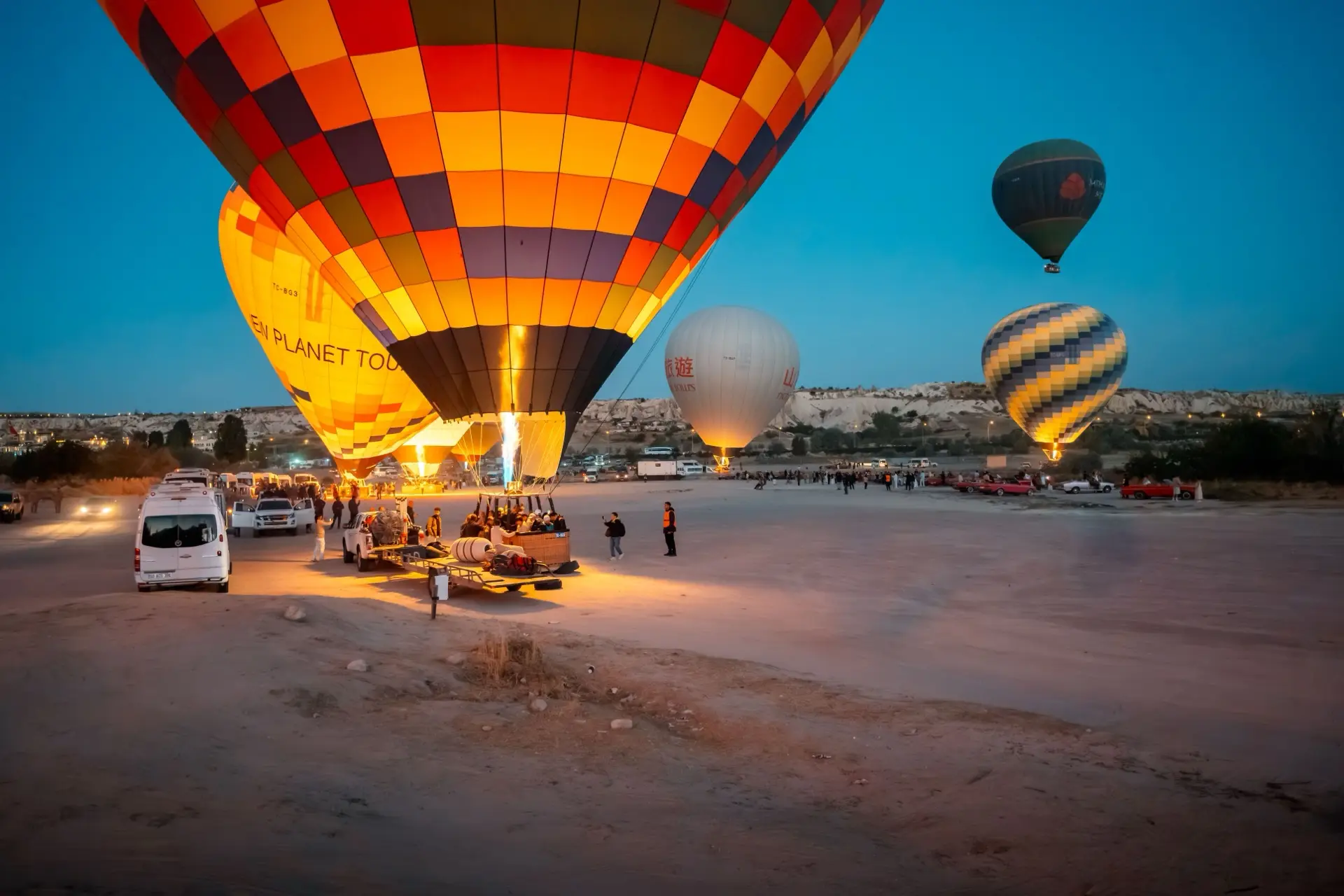
Hot air balloon flights in Cappadocia go ahead on about 50–60% of January mornings, against 90% or more in the best autumn weeks. Wind, fog and snowfall ground the rest. The civil aviation authority, the SHGM, makes the call at first light, and no operator can overrule it. A family that plans one Cappadocia night is tossing a coin. A family that plans two nights has a two-morning launch window. The odds of at least one flight then rise to about 80%.
A hot air balloon inflating on the launch field near Göreme. In January the launch comes just before sunrise, which falls between 07:47 and 07:58.
Two mornings turn 55% into about 80%
If one morning flies 55% of the time, two mornings both fail about 20% of the time. That leaves roughly four chances in five of flying once. A third night lifts it to about 90%. Winter weather comes in spells, so the true odds are a little lower than the sum suggests. If no flight goes up, the hot air balloon fee is refunded in full. Our Cappadocia hot air balloon guide has the fly rate for every month and explains how the call is made.
What fills a grounded morning
A grounded morning costs a family nothing but the early alarm, because the touring day starts at 09:00 either way, around these sites.
Göreme Open-Air Museum: rock-cut churches with painted interiors, a UNESCO World Heritage site, and mostly under cover.
Kaymaklı underground city: four levels open to the public, cut deep into the rock and well above freezing inside on the coldest day.
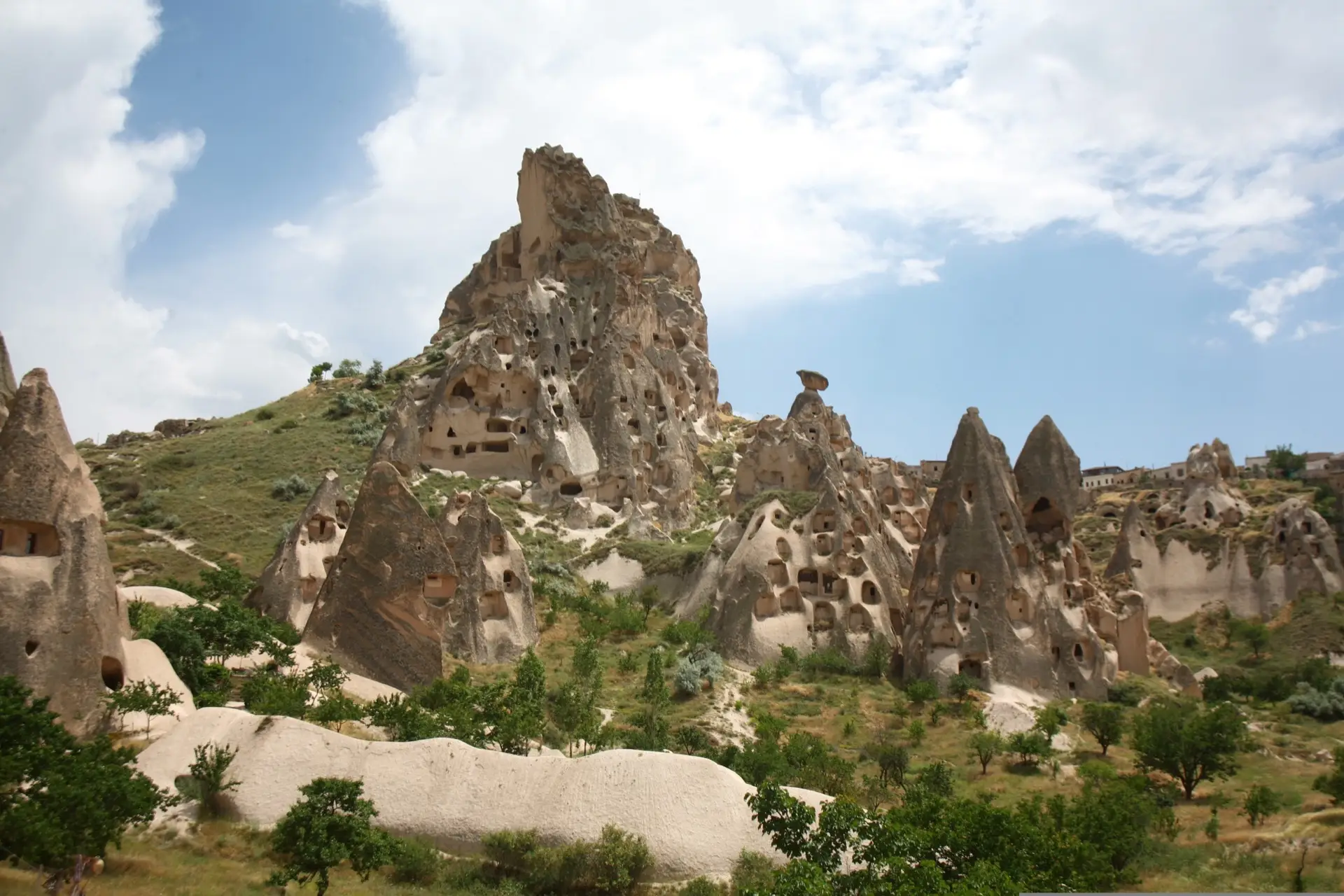
Uçhisar Castle: the highest point in the region, with the whole white valley below it.
Avanos: a pottery workshop where children throw a pot on a kick-wheel, indoors and warm.
Paşabağ and Devrent: fairy chimneys with snow caps, ten minutes from the vehicle at each stop.
Walking the valleys in snow
Valley walks are shorter in January, at 30 to 45 minutes instead of two hours. Paths in the Red and Rose valleys can be icy in shade, and the guide picks the stretch on the day. The reward is a landscape few families see. Snow sits on the cones and ledges, the rock glows pink at 16:30, and there is nobody else in the frame.
Uçhisar Castle, photographed in the green months. In January the same slopes are usually white.
Cave rooms are heated, and that is the point of them
A cave room holds its warmth, and the boutique cave hotels we use in Göreme heat every room. Our guide to Cappadocia cave hotels shows what those rooms look like. After a day at 4 °C (39 °F), that room is a large part of why families like Cappadocia in winter. The shortest route with a night in one is the Private 2-Day Cappadocia Tour from Istanbul, from USD 1,030 per adult with flights. It has one launch window. Our guide to how many days to spend in Cappadocia explains when a second or third night is worth adding.
What Runs and What Shuts on the Coast and at the Ruins in January
Museums and ancient sites in Turkey stay open in January, and state sites work a winter timetable until the end of March. Every museum and ancient site on our routes is open, and none of our private family tours stops running. What shuts in January is the summer layer of the coast: beach clubs, waterparks, most daily boat trips and many seasonal resort hotels. Winter hours close earlier to match the early sunset, and are set site by site on the Turkish Museums pages.
Grand Bazaar and Spice Bazaar (Grand Bazaar closed Sundays)
Most seasonal resort hotels, roughly November to April
Bosphorus ferries and short cruises, weather permitting
Daily boat trips from Fethiye, Kaş and Antalya
Göreme Open-Air Museum, underground cities, all valleys
Gulet cruises along the Turquoise Coast
Ephesus, the Terrace Houses (own ticket), Ephesus Museum in Selçuk
Saklıkent Gorge walk, because of high water
Pamukkale travertines, Hierapolis and the Antique Pool (own ticket)
Outdoor hotel pools, which are unheated
Antalya old town, Antalya Museum, Perge and Aspendos
Many restaurants in small resort villages
Gallipoli battlefields and Troy
Tandem paragliding at Ölüdeniz on most days
Cities and ruins work; resort villages sleep
On the coast, places where people live all year stay open, and places built for summer do not. Antalya is a city of over a million people, and its old town, museum and restaurants run as normal. Fethiye town works too, at a slower pace. The small beach villages between them are mostly shuttered. We route family trips on the January coast through the cities and the ancient sites, and leave the beach villages for a summer visit.
The Roman theatre at Aspendos, near Antalya. It is open all winter, and in January a family often has it alone.
Weekly closing days matter more in a short winter day
Three closing days shape every Istanbul plan. Topkapı Palace shuts on Tuesdays and the Grand Bazaar on Sundays, and Dolmabahçe Palace is closed on Mondays. In summer a missed site can move to the evening. In January it cannot, so the order of days is fixed around these three before anything else.
Tickets that are not part of the tour price
Entrance fees to the listed sites are included in our routes. Two sections are ticketed separately and are not included: the Harem at Topkapı Palace and the Terrace Houses at Ephesus. Both are under cover, which suits a wet day. Either one is quoted on request when the plan is written.
Ephesus at 12.5 °C and Pamukkale’s 36 °C Pool: the Aegean Leg in Midwinter
Ephesus in January is about 12.5 °C (55 °F) by day. The thermal water at Pamukkale fills the Antique Pool at about 36 °C (97 °F), whatever the air is doing. Those two facts make the Aegean the easiest part of a winter route. The flight from Istanbul to İzmir takes about 70 minutes. There is no snow on the coast, and frost is rare at Ephesus itself.
Ephesus: two hours on marble with nobody ahead
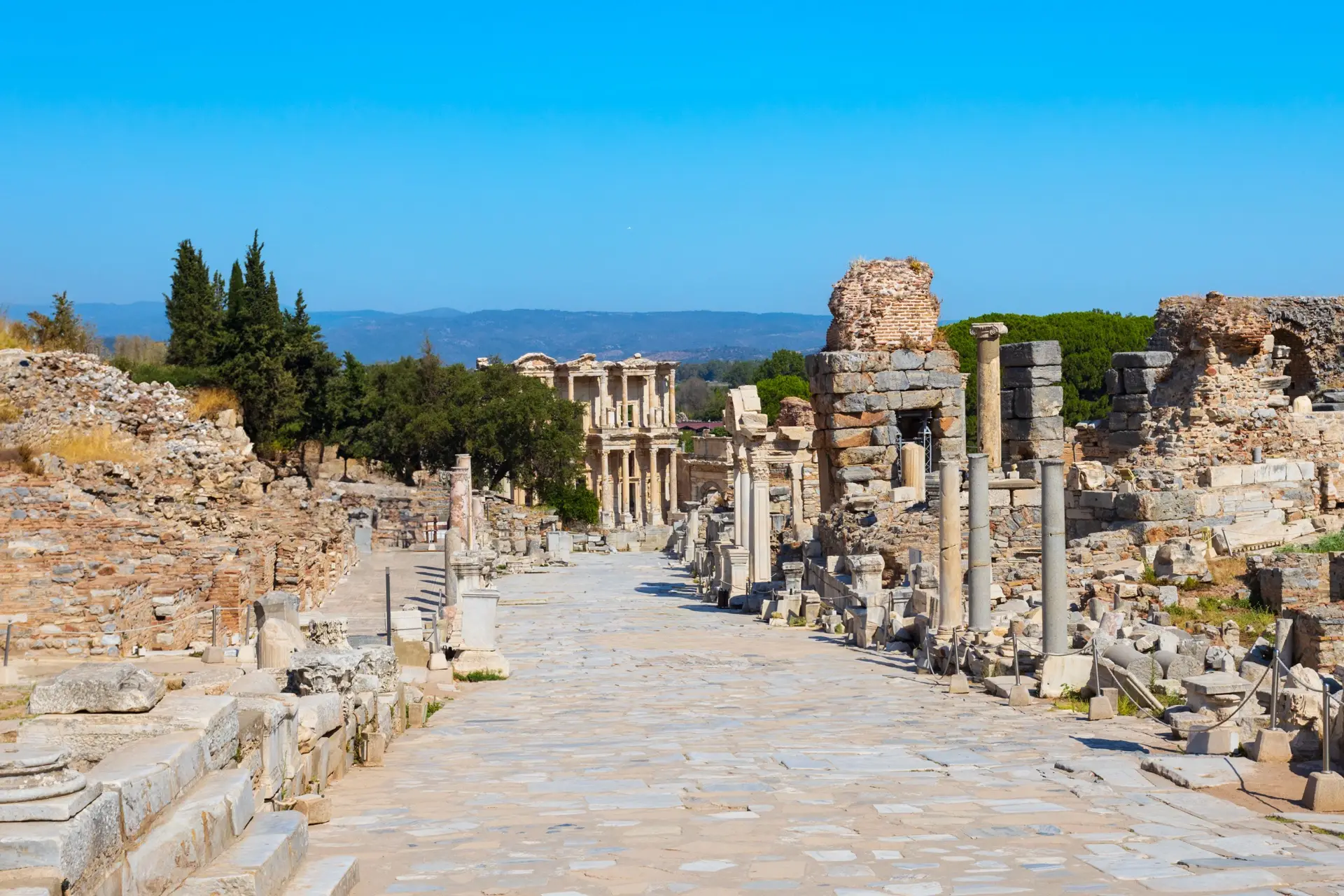
The walk through Ephesus runs downhill from the upper gate to the Library of Celsus and the great theatre. It takes about two hours. In July it is done early to escape the heat and the crowds. In January a family walks it at midday, in the warmest hour, on almost empty streets. Marble is slippery when wet, so shoes with grip matter more than an umbrella. If a front comes through, the roofed Terrace Houses and the Ephesus Museum in Selçuk take the wet hours. The ruins take the dry ones.
Curetes Street in Ephesus, looking down to the Library of Celsus. January mornings look like this until about 11:00.
The one-day version is our Ephesus day trip by air from Istanbul, at USD 630 per adult with flights. It fits inside a January day, because both flights are short and the site is 60 km from the airport.
Pamukkale: warm water, cold air, bare feet
Pamukkale is walked barefoot in every month, to protect the white travertine. In January that takes a little nerve, with air at 10.7 °C (51 °F). The water running over the upper terraces is warm, and it cools as it flows down. Most families walk the top third, where feet stay comfortable. The Antique Pool beside the terraces holds its thermal water at about 36 °C. The pool has its own ticket, which is not part of the tour price. The Pamukkale travel guide covers the terraces, the pool and Hierapolis above them.
The travertine terraces at Pamukkale. The water is warm at the top and cools as it runs down.
Linking the two in one overnight
Ephesus and Pamukkale are about three hours apart by road, and the road stays clear of snow in a normal January. The Private 2-Day Ephesus & Pamukkale Tour from Istanbul covers both from USD 1,140 per adult. The night is spent on the seafront in Kuşadası, a short drive from Ephesus. Families short of time can take the one-day Pamukkale trip by air at USD 715 instead.
Which Private Routes Hold Up in January: 5 to 14 Days, Per Adult in USD
Eight of the nine private multi-day routes at Turkey Family Tours hold up in January as written. The 11-day by-road route is the one that does not suit the month. Prices run from USD 1,645 per adult for five days in Istanbul to USD 5,395 for the 14-day circuit. Both prices are for two adults sharing. Each price covers hand-picked 4-5 star boutique hotels, a licensed local guide and a private vehicle with driver in every region. Domestic flights and listed entrance fees are included. The hot air balloon flight is optional and arranged separately.
Least suited: long plateau drives through snow country
For a family of four adults sharing, the same routes start lower per adult. The 7-day route is USD 2,420 and the 14-day route USD 4,640. The full list is in our private Turkey tour collection.
Seven days is the January sweet spot
The 7-day route gives two nights each in Istanbul and Cappadocia, one on the Aegean and a last night back in Istanbul. It asks a family for three short flights and no long drive. Every outdoor day has an indoor fallback close by. It also carries the two-morning launch window without any change. With eight days, a family adds Pamukkale between Cappadocia and Ephesus.
Why the by-road route waits for spring
The 11-day by-road route crosses the central plateau twice, from Ankara to Cappadocia and on to Pamukkale through Konya. Those cities average −3 °C to −4 °C at night in January, and the highway between them runs through open snow country. The roads are ploughed and usually passable. A full day of winter driving is still not what we advise with children. Families who prefer to avoid flights do better on this route from April onwards.
Snow Days, Fog and Domestic Flights: Where to Leave Slack in a January Plan
A January plan in Turkey needs slack in two places: before the flight home, and around the Cappadocia flights. Kayseri, where most Cappadocia flights land, averages −6.7 °C (20 °F) at night in January. Istanbul has 16 wet days with occasional fog and snow. A delayed flight can cost a family half a day, and the plan should survive that without a missed connection.
The last night belongs in Istanbul
The 7-day route, the 10-day route with Gallipoli and the 14-day route all end with a last night in Istanbul before the flight home. In winter that night earns its place. A domestic flight delayed by de-icing in Kayseri or İzmir then costs an evening, not an international departure. Families building their own plan should copy this. Never fly in from Cappadocia on the same day as a long-haul flight out in January.
Domestic flights: delays are common, cancellations are not
The Istanbul–Kayseri flight takes about 85 minutes, and several leave each day. On a snow morning the first departure may wait for de-icing or for the runway to be cleared. A full cancellation is unusual, and the next flight normally leaves the same day. The day’s programme is then shortened from the far end, so the main site is kept. Our guide to departure times on the route compares the flight options and transfer times.
Fog on the Bosphorus, wind on the Dardanelles
Two water crossings react to the weather more than the roads do. Bosphorus ferries pause in thick fog, usually for a morning. The Dardanelles can be rough in a southerly gale, although the 1915 Çanakkale Bridge now carries vehicles across in most weather. The Bosphorus cruise is simply never planned for the final day, so it always has a spare day behind it.
What a private tour can and cannot do about weather
A private tour cannot make a hot air balloon fly or a front pass faster. It can re-order the days, swap an open-air site for an indoor one, and start an hour later when the morning is icy. The guide re-plans a disrupted day around indoor sites at no extra cost. We also advise every family to carry travel insurance that covers delay and missed connections.
Booking a January Trip: What to Fix First and When
A January trip to Turkey can be booked 4 to 6 weeks ahead for dates after 3 January. It needs 4 to 5 months if it touches the New Year days. Outside them, hotels and flights have space, so lead time is about choice, not survival. Three things are still worth fixing first: the number of Cappadocia nights, the New Year’s Eve table if there is one, and the international flight times.
Travel dates
Book ahead
What goes first
Any trip touching 24 December – 3 January
4 to 5 months
Istanbul hotel rooms, then the New Year’s Eve dinner table
Arrivals from 4 January
4 to 6 weeks
Nothing is short; earlier booking only widens the hotel choice
Decide the Cappadocia nights before anything else
The number of Cappadocia nights sets the whole route, because it sets the domestic flights on both sides. With a 50–60% fly rate, one night is a gamble and two nights are a plan. Adding the second night later means moving a flight and a hotel, which is possible in January but untidy. It is easier for a family to write it in from the start.
New Year’s Eve: the one date with a deadline
A trip that includes 31 December should be confirmed 4 to 5 months ahead, which means by the end of August. The Istanbul hotel is the first thing to go, and a Bosphorus-view dinner the second. Arrivals from 4 January follow the relaxed 4-to-6-week timetable. A family that misses the deadline can still travel, by starting the trip a few days into January instead.
How the booking works: 24 hours, 25%, TURSAB 13538
Send the dates, the party size and the children’s ages through the plan-my-trip form. A written day-by-day plan with a fixed per-person price comes back within 24 hours. A 25% deposit confirms the booking; 75% is paid on arrival. Cancellations inside seven days of arrival are charged in full, and the booking FAQ sets out every condition. Turkey Family Tours holds TURSAB licence 13538, which anyone can check on the Association of Turkish Travel Agencies register. Our guide on how to plan a trip to Turkey walks through the steps before that form.
What to Wear in Turkey in January: Dressing for −3.6 °C at Dawn and 15 °C on the Coast
What to wear in Turkey in January is layers and one warm outer layer per person, for −3.6 °C (26 °F) to 15 °C (59 °F). The low end is a Cappadocia launch field before sunrise, and the high end is an Antalya afternoon. Many family routes meet both in the same week. Hotels, vehicles, museums and restaurants are all well heated. Families dress for the hours outdoors and peel off indoors.
The base list for every route
A waterproof, hooded winter coat. Istanbul wind makes umbrellas hard work, and a hood does the job better.
Waterproof shoes or boots with grip. Wet marble at Ephesus and icy paths in Cappadocia are the two main hazards.
Two warm mid-layers per person, such as a fleece and a wool jumper, to add or remove through the day.
Hat, gloves and scarf for everyone, and a spare pair of gloves for children.
Thick socks. Shoes come off at the Blue Mosque, and the floor is cold around the carpet edges.
A scarf to cover the hair for women and girls at the Blue Mosque and Hagia Sophia; any ordinary scarf will do.
Extra for a hot air balloon morning
The launch field is the coldest hour of the trip, at about −3.6 °C (26 °F) before sunrise. Thermal leggings under trousers, a second pair of socks and hand warmers for children make the difference. The basket itself is warmer than the field, because the burner is overhead. The cold is felt during the wait beforehand.
Extra for Pamukkale and the coast
Pack a swimsuit even in January. The Antique Pool at Pamukkale, thermal hotel pools and Turkish baths all use it. A small towel and a bag for wet feet help on the travertines. For Antalya, a light jacket and sunglasses are enough at midday, with the winter coat back on after dark at 6 °C (43 °F).
January or February: Picking the Winter Month
January or February in Turkey is a close call: Istanbul is 9.6 °C (49 °F) by day in January and 10.2 °C (50 °F) in February. January has slightly better hot air balloon odds, at 50–60% of mornings against 45–55%, and the New Year start. February is drier and brighter, with 148 mm of rain in Antalya against 226 mm. The Cappadocia nights are a degree milder in February. Both months give a family the same empty sites.
Measure
January
February
Istanbul day high
9.6 °C (49 °F)
10.2 °C (50 °F)
Istanbul wet days
16
14
Istanbul snowy days (Marmara shore – upper Bosphorus)
2.7 – 4.5
3.5 – 4.7
Cappadocia day high / night low
4.0 °C / −3.6 °C
5.5 °C / −2.6 °C
Hot air balloon fly rate
50–60%
45–55%
Antalya rain
226 mm
148 mm
Antalya sunshine per day
4.9 h
5.7 h
Istanbul daylight, mid-month
about 9½ hours
about 10½ hours
Choose January for the New Year start and a slightly better fly rate
January flies on 50–60% of mornings against 45–55% in February. The two ranges overlap, so the edge is small. January is also the only one of the two that can open with New Year’s Eve on the Bosphorus.
Choose February for the coast and the light
February takes a third less rain in Antalya and gains an hour of daylight everywhere. A family route that leans on the Mediterranean or the Aegean is a little more comfortable then. Istanbul is also slightly snowier in February than in January. Our page on February’s first week against its last shows where the extra hour of daylight falls.
And the months on either side
December is milder, at 11.8 °C (53 °F) in Istanbul, and ends where January begins; our December guide covers it. March is the first month that feels like spring on the coast, and the March guide shows how fast the numbers climb. A family with fixed school dates can take any of the four. A family with free dates and a hot air balloon wish should look at April first.
Turkey in January: Questions Asked Before Booking
It is worth going to Turkey in January for a family that wants museums, bazaars and winter scenery. It is not a beach month. Istanbul is 9.6 °C (49 °F) by day with 16 wet days, and its main sites are mostly indoors and almost empty. Cappadocia is 4 °C (39 °F) by day, often under snow, and hot air balloon flights go ahead on 50–60% of mornings. Ephesus is about 12.5 °C and quiet. The sea is around 18 °C, so nobody swims. The price of a private route is the same as in any other month. Our best time to visit Turkey guide compares January with the other eleven months, and shows where each one is strongest.
The hottest part of Turkey in January is the Mediterranean coast around Antalya. Antalya reaches 15.0 °C (59 °F) by day and falls to 6.1 °C (43 °F) at night. The city has 4.9 hours of sunshine a day, about twice the figure for Istanbul. Antalya is also the wettest place on any of our routes, with 226 mm of rain falling in short, heavy bursts. The Aegean coast near Ephesus comes second at 12.5 °C (55 °F), with 40% less rain. Neither coast is warm enough for the beach, because the sea is 17–19 °C. The Antalya guide lists what stays open through the winter, from the old town to Perge and Aspendos.
Turkey is not too cold in January for sightseeing, although one region is properly cold. Istanbul averages 9.6 °C (49 °F) by day and 4.2 °C at night, which is coat weather and nothing more. The Aegean and Mediterranean coasts sit at 12.5 °C to 15 °C. Cappadocia is the exception, at 4.0 °C (39 °F) by day and −3.6 °C (26 °F) at night. Even there the cold is dry, the vehicle is heated and the cave rooms are warm. A family with good boots, gloves and layers is comfortable for a full touring day. The Cappadocia guide shows which sites are under cover, for the coldest afternoons.
Turkey’s coldest month is January, in every city on our routes. Istanbul has a mean temperature of 6.8 °C in January against 6.9 °C in February and 9.0 °C in December. In Cappadocia the January mean is −0.1 °C, against 0.9 °C in February. Antalya bottoms out at 10.1 °C. The gap between January and February is small on the coast and about one degree on the plateau. The coldest place a family is likely to stand is a Cappadocia launch field at dawn, at around −3.6 °C (26 °F). Our guide to Turkey in December shows how the numbers look one month earlier, when Istanbul is still 11.8 °C.
Istanbul in January is 9.6 °C (49 °F) by day and 4.2 °C (40 °F) at night on the long-term average. It rains or snows lightly on about 16 days, and the sun shows for only two to three hours a day. Snow falls on three to five days of the month and rarely settles for more than a day. Wind off the Bosphorus makes the waterfront feel colder than the old city streets. None of this affects the main sites much, because Hagia Sophia, Topkapı Palace, the Basilica Cistern and the bazaars are indoors. Our guide to how many days to spend in Istanbul helps size the stay for a winter visit.
Hot air balloons fly in Cappadocia in January on about 50–60% of mornings. Wind, fog or snowfall ground the rest, and the civil aviation authority makes the decision at first light. With two Cappadocia nights a family has two launch windows, and the chance of at least one flight rises to about 80%. A third night lifts it to around 90%. If no flight goes up, the hot air balloon fee is refunded in full. January also has the latest sunrise of the year in Göreme, at 07:47 to 07:58, so the wake-up is kinder for children. The month-by-month hot air balloon fly rates are set out in our dedicated guide.
Museums and ancient sites in Turkey are open in January, on a winter timetable that closes earlier than in summer. Hagia Sophia, the Basilica Cistern, Ephesus, Pamukkale and the Göreme Open-Air Museum all run through the month. Weekly closing days still apply: Topkapı Palace shuts on Tuesdays and the Grand Bazaar on Sundays. On the public holiday of 1 January, hours vary from site to site. What does close is the summer coast, meaning beach clubs, waterparks and most daily boat trips. Winter hours are published site by site on the Turkish Museums pages. Our guide to Istanbul’s main sites notes which ones are indoors, which matters most on a wet day.
A private Turkey tour in January costs from USD 1,645 per adult for five days in Istanbul to USD 5,395 for 14 days. Each figure assumes two adults sharing a room. The 7-day route through Istanbul, Cappadocia and Ephesus is USD 2,815, or USD 2,420 per adult with four adults. Prices are the same in every month. Each price covers hand-picked 4-5 star boutique hotels, plus a licensed local guide and a private vehicle with driver in every region. Domestic flights and the listed entrance fees are part of the price. International flights, lunches, dinners and the optional hot air balloon flight are extra. The cost guide shows where each part of the per-adult price goes.
Seven days is the right length for a first January trip to Turkey. The 7-day Istanbul, Cappadocia and Ephesus route gives two nights in Cappadocia. That means two hot air balloon mornings at a 50–60% fly rate. It uses three short flights and ends with a last night in Istanbul. With five days, stay in Istanbul, where most of the programme is indoors. With ten days, add Antalya for the warmest afternoons, or Gallipoli and Troy for the history. The one route we steer away from in January is the 11-day circuit by road. It crosses the snowy central plateau twice by vehicle.
A January trip to Turkey should be booked 4 to 6 weeks ahead for arrivals after 3 January. A family trip that touches the New Year days needs 4 to 5 months, because Istanbul hotel rooms and dinner tables for 31 December go early. Outside those days the month has space, and earlier booking only widens the hotel choice. The first thing to fix is the number of Cappadocia nights, since it sets the domestic flights on both sides. A written day-by-day plan with a fixed per-person price comes back within 24 hours of an enquiry. A 25% deposit confirms the booking, and the remaining 75% is paid on arrival. Start with the trip planning form, which asks for dates, party size and the children’s ages.
If weather disrupts a January tour, the guide re-orders the family’s day around indoor sites at no extra cost. The Bosphorus cruise moves to a clearer day, and an open-air site swaps with a covered one. If the hot air balloon cannot fly, its fee is refunded in full. A delayed domestic flight shortens that day’s programme from the far end, so the main site is kept. Changes made by the family follow the booking conditions. Cancellations inside seven days of arrival are charged in full, and the 25% deposit is not refundable. We advise every family to carry travel insurance that covers delay and missed connections. The full booking conditions are on our FAQ page.
Put a January Plan in Writing with Turkey Family Tours
A January plan starts with three facts: the dates, the number of people and the children’s ages. Send them through the plan-my-trip form and a written day-by-day route with a fixed per-person price comes back within 24 hours. It shows which days are indoors, where the two hot air balloon mornings sit and where the slack is. Turkey Family Tours is a TURSAB-licensed agency, number 13538. Every route uses a licensed local guide and a private vehicle with driver in every region. A 25% deposit confirms the booking; 75% is paid on arrival. To compare routes first, see the private Turkey tour packages page, or write to us through the contact page.
A private Turkey tour runs from USD 220 per person for one guided day to USD 5,395 for a 14-day circuit, with multi-day routes at USD 382 to 402 per person per day. Domestic flights, a licensed local guide, hotels and every site admission are inside the figure.
How many days in Cappadocia? Two nights covers the Göreme valleys, an underground city and the sunrise hot air balloon; one day works from Istanbul but skips the balloon.
Pamukkale guide: white travertines, Cleopatra’s Antique Pool, Hierapolis ruins, best time to visit, family tips. Natural wonder on Turkey’s southwest coast.
A Turkish breakfast (kahvaltı) fills the table with 10–20 small plates: cheeses, olives, honey with kaymak, menemen and unlimited çay. Dish-by-dish guide with prices — serpme vs hotel buffet at USD 10–18 per person, plus Istanbul’s best breakfast quarters.
The Gallipoli battlefields in one guide: the three sectors, Anzac Cove, Lone Pine, Chunuk Bair, the Turkish memorials and Troy, with distances, drive times, ground conditions and the Anzac Day access rules.
Turkey in March: 18 °C and 6.7 hours of sun on the Antalya coast, 12 °C in Istanbul with the queues gone, frost at the Cappadocia sunrise and a 60–70% hot air balloon fly rate. Sea 16–19 °C, museums on winter hours, wide availability and private routes from USD 1,645.
The 12 best places to visit in Turkey across five regions — Istanbul to the Turquoise Coast, with the days each needs, how they connect, and which ones to save for a second trip.
The full 11-day overland route — Istanbul to Gallipoli with no domestic flights: leg-by-leg drive times, the Silk Road stops flights skip, and one fixed quote from USD 4,365.
✦ Tailor-Made
Let's Plan Your Private Turkey Trip
Tell us about your family — we reply within 24 hours.

 English
 Dutch
 Japanese
 Korean
 Chinese