Pamukkale Turkey: How to Visit the Travertines and Hierapolis
Quick Answer:Pamukkale Turkey is a hillside of white calcite terraces 18 km north of Denizli, with the Roman spa city of Hierapolis on the plateau above them. One €30 ticket covers both, and the Ministry of Culture and Tourism lists all three entrances as opening at 08:00 every day of the year, with the archaeological site closing at 18:45; the ancient city then reopens at 19:00 as a separately ticketed night visit. Cleopatra’s Antique Pool, the warm mineral bath at the top, is charged separately at the pool itself. The Pamukkale thermal pools are walked barefoot on hard ridged rock, not soft chalk, and only part of the hillside carries water on any given day. Most families need four to five hours for the terraces and the ancient city together; a same-day return from Istanbul cuts that to three or four. Turkey Family Tours, TURSAB-licensed (no 13538), runs Pamukkale as a private family day with a licensed local guide and every entry included, from USD 715 per person. Get a Private Quote →
Pamukkale sits on a hillside in southwest Turkey, and one ticket of €30 buys two sites there: the white calcite terraces, and the Roman city of Hierapolis on the plateau above them. Most families spend the whole visit on the terraces and walk past the other half. They also arrive at the wrong hour, at the wrong one of three gates, and expecting a hillside of water that nobody has seen since the conservation programme of the late 1980s. This guide covers what the ticket includes and what it does not, and which of the three entrances to use. It also sets out what the Pamukkale thermal pools actually look like at eight in the morning and again at one in the afternoon, and how Hierapolis repays the climb. Ticket prices, opening hours and the gate timetable come from the Ministry of Culture and Tourism’s own listing for the site. Everything about pacing, footing, shade and what holds a child’s attention comes from running Pamukkale as a working operator, week in and week out.
By Fatih — Founder & Tour Director, Turkey Family Tours · TURSAB licence 13538 · Last updated: July 2026
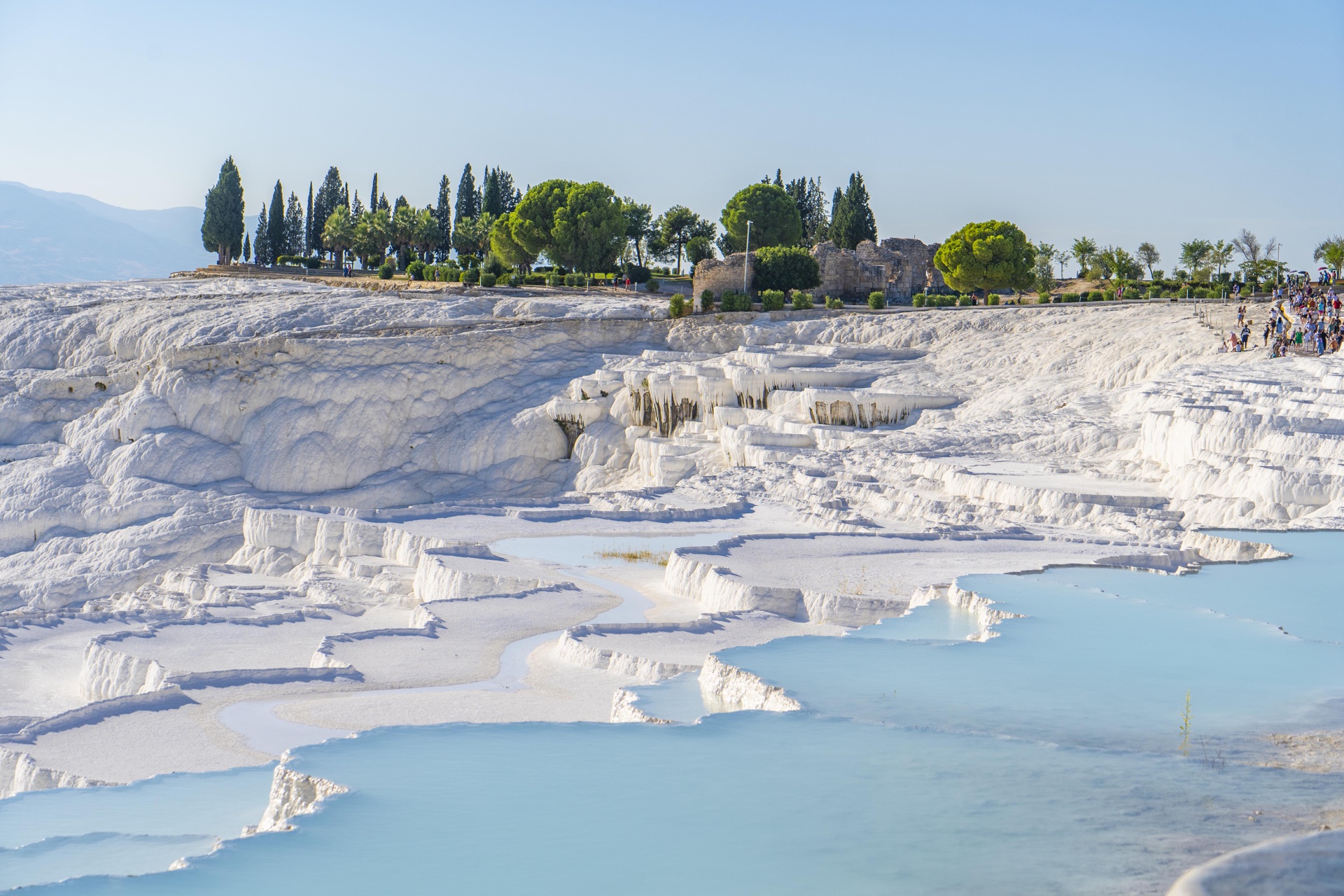
The terrace that appears on every postcard. On any given morning some thermal pools look like this and some are bone dry, and there is a reason for that.
How the White Terraces Formed, and Why the Rock Underfoot Is Not Soft
The white terraces of Pamukkale are a calcite shelf standing roughly 200 metres above the Denizli plain, and the rock underfoot is limestone, not chalk. Hot springs rise behind the hill carrying dissolved calcium bicarbonate. As the water reaches open air it loses carbon dioxide, the calcium sets as calcite, and over thousands of years that process terraced the slope into shallow basins.
UNESCO inscribed the site in 1988 as Hierapolis-Pamukkale, one of the few places on its list that qualifies on both cultural and natural grounds. Pamukkale means “cotton castle” in Turkish, and the name has misled families for a century. Nothing here is soft.
Families get more out of the day if they understand one thing before arriving: travertine is rock. Fresh deposits are chalky and slick. Older, dried surfaces are hard, ridged and faintly abrasive, closer to coral than to sand. Everyone walks it barefoot, which is a conservation rule and not an attraction, and children who imagine paddling across something like a bathmat get a surprise in the first thirty metres. Families who hear this in the car arrive ready for it. Families who do not spend the first ten minutes negotiating with a reluctant six-year-old. The barefoot section has its own guidance further down this page.
Why the white is whiter in some places than others
Calcite is brilliant white only while it is being washed. Left dry and exposed it greys, and algae colonise a warm wet basin within weeks if flow stays constant. That is why the hillside a family sees on a Tuesday in April is not identical to the one photographed the previous autumn. This is not decline. It is how the site is kept alive, and it is worth understanding properly before judging the place.
The spring water itself
The source water arrives warm, not hot. It is pleasant against the skin in spring and autumn, cool relative to the air in high summer, and warm enough to make the whole hillside steam on a January morning. It is mineral-heavy, mildly effervescent, and it stains fabric. Light swimwear survives it. A white cotton dress does not. The Romans built a spa city on top of these springs for exactly that reason, and the ancient city of Hierapolis is inseparable from the terraces below it: same ticket, same hill, same visit.
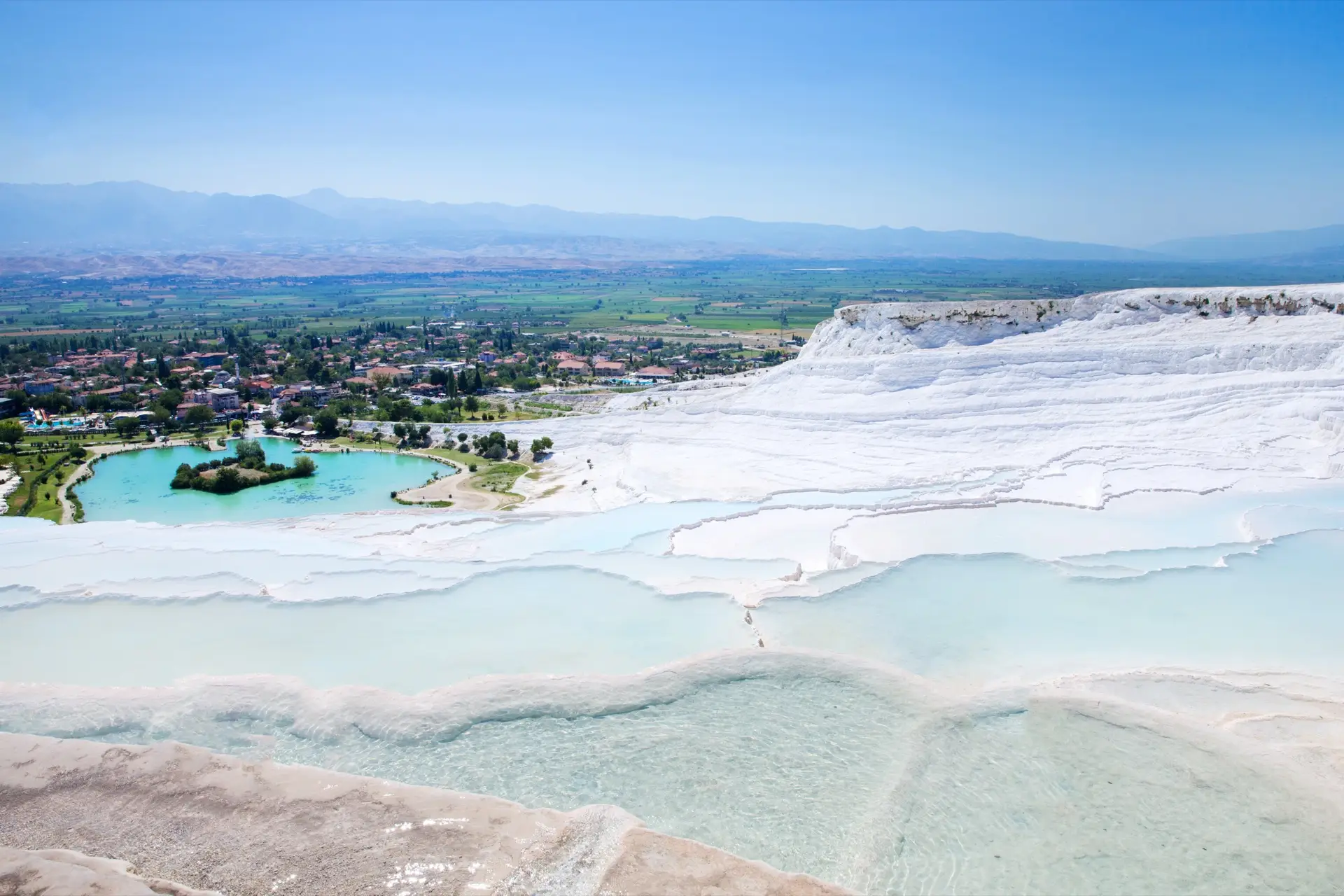
The full white shelf. The dark line crossing it is the marked barefoot walking route, the only part of the hillside families are permitted on.
The €30 Ticket: One Entry, Two Sites, and the Things It Does Not Include
A Pamukkale ticket costs €30 per adult for one product covering both the travertines and the ancient city above them. The Ministry of Culture and Tourism lists it as Hierapolis Archaeological Site and Pamukkale Travertines in its site record, sold through the state system and at the gate. There is no separate travertine ticket and no terrace-only option, so a family pays for both whether it climbs or not.
Online, the Ministry’s e-ticket portal is the only official channel; everything else resells it. The single-product rule surprises families who intended to see the white hillside and skip the ruins.
What you are buying
Price
Where it is sold
Included in our private tours
Hierapolis Archaeological Site + Pamukkale Travertines (one combined entry)
€30
State system and gate
Yes
Cleopatra’s Antique Pool
Charged separately, in lira
At the pool only
On request
Hierapolis Archaeology Museum
Inside the combined entry
—
Yes
Night visit at Hierapolis
200 TL
State system and gate
On request
Laodikeia Archaeological Site (12 km away)
€12
State system and gate
On request
Audio guide
Available on site
At the entrance
Not needed — you have a licensed guide
Parking at the South Gate
Charged locally
At the barrier
Yes, we drop at the gate
The museum is inside the ticket. This is the most under-used part of the €30. The Hierapolis Archaeology Museum sits within the archaeological site, in the vaulted halls of the Roman bath, and needs no second payment. Families walk past its door on the way to the theatre without realising, and it is the one air-conditioned room on the whole hill. It gets its own section below.
The pool is not inside the ticket, and it is not sold online. Cleopatra’s Antique Pool is operated separately and paid for at the pool entrance in Turkish lira. It does not appear in the Ministry’s online catalogue for the site at all. That explains something which confuses anyone researching Pamukkale: every guide quotes a different euro figure for the pool, from about six euros to over twelve, and none of them are wrong. They are all converting the same lira price on different days. Budget for it in lira, carry a card, and ignore any euro number you read elsewhere.
Müzekart is for Turkish citizens. The Ministry’s note on the site record reads that Müzekart is valid for citizens of the Republic of Turkey. Anyone travelling on a foreign passport is looking at the Museum Pass products instead, which are a different thing at a different price. A regional or countrywide pass only earns its keep for a family stringing several state sites together in the same week: Pamukkale, Ephesus, Laodikeia, Aphrodisias. For a single day here it does not pay for itself.
Children. Young children are admitted free at Turkish state sites and older children pay the full adult rate; there is no half-price child band, and no reduction for foreign student or senior cards. The cut-off age is posted at the ticket window and on the Ministry’s e-ticket portal, so confirm it on the day. Turkey Family Tours prices children differently: ages 0–3 at 30% of the adult rate, ages 4–6 at 60%, and from seven the adult rate, with every entry on the route already inside the quoted price. Our guide to what a Turkey tour costs sets out how those entry fees add up across a full family itinerary.
How you pay at the window. In our experience the state ticket offices here take cards and Turkish lira and turn away euro or dollar notes, even though the price is printed in euros. A family of four is committing €120 at that window, which is not the moment to discover a card problem, so carry two cards between the adults. On a Turkey Family Tours day nobody stands at that window at all, because the tickets are bought in advance. Ask for a costed Pamukkale day →
Gate Opening Hours — What the Ministry Lists, and Where the Guidebooks Disagree
Pamukkale opens at 08:00 at all three entrances, every day of the year, and the archaeological site closes at 18:45, with the ticket office shutting at 18:00. The South and North gates carry a separate listed closing time of 21:00 because the ancient city reopens at 19:00 as a night visit on its own ticket, so read 18:45 as the end of the day visit and 19:00 as the start of a different one. Those are the Ministry of Culture and Tourism’s own figures, published on its record for the site.
Entrance or facility
Open
Close
Last tickets
South Gate (Güney Kapı)
08:00
21:00
See site ticket office below
North Gate (Kuzey Kapı)
08:00
21:00
See site ticket office below
Village / pedestrian turnstile (Yaya Kapı)
08:00
18:00
—
Archaeological site overall
08:00
18:45
Ticket office closes 18:00
Hierapolis Archaeology Museum
08:00
20:30
Ticket office closes 20:00
Night visit
19:00
23:00
Ticket office closes 21:00
Closed days
None. Open every day of the year
Where the guidebooks disagree. A large number of travel articles state that the South Gate opens at 06:30 in summer, and families plan sunrise arrivals around that figure. The Ministry’s current listing gives 08:00 for all three entrances. We have written this page to the official record instead of the popular one. A family that drives out of Denizli at 05:45 to stand at a locked barrier has lost the first good hour, not gained it. If a sunrise arrival matters to a particular trip, confirm it with the site the week of travel. Opening times at Turkish state sites move with the season and occasionally with conservation work, and the Ministry page is the only source that is never stale.
What the 08:00 opening actually buys. Being at a gate at opening is still the highest-value decision at Pamukkale, though not for the reason most people assume. It is not about empty terraces, because independent travellers are there at opening too. It is about heat and light. Between 08:00 and about 10:30 the white surface is walkable without burning, and the low sun puts texture into the terrace rims instead of flattening them. The coach groups arriving from İzmir and Antalya have not landed yet. From 11:00 the hill turns into a mirror. For a family the gain is comfort, not solitude: cooler rock, kinder light, and children who last until lunch.
The late-afternoon alternative is real. Because the ticket office shuts at 18:00 while the site itself stays open to 18:45, and because the coaches start leaving in the middle of the afternoon, a family already inside has the terraces close to itself for the last hours of the day. This is the most under-exploited fact about Pamukkale and the basis of the second of our two suggested routes.
South Gate, North Gate or the Village Turnstile: Choosing Before You Arrive
Pamukkale has three entrances — the South Gate, the North Gate and the village turnstile — spread along a plateau nearly two kilometres long, and they produce three different days. The choice cannot be undone once inside, because the ticket is a single admission. Ephesus forgives a wrong gate more easily, because there the two entrances sit at either end of one street.
Gate
Where it puts you
Walk to the terraces
Parking
Best for
South Gate Güney Kapı
Top of the hill, above the terraces, near the Antique Pool and the museum
10–15 min, gently downhill
Largest car park, coaches
Families, first visits, anyone with a pushchair-age child or a grandparent
North Gate Kuzey Kapı
Far end of the ancient city, at the necropolis and the Roman gate
About 2 km through the ruins
Car park, coaches
Families who want Hierapolis first and the terraces as the reward
Village turnstile Yaya Kapı
Bottom of the hill, in Pamukkale village
Straight onto the barefoot climb
None, pedestrian only
Families staying in the village, and only in cool weather
Why we start families at the South Gate
The South Gate puts everything a family came for within a short downhill radius: the top of the terraces, Cleopatra’s Antique Pool, the museum and the theatre path. It has the largest car park and the shortest distance from a vehicle to a view, which matters enormously with a four-year-old at midday in July. It is also the only one of the three that a family member with limited mobility can use with any confidence. Nine times out of ten this is where Turkey Family Tours drops a family, and it is the default on every private Pamukkale tour we run. The same logic governs gate choice across our wider private Turkey tours.
When the North Gate is the better call
The North Gate rewards a specific kind of family: one that wants the archaeology first and is content to walk for it. Entering here, the route runs from the vast northern necropolis through the Roman gate and down the colonnaded main street. The terraces come after forty-five minutes to an hour of ruins. For a teenager with an interest in Roman cities it is the better introduction by a distance. For a family with small children in August it is a mistake, because the walk is exposed and there is no way to shorten it once started.
Families entering by the North Gate reach the theatre before the terraces. A superb approach for older children, a long walk for small ones.
The village turnstile, and its one hard limit
The pedestrian entrance in the village is the classic approach: barefoot up the terraces from the village, the way families have arrived for a century. It is genuinely the most memorable way in, and it is the one we suggest to families staying the night in Pamukkale. Its limit is the clock. Unlike the two vehicle gates it closes at 18:00, so a family that walks up in the late afternoon must come down another way or leave in good time. With tired children that is a decision worth making at the foot of the terraces rather than the top.
The mistake that costs an hour
Leaving through a different gate from the one you parked at is the classic error. In our experience it is expensive in a way families do not anticipate. The ticket is a single admission, so going back in for a forgotten bag or a second look at the pool means paying again. On a family of four that is a €120 mistake. Decide the exit before starting the walk down, and check the whole family has what it needs first.
Walking the Travertines Barefoot: The Surface, the Slip, the Sore Soles
The Pamukkale travertines are walked barefoot only. Shoes come off at the edge of the calcite and stay off for the whole crossing, roughly twenty minutes at a family pace, and wardens enforce it with no exception for children and no allowance for water shoes. The surface is ridged limestone rather than soft chalk, and more visits are spoiled by it than by anything else here.
What the surface is actually like
The marked route across the hillside is a mixture of three surfaces. Where water is currently flowing the calcite is smooth, slick and slightly soapy underfoot, and this is where families slip, almost always going downhill and almost always while looking at a phone. Where water flowed recently and has drained, the rock is firm and pleasantly warm. Where it has been dry for a long stretch, the surface hardens into low ridges with a fine abrasive texture that most adults describe as walking on coral. Nobody is injured by it, but after twenty minutes the soles of the feet complain, and small children complain sooner.
What we tell families to do
Carry a small dry bag or tote per adult. Shoes, socks and a towel have to go somewhere for the entire crossing, and there is no locker at the top of the walk.
Walk in the water, not beside it. The wet channels look like the slippery option and are in fact the kindest surface on the feet. The dry ridges beside them are what hurt.
Small steps, flat feet, no phone in hand. Every fall our guides have seen has been someone striding downhill while filming.
Bring a small towel. The mineral water dries on the skin with a faint chalky film and children dislike it more than adults do.
Leave the white clothes at the hotel. The water stains, and the staining is not always reversible.
The question families ask most
Can you wear water shoes? In our experience, no. The rule is bare feet, and water shoes are turned back at the edge along with sandals. The one accommodation the site makes is that families may carry their footwear instead of leaving it, which is why the dry bag matters. Families with a child who genuinely cannot manage the surface should plan the day around the South Gate, where the terraces can be seen and photographed from a paved viewpoint without crossing them at all.
The barefoot crossing, with Pamukkale village and the Denizli plain below. The dark wet channel down the middle is the comfortable line to walk.
Why Half the Pamukkale Thermal Pools Look Dry — the Water Rotation Explained
Only part of the Pamukkale hillside carries water on any given day, and that is deliberate. The conservation programme that followed the site’s 1988 UNESCO listing removed the hotels and the road across them, and the spring flow has been directed onto one section at a time since, so the calcite dries, hardens and stays white. Families expecting the whole shelf to be full read the dry sections as decline.
What happened, and why
By the 1980s the hillside was in serious trouble. Hotels had been built directly on the plateau and were drawing thermal water off for their own pools, a road ran across the terraces, and unrestricted walking had ground the calcite grey. The response, which followed the site’s UNESCO inscription in 1988, was drastic. The hotels came down and the road was removed. The spring water was taken into a controlled channel system instead of being left to run where it liked.
How the rotation works
Since then the flow has been directed onto the hillside section by section, never everywhere at once. Any family that visits Pamukkale twice a few years apart sees the result. The terrace that was brimming last time is resting, and one that was bone dry is full. There are two reasons for managing it this way. Constant warm water in a fixed basin grows algae within weeks and turns the white to green-brown. And the calcite itself only stays brilliant while it is periodically washed, then allowed to dry and re-harden. Rotating the flow keeps the whole shelf white and structurally sound instead of preserving a handful of pretty pools while the rest degrades.
For a family the practical consequences are simple:
Some sections will be dry on the day you visit. This is normal and deliberate. It is not drought and it is not neglect.
Flow is generally most visible earlier in the day. Volume is managed, and the marked walking route is prioritised.
The famous scalloped pools are not all accessible. Much of the most photographed terracing sits outside the permitted route and can only be looked at.
The upper basins near the top of the walk are the most reliable for water underfoot, which is another argument for the South Gate.
Set expectations for children before arriving, not at the edge. A seven-year-old told in advance that “some pools have water and some are resting so they stay white” accepts it completely. The same child, promised a hillside of turquoise swimming pools, does not. That one conversation, held in the car rather than at the edge, is the cheapest improvement a family can make to the day, and it is the first thing our guides raise on the drive in.
What You Actually See at 08:00, at Noon and in the Last Hour of Light
Between 08:00 and 10:00 the water reads blue; between 12:00 and 15:00 the same terrace photographs as a featureless white glare. The Pamukkale thermal pools change more by the hour than almost any site in Turkey, because it is a reflective surface under a strong southern light. Turkey Family Tours builds its Pamukkale days around that swing: the terraces early or late, the museum in the middle.
Time
Light and colour
Heat underfoot
Crowds
What it suits
08:00–10:00
Low sun, strong texture in the rims, water reads blue
Comfortable
Independent travellers only
Photographs and the barefoot walk
10:00–12:00
Rising glare, colour flattening
Warm, still fine
First coaches arrive
Hierapolis and the theatre
12:00–15:00
Overhead sun, white on white, hardest hours for photographs
Uncomfortable in summer
Peak
The museum, the pool, lunch, shade
15:00–17:00
Light softening again, colour returning
Warm
Coaches leaving
Second crossing of the terraces
17:00–closing
Light going gold, long shadows across the shelf
Pleasant
Very few people
The photographs everyone else missed
The pattern that falls out of this is the one most day-trippers get exactly backwards. Coach itineraries put families on the terraces between eleven and three, because that is what a return journey from the coast allows. Those are the worst three hours of the day for both comfort and photographs. A family in control of its own schedule should be walking the white at either end of the day and inside a building in the middle. That is precisely how a private Pamukkale day is structured, and it is the main practical reason for a family to have one. The same hour-by-hour logic shapes where Pamukkale falls on our 8-day Turkey itinerary and our 10-day route.
Cleopatra’s Antique Pool: Why the Price Changes and What You Get for It
Cleopatra’s Antique Pool is the one part of Pamukkale that the €30 ticket does not cover. It sits at the top of the hill near the South Gate, a warm mineral bath scattered with the fallen marble columns of a Roman portico that collapsed into it in an earthquake, and swimmers get in among them. It is the most photographed thing here after the terraces themselves.
Why every source quotes a different price
Because it is not sold through the Ministry’s online system at all. The pool does not appear in the state catalogue for the site; it is paid for at the pool itself, in Turkish lira. Every guide quoting a euro figure is converting that lira price on whatever day they wrote. That is why published figures range from about six euros to over twelve, and why none of them are wrong. Carry a card, budget in lira, and treat any euro number found online as an approximation, not a price.
What the fee actually includes
Entry to the pool enclosure for a fixed session, not the whole day
Changing rooms, showers and lockers, with the lockers usually carrying a small separate charge or deposit
Access to the surrounding terrace, café and shade, which is the best sheltered space on the plateau
Is it worth it for a family?
It depends entirely on the ages at the table. The water is warm year-round and the depth runs from shallow at the entry steps to well over an adult’s head above the column beds. Strong swimmers and teenagers love it. Small children find it warm, deep and crowded, and forty minutes is usually the ceiling. Buoyancy aids are permitted and worth bringing for anyone under about ten. The fair summary is that the pool is a highlight for families with children over ten and a mixed proposition below that. The fee is charged per person regardless, so a family of four pays four times for something two of them may leave after half an hour.
The closure to check
The pool closes periodically for maintenance and restoration, sometimes at short notice. The Ministry’s site record carries a current status line stating whether the Antique Pool is open, and that is the only reliable way to check before travelling. Families building a whole day around a swim should look at that line the week before, and pack the swimwear anyway.
Hierapolis Above the Terraces: Theatre, Necropolis, Plutonium and the Martyrium
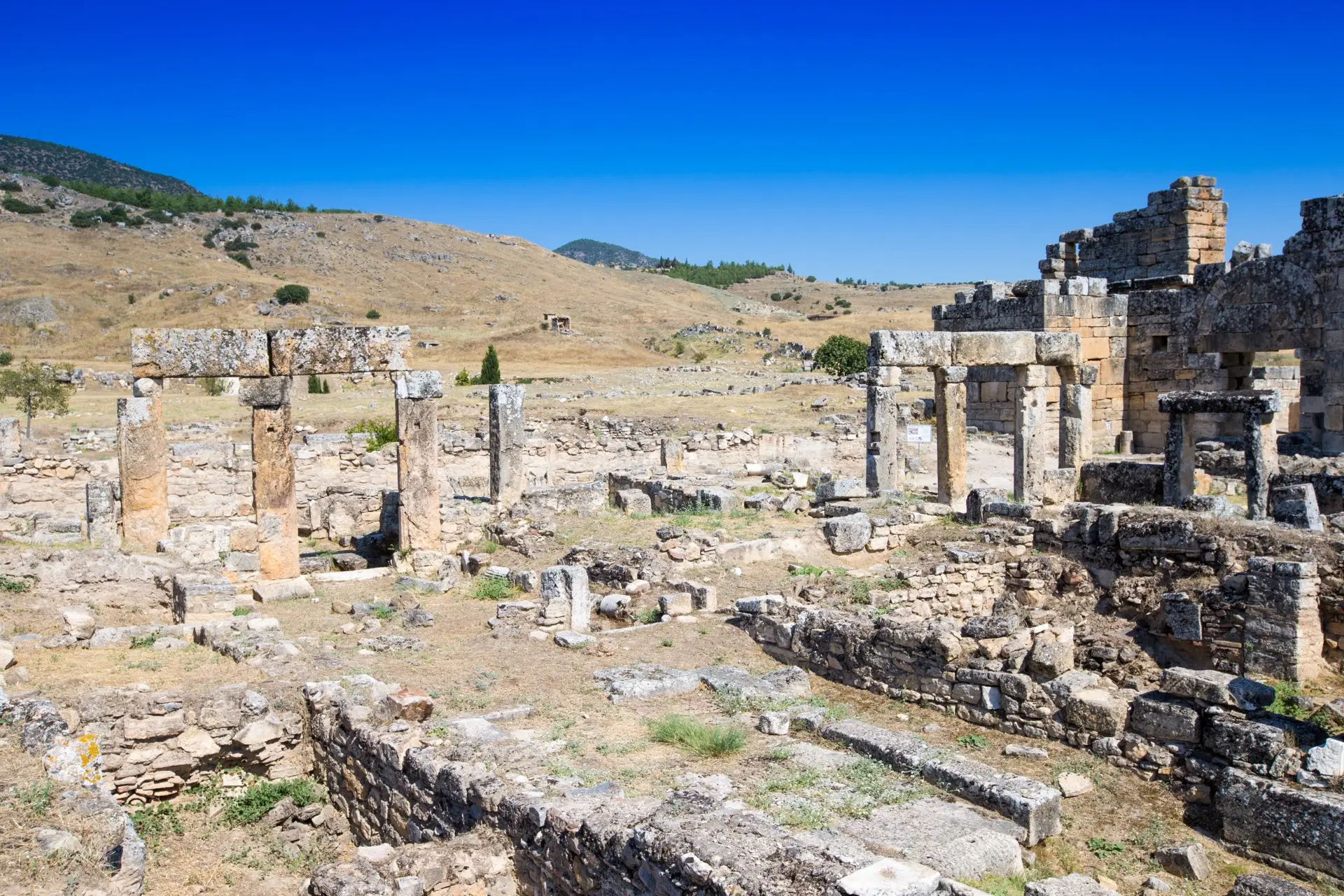
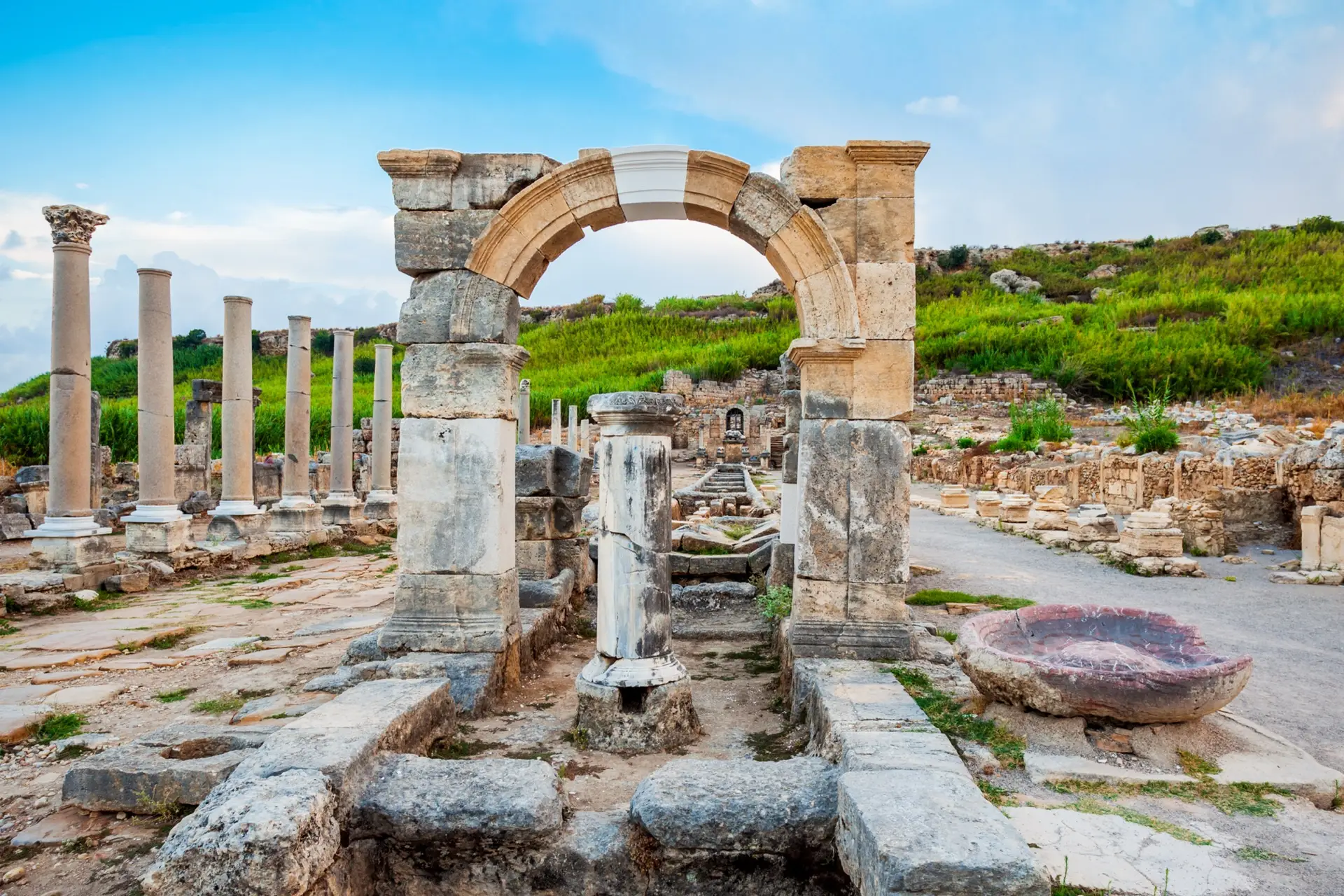
Hierapolis is the Roman spa city on the plateau above the Pamukkale terraces, founded by Eumenes II, King of Pergamon, in the 2nd century BC and covered by the same €30 ticket. What stands today was laid out on a grid after the earthquake of AD 60, which is why the street plan reads clearly. It is the half of Pamukkale that families skip and then regret skipping.
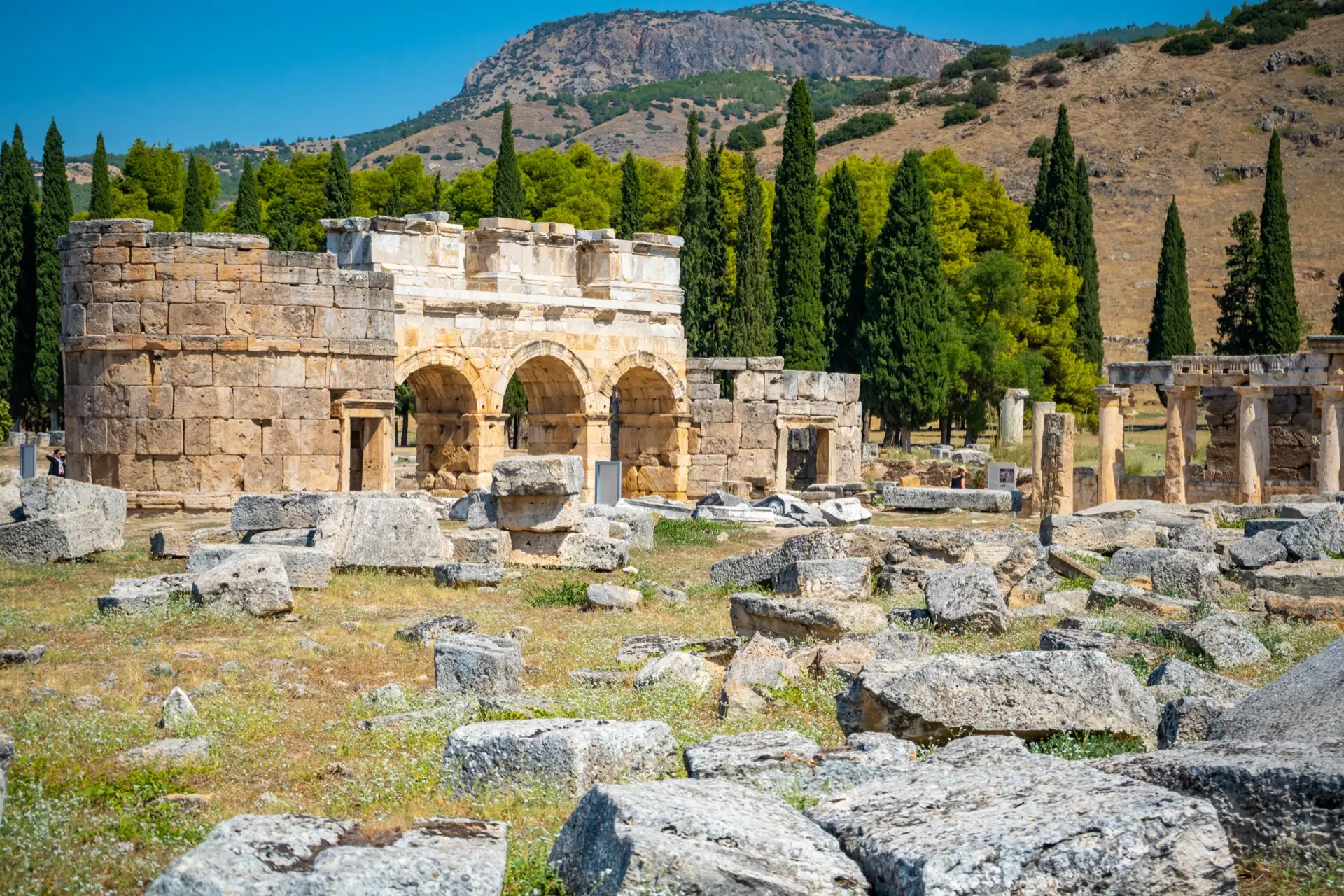
It is a full Roman city, not a scattering of stones. The name comes from Hiera, wife of Telephos, the legendary founder of Pergamon. The monumental Frontinus Gate stands at the head of the colonnaded main street, which runs about a kilometre and divides the city in two. The provincial culture portal for Denizli carries the fuller archaeological record for anyone who wants it.
The Frontinus Gate at the head of the colonnaded street. The main avenue runs about a kilometre and divides the city in two.
A working minute budget for the plateau
Three hours on the plateau covers the city properly with children, and that sits inside the four to five hours the whole site needs. This is how our licensed guides divide it, and the order matters as much as the minutes.
Order
What it is
Minutes
Shade
Works with children?
1
The Theatre
30
None — seating faces the sun
Yes, the best thing on the hill
2
Archaeology Museum (indoors)
45
Full, air-conditioned
Yes, and it is the midday answer
3
Frontinus Gate + colonnaded street
25
None
Yes, walked through, not studied
4
The Plutonium
10
Partial
Yes — the story of the site for a nine-year-old
5
Necropolis (North Gate end)
30
None
Better than it sounds
6
Martyrium of Saint Philip
40 including the climb
None
Older children only
The Theatre
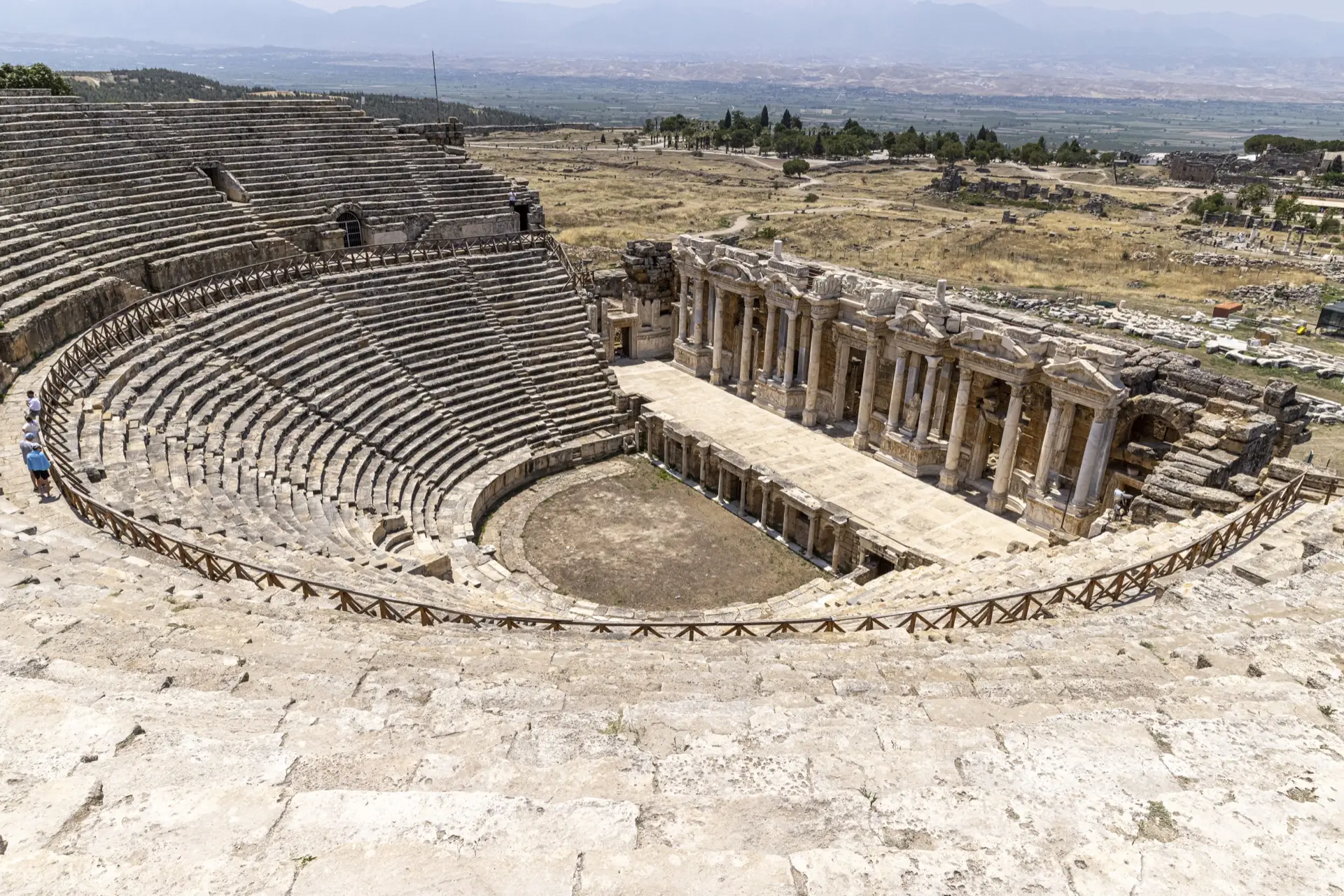
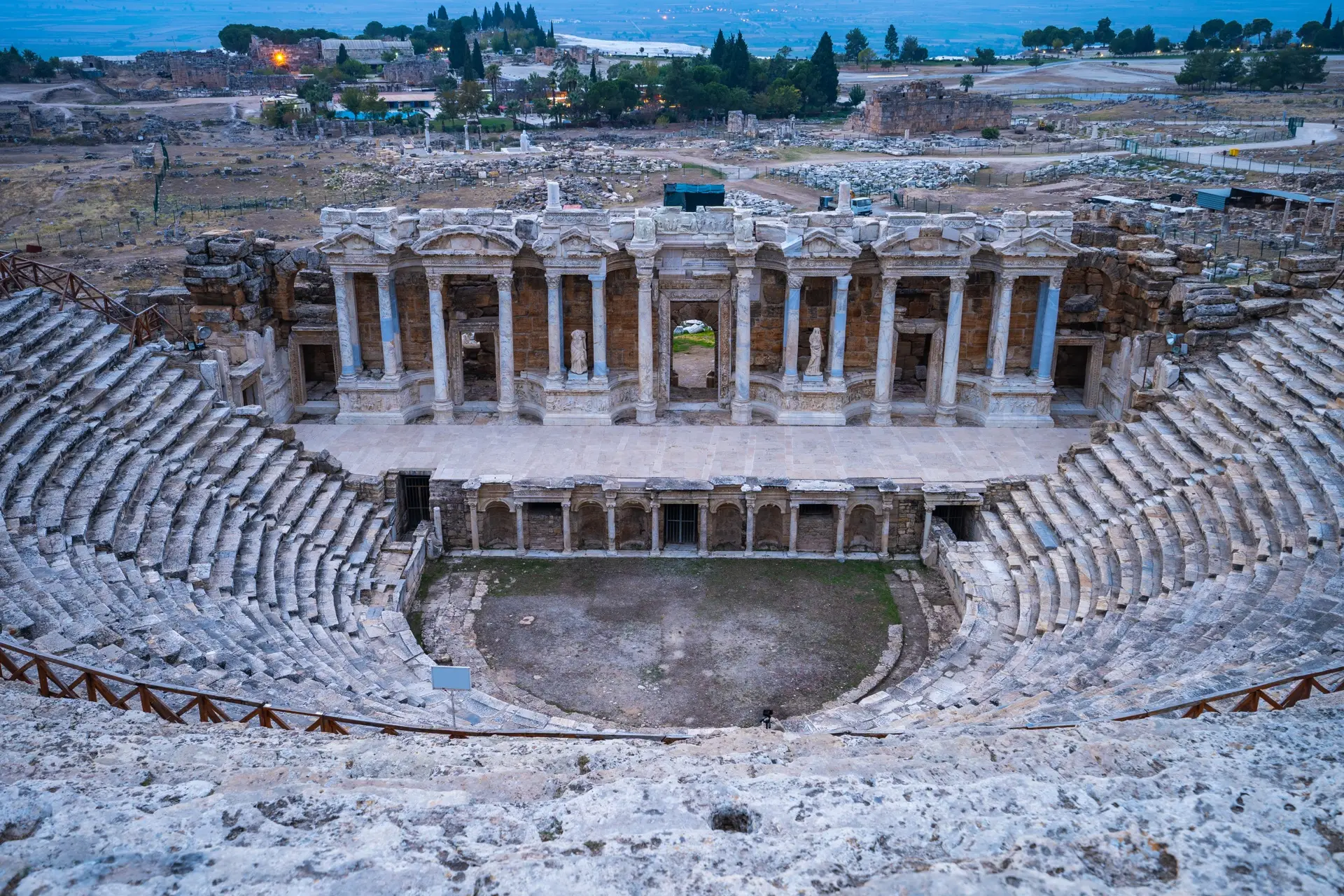
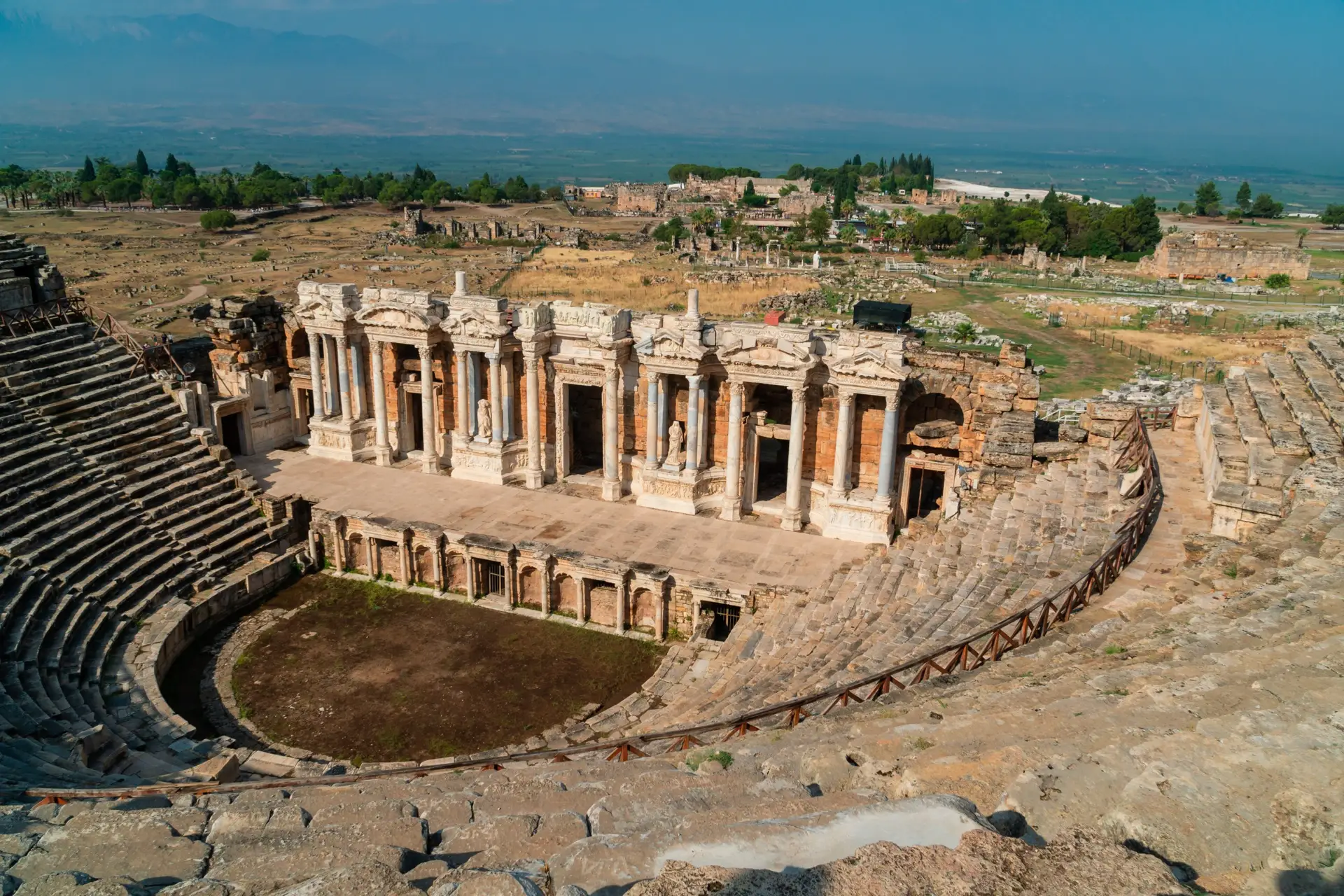
Thirty minutes, and it is the structure that stops children mid-sentence. Cut into the slope above the city, it is the best-preserved building on the hill, and it retains an unusually complete stage building. Its reliefs carry Dionysos, the legend of Niobe, the birth of Apollo and Artemis, and the coronation of the emperor Septimius Severus. Climb to the top row. The view over the plateau and out across the plain is the picture worth having from Hierapolis.
The Necropolis
The burial grounds outside the walls form the largest necropolis in southwest Anatolia, running north, south and east of the city. Tumuli, house-tombs and sarcophagi stand in open ground with the road between them, and this is the section a family entering by the North Gate walks through first. It works better with children than it sounds, because the tombs are house-shaped, individually strange, and can be walked among freely. Families with older children often stay here longer than they planned.
The Plutonium
Ten minutes, and it is the story a child repeats afterwards. A sanctuary of Pluto was built over a natural fissure venting carbon dioxide, dense enough that animals led to the opening died while the priests standing beside it did not. Ancient writers described the miracle at length; the geology explains it. The vent is fenced off and can only be looked into, which is exactly right.
The Martyrium of Saint Philip
The Apostle Philip was killed at Hierapolis in AD 80, and the city became a centre of Christianity from the fourth century onwards. An octagonal martyrium was raised on the hill above the city in his memory, and beside it stand the remains of the church built later. It is the longest walk on the site, up and away from the main street, and it is quiet in a way nothing else here is.
What else is on the plateau
The Ministry’s own list of significant structures also covers the Basilical Bath, the latrine, the Temple of Apollo, the Nymphaeum, the water channels and the ancient pool. A first visit does not need all of them. An audio guide service is available at the entrance for families visiting independently, and it is listed on the Ministry’s site record alongside the opening hours. On a Turkey Family Tours day it is redundant, because a licensed local guide walks the plateau with the family and pitches the same material at whichever child is asking.
The theatre at Hierapolis, with the stage building still standing. The carved reliefs from it are displayed in the museum a few minutes’ walk away.
The Archaeology Museum Inside a Roman Bath
The Hierapolis Archaeology Museum opens 08:00 to 20:30 every day and is already inside the €30 entry, housed in the vaulted halls of the city’s Roman bath, gymnasium and library across roughly 14,000 square metres. The ticket desk closes at 20:00. It is the only substantial indoor space on the hill, which makes it the obvious place to be between noon and three in summer.
What is inside
Tombs and Statues Gallery — sarcophagi and sculpture from the excavations at Hierapolis and Laodikeia.
Small Artifacts Gallery — terracotta, glass, jewellery and coins arranged chronologically from the 6th century BC through the Hellenistic, Roman, Byzantine, Seljuk and Ottoman periods.
Theatre Hall — the carved stage reliefs lifted from the theatre up the hill, displayed at eye level. Seeing the theatre first and these second is the right order, and it is the sequence our guides use.
The theatre from the orchestra floor. Its carved stage reliefs are displayed indoors in the museum, which is where families should be in the middle of a July day.
Forty-five minutes covers it comfortably. With children it works best as a deliberate cool-down between the terraces and the ruins, not as an addition at the end of a long day, when nobody has the patience left for it. Families running the site in summer should treat the museum as the middle of the plan, not the end of it.
Toilets, Lockers, Food and Step-Free Access on the Hill
There are no toilets and no drinking water on the twenty-minute travertine walk itself, and the only lockers on the hill are at Cleopatra’s Antique Pool. Everything else — toilets, drinks, shade, changing rooms — sits at the South Gate end of the plateau, and almost nothing in the middle of the site. That decides where a family with small children should base itself.
What you need
Where it is
Notes
Toilets
At the gates and near the Antique Pool
None on the travertine walk itself. Go before starting down
Lockers and changing rooms
At the Antique Pool only
Small charge or deposit; nothing at the top of the barefoot route
Café and cold drinks
Pool terrace and South Gate
The pool terrace is the best shade on the hill
Proper lunch
Pamukkale village, at the bottom
Family-run kitchens on the main street, at village prices rather than plateau-café prices
Shade
Museum and pool terrace
The terraces, theatre and street have none
Step-free route
South Gate viewpoint
Terraces can be seen without crossing them; wheelchair access on the plateau is partial and uneven
Drinking water
Bring it in
Two litres per adult in summer, and refill at the gate
What limited mobility rules in, and what it rules out
A family travelling with a grandparent or anyone who cannot walk far can still have a good day here, provided they enter by the South Gate. The viewpoint above the terraces gives the classic view without a step onto the calcite, the museum is close and indoors, and the pool terrace is a short flat walk. The barefoot crossing and the walk to the theatre are not possible with limited mobility, and no amount of planning changes that. When a family tells Turkey Family Tours in advance, we structure the plateau around the flat section and drive, not walk, between the ends of the site.
Pamukkale After Dark: The Night Visit at 200 TL
Hierapolis runs as a night museum from 19:00 to 23:00, every day, with the ticket office closing at 21:00. It is a separate ticket at 200 TL, listed by the Ministry alongside the main entry in its night museum programme. It appears in almost none of the widely read English-language guides to Pamukkale, and most families arrive without knowing it exists.
What it offers is the ancient city lit after dark, at a temperature that makes walking it a pleasure in July and August, with a fraction of the daytime numbers. For families spending a night in Pamukkale village instead of passing through, it turns a half-day site into two genuinely different visits. The terraces come in the morning light, and the Roman city under floodlights the same evening. It is also the answer for anyone arriving too late in the afternoon to do the site justice in daylight.
Two things to know. It is the archaeological site that opens at night, not the travertine walk, so treat it as a Hierapolis experience and not a second chance at the terraces. And the night ticket is priced in lira rather than euros, so it is bought at the gate or through the state system in the usual way. Turkey Family Tours builds it into itineraries on request, and it is one of the reasons we argue for a night in the village where the schedule allows.
Season by Season: Glare, the Winter Steam and the Best Months to Come
Pamukkale is open every day of the year, but the month changes the visit more than the hour does. April, May, September and October are the comfortable months, walkable barefoot at any hour. July and August are hard between eleven and three, when white rock throws the heat back up. June averages 31.5 °C at Denizli, so a June visit to the terraces after 18:00 gets cooler stone and fewer coaches. November to March is quiet, and the whole hillside steams on a cold morning.
Season
What the hillside is like
The water
The catch
April–May
Green plain below, clear light, comfortable barefoot walking all day
Warm and welcome
Nothing significant — the best window of the year
June
Strong light, still manageable early and late
Refreshing
Midday glare begins in earnest
July–August
Fierce reflected heat off white rock; the surface itself gets hot
Cool against the air
Midday is genuinely difficult with children; plan around it
September–October
Light softening, plain golden, crowds thinning after mid-September
Perfect
Very little — the second-best window
November–March
Quiet, often overcast; the whole hillside steams on cold mornings
Warm against cold air — the most dramatic version
Short daylight, cold feet between pools, rain makes the calcite slick
The glare problem, and why it is specific to here
A white calcite hillside under a Turkish summer sun reflects light upwards as well as down. Sunburn at Pamukkale arrives on the underside of the chin, the backs of the knees and the tops of the feet, which are places nobody creams. Sunglasses stop being an accessory and become necessary equipment, and children need a hat with a brim, not a cap. This is the practical reason our summer itineraries put families on the terraces before ten and after five, and inside the museum in between. A family that gives up the middle of the day loses nothing and gains three comfortable hours.
Winter, and why it is underrated
On a cold, still morning in January the entire shelf steams. Warm mineral water meeting freezing air produces a low mist that drifts across the terraces and through the ruins above, with very few other families in it. Feet are cold walking between pools and warm standing in them. For families travelling in the off-season and building a route that also takes in Istanbul and Cappadocia, Pamukkale in winter is one of the strongest arguments for the trip. Our page on the best time to visit Turkey sets the same question out across the whole country, and the month-by-month detail sits in May, July, August, October and December. For the week itself, the state meteorological service publishes city forecasts in English.
Two Ways to Spend the Day: the Early Route and the Late Route
Pamukkale opens at 08:00 and the archaeological site closes at 18:45, which leaves a family two workable shapes for the day: an early route that finishes at lunchtime, and a late route that runs to closing. Both start at the South Gate, where Turkey Family Tours drops families, and the choice turns on whether the family is staying nearby or arriving from a distance.
The Early Route — for families arriving from Denizli, Selçuk or a nearby hotel
Time
Where
Why then
08:00
Through the South Gate as it opens
Best light, coolest rock, no coaches
08:15–09:45
Barefoot down the terraces and back up
The photographs everyone comes for
10:00–11:30
Hierapolis: theatre, main street, Plutonium
Still walkable before the heat
11:30–12:30
Cleopatra’s Antique Pool
Warm enough to enjoy, before peak crowding
12:30–13:30
Lunch and shade on the plateau
The worst hour of the day, spent sitting
13:30–14:30
The museum
Indoors, cool, and it explains the theatre just seen
14:30
Leave, or a second look at the terraces on the way out
Beats the exit queue
The Late Route — for families staying the night in Pamukkale
Very few families run this one, and it is the better of the two. It works because the coaches pull out in the middle of the afternoon while the site stays open until 18:45, so the last stretch of the day belongs to whoever is already inside.
The catch with the Late Route is the ticket office closing at 18:00, so tickets have to be in hand well before the light turns. Buy on the way in at 14:30, and if the night visit appeals, buy that at the same window rather than coming back for it.
One Long Day or a Night in the Village: What Sleeping There Buys You
A same-day return from Istanbul to Pamukkale runs to about eighteen hours door to door on the early flight, and longer by road. That single number decides more about the visit than anything else, and it is the one families rarely price before booking. One night in the village is what buys the terraces at either end of the day.
What a day trip actually costs in time
Pamukkale sits about 18 km north of Denizli, a long way south of Istanbul by road. A same-day return from Istanbul means an early flight to Denizli or İzmir, the drive out, three or four hours on site, and the whole journey again in reverse. The hours on site fall in the worst light and the highest heat. It can be done and Turkey Family Tours runs it: our Pamukkale day trip from Istanbul exists precisely for families whose schedule allows nothing else. It is the compromise version, and families should know that going in. At USD 715 per adult it is also the priciest single day we run out of Istanbul, a gap our guide to the three flight-out day trips puts down to the airport sitting further from its site than the other two.
Three areas, and they suit different families. Pamukkale village, at the foot of the terraces, is a small place of family-run guest houses within walking distance of the pedestrian turnstile. It is where we put families who want the early and late routes on consecutive days. Karahayıt, a few kilometres north, is the thermal-hotel belt: larger properties with their own mineral pools and full board, which suits families with younger children who want a base instead of a village. Denizli itself, 18 km away, is a working city with business hotels, and it makes sense only when a flight time forces it. On a Turkey Family Tours itinerary the choice is made by what comes next on the route, not by the hotel itself.
Our own view, after running both patterns for years: if a family is already in the Aegean, one night at Pamukkale is the best night in the region for the money. If the family is Istanbul-based with four days total, the day trip is the sensible answer and there is no shame in it. What does not work is a day trip in July with children under school age, and that combination produces most of the reviews saying the site is overrated.
Arriving: the Airport at Çardak, the Denizli Dolmuş, and the Road from İzmir or Antalya
The site is 18 km north of Denizli, a substantial provincial city with an airport, a mainline station and a large intercity bus terminal, which makes Pamukkale considerably easier to reach than its remote reputation suggests. The provincial governorate publishes the official local information for the region.
From
How
Time
Notes
Denizli city / otogar
Dolmuş minibus from the bus terminal
About 30 min
Frequent, inexpensive, drops in Pamukkale village
Denizli Çardak Airport (DNZ)
Road transfer
About 1 hour
Domestic flights from Istanbul; airport detail at DHMİ
The minibus from Denizli’s bus terminal to Pamukkale village runs regularly through the day and takes about half an hour. It is the least expensive way in by a wide margin, perfectly straightforward for two adults with day packs, and the option most independent families end up using. With three children, luggage and an afternoon in full sun it is a different proposition, and it drops in the village below the terraces, meaning the climb up the calcite instead of the gentle South Gate approach. Families arriving by dolmuş should plan the day around the village turnstile deliberately, not discovering it on arrival.
Coming for the day from the coast
Pamukkale is sold as a day trip from every resort on the Aegean and Mediterranean coast, and the driving times are what decide whether it is sensible. From Kuşadası it is around three hours each way, which pairs naturally with the ruins at Ephesus and works as a long but reasonable day. From Bodrum or Marmaris it is closer to four, and that means leaving before dawn and returning after dark for three hours on site in the worst light of the day. Families already on the coast for a beach-and-ruins holiday are usually better served by an overnight at Pamukkale than by a coach day trip. If the schedule genuinely allows only one day, the Late Route salvages it better than an early departure does.
How our own transfers work
On a private tour the vehicle goes to the South Gate barrier and the family walks in. There is no car park hike, no dolmuş timetable, and no negotiation over where to be collected four hours later. On longer routes Pamukkale usually sits between Cappadocia and the coast, which removes the return journey entirely. Our tailor-made itineraries place it wherever the rest of the route makes it shortest in driving hours, and families driving the country end to end will find the same reasoning in our Turkey road trip itinerary and our guide to planning a Turkey trip.
The North Roman Gate. Families entering by the North Gate walk in through the necropolis and reach the terraces about an hour later.
Karahayıt, Laodikeia and the Things Families Do With a Second Day
Two places sit within a short drive of Pamukkale and fill a second day. Karahayıt, a few kilometres north, has iron-rich thermal springs that stain the rock rust-red instead of white. Laodikeia, an excavated Roman city 12 km away, costs €12 on the same state ticket system and is the most under-visited major site in the region.
Karahayıt and the red springs
A few kilometres north of Pamukkale, Karahayıt has thermal springs with a high iron content that stain the rock rust-red, not white. It is a small, unglamorous, wholly local place with a public thermal area and a belt of spa hotels around it. It makes a good hour for families curious about what the same geology does with different minerals. Younger children who found the barefoot walk hard work usually prefer it, because the water is warm and the walking is easy.
Laodikeia
Twelve kilometres from Pamukkale, Laodikeia was one of the wealthiest cities of the Roman province of Asia and one of the seven churches of Revelation. It is a large, actively excavated site with a stadium, two theatres and a long colonnaded street, and it carries a separate €12 entry through the same state system. It is quiet in a way Pamukkale never is. Families with an interest in the biblical sites usually pair it with the Ephesus excavations rather than treating it as an add-on here.
Paragliding over the terraces
Tandem paragliding operates from the ridge behind the site, launching over the white shelf with the plain beyond it. It is the single most requested extra we get for this stop. Operators run to their own weight and age minimums, so it is a teenagers-and-adults activity, not a family-wide one, and it is weather-dependent in a way nothing else here is. Families who want it should say so at the itinerary stage rather than arranging it at the roadside on the day.
Hot air balloons over Pamukkale, and how the morning actually runs
Hot air balloons fly here too, and the Pamukkale hot air balloon morning is shorter and earlier than families expect. Launch is at sunrise, so pickup is around 04:30 in summer and closer to 06:30 in winter; the flight itself is 45 to 60 minutes and the whole outing runs two to three hours door to door. In summer that puts a family back on the ground at about the moment the site gates open, and in winter inside the first hour or two of the day, which is why the balloon and an early terrace walk fit into the same morning rather than competing for it. Flights are cancelled on wind, and a cancelled flight is refunded or moved rather than flown, so treat it as a maybe when you plan the morning. Operators set their own minimum age and every passenger stands for the whole flight, so it suits older children rather than the whole family.
Drones, and the short answer
Do not bring one. Pamukkale is a protected archaeological site and flying over it requires permission that is not given to visitors, and the same applies at Hierapolis and Laodikeia. Wardens intervene, and the consequences run beyond a warning. The photographs worth having here are taken from the top row of the theatre and from the terraces themselves at either end of the day.
With Young Children: Carriers Not Strollers, Water Depth, Shade and Heat
The pools on the walking route run ankle to mid-calf for an adult, and the shade on the white shelf is none at all. Those two facts shape everything else about bringing small children here. Pamukkale can be an outstanding family site or a two-hour argument, and the difference is almost entirely preparation.
Leave the pushchair in the vehicle
A pushchair is unusable on the travertine, where the surface is ridged, wet and barefoot-only, and awkward on the unpaved sections of the ancient city above. A soft carrier or a back carrier for anyone under about three is the right answer, and it frees both hands for the walk down. The paved area immediately inside the South Gate is the one stretch where wheels work.
Water depth on the terraces
The pools along the permitted route are shallow, ankle to mid-calf for an adult, which is knee-height on a five-year-old. Nobody swims on the terraces and nobody is meant to. The genuine risk is not depth but slipping on the wet calcite, and it is a real one on the downhill sections. Hold small hands on the descent, not the climb. Cleopatra’s Antique Pool is the opposite case, deep enough over the column beds that a weaker swimmer needs a buoyancy aid, and buoyancy aids are permitted.
Heat, shade and the things nobody packs
There is almost no shade on the terraces. The plateau above has some; the white shelf has none.
Reflected sun burns upwards. Cream the underside of the chin, the tops of the feet and the backs of the knees.
Bring more water than seems reasonable. There are kiosks at the South Gate and near the pool, not on the hillside.
A brimmed hat, not a cap, and real sunglasses for children as well as adults.
A dry bag per adult for shoes, and a small towel each.
Swimwear under clothes if the pool is on the plan, because changing rooms exist but queue at midday.
What actually holds children’s attention
In order, from what our guides watch happen: paddling in the warm channels, the theatre’s top row, the Plutonium and its story, the tombs of the necropolis, and the pool for strong swimmers. The colonnaded street and the museum’s coin cases are for the adults. Building the day around the first list and treating the second as a bonus is what keeps everyone cheerful until three o’clock. Families weighing the practicalities will find the wider picture in our answer on whether Turkey is safe for families. What children will actually eat sits in our guide to Turkish food.
Where the Money Goes on a Pamukkale Day, Gate to Car Park
A family of four commits €120 at the gate before anything else is spent. Most guides quote the entry fee and stop there. This is what two adults and two children on full-price tickets are committing to on an independent visit, and where the money actually goes. Entry prices are set by the Ministry and revised from time to time, so treat the figures below as the shape of the bill rather than a quotation.
Line
Family of four
Notes
Site entry (travertines + Hierapolis + museum)
€120
€30 per full-price ticket; young children enter free and the cut-off age is posted at the window
Cleopatra’s Antique Pool
Charged in lira, per person
Not sold online — paid at the pool
Locker at the pool
Small charge or deposit
Cash or card at the desk
Parking at the South Gate
Charged at the barrier
Nothing if arriving by dolmuş
Dolmuş from Denizli, return
Modest, per person
Only if not driving
Lunch on the plateau
Café prices, not village prices
Better food in the village below
Water for a hot day
More than you expect
Buy at the gate, not on the hill
Night visit, if added
200 TL each
Separate ticket, 19:00–23:00
Laodikeia, if added
€12 each
12 km away, half a morning
Two things fall out of that table. The first is that the €120 gate charge is the large, fixed, unavoidable number and everything else is small, so a family that skips Hierapolis to save time has paid for it regardless. The second is that the pool, the locker and the parking are all charged in lira on the day, which is why carrying a card matters more here than knowing an exchange rate. Small cash is still worth having, as our guide to tipping in Turkey explains.
How a private day is quoted and paid
On a Turkey Family Tours day, every line above marked as included sits inside one quoted figure, agreed before travel. There is no ticket window and no cash on the hill. We send a fully costed itinerary within 24 hours of an enquiry. Bookings are held with a 25% deposit, which is non-refundable, and the remaining 75% is paid on arrival in Turkey rather than in advance. Cancellations made less than seven days before the tour, and no-shows, are charged in full. Children are priced at 30% of the adult rate for ages 0–3 and 60% for ages 4–6, with the adult rate from seven. Our wider guide to what a Turkey tour costs sets the same exercise out across a full itinerary.
Five Ways People Waste a Pamukkale Visit
Five things waste a Pamukkale visit: arriving between eleven and three, entering by the wrong gate, skipping Hierapolis, leaving the site and trying to come back, and dressing for a beach. Four of them cost nothing but the day. The fifth, walking back out through a turnstile, costs a family of four another €120, because the ticket is a single admission.
1. Arriving between eleven and three
The default coach schedule, and the worst three hours of the day for heat, glare and crowding. Most disappointed families saw the site in exactly that window. If the arrival time is fixed and falls there, invert the plan: museum and pool first, terraces at the end.
2. Entering by the wrong gate
A family with small children entering by the North Gate in August faces a two-kilometre exposed walk before the first pool. The gates are kilometres apart and the choice cannot be undone from inside.
3. Skipping Hierapolis because “we came for the white ones”
The ancient city is inside the same €30 and it is a first-rank Roman site with one of the best-preserved theatres in Turkey. Walking past it is leaving half the ticket on the table.
4. Leaving and trying to come back
The entry is a single admission. Passing back out through a turnstile means buying again at full price, €120 for a family of four who forgot something in the car. Fix the way out while everyone is still at the top, with bags, phones and water accounted for.
5. Dressing for a beach
White clothes stain in the mineral water, flip-flops have to be carried the whole way, and reflected sun catches skin that never sees a bottle. Dark, light-weight clothing, a brimmed hat, real sunglasses and a dry bag make more difference here than at any other site in Turkey.
Does Pamukkale Live Up to the Photographs?
Pamukkale lives up to the place, not to the photographs. The images that circulate show a full hillside of brimming turquoise basins, usually shot before the conservation programme of the late 1980s, colour-graded and framed to exclude whatever is dry that day. Nobody visiting now will see that hillside, because the Pamukkale thermal pools are watered on rotation and the version in the photographs is what nearly destroyed the site.
What it does live up to is something better documented and more durable. Picture the real thing instead. A family walks barefoot down warm mineral channels on a white shelf two hundred metres above a green plain, and a complete Roman city waits at the top with its theatre and a necropolis larger than any other in the region. That experience exists nowhere else. The terraces and the ruins together are a UNESCO World Heritage Site on both cultural and natural criteria, a rare double, and the reason the water is now managed the way it is.
The verdict. Pamukkale rewards a family that arrives early or late, that treats Hierapolis as half the visit and not a bonus, and that has been told in advance why some terraces are dry. It disappoints families who arrive at midday in August expecting a swimming pool, and it disappoints families who budget ninety minutes for a site that deserves four hours. Both of those outcomes are decided before anyone reaches the gate, which is the whole argument for planning it properly, or handing the planning to somebody who does it every week.
Which of Our Tours Reach Pamukkale, and on Which Day
Turkey Family Tours runs nine private itineraries including Pamukkale, from a one-day trip out of Istanbul at USD 715 to a fourteen-day circuit at USD 5,395. What matters is which day Pamukkale falls on, because that decides whether the terraces come in good light or at noon. Prices are per person for two adults sharing, with site tickets, a licensed local guide and any domestic flights the route needs included, and every route runs for one family alone.
The two short options are Istanbul-based and put Pamukkale in the middle of a long travel day, the compromise described above. The four-day Gallipoli route sits between the two: it sleeps in Kuşadası the night before, drives in for the final day, and leaves on the evening Denizli–Istanbul flight instead of the road back. Every route of eight days or more stays the night nearby, which is what buys the early terraces or the golden hour. The by-road itinerary reaches Pamukkale without a single internal flight, which matters to families travelling with a nervous flyer or a lot of luggage. Families with two weeks to spend will find Pamukkale sitting inside our two-week Turkey itinerary as well.
On routes of eight days or more, Pamukkale sits between Cappadocia and the coast, which is what buys the family an early start on the terraces.
Children are priced by age on all of them: ages 0–3 at 30% of the adult rate, 4–6 at 60%, and from seven the adult rate. The full range sits on our Turkey tour packages page, and anything on this list can be rebuilt around different dates through a tailor-made itinerary. Turkey Family Tours is a TURSAB-licensed agency, registration 13538, rated 5.0 from 41 reviews on TripAdvisor. Itineraries are confirmed with a 25% deposit, the balance is paid on arrival, and cancellations inside seven days are charged in full.
Want Pamukkale in the golden hour instead of at noon?
Tell us your dates, who is travelling and where you are coming from — Istanbul, İzmir, a coastal hotel. You get a costed private itinerary back within 24 hours, tickets included, no obligation. A 25% deposit confirms it; the balance is paid on arrival.
Frequently Asked Questions About Visiting Pamukkale
Pamukkale entry is €30 per adult on the Ministry of Culture and Tourism’s own ticket. That single admission covers both the travertine terraces and the ancient city of Hierapolis above them, including the archaeology museum. Young children enter free and older children pay the full adult rate; the cut-off age is posted at the ticket window. Cleopatra’s Antique Pool is charged separately at the pool itself in Turkish lira, which is why published figures for it vary so widely. The nearby site of Laodikeia is a separate €12, and the evening opening of Hierapolis is a separate 200 TL. The MüzeKart pass is valid for Turkish citizens only. On our private Pamukkale tours every ticket is bought in advance and included in the quoted price.
Pamukkale opens at 08:00 at all three entrances and the archaeological site closes at 18:45, every day of the year, with no closing day. The ticket office shuts at 18:00, so a family already inside with tickets in hand still has the last three quarters of an hour on the hill. The South and North gates are listed separately as open until 21:00 because the ancient city reopens at 19:00 as a night visit on its own ticket. The village turnstile below the terraces runs 08:00–18:00 only. Those are the Ministry of Culture and Tourism’s own figures. Many guides still repeat a 06:30 summer opening; the Ministry does not list one, and families should plan on 08:00. The archaeology museum keeps longer hours, 08:00–20:30.
You cannot swim in the Pamukkale thermal pools themselves; swimming is allowed in one place only, Cleopatra’s Antique Pool at the top of the hill. The white terraces are for paddling, not swimming: the permitted pools run ankle to mid-calf deep on an adult, and most of the hillside is closed to feet so the calcite can rebuild. In the Antique Pool, warm mineral water runs over the fallen marble columns of a Roman portico and it is well over head height above the deepest column beds, so buoyancy aids are allowed and worth bringing for weaker swimmers. Anyone expecting to swim down the terraces the way old photographs suggest will be disappointed.
Pamukkale is worth visiting for families who arrive early or late and who treat the ancient city above the terraces as half the visit rather than a bonus. It is a UNESCO World Heritage Site listed on both cultural and natural criteria, an unusual double listing. It combines a white calcite shelf two hundred metres above a green plain with a complete Roman city, a well-preserved theatre and one of the largest Roman burial grounds in Anatolia. It is not worth a midday arrival in August with small children, and it will not look like the heavily edited photographs online, because the water is rotated between sections to let the rock recover.
Four to five hours covers the terraces, the main monuments of Hierapolis and a swim, and that is what most families should budget. Ninety minutes is enough for the white terraces alone if the visit is squeezed. A full day is only worth it if the archaeology museum, the necropolis and the Martyrium of Saint Philip are all on the list. A full day in July is best split: terraces early, museum through the worst of the heat, ruins again in the late afternoon. Families arriving on a same-day return from Istanbul should expect three to four hours on site inside a day of roughly eighteen hours door to door.
Bare feet are compulsory on the Pamukkale travertines: shoes come off at the edge and stay off for the whole walk down and back. The rule is enforced by wardens, and it exists because footwear grinds and stains the calcite. The surface is not soft: it is ridged, rippled limestone, cool and slippery where water runs and coarse where it does not, and twenty minutes of it is enough to leave most adults with sore soles. Water shoes are not permitted on the terraces either. Bring a dry bag for shoes and a small towel each, and hold small children’s hands on the downhill sections, which is where people slip. The paths of Hierapolis above are ordinary walking ground and shoes go back on there.
Pamukkale works well with children from about four upwards, and with babies in a carrier. A pushchair is unusable on the travertine, so a soft or back carrier is the right call for anyone under three. The water on the permitted terraces is shallow enough to paddle safely, the real hazard being slips on wet calcite, not depth. The genuine difficulty is heat and glare: white rock reflects sun upwards, there is almost no shade, and midday in July or August is hard on small children. Young children enter free, with no discounted band above that. Wider age-by-age detail sits on our Turkey travel guide.
Pamukkale and Ephesus cannot both be seen properly in one day by a family: the two sites are two and a half to three hours apart by road. A single day produces roughly two hours at each, in the worst light, with five or six hours in the vehicle. The standard solution is two days with a night between them. That is what our two-day Ephesus and Pamukkale itinerary does: the Ephesus site on the first day, a night near Pamukkale, and the terraces early on the second before the coaches arrive. That night is what buys the good light at both sites.
The South Gate is the right entrance for almost every family. It puts the vehicle close to the top of the site, so the walk is downhill onto the terraces and back up, not a long climb. The pool, the museum and the theatre all sit within a short distance of it. The North Gate enters through the necropolis and the colonnaded street, a superb approach for anyone interested in the Roman city but around two kilometres of exposed walking before the first pool. The village turnstile at the bottom is the hardest work, because everything is uphill. The gates are kilometres apart and the choice cannot be changed once inside.
Pamukkale is open every day of the year with no closing day, and winter is one of the most striking times to see it. The springs run at a constant temperature, so on a cold morning the whole hillside steams and the mist drifts through the ruins above with very few people in it. The trade-offs are short daylight, a real chance of rain making the calcite slick, and cold feet walking between warm pools. Families travelling in the off-season and combining Pamukkale with Cappadocia or Istanbul get a version of the site summer visitors never see. Our guide to the best time to visit Turkey sets out the same trade-off country-wide.
A private day at Pamukkale from Istanbul starts at USD 715 per person for two adults sharing, including flights, the vehicle, a licensed local guide and every entry ticket. Two days with the Ephesus ruins start at USD 1,140. On longer itineraries Pamukkale is a stop, not a trip: the 8-day Istanbul, Cappadocia, Pamukkale and Ephesus route starts at USD 3,205 per person. Children are priced by age, at 30% of the adult rate to age three and 60% from four to six. Every quote is a single figure agreed before travel, with no ticket windows and no cash on the hill. Ask for a costed itinerary.
Two to three months ahead is comfortable for April, May, September and October, which are the strongest months here and the ones that fill first. For July and August, book as soon as the flights are held, because the hotels in Pamukkale village are few and small and the good ones go early. Turkey Family Tours returns a fully costed itinerary within 24 hours of an enquiry. A booking is confirmed with a 25% deposit, and the remaining 75% is paid on arrival in Turkey. Shorter notice is usually workable outside high summer, so ask even if the dates are close.
Cancellations made less than seven days before the tour, and no-shows, are charged in full. Outside that window the deposit is what is at risk and nothing further: a booking is held with a 25% deposit, which is non-refundable, and the remaining 75% is paid on arrival in Turkey rather than charged in advance. If Cleopatra’s Antique Pool is closed for maintenance on the day, or weather makes the terraces unsafe, the itinerary is rebuilt around it and not cancelled, and there is no charge for that change. The full terms come with the costed itinerary before any payment is made.
The terraces need no guide. Hierapolis does. It is a full Roman city with almost no interpretation on the ground, and families who walk it unaccompanied usually see the theatre and miss the Plutonium, the Martyrium and the necropolis entirely. An audio guide is available at the entrance for independent visitors and is listed on the Ministry’s site record. A licensed local guide does something an audio guide cannot: reads the children in the group, cuts the walk short when they have had enough, and puts the museum in the middle of the day, not the end. Every Turkey Family Tours day here includes one.
Two things, and the second is the one people forget. The first is the rock: mineral-heavy spring water has been laying down calcite on a 200-metre hillside for thousands of years, and Pamukkale is one of very few places on earth where visitors are allowed to walk on that formation barefoot rather than look at it from a boardwalk. The second is what sits on top of it. The same €30 ticket that opens the terraces also covers Hierapolis, a full Roman city with a theatre, a necropolis and a temple complex, which is why the pair carries a joint UNESCO listing rather than the terraces alone. Families who plan for the white rock and nothing else use about half of what they have already paid for.
They answer different questions, so compare them by who is coming rather than by rank. Ephesus is the stronger site for anyone who came for Roman archaeology: it is denser, better preserved and mostly flat, and a family covers it in about three hours on marble streets. Pamukkale is the stronger site for children, because they get to walk in warm water on a white hillside instead of being walked past ruins. With two and a half hours of road between them, most families we route through the Aegean take Ephesus one day and Pamukkale the next, and a night in Selçuk or the Pamukkale village makes that comfortable rather than rushed. If the trip allows only one and the children are under ten, come here.
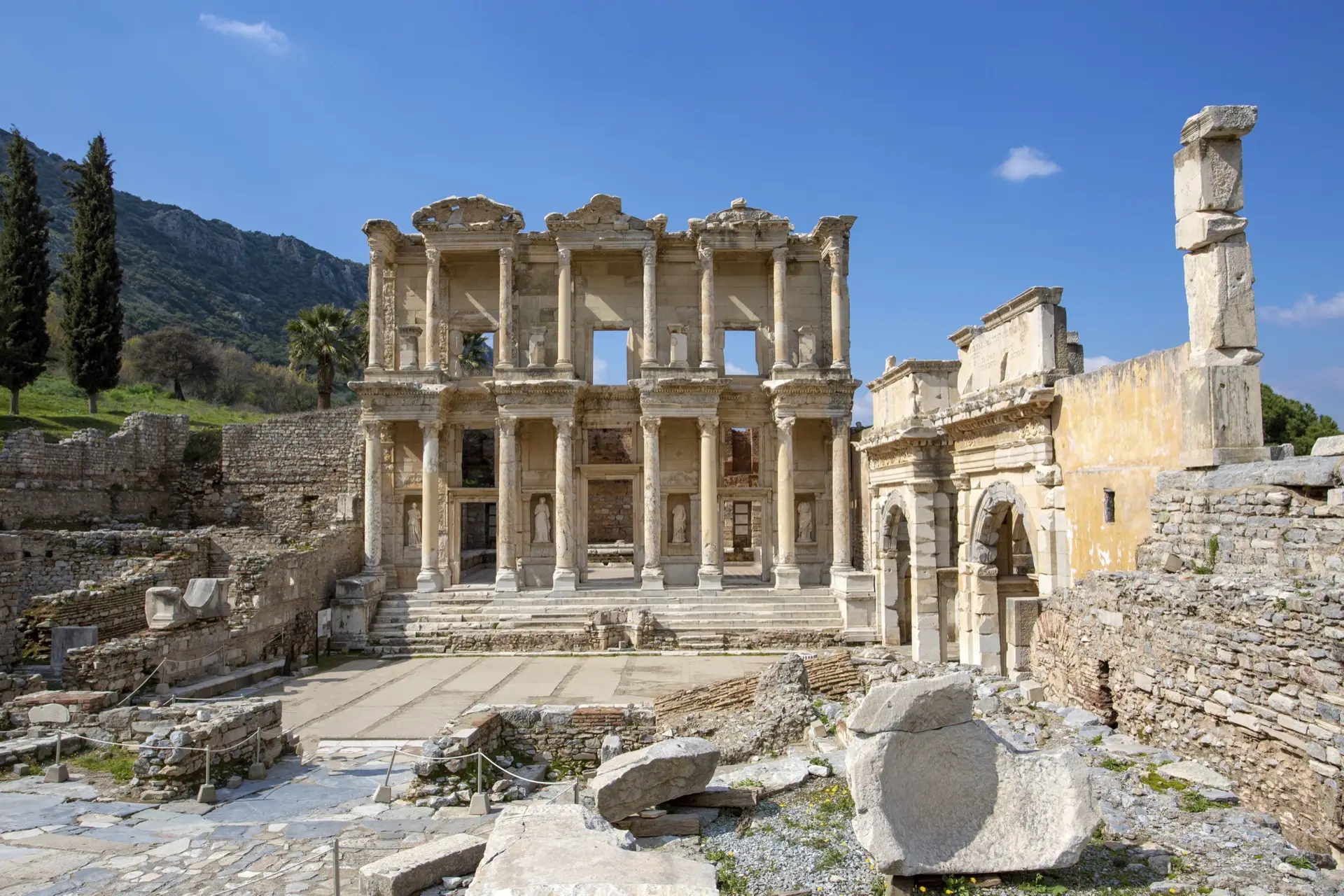
Ephesus, two and a half hours west. Pairing it with Pamukkale over two days is the route most families take through the Aegean.
Before & After Pamukkale — the Aegean Leg
Laodikeia is 15 minutes away and Aphrodisias about two hours, which is why Pamukkale is rarely a destination on its own. It sits inland from the Aegean coast, roughly halfway between the classical sites of the west and the mountain road south, making it a natural hinge in a Turkey route, not a terminus. What comes before and after it decides how much driving the family does.
The ruins of Hierapolis on the plateau. Pamukkale sits inland from the Aegean, which is what makes it the hinge in most Turkey routes.Antalya, three and a half hours south over the mountains. Ending an Aegean route on the coast is what most children want after a week of ruins.
Almost everything that goes wrong at Pamukkale is a timing problem, not bad luck. The wrong gate, the middle of the day, the terraces that happened to be dry, the shoes that had to be carried. None of it is difficult to avoid, and all of it has to be decided before the family reaches the barrier. Get the hour right and it becomes the most photographed morning of the trip, and the one the children remember, because they were allowed to walk in the water.
Turkey in February keeps January’s temperatures and gains March’s light: 10.2 °C by day in Istanbul, 15.6 °C in Antalya and −2.6 °C nights in Cappadocia. Antalya gets a third less rain than in January, Istanbul gains 67 minutes of daylight, hot air balloon flights go ahead on 45–55% of mornings, and private routes start from USD 1,940 per adult.
Turkey in November splits in two: the south coast still reaches 21.4 °C by day while Cappadocia falls to 2.5 °C at night. Hot air balloons fly on about 75% of mornings, daylight runs under ten hours, and private land arrangements start at USD 1,645 per adult.
The best time to visit Turkey in August: hot inland with dawn starts for the ruins and the Cappadocia balloon, warm seas on the coast — private tour itineraries and costs. TURSAB-licensed.
How many days in Istanbul: four sees the headline sights, five sees the city. Decision matrix for 2–5 day trips, USD cost bands from the 220 guided day to the 1,645 five-day package, the Istanbul-vs-Cappadocia fork and the 5-day shape day by day.
Istanbul, Gallipoli, Ephesus, Pamukkale, four Turquoise Coast days and Cappadocia to finish — a 2 week Turkey itinerary with 13 nights, two flights and eight bases, day by day.
A Bosphorus cruise in Istanbul ranges from a USD 2–3 public ferry to a USD 280–380 private yacht. Six options compared — prices, best time of day, hidden costs, and how a private Istanbul tour can include the cruise.
Things to do in Antalya, ordered the way a trip actually uses them: Kaleici old town, the Aspendos theatre, Perge and the Duden waterfalls, with official opening hours, entry prices and honest drive times from the old town.
✦ Tailor-Made
Let's Plan Your Private Turkey Trip
Tell us about your family — we reply within 24 hours.

 English
 Dutch
 Japanese
 Korean
 Chinese