Turkey Itinerary: How Many Days You Need, Where to Go, What It Costs
Quick Answer: A Turkey itinerary comes down to four decisions: how many days, which regions, which season and what it costs. A first trip runs 5 to 14 days, and the day count decides how far past Istanbul you get. Five days covers Istanbul and Cappadocia. Eight days adds Ephesus and Pamukkale. Fourteen days covers all five regions, including the Antalya coast. Spring (April–June) and autumn (September–October) bring mild days of 18–26°C and the steadiest conditions for the Cappadocia hot air balloon. Book three to five months ahead for those seasons, four to six for July and August. Most nationalities enter visa-free for tourist stays of up to 90 days within any 180-day period. Turkey Family Tours is TURSAB-licensed (no 13538). Booked privately, a private Turkey tour runs from USD 220 for a single day in Istanbul to USD 5,395 for 14 days. Hotels, guiding and internal flights are built into the multi-day packages. Get a Private Quote →
This Turkey itinerary guide maps a first family trip end to end, from day count to final cost. It covers the five regions worth your days, how many days each needs, and the months that give the best conditions. It also covers what a private trip costs per person and the ground rules on visas, money, food and getting around. A first visit runs 5 to 14 days and, booked privately, costs USD 220 to USD 5,395 per person.
By Fatih — Founder & Tour Director, Turkey Family Tours · TURSAB licence 13538 · Last updated: July 2026
Turkey Itinerary Guide — Table of Contents show / hide
Sunrise over the Cappadocia valleys — the single image most first-time visitors build a Turkey trip around.
Is Turkey Worth Visiting?
Turkey is worth visiting because one country covers what most itineraries need two or three countries to reach. A two-week route through Istanbul, Cappadocia, Pamukkale, Ephesus and the Mediterranean coast crosses four UNESCO World Heritage sites and 1,500 years of Byzantine and Ottoman building. It needs one visa entry and one short domestic flight. It also takes in a volcanic landscape unlike anywhere in Europe. The coastline is warm-water, with a swimming season that runs from May into October.
Three things decide it for most families:
Short internal distances, no border crossings. Istanbul to Cappadocia is a 75-minute flight. Ephesus to Pamukkale is a three-hour drive. Nothing on the classic route needs a second visa or an overnight train.
Food children eat without negotiation. Köfte (grilled meatballs), pide (flatbread), sütlaç (rice pudding) and seasonal fruit turn up at every hotel breakfast and lokanta lunch, and hotel breakfast is included on every multi-day route.
Private touring is straightforward to arrange. A licensed local guide, a private vehicle with driver and 4-5 star hotels come as one package. Cave hotels in Cappadocia are included, so a first trip is not a dozen separate bookings. Two to eight people travel in one private minivan.
Turkey is also large: roughly 1,600 km from the Aegean coast to the eastern border. Adding the Black Sea, the eastern highlands or Mount Nemrut to a ten-day first trip costs more driving hours than sightseeing hours. This guide stays on the western circuit, where the UNESCO density, the flight connections and the hotel quality all sit. The shortlist itself is ranked in our guide to the top places to visit.
Turkey Trip Essentials at a Glance: Visa, Money and Flights
Turkey runs on UTC+3 all year and admits most nationalities visa-free for 90 days. Istanbul Airport takes direct long-haul flights from Europe, the Americas and Asia-Pacific. The rest of the basics:
Item
Detail
Main gateway
Istanbul Airport (IST) — direct long-haul routes from Europe, the Americas and Asia-Pacific
Visa
Visa-free for most nationalities, up to 90 days in any 180; e-visa online for the rest
Currency
Turkish lira (TRY); cards accepted almost everywhere, cash useful in bazaars
Language
Turkish; English widely spoken in hotels and at tourist sites
Time zone
UTC+3, year-round — no daylight-saving change
Electricity
230V, type C and F round two-pin plugs
Tap water
Chlorinated and safe for washing; bottled water is the norm for drinking
Typical first trip
8 to 10 days, Istanbul + Cappadocia + the Aegean
Typical family group
Two to eight people in one private minivan, and family rooms are standard in cave hotels
Best months
April–June and September–October
Private tour range
USD 220 (one day) to USD 5,395 (14 days), per person
Those figures come from the published cost breakdown for a Turkey trip, which sets the same numbers out by trip length and family size.
Where Should You Go in Turkey? The Five Essential Regions
Five regions carry the classic route: Istanbul, Cappadocia, Ephesus, Pamukkale and the Mediterranean coast. They slot together in a fixed order — Istanbul first, Cappadocia second, the Aegean pair third, the Mediterranean last. Each earns a full day or more.
1. Istanbul — Two Continents, One Old City
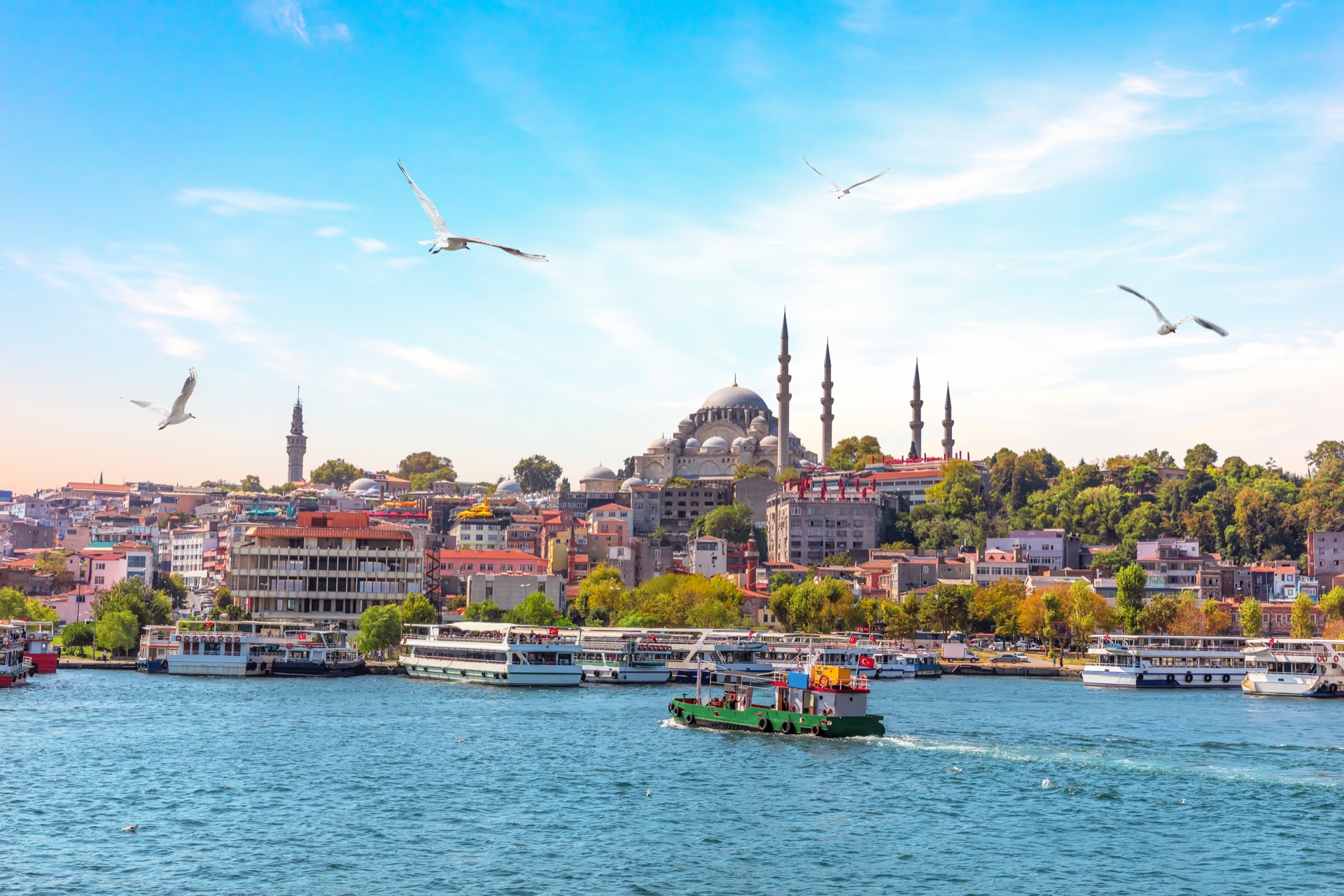
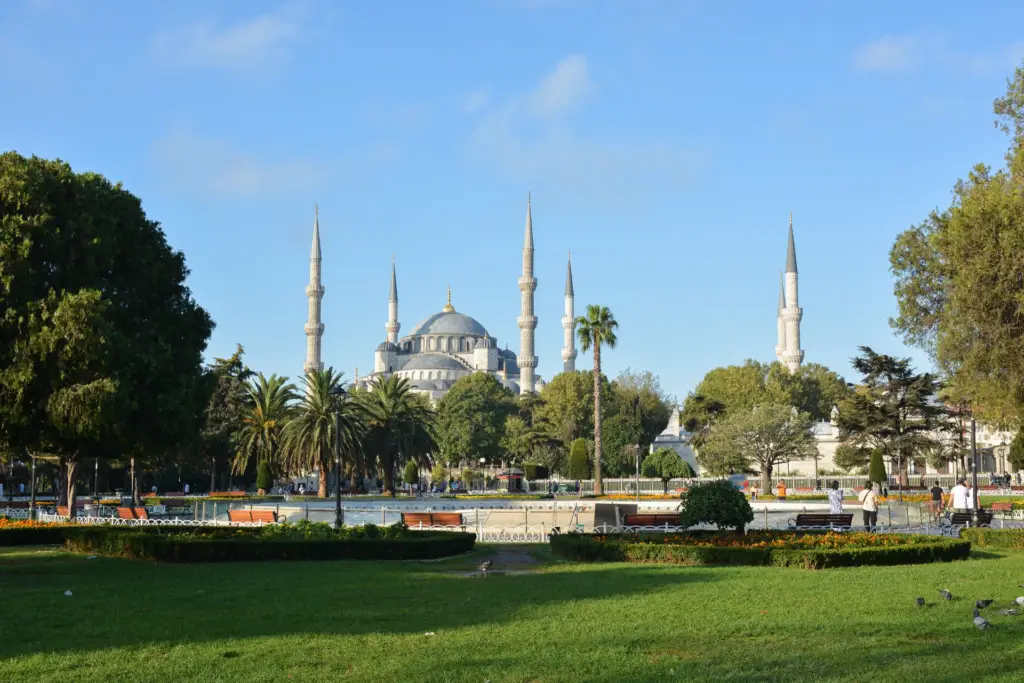
Sultanahmet — Hagia Sophia, the Blue Mosque and Topkapı Palace sit within a ten-minute walk of each other.
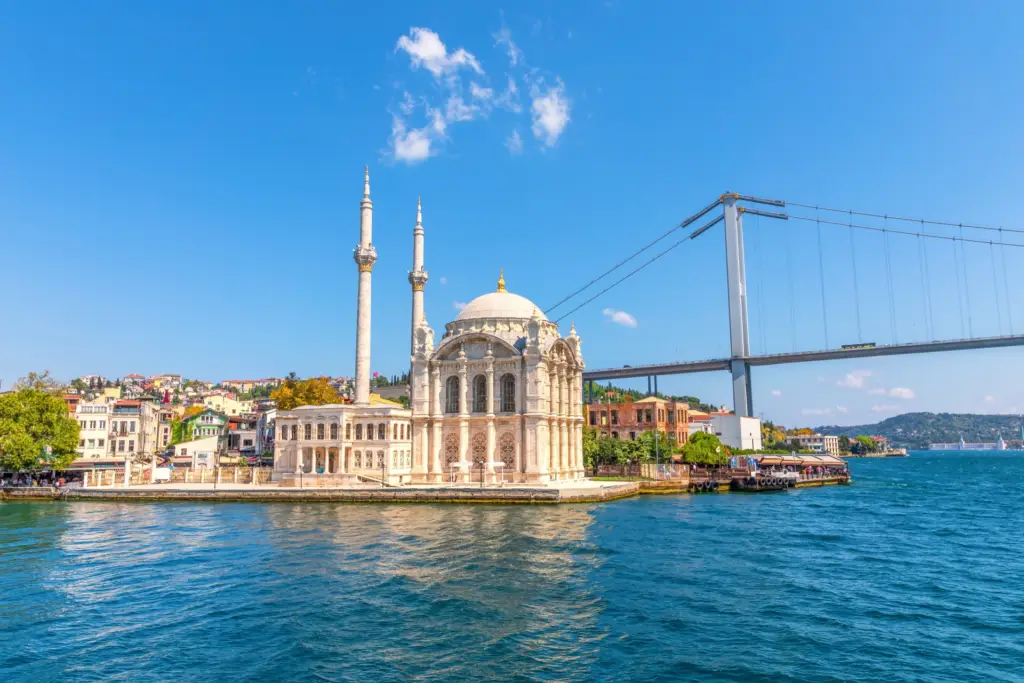
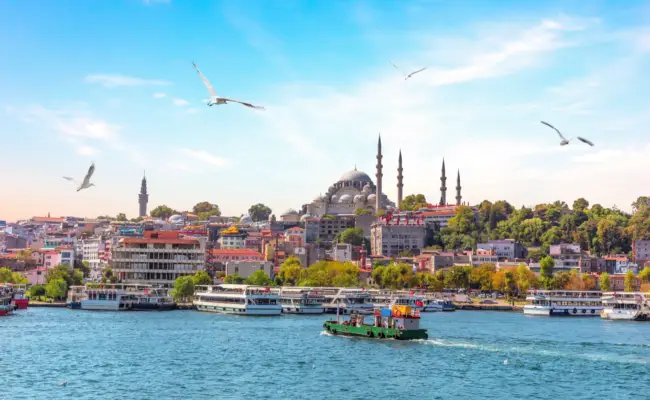
The headline sights cluster inside Sultanahmet, itself a UNESCO World Heritage site. Hagia Sophia was raised in 537 AD and held the largest domed interior in the world for nearly a thousand years. The Blue Mosque stands opposite it, Topkapı Palace was the seat of the Ottoman court for four centuries, and the Grand Bazaar has 4,000 shops. A Bosphorus cruise between the European and Asian shores fills a half day, and it is the only sightseeing block on the route that asks nothing of small legs. Two to three days is the least that covers it, and our breakdown of how many days Istanbul needs sets out what each extra day buys. Istanbul travel guide →
2. Cappadocia — Fairy Chimneys, Cave Hotels and the Hot Air Balloon
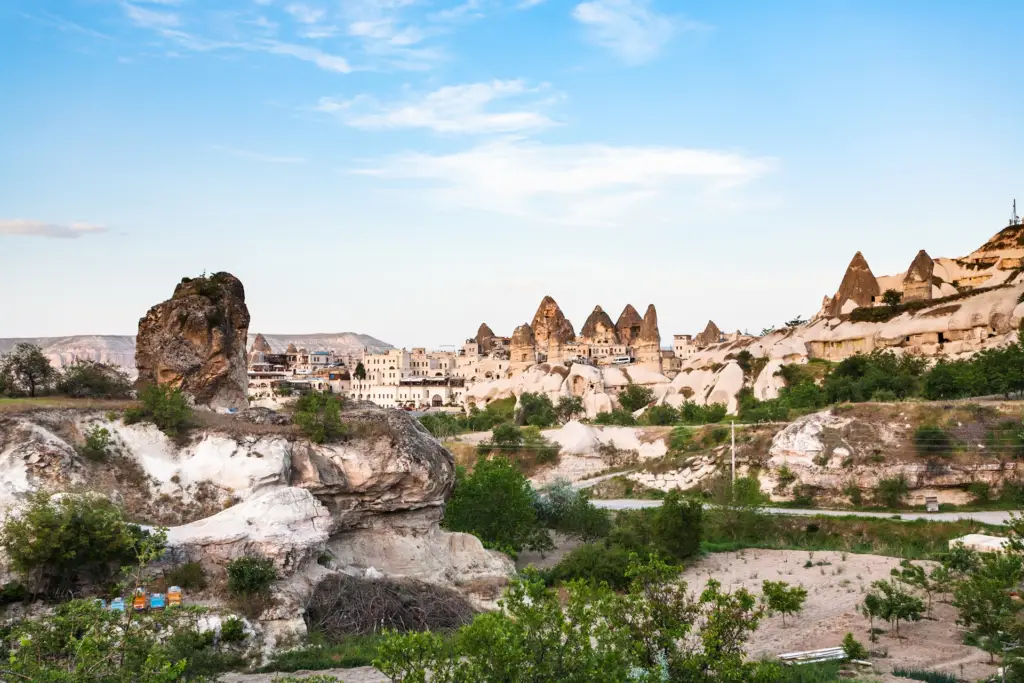
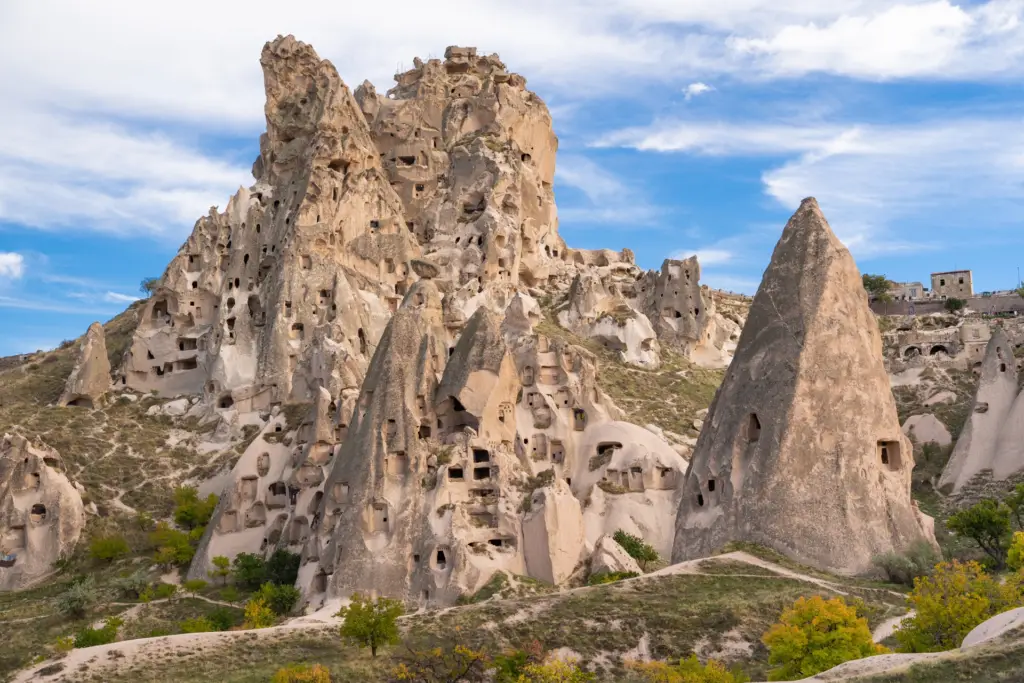
Göreme, seen from the valley rim — the base for two Cappadocia days.
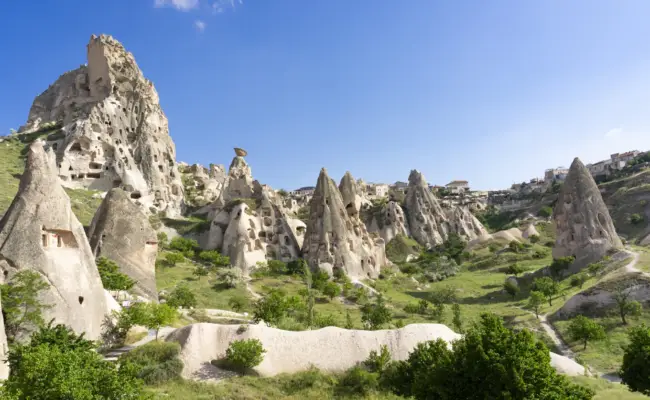
Cappadocia is a volcanic landscape in central Anatolia. Soft ash rock was eroded into cones and pinnacles, then hollowed out by hand over a thousand years. The Göreme Open-Air Museum holds rock-cut churches with frescoes still on the walls. The Kaymaklı and Derinkuyu underground cities were carved storey by storey into the rock, and Derinkuyu reaches about 85 metres below ground. The dawn hot air balloon flight is optional, weather-dependent and best from around age six. Two days covers it, and a third is easy to fill — see how long to stay in Cappadocia. Cappadocia sights, times and costs →
3. Ephesus — The Best-Preserved Classical City in the Eastern Mediterranean
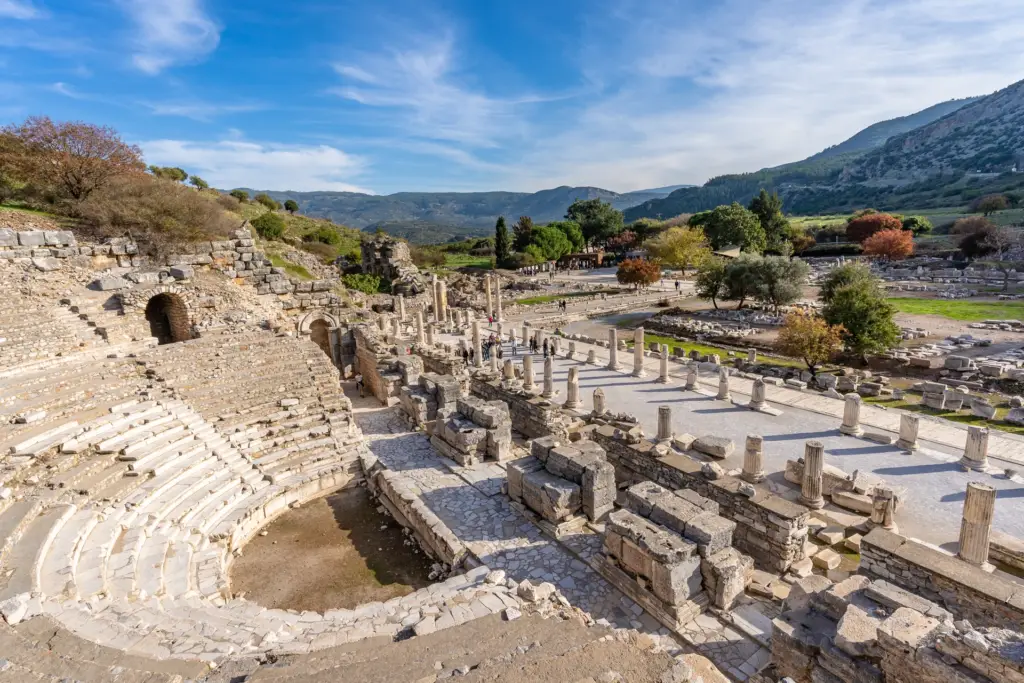
The Great Theatre at Ephesus seated 25,000 — the largest surviving theatre of the Roman world in Asia Minor.
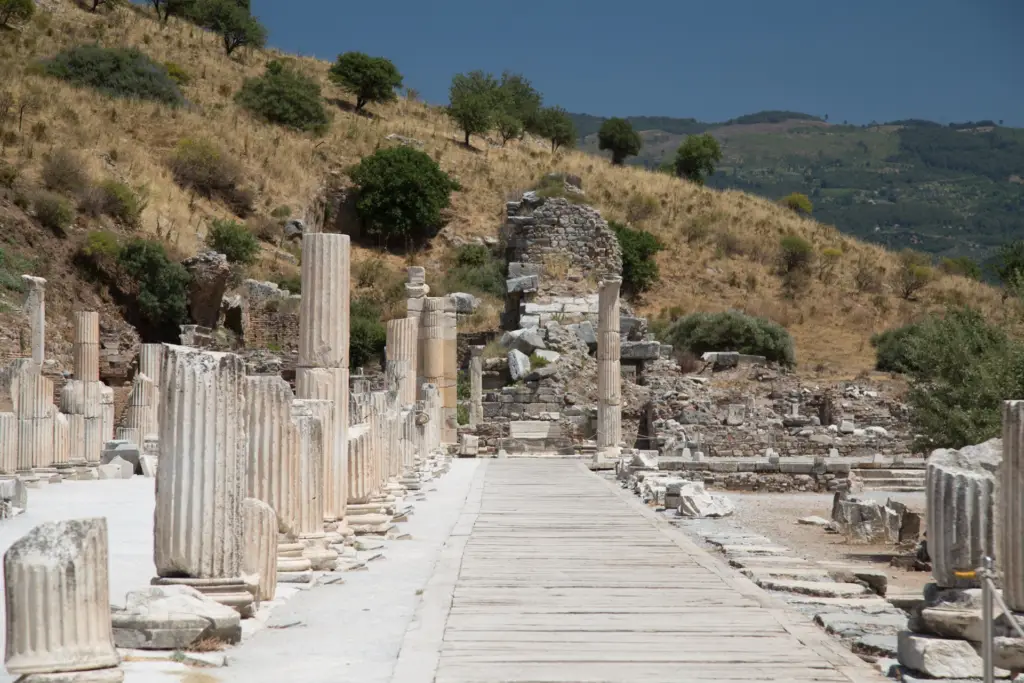
A UNESCO-listed classical city laid out along a marble street a family can cover in a single morning. The set pieces are the two-storey Library of Celsus, the 25,000-seat Great Theatre and the terraced houses with their mosaic floors. At the edge of the site stands what remains of the Temple of Artemis, one of the Seven Wonders of the Ancient World. The House of the Virgin Mary sits on the hillside above. The ground is flat and the distances are short, which matters with children in tow. Base yourself at Kuşadası or İzmir. Pamukkale pairs with Ephesus naturally, three hours away by road. Ephesus travel guide →
4. Pamukkale — Travertine Terraces Above a Roman City
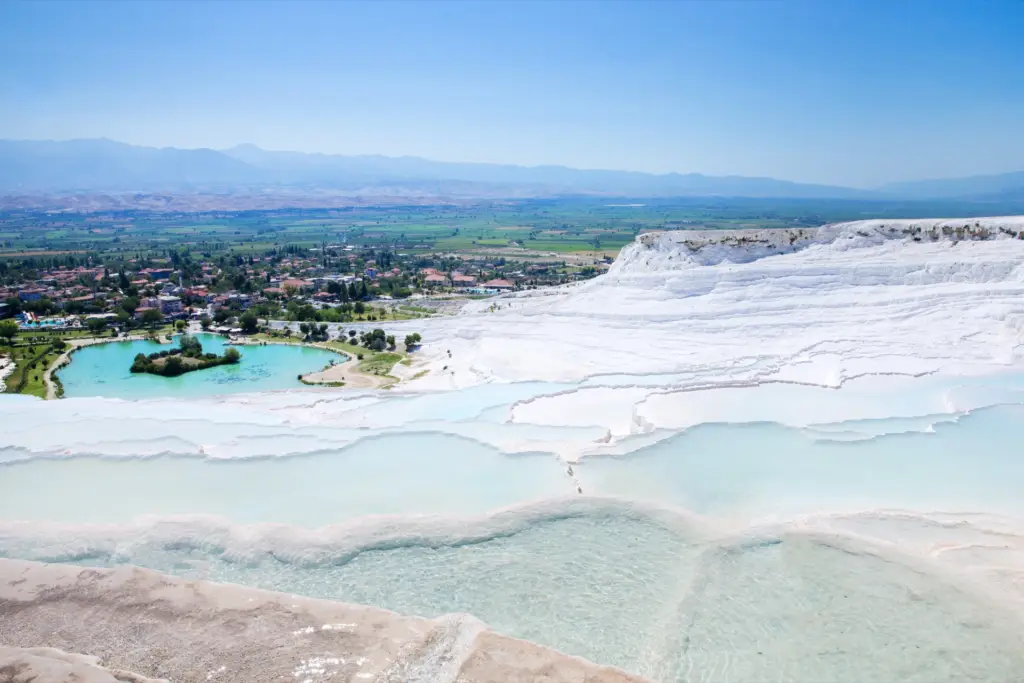
The travertines are walked barefoot — shoes come off at the entrance and stay off.
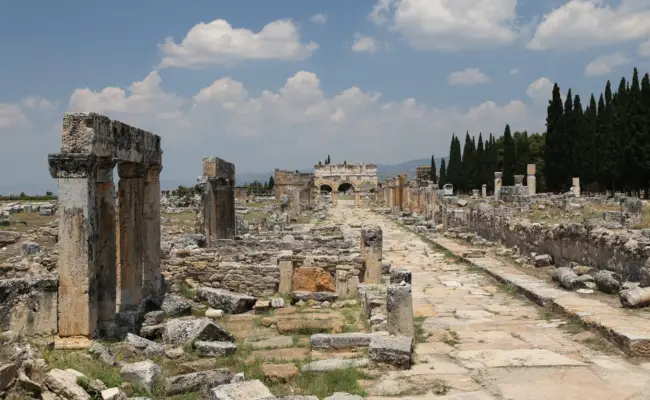
Pamukkale is a hillside of white travertine terraces built by calcium-rich spring water over millennia. You walk them barefoot, through ankle-deep warm water. Above sits Hierapolis, a Roman spa city with a well-preserved theatre and a necropolis. Beside it is Cleopatra’s antique pool, where you swim among fallen columns — an optional extra the guide arranges on the spot for families who want it. Half a day on the terraces, half at Hierapolis. Pamukkale travel guide →
5. The Mediterranean Coast — Antalya, Fethiye and the Turquoise Water
The Ölüdeniz lagoon near Fethiye — the calmest swimming water on the coast.
Two or three coastal days close a longer trip. Antalya gives the walled old town of Kaleiçi, the near-complete Roman theatre at Aspendos that seated 15,000, and the Düden waterfalls. Further west, Fethiye holds the Ölüdeniz lagoon and the Saklıkent gorge. A cold river runs through the gorge and children wade in up to the knees. This is the swimming half of a Turkey trip and it works best from late May to early October. Antalya travel guide →
Which Regions to Combine — and What to Leave Out
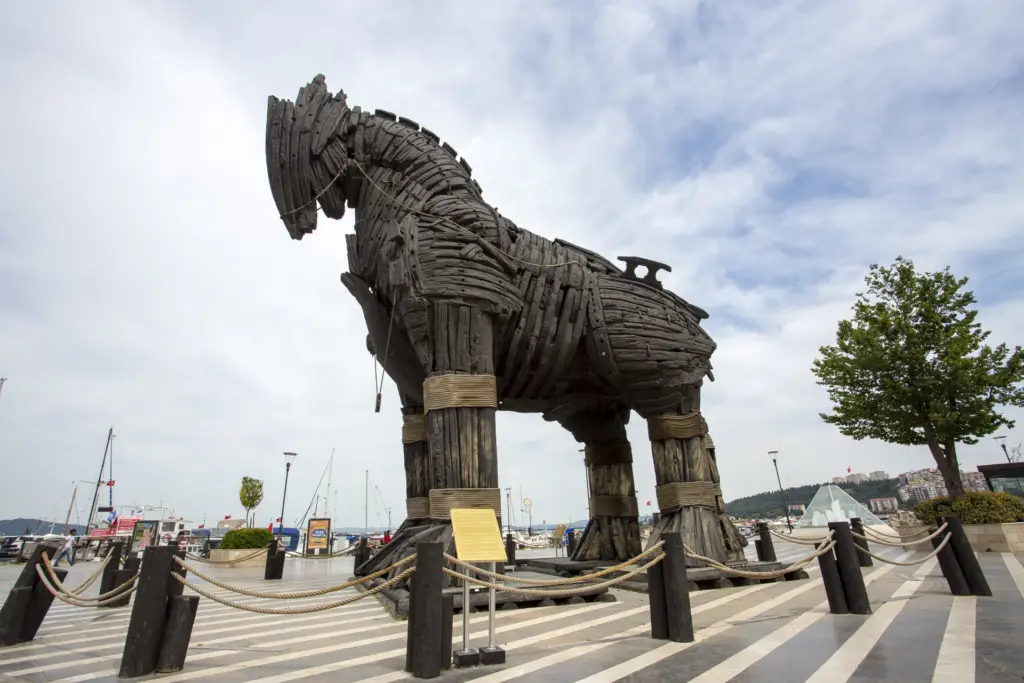
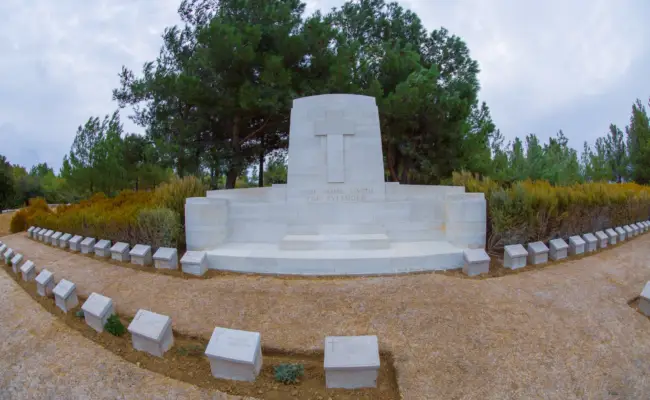
Istanbul and Cappadocia are the fixed pair. Every itinerary of five days or more contains both. Ephesus and Pamukkale are the second pair and travel together, since they sit three hours apart on the same road. The Gallipoli battlefields and Troy form a third pair on the north Aegean, added on ten days or more. Our Anzac Cove and Chunuk Bair guide covers the memorial sites in visiting order. The Mediterranean coast is the natural close for two weeks. Everything east of Cappadocia belongs to a second trip, since Nemrut, Mardin and the Black Sea are each a week in themselves. A wider view of the shortlist sits in our guide to the best places to visit in Turkey.
How Many Days Do You Need in Turkey?
Eight to ten days is the working answer for a first trip. Five days covers Istanbul and Cappadocia properly. Eight adds the Aegean pair. Ten adds either the battlefields or the Antalya coast. Fourteen takes all five regions without a compressed day anywhere.
Days
Regions covered
Best suited to
Pace
2–3
One region, from Istanbul
An add-on to a business trip or a longer stopover
One flight, one overnight
5
Istanbul + Cappadocia
A first family visit with limited leave
Two bases, one internal flight
7–8
+ Pamukkale + Ephesus
Four regions, one unhurried day in each
Four bases, one to two flights
10
+ Gallipoli and Troy, or the Antalya coast
History-led trips, or a beach finish
Five bases, a driving day or two
12–14
All five regions
The full country, unhurried
Six bases, two internal flights
Under five days, pick one region and go deep rather than two and go shallow. The single-region options from Istanbul run as a two-day Cappadocia trip with a cave-hotel night or as day trips by plane. Beyond fourteen days, add nights to the regions you already have rather than new ones. Our guide on how to plan a trip to Turkey works through the same decisions in order. It covers dates, region order and booking sequence.
What Do Turkey Itineraries Look Like? 5, 8, 10 and 14 Days
Four routes cover most first trips, and all four run on one spine: Istanbul, a 75-minute flight to Cappadocia, then west to the Aegean. What separates them is the number of bases, not the order. The five-day route uses two bases, the eight-day four, the ten-day five, and fourteen days spread across six. Each route inherits the one before it and adds a region.
5 Days: Istanbul and Cappadocia
Two nights in Istanbul cover Sultanahmet and the Bosphorus. A 75-minute flight and a cave-hotel night in Göreme then cover the valleys, the underground city and the optional dawn hot air balloon. The last night is back in Istanbul, before departure. It is the shortest route that still gives each region a full day, and it suits families with only a week of leave. Day by day, it is set out in our five-day Turkey itinerary.
8 Days: Adding Ephesus and Pamukkale
The five-day core plus a flight west to İzmir, the Ephesus marble street, the Pamukkale terraces and Hierapolis. It is the length most families book, because it reaches four of the five regions with a single unhurried day in each. Compare it against the shorter version in the seven-day route and the eight-day route.
10 Days: Sample Route with Gallipoli and Troy
Çanakkale, the base for Troy and the Gallipoli peninsula on the ten-day route.
Days
Where
Highlights
1–2
Istanbul
Arrival, then Hagia Sophia, the Blue Mosque, Topkapı Palace, the Grand Bazaar and a Bosphorus cruise
3
Cappadocia (fly)
A 75-minute flight, then the Göreme Open-Air Museum, the Paşabağ fairy chimneys and Uçhisar Castle
4
Cappadocia
Optional sunrise hot air balloon, the Red and Love valleys, the Kaymaklı underground city
5
Cappadocia to Kuşadası
Morning flight from Cappadocia to İzmir, then a private transfer to the Aegean coast
6
Pamukkale
The white travertine terraces, Roman Hierapolis and Cleopatra’s antique pool
7
Ephesus
The Library of Celsus, the 25,000-seat Great Theatre and the House of the Virgin Mary
ANZAC Cove, Lone Pine and Chunuk Bair, then the drive back to Istanbul
10
Departure
Free time in Istanbul before the flight home
The same ten days can be spent on the coast instead: swap the battlefields for Pamukkale and three Antalya days. The full day-by-day sits in our 10 day Turkey itinerary.
14 Days: The Full Country
Everything above plus Fethiye and Antalya: the Ölüdeniz lagoon, the Saklıkent gorge, Kaleiçi and Aspendos. There is enough slack that a slow morning does not cost a family a site. Two weeks is also the length at which a rest day earns its place, which matters most to families with children under ten. See the two-week Turkey itinerary for the ordering.
Is Turkey Expensive? Daily Budget and Private Tour Costs
Dinner with meze and a main runs USD 20–40 a head in a mid-range restaurant.
Turkey costs a family of four roughly USD 150–320 a day on the ground, outside a package. That covers meals, entrance fees and local transport for all four. Museum entry runs USD 8–30 a head, a lokanta lunch USD 8–15, a domestic flight USD 45–110. None of those is what moves a Turkey budget. Hotel category is, because 5-star Istanbul rooms and Cappadocia cave hotels price at the European band.
What You Spend Per Day Outside a Package
Item
Typical cost
Note
Lokanta lunch
USD 8–15 per person
Soup, a main, bread and tea
Restaurant dinner
USD 20–40 per person
Meze, a main and a drink
Museum entry
USD 8–30
Hagia Sophia and Topkapı sit at the top of the range
Hot air balloon flight
USD 220–350 per person
Seasonal; booked separately as an add-on
Domestic flight
USD 45–110 one way
Istanbul–Cappadocia, Cappadocia–İzmir
Airport taxi, Istanbul
USD 25–45
Metered; a private transfer is fixed in advance
Children shift the arithmetic more than most people expect. Under-eights enter most state-run museums free. On a private tour the guide and the vehicle are shared across the whole group. A family of four therefore pays less per person than a couple travelling alone. Our Turkey tour cost guide breaks the whole budget down line by line.
What a Private Turkey Tour Costs
A private tour with us runs from USD 220 for a full day in Istanbul to USD 5,395 for the 14-day grand tour. Both figures are per person, on a double-occupancy basis. Multi-day packages include 4-5 star hotels and cave hotels in Cappadocia, plus daily breakfast. Also inside the price: a private vehicle with driver, a licensed local guide and every entrance fee listed on the itinerary. Whatever domestic flights a route needs are priced in as well. The exception is the 11-day by-road tour, which uses no internal flights and runs overland end to end. International flights, lunches and dinners, and optional extras such as the hot air balloon sit outside the price and are quoted separately.
Private Tour or Group Tour: What Changes
A private Turkey tour means the guide, the vehicle and the schedule belong to your booking alone. No other party joins, no departure date has to fill, and the day can be shortened or reordered on the morning itself. Group size stays between two and eight people, all from the same booking.
Private tour
Group tour
Group size
Your family only, 2–8 people
20–45 strangers
Start times
Set with you, changed on the day
Fixed for the coach
Pace at sites
Longer where children engage, shorter where they do not
Prices are starting-from, per person, double occupancy. The Cappadocia hot air balloon is an optional add-on on every route and is not included in these figures. Full inclusions sit on each private tour package page.
When Is the Best Time to Visit Turkey?
April to June brings the clearest mornings of the year in central Anatolia.
April to June and September to October are the two best windows, with daytime highs of 18–26°C, manageable crowds and the steadiest hot air balloon conditions. July and August run 30–35°C at the inland ruins, which is hard going at Ephesus by midday but ideal for the coast. November to March drops Istanbul to 8–12°C, puts Cappadocia under occasional snow and empties the Göreme valleys. It is the quietest the country gets, and cave-hotel availability is at its widest. The country splits in two around the 15th of the month, and our page on November in Turkey shows which regions still work once Cappadocia’s nights drop to 2.5 °C.
Season
Weather
Crowds
Book ahead
Apr–Jun
18–26°C, dry
Moderate
3–5 months
Jul–Aug
30–35°C inland
Peak
4–6 months
Sep–Oct
20–26°C, dry
Moderate to high
3–5 months
Nov–Mar
8–12°C, some snow inland
Low
6–10 weeks
The Hot Air Balloon Season
Flights are cleared by the civil aviation authority each morning and are cancelled for wind or low cloud, so no month guarantees a lift-off. Across our own departures the flight lifts off on roughly nine mornings in ten over the year. Spring and autumn sit among the highest of any month, and winter mornings are grounded more often. Two nights in Cappadocia rather than one is the practical insurance for a family, because it gives the flight a second chance. Month-by-month detail sits in our best time to visit Turkey guide, and the flight itself in the Cappadocia hot air balloon guide.
Is Turkey Safe?
The four regions on the classic route are safe for family travel: Istanbul, Cappadocia, the Aegean and the Mediterranean coast. Each is patrolled by a dedicated tourism police force. Turkey receives more than 50 million foreign visitors a year and ranks among the world’s ten most-visited countries, on the arrivals figures published by UN Tourism. Almost all of them travel through those four areas: Istanbul, Cappadocia, the Aegean around Ephesus and Pamukkale, and the Mediterranean at Antalya and Fethiye.
The provinces that government advisories flag sit in the far south-east, along the Syrian and Iraqi borders. That is between 800 and 1,400 km from anything on the classic route. No standard itinerary goes near them.
The Safety Questions Families Ask Most
Three questions come up in almost every enquiry we answer. Can children walk the sites safely? Ephesus and Hierapolis are flat, so a five-year-old walks them without complaint. The underground cities have low, narrow passages that suit confident walkers rather than toddlers. Is the food safe for small children? Restaurants are inspected, and on a private tour the guide checks allergies with the kitchen before you sit down. What happens if someone falls ill? Private hospitals in Istanbul, Antalya and İzmir have English-speaking staff, and the guide arranges the visit rather than leaving a family to find one.
Everyday Precautions That Apply Day to Day
Pickpocketing in crowds. The Grand Bazaar, the Eminönü ferry piers and the Istanbul tram are the places to keep a bag zipped and in front of you.
Taxi overcharging. Insist on the meter, or use a ride-hailing app. On a private tour the question does not arise, since transfers are arranged.
Drinking water. Tap water is chlorinated and fine for teeth and washing. Bottled water is what everyone drinks, and it is sold at every shop, hotel and site entrance.
Summer heat. Ephesus runs 30–35°C in July and August, and the marble holds the heat well past midday. Guides start the site at 8am in July and August, and the vehicle carries chilled water for the children.
Check your own government’s current advisory before booking — it is the only source that is current for your passport. Our full treatment, region by region and with children in mind, is in is Turkey safe for families.
Do You Need a Visa for Turkey?
Most nationalities enter visa-free for tourist stays of up to 90 days within any 180-day period. A smaller group needs an e-visa, applied for online in a few minutes with approval usually arriving the same day. Nobody needs to visit an embassy for a standard holiday.
Passport validity: at least six months beyond your arrival date, with a blank page for the entry stamp.
Where to check: the official Turkish e-visa portal confirms the current rule for your passport, and it is the only source that updates when rules change.
Cost: the e-visa is paid by card during the application, and visa-free entry costs nothing.
Children: each child needs their own passport and, where applicable, their own e-visa.
Apply a week or two before departure rather than months ahead, since the e-visa carries a validity window from the date of issue. Where the visa sits in the wider booking order is set out in our planning guide.
How Do You Get Around Turkey?
The Bosphorus — in Istanbul, the ferry is public transport as well as a sightseeing route.
One or two domestic flights cover the long hops, and a private vehicle covers everything else. Turkey is roughly 1,600 km across, so the classic route flies the two longest legs. Each of those flights skips a drive that would otherwise cost a full day. Every leg between the flights is comfortably driveable with children on board.
Leg
How
Time
Istanbul → Cappadocia
Domestic flight to Kayseri or Nevşehir
75 minutes
Cappadocia → İzmir / Kuşadası
Morning flight, then a private transfer
~90 min flight + 1.5 hr drive
Kuşadası → Pamukkale
Private vehicle
~3 hours
Ephesus → Pergamon → Troy
Private vehicle, coastal road
~5 hours with stops
Çanakkale → Istanbul
Private vehicle
~4.5 hours
Within Istanbul
Tram, ferry, private vehicle
15–45 minutes per hop
Which Legs Are Worth Flying
Two legs justify a flight and the rest do not. Istanbul to Cappadocia is a 9- to 10-hour drive against a 75-minute flight, so the fly-in routes always fly it. Cappadocia to İzmir saves a similar day. We book these as morning departures rather than evening ones. An early flight leaves a usable afternoon at the far end, and a family arriving at 9pm has lost a day either way. Everything else on the western circuit is a two-to-five hour drive with stops, which reads better as sightseeing than as transit.
Istanbul traffic is the variable that breaks schedules. Cross-city moves at rush hour can triple. Sultanahmet is walkable end to end, which is why itineraries keep the Old City days on one side of the water.
Ferries are the fastest way across the Bosphorus and, in practice, the most enjoyable half hour of an Istanbul day.
Intercity buses are comfortable but slow. A Cappadocia-to-Kuşadası run overnight costs a full sightseeing day.
Self-driving is unnecessary on the classic route and adds parking problems in Istanbul and Antalya old towns.
On our tours the flights, transfers and driver are arranged as one chain. Each region you land in has its own licensed local guide and its own private vehicle with driver, booked and briefed by us, so no leg of the trip is left for you to arrange.
The one route that skips flying altogether is the 11-day fully by-road tour, which covers four regions overland. For families with young children it trades two airport mornings for longer, scenic driving days.
What Do You Eat in Turkey?
Breakfast is the largest meal of the Turkish day and comes included at every hotel on a tour.
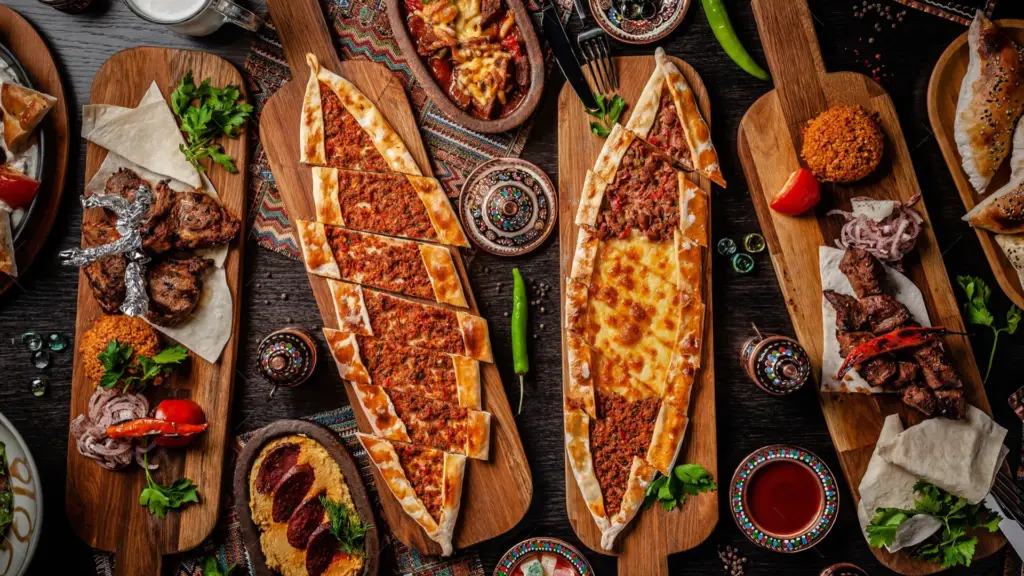
Köfte, pide, lahmacun, meze and balık ekmek are the five dishes that cover most Turkish menus. A full lokanta lunch runs USD 8–15 and a restaurant dinner USD 20–40. The meal Turkey does best is breakfast, and it arrives as a table rather than a plate. White cheese and aged kaşar, olives, tomatoes and cucumber, honey with clotted cream, several jams, eggs cooked to order, and bread that keeps coming. It is included at every hotel on a private tour, and it is the reason lunch often turns out to be optional. Our Turkish breakfast guide walks through what is on the table and in what order it is eaten.
The Dishes Worth Ordering
Köfte — grilled meatballs, the dish children order twice and the safest bet on any menu.
Pide and lahmacun — flatbreads, one boat-shaped and cheese-filled, the other thin and topped with spiced minced meat.
Meze — a spread of cold starters, from smoked aubergine to yoghurt with garlic, ordered by pointing at the tray.
Balık ekmek — a grilled fish sandwich handed over the rail at the Eminönü waterfront, eaten standing up for the price of a coffee.
Künefe — shredded pastry over melted cheese, soaked in syrup and served hot.
Çay and Turkish coffee — tea arrives in tulip glasses all day, and coffee comes unfiltered and is sipped, not drained.
Dietary Needs and Fussy Eaters
Vegetarian eating is straightforward, since the meze tradition is largely vegetable-based, and lentil soup is on every menu in the country. Nut allergies need naming clearly, because pistachio and walnut appear in desserts and some pilafs. On a private tour the guide confirms allergies and dietary requirements with each restaurant ahead of the meal rather than at the table. The wider survey, region by region, is in our Turkish food guide.
What Should You Wear, and What Counts as Good Manners?
Hagia Sophia is a working place of worship, and the dress rule applies to visitors as well.
A dress rule applies at three sites on the classic route, and nowhere else. Everyday clothing in Turkey is what you would wear in Athens or Barcelona. The exception is a working place of worship: Hagia Sophia, the Blue Mosque, Süleymaniye. There, shoulders and knees are covered, shoes come off at the door, and women cover their hair with a scarf. Scarves are lent at the entrance, and no one minds if you get it slightly wrong.
Shoes off indoors. This applies in homes and at places of worship. Slip-on shoes save a great deal of bending down.
Say yes to tea. A shopkeeper offering çay is being polite, not opening a negotiation, and accepting carries no obligation to buy.
Bargaining has a place and a limit. It is expected in the Grand Bazaar and for carpets and souvenirs. It is not done in shops with price tags, cafés or supermarkets.
Photographs of people need a nod first. Market traders almost always say yes, and almost always want to see the result.
Public affection stays low-key outside the big-city districts, and children are welcomed everywhere, including at restaurants late in the evening.
Summer packing works better around fabric than around coverage. Pack linen and cotton, a light long-sleeve for the ruins where there is no shade, and closed shoes for the marble streets at Ephesus. Add something warm for a dawn hot air balloon flight, which is cold even in July, and for the children more than for the adults. What families pack month by month follows the calendar in our month-by-month season guide.
Turkey Travel Tips: Money, Cards and Tipping
Tipping runs at USD 5–10 a day for a guide and USD 3–5 for a driver, and the currency is the Turkish lira (TRY). Cards work almost everywhere: hotels, restaurants, museums, taxis and supermarkets all take them. Cash is still useful in bazaars, at small cafés and for tips, and a family of four gets through more of it than a couple does. Exchange rates move, so treat any lira figure you read online as indicative and check on arrival.
Bring USD or euros to exchange rather than lira bought at home, since Istanbul exchange offices quote the working rate.
Use bank ATMs rather than the ones in tourist arcades, and decline the machine’s offer to convert to your own currency.
An eSIM is the simplest data option, activated before you land. Hotels, cafés and most restaurants also have Wi-Fi.
Tipping is modest and expected in specific places. Round up at restaurants, leave a few dollars a day for a guide and driver, and hand a small note to hotel staff who carry bags.
Keep small notes for shoe attendants at the historic monuments, public toilets and the balık ekmek stand — the places where cards genuinely do not reach.
Most of that cash goes on entrance fees for the older children and on the small notes nobody plans for. Our tipping in Turkey guide gives the customary amounts by situation, including what to do at the end of a multi-day private tour.
What Do First-Time Visitors Get Wrong in Turkey?
Ephesus has almost no shade — the marble street is a different experience at 8am and at 1pm.
Six patterns account for most of what goes wrong on a first trip, and all six are decided before departure rather than on the ground.
Too many regions, too few nights. A ten-day trip with six bases spends three of those days in transit. Adding a region always costs a full day, never half of one.
One night in Cappadocia. The hot air balloon is weather-dependent, so a single morning gives it one chance. Two nights gives it two mornings, at the cost of one hotel night.
Ruins at midday in summer. Ephesus and Hierapolis are unshaded marble and stone. The same site at 8am and at 1pm in August are not the same visit.
Underestimating Istanbul traffic. A museum on the Asian side scheduled tightly after a Sultanahmet morning is a plan that depends on the road being clear, and it often is not.
Booking the hot air balloon and the flight too late. Cave hotels and hot air balloon slots are the first things to go for July and August, well before the airfare rises.
Treating the last day as a touring day. Istanbul Airport sits well outside the city. An afternoon departure costs the whole morning if the transfer is not planned.
The sequence that avoids all six is dates first, then regions, then nights per region, then bookings. Our guide sets out the planning order step by step.
What Changes When You Travel With Young Children?
Saklıkent Gorge near Fethiye — knee-deep cold water in the middle of a hot afternoon.
Four to five hours of sightseeing a day is the ceiling with children under ten, and that is the main change: pace, not route. The itinerary itself stays the same. What shifts is where the rest goes, which sites get cut short, and which afternoons turn into swimming.
Shorter touring days. Four to five hours of sightseeing with a rest afternoon beats a full day, and a private schedule can be shortened on the morning itself.
Water in the itinerary. The Pamukkale terraces, the Saklıkent gorge and the Bosphorus ferries carry the days that ruins do not.
Age limits worth knowing. The hot air balloon works from around age six. Kaymaklı’s lower levels need ducking under a metre of rock in places, so a child who tires of being carried is happier waiting at the entrance with one parent.
Prams struggle on marble and cobbles. A carrier is more useful at Ephesus, in Sultanahmet and around Kaleiçi.
Child pricing on our tours reduces the per-person rate for ages 4 to 6, and reduces it further for children aged 3 and under. Ages 7 and up are priced as adults.
Region-by-region detail on walking distances, site conditions and medical cover sits in our family safety guide.
Turkey Travel FAQ
A private Turkey tour with Turkey Family Tours runs from USD 220 for a full day in Istanbul to USD 5,395 for the 14-day grand tour. Both are per-person prices on a double-occupancy basis. The two most-booked lengths are the eight-day circuit from USD 3,205 and the ten-day route from USD 3,815. Every price includes 4-5 star and cave hotels, daily breakfast, domestic flights inside Turkey, a private vehicle with driver and a licensed local guide. A family of four pays less per person than a couple, because the guide and the vehicle are shared across the group. Turkey Family Tours is TURSAB-licensed (no 13538). Compare the full range of Turkey tour packages.
Multi-day packages include 4-5 star hotels, cave hotels in Cappadocia and daily breakfast. Each also carries a licensed local guide, a private vehicle with driver, every listed entrance fee and all airport transfers. They also carry the domestic flights each route needs. The 11-day by-road tour is the deliberate exception and runs overland throughout. Outside the price: international flights to and from Turkey, lunches and dinners, and optional extras, of which the Cappadocia hot air balloon is the main one. Itineraries are timed around your international flight schedule, so airline miles or a preferred carrier can be used for the long-haul leg. Exact inclusions sit on each tour package page.
A 25% deposit confirms your dates, hotels and guide, and it is non-refundable once the booking is made. The remaining 75% is settled on arrival in Turkey, by cash or card, before the touring starts. Nothing is charged to your card in the months in between. Cancellations made fewer than seven days before arrival, and no-shows, are charged in full, since hotels and internal flights are committed by that point. Outside that window you lose only the deposit. Every quote is fixed in writing before the deposit, with no open pricing and no later adjustment. Turkey Family Tours is TURSAB-licensed (no 13538). The same terms apply to every route in the Turkey tour catalogue.
Book three to five months ahead for spring and autumn and six to ten weeks for a winter trip. Allow four to six months for July and August and for the Christmas and Easter school holidays. Two things bind, and neither is the tour date itself. Cave-hotel rooms in Cappadocia and hot air balloon slots are committed earliest for summer departures. If your dates are fixed by a school calendar, book at the longer end of each band. Dates are held once the 25% deposit is received, and the remaining 75% is settled on arrival. Get a Private Quote →
The eight-day circuit from USD 3,205 is the package most families book. It covers Istanbul, Cappadocia, Pamukkale and Ephesus, and reaches four regions with one unhurried day in each. The ten-day route at USD 3,815 adds the Gallipoli battlefields and Troy. A second ten-day option at USD 4,010 swaps those for the Antalya coast and a swimming finish. The 14-day grand tour at USD 5,395 takes all five regions with rest days built in. For a first short visit, five days in Istanbul and Cappadocia from USD 1,940 works. All run at a child-friendly pace with a private guide and vehicle.
The strongest ten-day route runs Istanbul (2 nights) → Cappadocia (2 nights) → Pamukkale → Ephesus → Pergamon, Troy and the Gallipoli battlefields. It closes with the drive back to Istanbul. It covers six UNESCO World Heritage sites and the north Aegean coast, and it uses two domestic flights to remove two full days of inland driving. The alternative ten days replaces the battlefields with Pamukkale and three days on the Antalya coast. That version suits families who want a swimming finish rather than a history one. Either version works better with two nights in Cappadocia than one, because that gives the hot air balloon a second morning if the first is grounded. The day-by-day version sits in the sample itinerary above.
A private guided Turkey tour changes three things a group coach tour cannot. The schedule bends to the family: a late start after a dawn hot air balloon flight, a shortened afternoon when children flag, an extra hour at Ephesus. The logistics disappear: entrance tickets, internal flights, transfers and restaurant bookings are handled, so no day begins with a queue. And no other party joins the booking, so a licensed local guide and a private vehicle cover every leg. Across regions as different as Istanbul, Cappadocia and the Aegean, that control is what a family is actually paying for. Private trips start from USD 1,940. See the private tour range.
Turkey is safe for families across the four regions on the classic route: Istanbul, Cappadocia, the Aegean and the Mediterranean coast. All four have a dedicated tourism police presence. Turkey receives more than 50 million foreign visitors a year, and effectively all of them move through these same areas. The provinces that carry government advisories sit on the south-eastern borders, 800 to 1,400 km from anything on a standard itinerary. Everyday care is the same as any large European city: watch bags in crowded bazaars, drink bottled water, insist on the taxi meter. Our region-by-region safety guide goes through each area in turn.
Every itinerary is adjusted before you book, and the common changes are worth naming. Families swap an Aegean day for a third night in Cappadocia, or add a Bosphorus cruise. Others trade an overland drive for a domestic flight, or extend the coastal leg by two days. Hotels move up or down in category, touring days shorten for younger children, and arrival and departure days are shaped around your international flights. Tell us your dates, the ages of the children and the two or three things you most want to see, and the route is built around that. Start planning your trip →
Turkey Travel Guides by Region
Where this page stops, six regional guides pick up. Each covers the sites in visiting order, how long a family should stay, and how that region fits into a longer route.
Send your dates and group size and a draft itinerary comes back within 24 hours. The quote is a fixed per-person price, with no open pricing and no call required. Turkey Family Tours is TURSAB-licensed (no 13538), with a 5.0 rating from 41 reviews on TripAdvisor. Every family trip runs privately, with a licensed local guide and a private vehicle in each region on the route. Get a Private Quote →
Turkey in March: 18 °C and 6.7 hours of sun on the Antalya coast, 12 °C in Istanbul with the queues gone, frost at the Cappadocia sunrise and a 60–70% hot air balloon fly rate. Sea 16–19 °C, museums on winter hours, wide availability and private routes from USD 1,645.
A Bosphorus cruise in Istanbul ranges from a USD 2–3 public ferry to a USD 280–380 private yacht. Six options compared — prices, best time of day, hidden costs, and how a private Istanbul tour can include the cruise.
The full 11-day overland route — Istanbul to Gallipoli with no domestic flights: leg-by-leg drive times, the Silk Road stops flights skip, and one fixed quote from USD 4,365.
The best time to visit Turkey, month by month: ~90–95% Cappadocia hot air balloon reliability from May to October, sea temperatures, school-holiday windows and booking lead times.
Turkey in February keeps January’s temperatures and gains March’s light: 10.2 °C by day in Istanbul, 15.6 °C in Antalya and −2.6 °C nights in Cappadocia. Antalya gets a third less rain than in January, Istanbul gains 67 minutes of daylight, hot air balloon flights go ahead on 45–55% of mornings, and private routes start from USD 1,940 per adult.
Galata Tower entry is €30 (about USD 33), open daily, ticket desk closes 18:14. Queue timings, the lift that stops at floor seven, and what the balcony shows.
Turkey in July: Istanbul 29.7 °C (85 °F), Ephesus 36.4 °C, Cappadocia nights 13.7 °C, sea 24–28 °C. Where it’s cooler and private routes from USD 1,940.
Turkey in January is the coldest month of the year: 9.6 °C by day in Istanbul with 16 wet days, 15 °C in Antalya and −3.6 °C nights in Cappadocia. Hot air balloon flights go ahead on 50–60% of mornings, sites are open and quiet, and private routes start from USD 1,645 per adult.
✦ Tailor-Made
Let's Plan Your Private Turkey Trip
Tell us about your family — we reply within 24 hours.
 English
 Dutch
 Japanese
 Korean
 Chinese