Turkey in March: Where It’s Warm, Where It Still Snows
Quick Answer:Turkey in March suits a family trip built on Istanbul, Cappadocia and the ancient cities, and does not suit a beach holiday. The Antalya coast is the warm part, at 18.0 °C (64 °F) by day with 6.7 hours of sun. Istanbul stays at 12.4 °C (54 °F) with thirteen wet days, and Cappadocia wakes to 0.7 °C (33 °F) sunrises. Hot air balloons, arranged separately, fly on 60–70% of March mornings, so our routes give Cappadocia two nights and two chances. Queues at Hagia Sophia and Ephesus are the shortest of the year. A private Turkey tour in March runs USD 1,645–5,395 per adult, with hand-picked 4-5 star (boutique) hotels, breakfasts, admissions, domestic flights and a licensed local guide with a private vehicle in every region. Turkey Family Tours is TURSAB-licensed (no 13538). A 25% deposit confirms the booking; 75% is paid on arrival. Your written day-by-day plan arrives within 24 hours. Get a Private Quote →
Turkey in March averages 12.4 °C (54 °F) in Istanbul, 10.3 °C (51 °F) in Cappadocia and 18.0 °C (64 °F) in Antalya on an ordinary afternoon. The same week means a coat in one city and a T-shirt in another. Antalya collects more sunshine than any other stop on our routes. Istanbul sees rain on thirteen days, and Cappadocia launches its hot air balloons into a sunrise near freezing. The month is the quietest of the touring year at the monuments, and the day gets 80 minutes longer between the 1st and the 31st. Below: the weather in Turkey in March by region, whether the sea is swimmable, the hot air balloon odds, the two dates that fill domestic flights, and which private route fits the month.
By Fatih — Founder & Tour Director, Turkey Family Tours · TURSAB licence 13538 · Last updated: September 2026
Planning a private Turkey tour?
We build family-paced private itineraries with hand-picked 4-5 star hotels and send a written plan and fixed price within 24 hours.
Turkey in March: What the Month Gives a Family, and What It Withholds
The short answer for a family
March is a good time to visit Turkey for a trip built around Istanbul, Cappadocia and the ancient cities, and the wrong month for a beach. March gives a family the emptiest Sultanahmet of the year, wide hotel availability in every region we use, and an Antalya coast at 18 °C (64 °F). The hot air balloon mornings improve as the month goes on. It withholds the sea, the tulips and the long warm evenings; those belong to April and May.
The gains: empty rooms, an 18 °C coast, a longer day
No queue at Hagia Sophia, Topkapı or the Basilica Cistern, on any day of the month.
An Antalya coast at 18.0 °C (64 °F) with 6.7 hours of sun a day.
Hot air balloons on 60–70% of Cappadocia mornings, better after mid-month, over valleys that turn green in the last ten days while Erciyes behind them still carries snow.
Wide availability at the hand-picked 4-5 star (boutique) hotels we use in every region, six weeks out rather than three months.
The losses: the sea, the tulips, the warm evenings
The long warm evenings, because sunset is 18:55 on the 1st and the air drops fast after it. Swimming, because the sea is 16–19 °C (61–66 °F) all month. A guaranteed hot air balloon flight on a single Cappadocia night. Some coast resort hotels, which stay closed until late March. And the Istanbul tulips, which open in April; a family that wants them should read our April guide instead.
How the plan changes
Sites come first, and the Bosphorus takes the clearest afternoon.
The coast is used for Ephesus, Pamukkale and a boat morning rather than beach days.
Two Cappadocia nights go on every route of seven days or more. Our 8 day Turkey itinerary pairs them with two Kuşadası nights for Ephesus and Pamukkale, so a 60–70% fly rate gets a second morning.
Coast nights are in Antalya city and Fethiye town, in hotels open all year rather than a seasonal resort.
Shoulder season does not change the price
March is shoulder season, which means hotels have rooms and the domestic flights we book into Kayseri and Izmir have seats at short notice. We price a March trip the same as an April one. The route costs the same, from USD 1,645 per adult for five days in Istanbul to USD 5,395 for fourteen days across the country. What the family gets for the money is time: no minute of a March day is spent in a line. Our month-by-month guide to the best time to visit Turkey sets March next to the other eleven months.
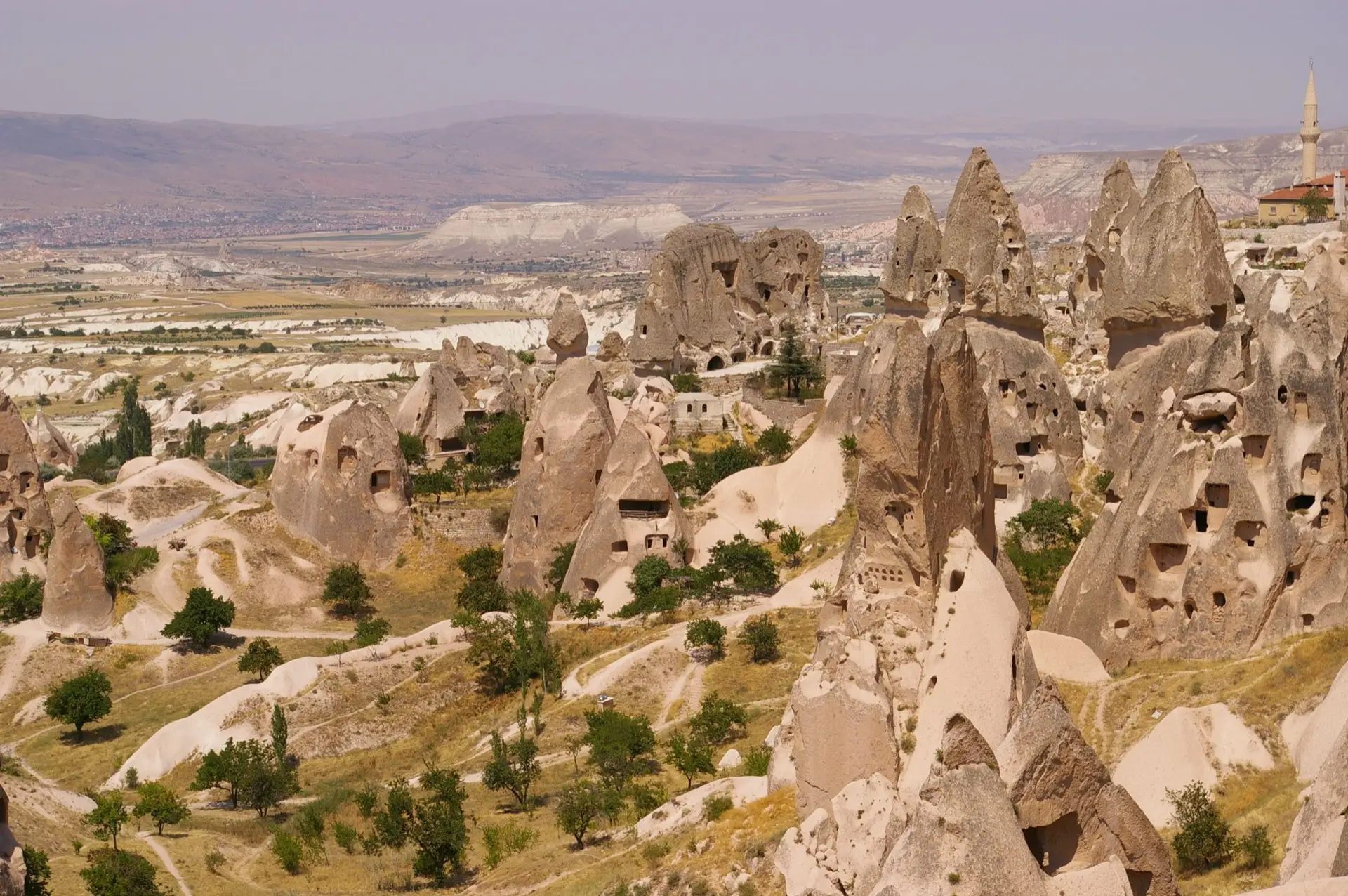
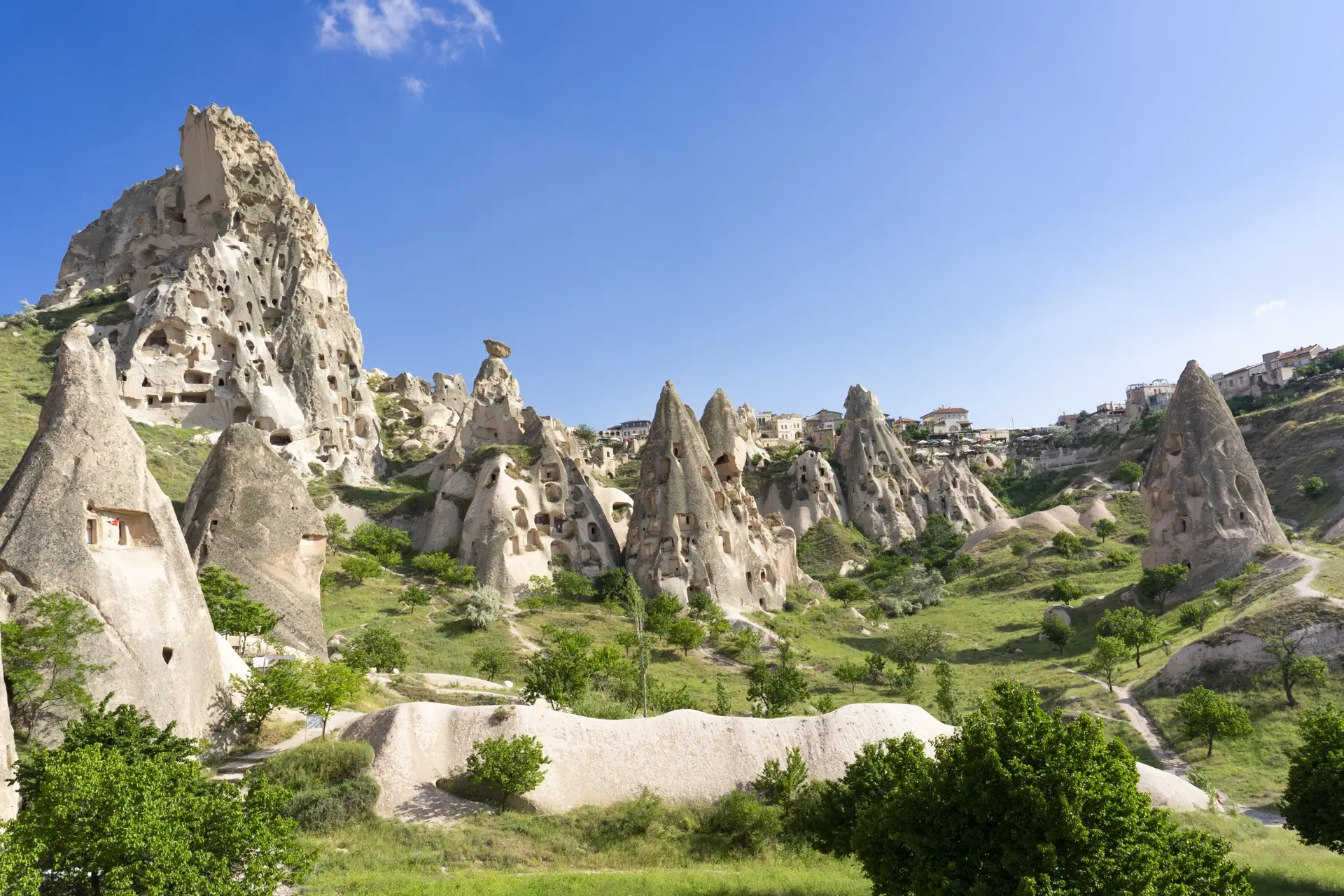
Uçhisar on a hazy March morning: the light is soft, the paths are empty, and the sunrise behind the castle is close to 0 °C.
Turkey Weather in March: 12 °C in Istanbul, 18 °C in Antalya, Frost at the Cappadocia Sunrise
Turkey weather in March averages 12.4 °C (54 °F) in Istanbul, 10.3 °C (51 °F) in Cappadocia and 18.0 °C (64 °F) in Antalya by day. That six-degree spread between the plateau and the sea widens at night. Istanbul’s nights sit at 5.5 °C (42 °F). Cappadocia, measured at the Nevşehir station, falls to 0.7 °C (33 °F) before dawn, the temperature a family stands in for the hot air balloon launch. Antalya’s nights hold 8.1 °C (47 °F), and Izmir, the station for Ephesus, reaches 16.4 °C (62 °F) by day. The figures are long-term normals from the Turkish State Meteorological Service; a warm or cold March sits three degrees either side of them.
Region
Station
Daytime high
Night low
Wet days
Rain
Sunshine per day
Record high / low
Marmara
Istanbul
12.4 °C (54 °F)
5.5 °C (42 °F)
12.6
62 mm
4–5 hours
28.6 / −5.6 °C
Central Anatolia
Cappadocia (Nevşehir)
10.3 °C (51 °F)
0.7 °C (33 °F)
13.1
48 mm
5.3 hours
— / −18.0 °C
Central Anatolia
Konya
11.8 °C (53 °F)
−0.2 °C (32 °F)
8.8
29 mm
—
—
Mediterranean
Antalya
18.0 °C (64 °F)
8.1 °C (47 °F)
8.5
91 mm
6.7 hours
29.4 / −1.6 °C
Mediterranean
Muğla (Fethiye, Dalaman)
18.5 °C (65 °F)
8.0 °C (46 °F)
7.8
62 mm
—
—
Aegean
Izmir (Ephesus, Kuşadası)
16.4 °C (62 °F)
7.7 °C (46 °F)
9.2
74 mm
6.5 hours
—
Inland Aegean
Denizli (Pamukkale)
16.1 °C (61 °F)
5.5 °C (42 °F)
11.1
63 mm
—
—
Marmara south
Bursa
13.9 °C (57 °F)
3.6 °C (38 °F)
12.5
70 mm
—
—
Eastern Anatolia
Erzurum
2.7 °C (37 °F)
−7.0 °C (19 °F)
12.5
35 mm
—
— / −33.2 °C
Early March and late March are different months
The monthly average hides the slope. The first week of March in Istanbul behaves like February: afternoons near 10 °C (50 °F), a north wind off the Black Sea, and the year’s last chance of snow on the Old City domes. Our Turkey weather in February page gives that month as 10.2 °C (50 °F) by day, with 3.5 snow days in Istanbul. The last week behaves like early April, with afternoons that touch 15–16 °C (59–61 °F) and the first café tables outside on İstiklal. April’s Istanbul afternoon averages 17.4 °C (63 °F), and most of that climb happens after the 20th. Cappadocia makes the same jump, from 10.3 to 16.0 °C, the coast a smaller one, from 18.0 to 21.4 °C. A family choosing a March week should prefer the last ten days if the dates are free.
Rain in March: thirteen days in Istanbul, nine on the coast, 48 mm in Cappadocia
March is a wet month by count and a light one by volume. Istanbul records rain on 12.6 days but only 62 mm across them, so the typical March rain is a two-hour shower, not a lost day. Cappadocia has its highest count of wet days of the year in March, 13.1, yet only 48 mm falls, part of it as a morning flurry that has melted by lunch. Antalya is the opposite: fewer wet days, 8.5, but 91 mm, because Mediterranean rain comes in short heavy bursts between long clear spells. A licensed local guide reads the morning sky and swaps the order of the day, indoor sites in the wet hours and open-air ones in the dry, as the Istanbul section shows.
The records: 28.6 °C and −5.6 °C in the same Istanbul month
Istanbul’s March record high is 28.6 °C (83 °F) and its record low −5.6 °C (22 °F); a normal March week sits between 8 and 15 °C. Antalya’s records are 29.4 °C (85 °F) and −1.6 °C (29 °F). Nevşehir’s −18.0 °C (0 °F) belongs to a night in the archive, but it explains why we recommend gloves for the March launch and why our Cappadocia hotel is a heated cave house.
Where the Sun Is in March: Antalya’s 6.7 Sunshine Hours Against Istanbul’s 4 to 5
Which part of Turkey is warmest in March?
The Mediterranean coast around Antalya is the warmest part of Turkey in March, at 18.0 °C (64 °F) by day with 6.7 hours of sunshine. The warmth runs east to Side and Alanya and west to Fethiye and Dalaman. Muğla province, which covers Fethiye and Dalaman, reads 18.5 °C (65 °F) under the same sun. That sunshine figure matters more than the temperature: Istanbul in March averages 4 to 5 hours of sunshine a day, about two hours less than Antalya. A grey week in the city and a bright week on the coast happen at the same time. Families who ask where they can find 25 °C in March get a plain answer: nowhere in Turkey. The ordinary Antalya afternoon is 18, a warm one 21 or 22.
Coast
Afternoon
Sunshine per day
Sea
Wet days
How we use it in March
Antalya, Side, Alanya
18.0 °C (64 °F)
6.7 hours
17–19 °C (63–66 °F)
8.5
Kaleiçi old town, Aspendos, Perge, a boat along the cliffs
Fethiye, Dalaman, Ölüdeniz
18.5 °C (65 °F)
about 6.5 hours
17–19 °C (63–66 °F)
7.8
Saklıkent gorge, Kayaköy, the Lycian Way in walking weather
Kuşadası, Ephesus coast
16.4 °C (62 °F)
6.5 hours
16–17 °C (61–63 °F)
9.2
Ephesus, Şirince, the Ephesus Museum on a wet hour
Bodrum
about 18 °C (64 °F)
about 6.5 hours
17–18 °C (63–64 °F)
about 8
Castle and marina; most beach hotels still closed
How the sunshine gap shapes a March route
Four and a half extra hours of sun a day on the coast decide the order of a March route. A family that starts in Istanbul and finishes on the coast ends the trip in the best weather of the trip. That is the order our 10-Day Istanbul, Cappadocia and Antalya tour follows, at USD 4,010 per adult. Run the other way, coast first, it sends the family into the grey Istanbul week at the end, when they are tired. Antalya in March is also a museum city: the Antalya Museum, Aspendos theatre and the ruins of Perge are open all year and walked in a light jacket. What it does not have is beach weather; the next section gives the sea temperatures.
The clear Istanbul day exists in March; 4 to 5 sunshine hours a day says it is the day to keep for the Bosphorus, not for the museums.
Sunbathing Yes, Swimming No: the Sea at 16–19 °C in March
Can you swim in Turkey in March?
You cannot swim comfortably anywhere in Turkey in March: the sea is 16–19 °C (61–66 °F) on every coast. The sea off Antalya averages 17.7 to 19.0 °C (64 to 66 °F) across the month, and Fethiye is almost the same. Bodrum is a degree cooler and Kuşadası on the Aegean two degrees cooler at 16 to 17 °C (61 to 63 °F). The figures are three-year March averages from the Open-Meteo marine archive. The striking thing is how flat they are: the Mediterranean bottoms out in February, holds through March, and only climbs in the second half of April. A child will go in for four minutes on a hot afternoon; nobody stays in.
Coast
Sea, 1 March
Sea, 31 March
Sea in April
Verdict for March
Antalya
17–18 °C (63–64 °F)
18–19 °C (64–66 °F)
18–20 °C (64–68 °F)
Sunbathing on a warm afternoon, boat deck, no swimming
Fethiye, Ölüdeniz
17–18 °C (63–64 °F)
18 °C (64 °F)
18–19 °C (64–66 °F)
Same; the lagoon is a viewpoint in March
Bodrum
17 °C (63 °F)
17–18 °C (63–64 °F)
18 °C (64 °F)
Castle and marina, not the beach
Kuşadası
16 °C (61 °F)
16–17 °C (61–63 °F)
17–18 °C (63–64 °F)
Ephesus base, nothing more
Can you sunbathe in Antalya in March?
Sunbathing in Antalya in March works on the warm afternoons, and there are more of them than the temperature suggests because the sun is out for 6.7 hours a day. A family on the Konyaaltı promenade at two in the afternoon on a clear March day is in T-shirts. The same family at six is in jackets, because the night low is 8 °C (47 °F). Some of the coast hotels we use heat their pool, which is worth asking about when the coast week is planned, since a heated pool is the only March swim. The sea rises to 18–20 °C in April and 20–22 °C in May, where swimming starts for adults; our May guide covers the first real beach month.
Boat mornings on the calm days
The right use of the coast in March is a deck, not a towel. A private boat from Antalya’s old harbour runs along the Düden cliffs in an hour and a half, and a gulet out of Fethiye reaches the Butterfly Valley cove and back in a half day. Both run on calm March days and both are cancelled by the guide on a windy one, which happens more in the first half of the month than the second. The rest of a coast day goes to what the coast does best in cool weather: Aspendos, Perge and the Antalya Museum from Kaleiçi, or Saklıkent gorge and Kayaköy from Fethiye. Our 12-Day Cappadocia and Turquoise Coast tour gives the coast four days in that pattern, at USD 4,770 per adult.
Cappadocia in March: Frost at Sunrise, Two Hot Air Balloon Mornings and a 60–70% Fly Rate
Cappadocia in March reads 10.3 °C (51 °F) by afternoon and 0.7 °C (33 °F) at the hot air balloon launch, on a plateau at 1,000 metres coming out of winter. The dawn is what the family is up for: hotel pickup for the hot air balloon comes 60–90 minutes before a sunrise near 06:35 at the start of the month and 06:28 by the end. Snow lies on the ridges above Göreme in the first fortnight and on the cone of Erciyes, the 3,917-metre volcano behind Kayseri, all month; a half day in real snow can be added on request. Down in the valleys the change is fast: Rose Valley and Love Valley turn green in the last ten days, and the almond trees on the Ürgüp road flower at the end of the month.
The fly rate: 60–70%, and better after mid-month
Do hot air balloons fly in Cappadocia in March? On roughly 60–70% of mornings, the lowest fly rate of the touring months we recommend and the reason March needs two Cappadocia nights. The Civil Aviation authority grounds the flight when wind at launch height exceeds the limit, and March is the month the winter westerlies loosen their grip. Our Cappadocia hot air balloon guide records the pattern from our own trips: the first fortnight closer to 60%, the second closer to 70%, and by April near 80%. Temperature at launch is not the issue, since the hot air balloons fly at −5 °C without complaint; the wind is.
Cappadocia in March
Figure
What it means for the family
Hot air balloon fly rate
60–70%
Two Cappadocia nights on every route of 7 days or more
Chance both mornings are grounded
about 10–15%
Fee rebooked or refunded; valley viewpoint by vehicle instead
Temperature at launch
0.7 °C (33 °F) average
Gloves, hat, two layers under the coat
Sunrise
06:35 → 06:28
Pickup 60–90 minutes before sunrise, back at the hotel for breakfast by about 08:30
Wet days
13.1, mostly light
Underground cities and the Göreme Open Air Museum take the wet hours
Afternoon walking
10.3 °C (51 °F)
Rose Valley and Paşabağ in a jacket; no heat, no dust
Why a single night in Cappadocia does not work in March
A single-night stay leaves the flight to one morning, and in March that morning is grounded about one time in three, so a one-night stay carries 30–40% odds of missing the flight. That is why every route of seven days or more gives Cappadocia two nights. The 5-Day Istanbul and Cappadocia tour, at USD 1,940 per adult, and the 2-Day Cappadocia tour from Istanbul each have one Cappadocia night, so for a March date we suggest adding a second night to either. On a two-night stay, if the first morning flies, the second is a lie-in; if not, the second is the flight. A grounded flight is rebooked or refunded, and the licensed local guide drives the family to a valley viewpoint for the sunrise. Turkey Family Tours plans two Cappadocia nights on every March route of seven days or more for this reason.
The rest of the day: valleys at 10 °C, Kaymaklı at 13 °C, a heated cave hotel
The rest of a Cappadocia day in March is walked, and the walking is good. At 10 °C the valley trails are cool and empty, and the Göreme Open Air Museum, a shadeless bowl in July, is comfortable at noon. Kaymaklı underground city holds a constant 13 °C all year and is warmer than the surface in March. We keep families in a heated cave hotel in Göreme, because cave rooms hold warmth in a way a courtyard hotel does not.
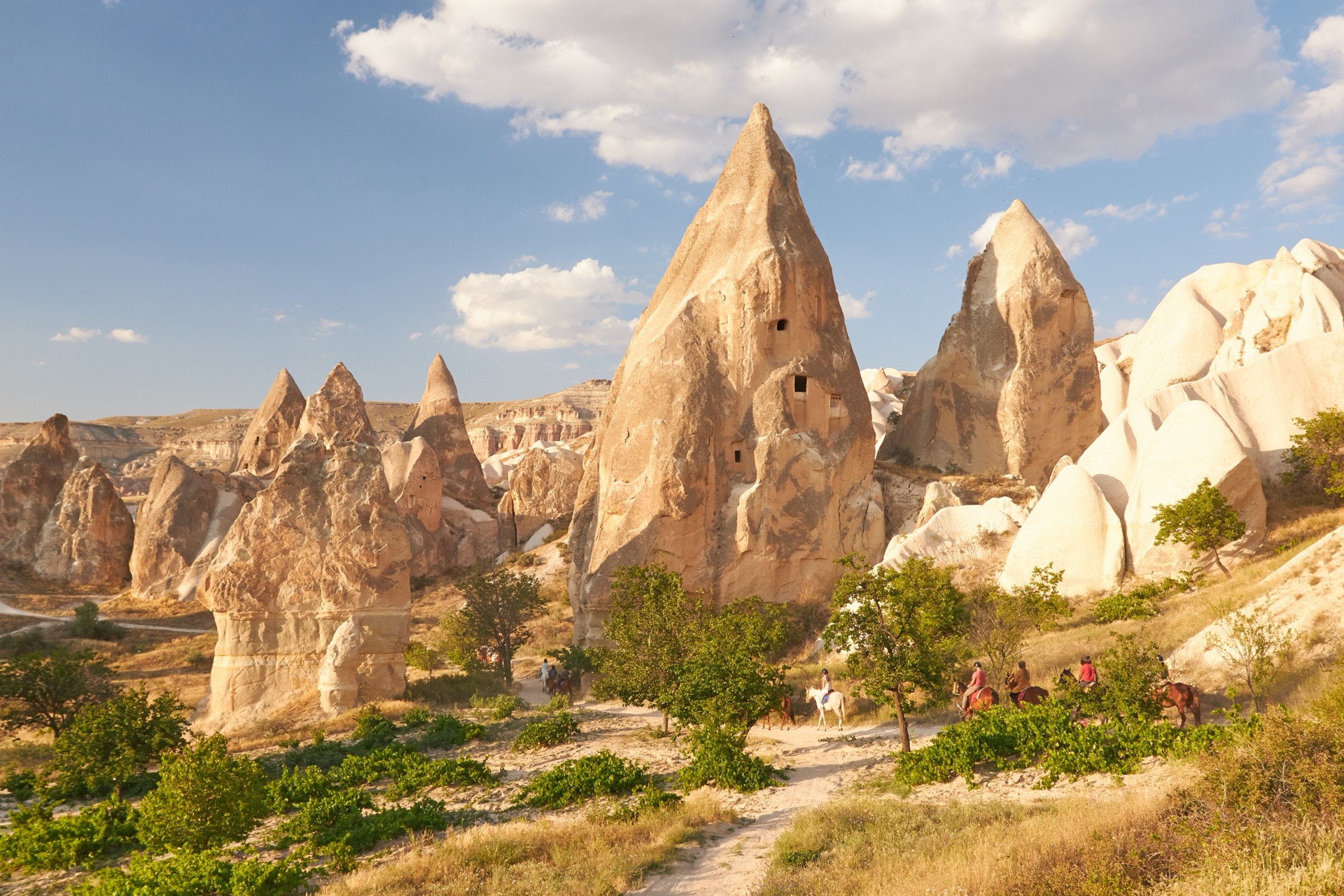
Late March in Cappadocia: the valley floor has turned green, the ridges still carry snow, and the trails are empty at noon.
From 11 to 12½ Hours of Daylight: How the Equinox Lengthens a March Touring Day
Sunrise and sunset on 1, 15 and 31 March
Daylight in Istanbul grows by 80 minutes in March, the fastest gain of the touring year. On 1 March the sun rises in Istanbul at 07:39 and sets at 18:55, giving 11 hours 16 minutes of daylight; on the 31st it rises at 06:50 and sets at 19:27, giving 12 hours 37 minutes. The equinox falls on or about 20 March, and Turkey does not change its clocks, so the gain is real rather than a shifted hour. That 80-minute difference is a whole extra site: a family arriving in the last week can leave Ephesus at 17:00 and still walk Şirince in daylight, which a family in the first week cannot. The times are from the NOAA solar calculator for each town.
Place
1 March sunrise → sunset
15 March
31 March
Daylight, 31 March
Istanbul
07:39 → 18:55
07:17 → 19:10
06:50 → 19:27
12 h 37 min
Cappadocia (Göreme)
07:14 → 18:33
06:53 → 18:47
06:28 → 19:03
12 h 35 min
Antalya
07:29 → 18:51
07:09 → 19:04
06:45 → 19:18
12 h 33 min
Çanakkale (Gallipoli)
07:49 → 19:06
07:27 → 19:21
07:01 → 19:37
12 h 36 min
What the extra eighty minutes buy
Cappadocia’s sun rises 25 minutes earlier than Istanbul’s because it lies further east on the same clock, which is why the hot air balloon pickup there comes half an hour earlier than an Istanbul clock suggests. The museums do not stretch with the day. Ministry sites run winter hours through March, opening around 09:00 and closing in the late afternoon. The extra daylight at the end of March therefore goes to the places with no gate: the Bosphorus ferry, the Ürgüp valley trails, the Kaleiçi harbour and the Pamukkale travertines. A licensed local guide plans a late-March day as a 09:00 site, a second site after lunch, and an open-air hour at 18:00 that a February visitor never had.
Istanbul in March: Empty Queues at Hagia Sophia and Thirteen Wet Days Re-ordered
Istanbul in March averages 12.4 °C (54 °F) by afternoon, and the Hagia Sophia line that takes forty minutes in May takes five. The morning starts at 5.5 °C (42 °F), and the sun is out for a little over two hours a day; the empty queues are the exchange. The Basilica Cistern is walked at a family’s own pace, and Topkapı’s Harem is seen without a tour group at every doorway. Our Istanbul travel guide explains the neighbourhoods and the ferries; what follows is the March version of the days we run there.
The wet-day order of a March Old City day
Rain falls on 12.6 March days in Istanbul, and almost all of it in showers of an hour or two. The licensed local guide does not cancel; they re-order. A March day that starts wet begins under a roof and moves outside when the sky clears. The Old City is built for it: its four biggest sites are within 400 metres of each other and three have roofs.
Hour
Wet morning version
Clear morning version
09:00
Hagia Sophia (indoors, no queue)
Blue Mosque and Hippodrome, then Hagia Sophia
10:30
Basilica Cistern (indoors)
Topkapı Palace courtyards and Harem
12:00
Lunch in Sultanahmet
Lunch in Sultanahmet
13:30
Topkapı Palace, Harem and treasury first
Basilica Cistern, then Grand Bazaar
15:30
Grand Bazaar (covered), Spice Bazaar
Bosphorus ferry from Eminönü in the clearest light
17:00
Back at the hotel; Bosphorus moved to a clear day
Galata and İstiklal on the walk back
The Bosphorus on the clear afternoon
The Bosphorus crossing is moved to the clearest afternoon rather than fixed to a day. At 12 °C with a north wind, an open ferry deck is 8 °C, and the point of the crossing is the light on the shore palaces, which a grey sky removes. On a five-day Istanbul stay there is always one clear afternoon, and the guide keeps the crossing for it. Our Bosphorus cruise guide compares the public ferry with the private boat; in March the public ferry is the better answer, because it has a heated saloon.
Snow in Istanbul in March, and the tulips that are not there yet
Does it snow in Istanbul in March? Rarely, and only in the first ten days. The record March low is −5.6 °C (22 °F), and a dusting on the Süleymaniye domes happens perhaps one March in four. It closes nothing; the sites open, the ferries run, and the photographs are the best of the trip. What March does not have is the tulips: the first blooms open in the last days of a mild March, and the peak in Emirgan Park and Sultanahmet is April. A family whose reason for Istanbul is the tulips should read Turkey in April and move the trip by three weeks. A family whose reason is the city itself has it to themselves in March, on a 5-Day Private Istanbul tour at USD 1,645 per adult or a single Old City day at USD 220.
Ephesus, Pamukkale and Gallipoli in March: Quiet Ruins, and the 18 March Day to Avoid on the Peninsula
Ephesus and Pamukkale at 16 °C: the 09:00 gate and the warm travertines
Ephesus in March is walked at 16.4 °C (62 °F) with no cruise groups, Pamukkale at 16.1 °C (61 °F), and Gallipoli is empty on every day except 18 March. In July the same site reads 33 °C; in March the marble of Curetes Street is not yet hot underfoot. The coach groups from the Kuşadası cruise pier, which fill the Library of Celsus from April, have not started; a family at the upper gate at 09:00 has the Terrace Houses to itself. At Pamukkale the travertine water is warm from the spring and walked barefoot in March as in any month. The afternoon wind across the terraces wants a jacket. Our Ephesus guide and Pamukkale guide cover both sites, and the 8-Day route, at USD 3,205 per adult, gives each a full day.
Site
March afternoon
Wet days
March advantage
How we reach it
Ephesus (Izmir)
16.4 °C (62 °F)
9.2
No cruise groups, cool marble, Terrace Houses empty
Morning flight to Izmir, or on the 7 and 8-day routes
Pamukkale (Denizli)
16.1 °C (61 °F)
11.1
Warm spring water against cool air; sunset over the terraces at 19:00
Three hours by road from Ephesus
Gallipoli (Çanakkale)
about 12 °C (54 °F)
about 12
Empty cemeteries, long views; avoid 18 March
Four hours by road from Istanbul, or 2-day route with Troy
Aspendos and Perge (Antalya)
18.0 °C (64 °F)
8.5
Theatre and stadium in shirt-sleeves; no heat haze
Half day from Kaleiçi
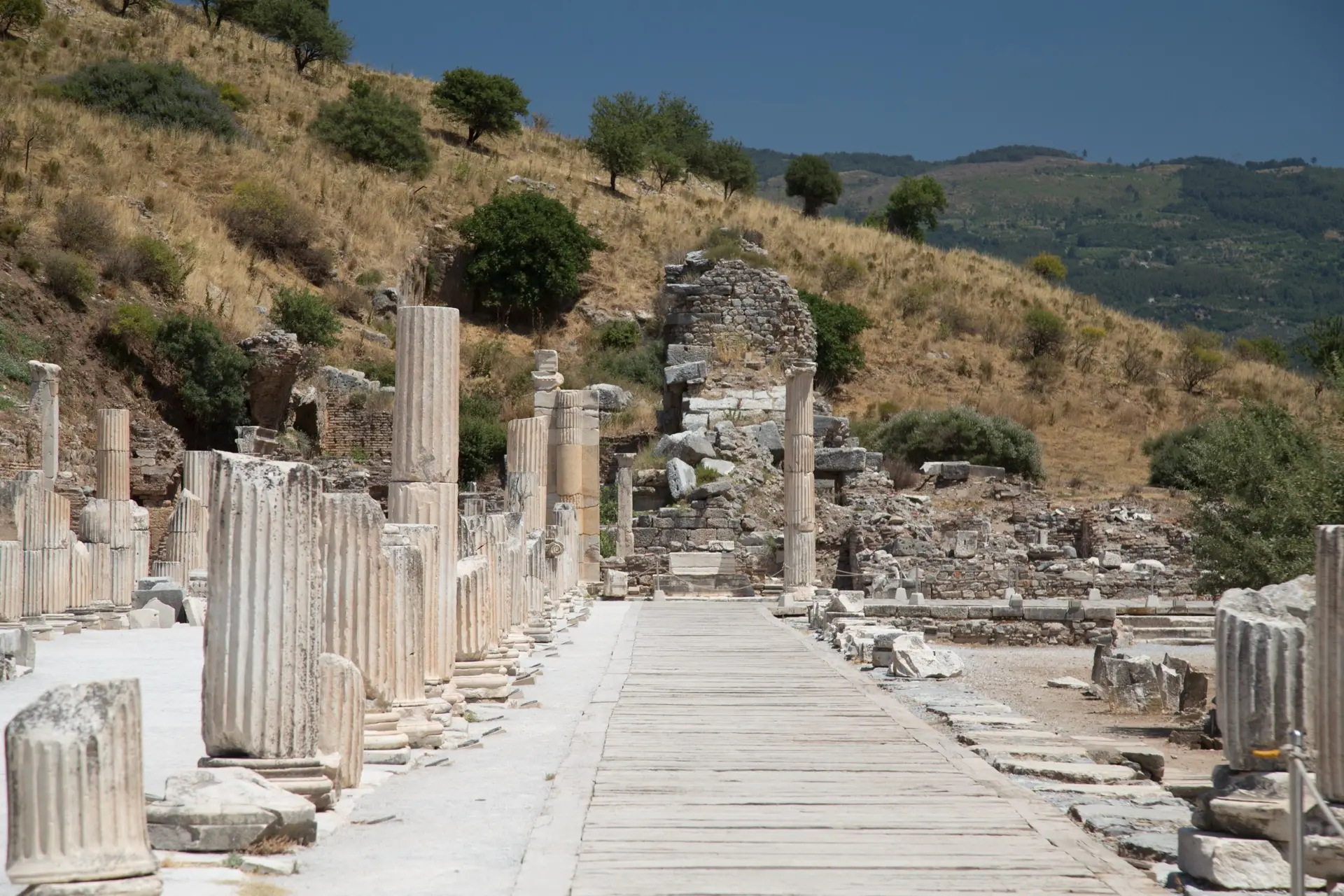
Frontinus Street at Hierapolis: at 16 °C the walk from the gate to the theatre is done at an easy pace, with nobody in the frame.
Gallipoli on 18 March: the one day to keep the family off the peninsula
Gallipoli in March is cold, windy and empty, and the cemeteries are at their most affecting in that weather. The exception is 18 March, the anniversary of the naval battle of the Dardanelles, when the Allied fleet lost three battleships to mines in a single day, and Turkey marks it as Çanakkale Victory and Martyrs’ Day. The state ceremony is held at the Çanakkale Martyrs’ Memorial at the tip of the peninsula, with official delegations and school groups arriving from early morning. Access to the southern end of the peninsula may be restricted around it. It is not a public holiday, so the rest of the country runs as normal, but a family on the peninsula that day sees a security cordon rather than Lone Pine. The Gallipoli Historic Site Directorate publishes the programme each year.
The fix: a day either side of the 18th
A Gallipoli day on 17 or 19 March sees the same cemeteries with the peninsula empty again. Our 2-Day Gallipoli and Troy tour, at USD 945 per adult, is timed around the 18th when it falls in a family’s week. On the 10-Day Gallipoli and Troy route at USD 3,815 the peninsula day is simply moved. The crossing uses the 1915 Çanakkale Bridge, opened on 18 March 2022 with a 2,023-metre main span, the longest of any suspension bridge. Anzac Day on 25 April, the other date that changes the peninsula, belongs to April; our Gallipoli travel guide sets out both.
The Çanakkale Martyrs’ Memorial, where the 18 March state ceremony is held; on any other March day the approach is this empty.
The Eid Holiday and Easter Weekend: the Two Dates That Fill Domestic Flights in March
March has no fixed Turkish public holiday, but two moving dates land in it often enough to plan around. The first is Eid al-Fitr, the three-day national holiday that ends the month of fasting. It follows the lunar calendar, so it arrives about 11 days earlier each year. It falls in the second half of March in one year and the first half the next, and then slips into February. The second is Easter, which is not a holiday in Turkey at all but is the week many families travel, and in some years its weekend falls in the last days of March. Neither closes the country. Both fill seats and rooms.
The Eid holiday: three days that move eleven days earlier each year
On the first day of the holiday the banks and government offices are shut, the Grand Bazaar closes for the holiday days, and the ministry museums open from the afternoon. The sites, restaurants and hotels never close. What we do is book the domestic flights and hotels for that week 10–12 weeks out instead of six, because those are the seats and rooms that go first.
Easter weekend, in the years it falls in late March
Easter closes nothing in Turkey, but the hotels in Sultanahmet and Göreme are fuller that weekend with families from abroad, and the cave hotel with the view is the first to go. 18 March at Gallipoli, covered above, is not a third date: it affects one peninsula for one day and nothing else in the country.
Why the Eid week changes the lead time and nothing else
The Eid holiday is the date that changes the lead time. Turkey’s own families travel in those three days, and when they fall on a weekend the holiday is sometimes extended to nine. Domestic flights to Kayseri, Izmir and Antalya sell out, the cave hotels in Göreme fill with Istanbul families, and the coast hotels that have opened early are full. Nothing about the trip changes on the ground; what changes is the lead time. A family whose March week overlaps the holiday needs the flights and hotels fixed ten to twelve weeks ahead rather than six; the booking section below sets the dates out. Our guide to April in Turkey covers Children’s Day on 23 April, the next fixed date after March.
What Is Open in March, and Which Coast Hotels Reopen Late in the Month
Winter hours: doors at 09:00, closing around 17:00
Every site on our routes is open in March, on winter hours of roughly 09:00 to 17:00. The ministry-run museums and archaeological sites, which include Hagia Sophia’s upper gallery, Topkapı, Ephesus, Hierapolis and the Göreme Open Air Museum, keep the Turkish Museumswinter timetable through March. Doors open at about 09:00 and close in the late afternoon; the exact hours for each site are on that register. The Bosphorus ferries run their full winter schedule. Hot air balloons fly whenever the wind allows. The two things not fully open are the sea-front resort hotels and the gulet charter season, which begins in late April. Our coast nights in March are in hotels that stay open all year, on the Antalya cliffs and at the Fethiye marina.
Which coast hotels are shut, and why it does not matter to a private tour
The resort hotels of Belek, Side and Ölüdeniz are the ones a family finds closed. Many do not open until late March and some not until April, because their business is the pool and the beach. We do not use them in March. The coast nights on our routes are in Antalya, on the cliffs a short drive from Kaleiçi, and at the marina in Fethiye town. Both are hotels open all year, with the restaurants and old-town lanes within a walk. Gulet and yacht charters are the other seasonal closure: day boats run on calm March days, multi-day charters begin in late April. Rooftop dinners in Istanbul move indoors or under glass; the view is the same.
Availability: the quiet advantage of a March booking
A March booking made six weeks out still finds rooms. March is shoulder season, so a cave hotel in Göreme that needs three months’ notice in May can usually be held at six weeks, and the domestic flights between regions have seats. That gives a March family a freedom the summer family lacks. A route can change two weeks out, a night can be added in Cappadocia for a third hot air balloon try, a coast hotel swapped for a better room. The routes are priced the same in every month; in March the plan can still change two weeks out, and the family’s saving is queue time at Topkapı and Hagia Sophia.
A 12-Day March Route That Works, and the 5, 7 and 10-Day Versions
A 12-day private Turkey tour in March, across Istanbul, Cappadocia and the coast, costs USD 4,770 per adult and is the route families ask about most. It is the right length because March needs its slack. Two Cappadocia nights cover the hot air balloon, the coast is used for ancient cities and a boat rather than beach days, and an Istanbul half day is kept for the Bosphorus to find its clear afternoon. Our 12-Day Cappadocia and Turquoise Coast tour is that shape, priced per adult with two sharing. The price includes a licensed local guide and a private vehicle with driver in every region, domestic flights, admissions and hand-picked 4-5 star (boutique) hotels. The table shows how each of our standard lengths behaves in March.
Good for a family with the days; last week of March preferred
Start in Istanbul, finish on the coast
The 12-day March route, day by day
Days 1–2, Istanbul: the arrival evening, then the Old City in the wet-day order above, with the Bosphorus kept for the clearest afternoon.
Days 3–4, Cappadocia: an early flight for two cave-hotel nights, with the hot air balloon booked for the dawn of day 4. A grounded day 4 is rebooked for the next dawn where the flight time allows, or refunded; a family that wants a sure second chance adds a third night when the plan is written.
Days 5–6, Antalya: Kaleiçi without a coat on the afternoon of arrival, then Perge, Aspendos and the Düden waterfalls, at their fullest after the March rain.
Days 7–8, Fethiye: the Lycian coast road, Saklıkent Gorge, Ölüdeniz and Kayaköy, with a boat morning on the calm day.
Days 9–10, Pamukkale: the thermal hotel, then the travertines and Hierapolis before the drive to Kuşadası.
Days 11–12, Ephesus and home: Ephesus from the 09:00 gate, an evening flight to Istanbul, and the departure on day 12.
In March the coast days go to ruins and a boat; in May the same twelve days include the sea, at the same price.
The 5, 7 and 10-day versions, and which family each suits
For a family with less time, the 7-day route is the one we recommend for March above the others, because every one of its three stops is a place March improves. For a family whose reason for Turkey is Gallipoli, the 10-day Gallipoli and Troy route does the peninsula in its quietest month and only needs the 18th kept clear. Every route is private, with a licensed local guide and a private vehicle with driver in every region, and every one is re-shaped to the family’s dates. The private Turkey tour collection page explains what is inside every price.
Ephesus at the 09:00 gate in March: 16 °C, the marble still cool, and the coach groups from the cruise pier a month away.
How Late You Can Leave a March Booking
6 to 8 weeks for an ordinary week, 10 to 12 for the holiday dates
A March trip to Turkey can be booked 6 to 8 weeks ahead for an ordinary week, and needs 10 to 12 weeks if the dates touch the Eid holiday or a late-March Easter weekend. The shorter lead time is enough to hold the cave hotel in Göreme, the boutique hotel in Sultanahmet and the domestic flights at sensible fares. The longer one is needed because the Istanbul–Kayseri and Istanbul–Antalya flights are the first things to fill and the last a private tour can do without.
The decision that cannot wait: the second Cappadocia night
The other decision that cannot be left late is the second hot air balloon morning. A family that wants the 60–70% March fly rate turned into two sure chances needs two Cappadocia nights, and a third if the onward flight leaves too early for a rebooked dawn. That is a hotel night and a flight time, and both are fixed when the plan is written. On a route that never touches Cappadocia, such as the 4-Day Gallipoli, Ephesus and Pamukkale tour, the question does not arise. Everything else about a March trip can move. A wet Istanbul day is re-ordered on the morning itself, a Gallipoli day is moved off 18 March when the plan is written. A coast day becomes a boat day or a ruins day by looking at the sky at breakfast.
How the booking works: 24 hours, 25%, TURSAB 13538
The booking itself is the same in every month. Tell us the dates, the party size and the children’s ages through the plan-my-trip form. A day-by-day plan with a fixed per-person price comes back within 24 hours. A 25% deposit confirms the booking; 75% is paid on arrival. The deposit is what holds the hotel rooms, the domestic flights and the hot air balloon morning in the family’s name, and until it is paid nothing is reserved. Turkey Family Tours is licensed by TURSAB under number 13538, and the licence is checkable on the Association of Turkish Travel Agencies register.
Gallipoli in a clear March week; the peninsula is empty on every day of the month except the 18th.
Packing for 0 °C Dawns and 18 °C Afternoons: the March Suitcase
Three climates in one suitcase
Packing for Turkey in March means covering a 0.7 °C hot air balloon dawn in Cappadocia, a 12 °C wet Istanbul afternoon and an 18 °C Antalya afternoon in 6.7 hours of sun, all in one suitcase. The mistake families make is to pack for the average, and the average March day is 12 °C. The list below is what our guides see families wish they had brought, by the place it earns its space.
Item
Where it earns its place
Why in March
Gloves, hat and a warm layer
Cappadocia, the hot air balloon basket
Dawn at 0.7 °C; the basket is in the open air for an hour before sunrise warms it. We recommend them from October to March
A waterproof shell, not an umbrella
Istanbul
Thirteen wet days and the wind on the Bosphorus turns umbrellas inside out; a shell works on the ferry deck
Walking shoes with grip
Ephesus, Pamukkale, the Cappadocia valleys
Marble streets are slippery after rain, and the travertines are walked barefoot but the approach is wet stone
Sunscreen and sunglasses
Antalya, Fethiye, Pamukkale
The coast has three times Istanbul’s March sunshine, and white travertine doubles the glare
A swimsuit
Hotels with a heated pool, and the thermal pools at Pamukkale
The sea is 16–19 °C and not for swimming, but some hotel pools are heated and the Cleopatra pool at Hierapolis is a constant 36 °C
One warm evening layer
Everywhere
Evenings drop to 5 °C in Istanbul and below freezing in Göreme; restaurant terraces are heated but the walk back is not
What not to pack, and the item that decides the Istanbul wet day
Two things are not needed. A heavy winter coat is more than March asks for anywhere south of Istanbul; the layered shell does the same job on the cold morning. Beach kit beyond one swimsuit goes unused, because the sea is 16–19 °C in March, as the sea section explains. For the children, one waterproof pair of shoes each is the item that decides whether the Istanbul wet day is a good day or a bad one. Everything else is what they wear at home in early spring. A small day bag for the layers taken off between the 0 °C dawn and the 10 °C noon in Cappadocia is the most useful thing in the vehicle.
A March afternoon on the Çanakkale waterfront: bright, cool and windy, the shell-and-sunglasses weather the coast delivers all month.
Turkey in March or April: When Waiting for the Tulips Is Worth It
April is five degrees warmer than March in Istanbul, 17.4 °C against 12.4 °C, and flies hot air balloons on about 80% of mornings against 60–70%; March has no queues and wider hotel choice. Which of those matters more is a family decision, and it is the question we are asked most about March. The table puts the two months side by side on the numbers that change a trip.
Measure
March
April
Which month it favours
Istanbul afternoon
12.4 °C, 4 to 5 hours of sun, thirteen wet days
17.4 °C, more sun, ten wet days
April
Cappadocia dawn and afternoon
0.7 °C / 10.3 °C
5.1 °C / 16.0 °C
April
Antalya afternoon
18.0 °C, 6.7 hours of sun
21.4 °C, 7.9 hours of sun
April, but a March afternoon is already warm
Sea temperature
16–19 °C, sunbathing not swimming
18–20 °C, still cold for most families
Neither; May is the first swimming month
Hot air balloon fly rate
60–70%, two mornings needed
About 80%
April
Queues at Hagia Sophia, Topkapı, Ephesus
None
Building from mid-month
March
Hotel and flight availability
Wide all month outside the Eid week
Tightens around the tulip peak and 25 April
March
Fixed dates
18 March at Gallipoli only
Tulip festival, Children’s Day on 23 April, Anzac Day on the 25th
April if the tulips or Anzac Day are the reason; March if they are not
Our verdict: March for the empty city, April for the tulips
A family whose trip is Istanbul, Cappadocia and the ruins, and whose priority is walking into Hagia Sophia without a queue, should take March, and the last ten days of it if the dates are free. A family that wants the tulips in Emirgan, warmer valley walks and a better hot air balloon percentage should read our Turkey in April guide and take the second half of that month. A family whose trip depends on the sea should read neither and go to May. The hub guide to the best time to visit Turkey ranks all twelve months on the same measures. The December guide and the coldest-month guide for January cover the deep-winter version of the route, where the museum hours and cave-hotel logic match early March.
The price is the same in both months; the choice is what changes
The price does not decide it, because our private tour prices are the same in both months; the 7-Day route is USD 2,815 per adult whether it runs on 10 March or 10 April. March adds choice at the same price: the exact hotel, the exact room type and the domestic flight time the family prefers. Six weeks out, March usually still offers all three, and April often does not.
Turkey in March: Frequently Asked Questions
March is a good time to visit Turkey for a family whose trip is Istanbul, Cappadocia and the ancient sites, and a poor one for a family that wants to swim. Istanbul averages 12.4 °C (54 °F) by day with thirteen wet days, Cappadocia reaches 10.3 °C with frost at dawn, and Antalya holds 18.0 °C (64 °F) in 6.7 hours of daily sun. Every museum and site is open, the queues at Hagia Sophia and Ephesus have not formed, and hotels and flights are widely available outside the Eid week. The last ten days are better than the first ten. Our month-by-month guide ranks March against the other eleven.
Antalya and the Mediterranean coast east of it are the warmest part of Turkey in March, at an average afternoon of 18.0 °C (64 °F) with 6.7 hours of sunshine and about nine wet days. Fethiye and Bodrum on the Muğla coast are within half a degree, and İzmir on the Aegean reads 16.4 °C. Nowhere in Turkey averages 25 °C in March; the warmest Antalya afternoons reach the low twenties in the last week. Inland is cold: Cappadocia 10.3 °C by day and 0.7 °C at dawn. Our 10-Day Antalya route ends the trip in that warmest weather.
You can sunbathe in Antalya in March but not swim. On a clear afternoon at 18 °C in 6.7 hours of sun, a sheltered hotel terrace or the old harbour wall is warm enough to sit in a T-shirt. The sea is another matter: 16–19 °C (61–66 °F) all month, which is cold-water swimming for adults and a few minutes for children. Families swim in a heated hotel pool where there is one and use the beach for walking; a boat trip from the harbour is comfortable on a calm day. The first month with a sea most families will swim in is May, at 20–22 °C, which our Turkey in May guide covers.
Hot air balloons fly in Cappadocia in March on roughly 60–70% of mornings, and the rate improves through the month as the winter wind settles. That is well below the 90% or more of summer, which is why we book two Cappadocia nights in March so the flight has two chances. A single night carries about a 30–40% chance of missing it. Pickup comes 60–90 minutes before a sunrise near 06:35, at 0.7 °C, so gloves and a hat are needed. If the Civil Aviation Authority grounds every booked morning, the fee is rebooked or refunded. The full March picture is in our hot air balloon guide for Cappadocia.
It snows in parts of Turkey in March, but not where most families travel. Cappadocia keeps snow on the ridges into the first half of the month, and a fresh fall on the fairy chimneys happens in some years; the Nevşehir March record is −18.0 °C. Erzurum in the east reaches 2.7 °C by day and −7 °C at night, still full winter. Istanbul sees snow in March rarely and only in the first days, and it is gone by lunchtime. Antalya, Fethiye, Ephesus and Pamukkale have no March snow. For a family that wants the snow version of the same route, our Turkey in December guide is the guide to read.
For a family, April is the warmer month and March the emptier one. Istanbul goes from 12.4 °C to 17.4 °C between the two months, Cappadocia’s dawn from 0.7 °C to 5.1 °C, and the hot air balloon fly rate from 60–70% to about 80%. In return March gives a family Hagia Sophia and Ephesus without queues, its choice of hotel six weeks out, and no fixed dates except 18 March at Gallipoli. April adds the Istanbul tulips, Children’s Day on 23 April and Anzac Day on the 25th, and the queues that arrive with them. Neither month has a sea to swim in. Our guide to April in Turkey gives the other side of the comparison.
A private Turkey tour in March costs from USD 1,645 per adult for the 5-Day Private Istanbul route to USD 5,395 for the 14-Day Private Turkey tour, based on two adults sharing. The 7-Day route is USD 2,815 and the 12-Day route USD 4,770. The price includes hand-picked 4-5 star boutique hotels with breakfast, domestic flights, all transfers, a licensed local guide and a private vehicle with driver in every region, and entrance fees. Children aged 4 to 6 pay 60% of the adult price and children under 4 pay 30%; from age 7 the adult price applies. The Turkey tour packages page lists what is inside every price.
A 10 to 12-day March itinerary runs Istanbul, Cappadocia, then south to the coast and back through the ruins. Our 12-Day Private Turkey Tour gives Istanbul two days and Cappadocia two cave-hotel nights for the hot air balloon. Antalya then has two days for Perge, Aspendos and the old harbour, Fethiye two for Saklıkent and Kayaköy. The route ends with Pamukkale, Ephesus and an evening flight to Istanbul, at USD 4,770 per adult. In March the coast days are ruins, gorges and a boat morning rather than the beach. The 10-day versions drop either the Turquoise Coast (USD 4,010, ending in Antalya) or the Mediterranean altogether for Gallipoli and Troy (USD 3,815).
Book a March trip to Turkey 6 to 8 weeks ahead for an ordinary week, and 10 to 12 weeks ahead if the dates touch the three-day Eid holiday. The same applies to the Easter weekend in the years it falls in late March. Domestic flights and the better Cappadocia cave hotels fill first for those dates. Outside them March is the easiest spring month to book late: hotels have rooms and flights have seats. What must be decided at booking is the second Cappadocia night for the hot air balloon. A written plan with a fixed price comes back within 24 hours of the planning form.
A 25% deposit confirms a March booking and 75% is paid on arrival in Turkey, in every month and for every route. The deposit reserves the hotel rooms, the domestic flights and the hot air balloon morning in the family’s name. The hot air balloon is booked separately from the tour price. If the Civil Aviation Authority grounds every morning the family has booked, that fee is rebooked or refunded and the licensed local guide takes the family to a valley viewpoint instead. A cancellation within 7 days of departure, or a no-show, is charged in full; the earlier cancellation steps are on the booking FAQ.
Start a March Trip Plan with Turkey Family Tours
A March plan starts with one question: which ten days of the month, because the last ten are the best. Send us the week the family can travel, how many of you there are and the children’s ages through the plan-my-trip form. A day-by-day plan with a fixed per-person price comes back within 24 hours. If the dates touch 18 March we move the Gallipoli day. If they touch the Eid week we book the flights first. If the family wants the hot air balloon we build in the second Cappadocia morning without being asked. Turkey Family Tours is TURSAB-licensed (no 13538). A 25% deposit confirms the trip and 75% is paid on arrival. The private guided tours of Turkey page shows how every route is built, and the contact page has WhatsApp for a quick question.
Turkey in September: 28–29 °C sea, 25–28 °C Istanbul, ~92% hot air balloon mornings and the only month for the Cappadocia grape harvest. Region-by-region weather, crowds, what is open and private family routes.
Galata Tower entry is €30 (about USD 33), open daily, ticket desk closes 18:14. Queue timings, the lift that stops at floor seven, and what the balcony shows.
A Turkish breakfast (kahvaltı) fills the table with 10–20 small plates: cheeses, olives, honey with kaymak, menemen and unlimited çay. Dish-by-dish guide with prices — serpme vs hotel buffet at USD 10–18 per person, plus Istanbul’s best breakfast quarters.
Turkey in July: Istanbul 29.7 °C (85 °F), Ephesus 36.4 °C, Cappadocia nights 13.7 °C, sea 24–28 °C. Where it’s cooler and private routes from USD 1,940.
Turkey in October: 26.1C sea, 20.6C Istanbul days, 90% hot air balloon fly rate. Region-by-region weather, what to pack, and private family tour routes.
Three nights in Istanbul, one in a Göreme cave hotel, two 75-minute flights: the 5 day Turkey itinerary day by day — what it costs, when to go, and where to bend the route.
Grand Bazaar Istanbul explained: 61 covered streets, 4,000+ shops, free entry, closed Sundays — what to buy, how to bargain, and the 60-90 minute morning route between the Nuruosmaniye and Beyazıt gates.
✦ Tailor-Made
Let's Plan Your Private Turkey Trip
Tell us about your family — we reply within 24 hours.

 English
 Dutch
 Japanese
 Korean
 Chinese